Pastelitos de Carne Salvadoreños
Corn masa, not wheat, kneaded sunset-orange with achiote. The oil is rubbed into the dry flour *before* any water goes in, which coats the starch particles and keeps the dough from turning rubbery — and the shell is pressed to 2 mm, so it shatters instead of going gummy at the seam.
- Prep
- 40 min
- Cook
- 20 min
- Serves
- 16 pastelitos
- Difficulty
- Medium
Researched · Kitchen testing pending
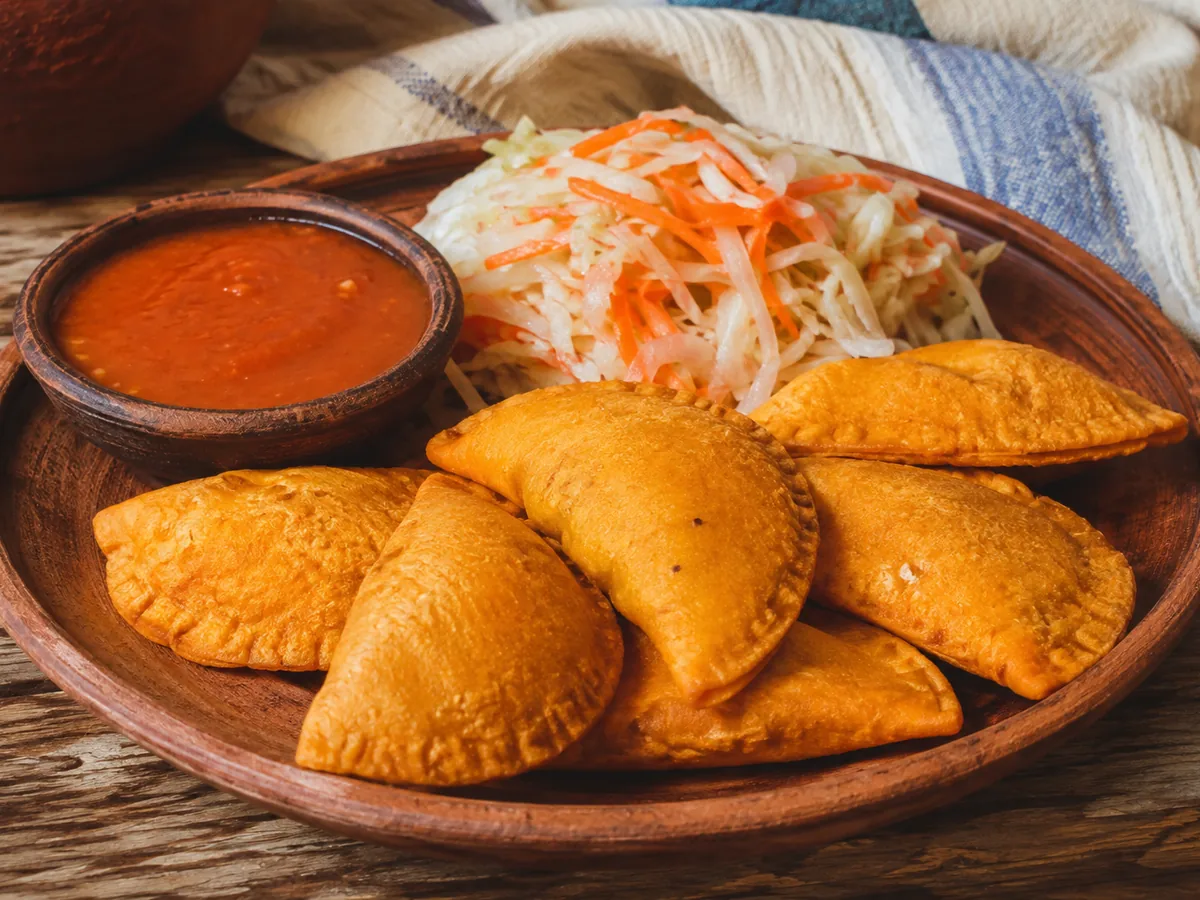
In late-afternoon markets across Santa Ana and San Miguel, pastelitos fry in bubbling calderos of hot lard.
Unlike the flour empanadas of South America, the Salvadoran pastelito uses a thin sun-orange corn masa kneaded with achiote oil, toasted cumin and chicken stock. Inside sits a moist picadillo of finely minced beef chuck with tiny potato cubes, carrot, onion and sweet pepper.
Folded into crimped half-moons and dropped into hot oil, they blister into a fragile shell that shatters at the first bite — then get buried in cold cabbage curtido and warm tomato salsa.
The masa
- 500 g3.3 cupsPrecooked white corn flour
- 60 ml4 TbspAchiote oil, warm
- 600 ml2.5 cupsWarm chicken stock or water, about 40 °C
- 8 g1.5 tspFine sea salt
- 4 g1 tspCumin seeds, freshly toasted and ground
The picadillo
- 500 g1.1 lbLean ground beef chuck (85/15), or finely minced flank
- 30 ml2 TbspRendered pork lard, or vegetable oil
- 150 g1 cupYellow onion, minced into fine 3 mm brunoise
- 4 cloves4 clovesFresh garlic, minced to a paste
- ½ medium½ cupGreen bell pepper, cored and minced fine
- 2 large2 largeRipe plum tomatoes, peeled, seeded and chopped fine
- 200 g1.5 cupsRusset or Yukon Gold potatoes, peeled and cut into fine 4 mm dice
- 100 g¾ cupCarrot, peeled and cut into fine 4 mm dice
- 15 ml1 TbspWorcestershire sauce (salsa inglesa)
- 120 ml½ cupRich beef or chicken stock
- 8 g1.5 tspFine sea salt
- 2 g½ tspFreshly ground black pepper
To fry and serve
- 1 L4.2 cupsHigh-smoke-point vegetable oil, or lard
- 400 g4 cupsCabbage curtido, cold
- 300 ml1.2 cupsWarm tomato salsa roja
Oil into the flour first
Rubbing warm achiote oil into the dry corn flour with your fingertips coats the starch particles before any water arrives. Add the oil after and the masa turns tough and rubbery.
The filling must be dry
Uncover the picadillo for the last three minutes and drive every drop of pan liquid off. Free moisture inside a sealed turnover becomes violent steam at 180 °C and tears the thin seams open.
2 mm, no thicker
Pressed thin, the shell flash-dehydrates into tiny blistered bubbles that crunch cleanly. Rolled thick, the seam stays gummy and undercooked.
Press the air out
Fold, press the edges firmly with your fingers to expel every pocket, and only then crimp with fork tines.
180 to 185 °C
Below 175 °C the porous corn masa simply absorbs grease and the whole thing eats heavy.
Passive time, counted separately
The picadillo cools completely in the fridge, and the fried pastelitos drain a minute on a rack. Neither is active work.
The five tastes on this plate
Salt is in the seasoned masa and the beef picadillo. Fat is achiote oil in the dough and the frying fat making the shell. Acid arrives entirely as the vinegar curtido heaped on top. Heat is toasted cumin, garlic, black pepper and jalapeño in the slaw. Umami is browned beef fond, stewed tomato, Worcestershire and fried masa.
Equipment
- Skillet, for the picadillo
- Wide bowl and a damp cloth
- Tortilla press or flat pie plate, with plastic wrap
- 5 qt Dutch oven with a deep-fry thermometer
- Fork and a wire rack
Traditionally a cast-iron or aluminium caldero over gas. A 5-quart enamelled Dutch oven with a thermometer works in a modern kitchen — holding 180 °C is what makes the shell brittle rather than greasy.
Method
Cook the picadillo25 min
Brown the beef in the lard 5 minutes, add the onion, garlic and bell pepper and sauté 4 minutes.
Stir in the potato, carrot, tomato, Worcestershire, cumin, pepper, 8 g salt and the 120 ml stock, cover, and simmer 12 minutes until the potato is tender. Uncover and cook 3 minutes until completely dry, then chill.
Brown beef in lard 5 minutes; sauté onion, garlic and pepper 4 minutes. Add potato, carrot, tomato, Worcestershire, cumin, pepper, 8 g salt and 120 ml stock. Cover; simmer 12 minutes until potato is tender. Uncover 3 minutes until completely dry; refrigerate until cold.
Knead the achiote masa8 min
Combine the corn flour, 8 g salt and cumin, then rub the warm achiote oil into the flour with your fingertips until it is evenly orange.
Drizzle in the 600 ml warm stock and knead 4 minutes into a smooth pliable dough that does not crack when pressed. Cover with a damp cloth.
Mix corn flour, 8 g salt and cumin. Rub warm achiote oil into dry flour until evenly orange, before adding liquid. Add 600 ml stock at about 40 °C; knead 4 minutes until smooth without cracks. Cover with a damp cloth.
Press and fill20 min
Divide into 16 balls of 45 g. Press each between two sheets of plastic into a thin circle 12 cm across and 2 mm thick.
Place 1.5 tablespoons of cold picadillo in the centre, fold into a crescent, press the edges to expel the air, and crimp tightly with fork tines.
Make 16 balls of 45 g. Press between plastic to 12 cm circles, 2 mm thick. Add 1.5 tablespoons cold picadillo; fold into crescents, press edges to expel air and crimp tightly with a fork.
Fry20 min
Heat the oil to 180–185 °C and fry in batches of three or four for 3 to 4 minutes, flipping once, until blistered, rigid and golden-orange, with the filling at 74 °C.
Heat the oil to 180–185 °C and fry in batches of three or four for 3 to 4 minutes, flipping once, until blistered, rigid and golden-orange, with the filling at 74 °C.
Drain and serve
Drain on a wire rack for a minute, then serve immediately buried under cold curtido and drizzled with warm salsa roja.
Drain on a wire rack for a minute, then serve immediately buried under cold curtido and drizzled with warm salsa roja.
Sensory cues of doneness
- Visual: vivid sunset-orange crescents with crisp blistered edges, the fork crimps still sharp, and nothing leaked.
- Auditory: a rushing sizzle as they drop into the fat, and a loud delicate crunch when bitten.
- Olfactory: toasted corn masa, achiote, browned beef, stewed cumin and sharp vinegar curtido.
Check for vivid orange crescents with crisp blisters, sharp fork crimps and no leaking filling. Expect a rushing frying sizzle, delicate crunch, and aromas of toasted masa, achiote, beef, cumin and vinegar curtido.
Storing it
Freeze them raw on parchment-lined trays, then bag. Fry straight from frozen at 175 °C for 5 to 6 minutes.
Troubleshooting
- Blowouts in the oil.
The filling was wet. Reduce the picadillo dry and chill it before folding.
- Greasy shells.
The oil was below 175 °C. Hold 180–185 °C.
- A gummy, undercooked seam.
The dough was pressed too thick. Keep it at 2 mm.
Substitutions
One-to-one global substitutions, with the technique adjustment each one requires.
Ingredient substitutions
| Ingredient | Replace with | Culinary impact and technique adjustment |
|---|---|---|
| Ground beef | Minced pork shoulder, shredded chicken, or black beans with cheese | One-to-one in the filling |
| Achiote oil | Neutral oil with 1 Tbsp paprika and ½ tsp turmeric | One-to-one for the colour |
| Precooked corn flour | Fine white masa harina | One-to-one |
Scaling
Half, for 8 pastelitos
Halve everything. Frying times are identical.
Double, for 32 pastelitos
Double everything and fry in batches of four so the oil temperature holds.
What to serve it with
- Curtido and salsa roja — the non-negotiable topping
- A sweet Kolashanpan, or chilled horchata de morro
Questions
Can they be filled with chicken?
Yes — pastelitos de pollo use shredded poached chicken with the same potato and carrot picadillo.
Can they be baked?
At 200 °C for 18 minutes brushed with oil, yes, though the blistered crunch really needs frying.
Can I freeze them raw?
Yes. Freeze on trays, bag them, and fry from frozen at 175 °C for 5 to 6 minutes.