Yuca Frita con Chicharrón
Boiled, dried, then fried — and the ten-minute rest on a rack between the two is what makes it work. Frying does not cook cassava, it only crisps it, so the root has to be tender to the centre first and dry on the outside second.
- Prep
- 30 min
- Cook
- 40 min
- Serves
- 6 portions
- Difficulty
- Easy
Researched · Kitchen testing pending
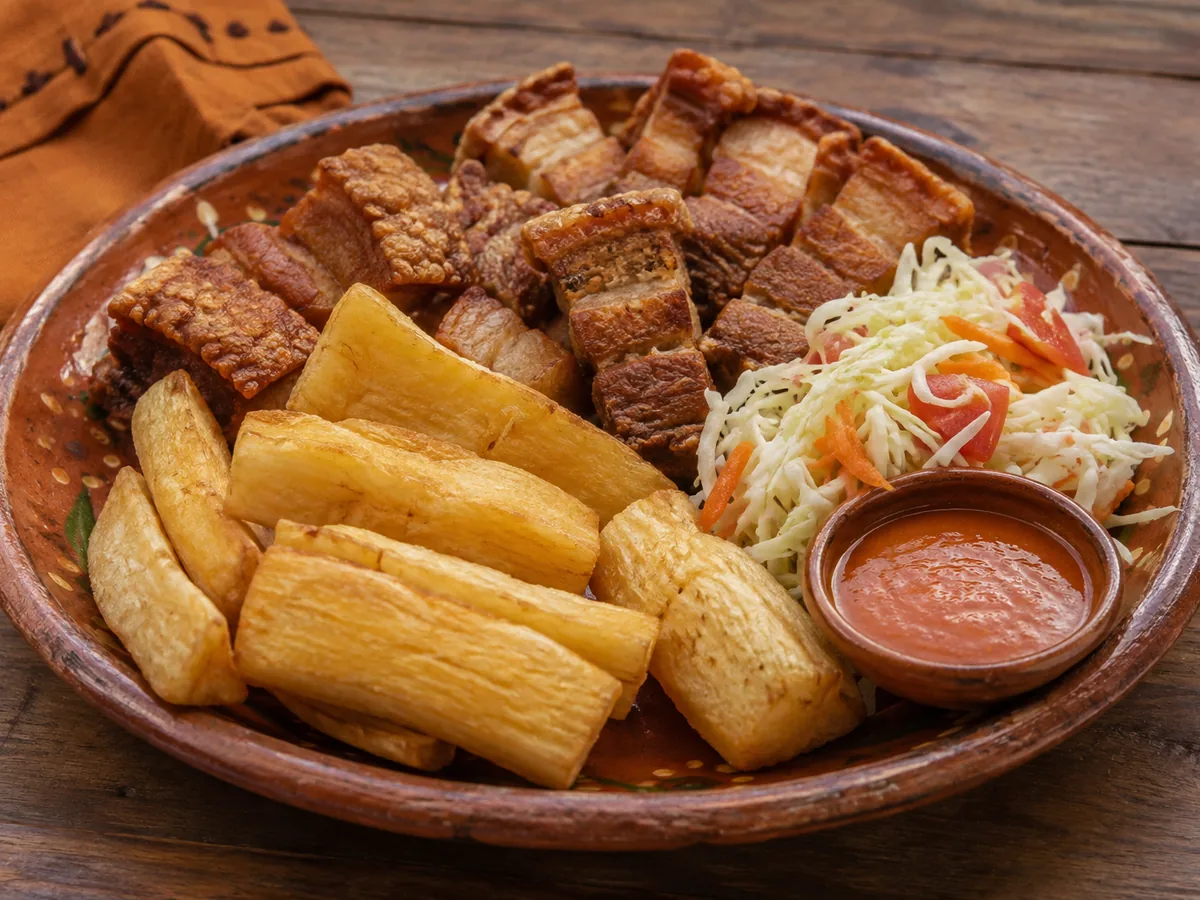
In street stalls across Sonsonate and Juayúa, yuca con chicharrón is served on fresh banana leaves. It is a study in texture built on cassava.
Thick logs of yuca are boiled in salted water with whole garlic until they swell and burst open along their seams, then cut into batons and plunged into hot lard until crisp and golden around a fluffy steaming core.
Mounded high, the fried yuca goes under a mountain of tangy cabbage curtido, a drizzle of warm tomato sauce, and a crown of freshly fried pork cracklings.
The yuca
- 1.5 kg3.3 lbFresh yuca root, peeled and cut into 8 cm logs
- 4 cloves4 clovesFresh garlic, smashed flat, for the boiling water
- 20 g1 Tbsp + 1 tspFine sea salt, for the boiling water
The chicharrones
- 1 kg2.2 lbPork belly and shoulder, cut into 3 cm cubes
- 250 ml1 cupCold water, for the initial render
- 5 g1 tspCumin seeds, toasted and ground
- 6 g1 tspFine sea salt
To fry and serve
- 1 L4.2 cupsHigh-smoke-point oil, or rendered pork lard
- 400 g4 cupsFresh cabbage curtido
- 300 ml1.2 cupsWarm tomato salsa roja
- 2 large2 largeFresh limes, cut into quarters
Boil first — properly
Cassava is dense tightly bound amylose and amylopectin. Twenty-five minutes at 95 °C gelatinises the internal starches until the root swells and cracks along its seams. Frying will not cook an under-boiled interior.
Then dry, ten minutes
Spread on a rack, the surface starches retrograde slightly and the free water goes. Wet yuca in hot oil spatters violently and comes out greasy and limp.
180 to 185 °C
At temperature, the last surface water flashes outward as steam and keeps oil from penetrating, so the crust goes rigid while the inside stays fluffy and dry. Below 175 °C the porous root simply drinks the oil.
The pork renders itself
Fifteen minutes with a cup of water, and once that goes the cubes fry in their own fat. No extra oil is needed for the chicharrones at all.
Curtido on top, at the end
Cold vinegar cabbage over hot fried starch. Its acid is what keeps a plate this rich from becoming heavy.
Passive time, counted separately
The boiled batons air-dry 10 minutes on a rack before frying. That sits outside the times quoted above.
The five tastes on this plate
Salt goes into the boiling water to season the yuca to its centre, and onto the pork. Fat is cracklings and clean frying oil. Acid is cane vinegar and fermented cabbage cutting the fried starch. Heat is garlic in the boil, toasted cumin on the pork, jalapeño in the curtido. Umami is browned pork, cooked tomato and toasted cassava starch.
Equipment
- 6 qt stockpot
- 5 qt Dutch oven with a deep-fry thermometer
- Wire rack
- Slotted spoon
Traditionally a large cast-iron or aluminium paila over a wood fire. A 6-quart pot for boiling and a 5-quart Dutch oven with a thermometer works in a modern kitchen — the thermometer is what holds the 185 °C the crust depends on.
Method
Boil the yuca25 min
Cover the peeled logs with cold water, the smashed garlic and 20 g salt and boil 20 to 25 minutes until they swell and crack open along the seams.
Drain immediately, pull out the woody central cords, and cut into 2 cm batons.
Cover the peeled logs with cold water, the smashed garlic and 20 g salt and boil 20 to 25 minutes until they swell and crack open along the seams.
Drain immediately, pull out the woody central cords, and cut into 2 cm batons.
Dry on a rack10 min
Spread the batons on a wire rack and leave 10 minutes to dry and let the surface starch set.
Spread boiled batons on a rack and air-dry 10 minutes before frying. The surface must be dry to reduce splattering and keep the fried yuca crisp.
Render and fry the chicharrones27 min
Boil the pork cubes with the 250 ml water, cumin and 6 g salt 15 minutes until the water goes and the meat starts frying in its own fat.
Fry 10 to 12 minutes, stirring often, to deep chestnut and crisp at 74 °C. Drain on paper towel.
Boil pork with 250 ml water, cumin and 6 g salt 15 minutes until water evaporates and pork fries in its own fat. Fry 10–12 minutes, stirring often, until deep chestnut, crisp and 74 °C. Drain on paper towels.
Fry the yuca15 min
Heat the litre of oil to 180–185 °C and fry the batons in batches of six to eight for 4 to 5 minutes, until deeply golden, rigid and crisp.
Drain on a rack and salt lightly.
Heat the litre of oil to 180–185 °C and fry the batons in batches of six to eight for 4 to 5 minutes, until deeply golden, rigid and crisp.
Drain on a rack and salt lightly.
Build the platter
Mound the hot yuca in the centre of a banana leaf or a warm platter, heap cold curtido over it, drizzle warm salsa roja across, and crown with the hot cracklings.
Lime wedges alongside, and serve immediately.
Mound the hot yuca in the centre of a banana leaf or a warm platter, heap cold curtido over it, drizzle warm salsa roja across, and crown with the hot cracklings.
Lime wedges alongside, and serve immediately.
Sensory cues of doneness
- Visual: golden-amber batons with crisp jagged edges, dark mahogany cracklings, pale green cabbage and crimson salsa.
- Auditory: a loud crunchy snap through the fried shell, and furious bubbling as the yuca hits the oil.
- Olfactory: fried cassava, rendered pork, toasted garlic, sweet tomato and sharp vinegar.
Look for golden-amber yuca with crisp jagged edges, dark mahogany pork, pale-green cabbage and crimson salsa. Expect bubbling as yuca enters oil, a crisp bite, and aromas of cassava, pork, garlic, tomato and vinegar.
Troubleshooting
- Greasy, limp batons and a spattering pan.
The yuca went in wet. Drain and air-dry 10 minutes first.
- Hard, raw centres.
It was under-boiled. Frying crisps the surface but cooks nothing.
- Heavy, oil-soaked yuca.
The oil was below 175 °C. Hold 180–185 °C.
Substitutions
One-to-one global substitutions, with the technique adjustment each one requires.
Ingredient substitutions
| Ingredient | Replace with | Culinary impact and technique adjustment |
|---|---|---|
| Fresh yuca | Frozen peeled cassava | One-to-one, boiled from frozen — often more tender than fresh |
| Pork chicharrón | Thick-cut slab bacon lardons, or chicken cracklings | One-to-one, fried until genuinely crisp |
| Cane vinegar | Distilled white or cider vinegar | One-to-one in the curtido |
Scaling
Half, for 3 portions
Halve everything. Frying times are identical.
Double, for 12 portions
Double everything and fry the yuca in four batches so the oil holds 185 °C.
What to serve it with
- Pescaditas fritas, small crisp fried river fish
- Big bowls of extra curtido and salsa on the table
- A cold Pilsener, or chilled horchata de morro
Questions
Can I use frozen yuca?
Yes, and it is often more tender than fresh. Boil it straight from frozen for 20 minutes before frying.
What is yuca salcochada?
The same boiled yuca served soft without frying, under curtido and chicharrones — a lighter and equally beloved version.
Can I use an air fryer?
Yes. Toss the boiled batons in 2 Tbsp oil and air-fry at 200 °C for 15 to 18 minutes, shaking halfway.