Sancocho de Siete Carnes
New Year's Eve, national holidays, and torrential rain. Seven meats enter the caldero in strict order of how long their collagen needs — beef, ribs and goat alone for the first 45 minutes — and the broth is thickened by mashing cooked plantain and yautía back into it, never by flour.
- Prep
- 50 min
- Cook
- 2 hr 30 min
- Serves
- 10 to 12 hearty servings
- Difficulty
- Hard
Researched · Kitchen testing pending
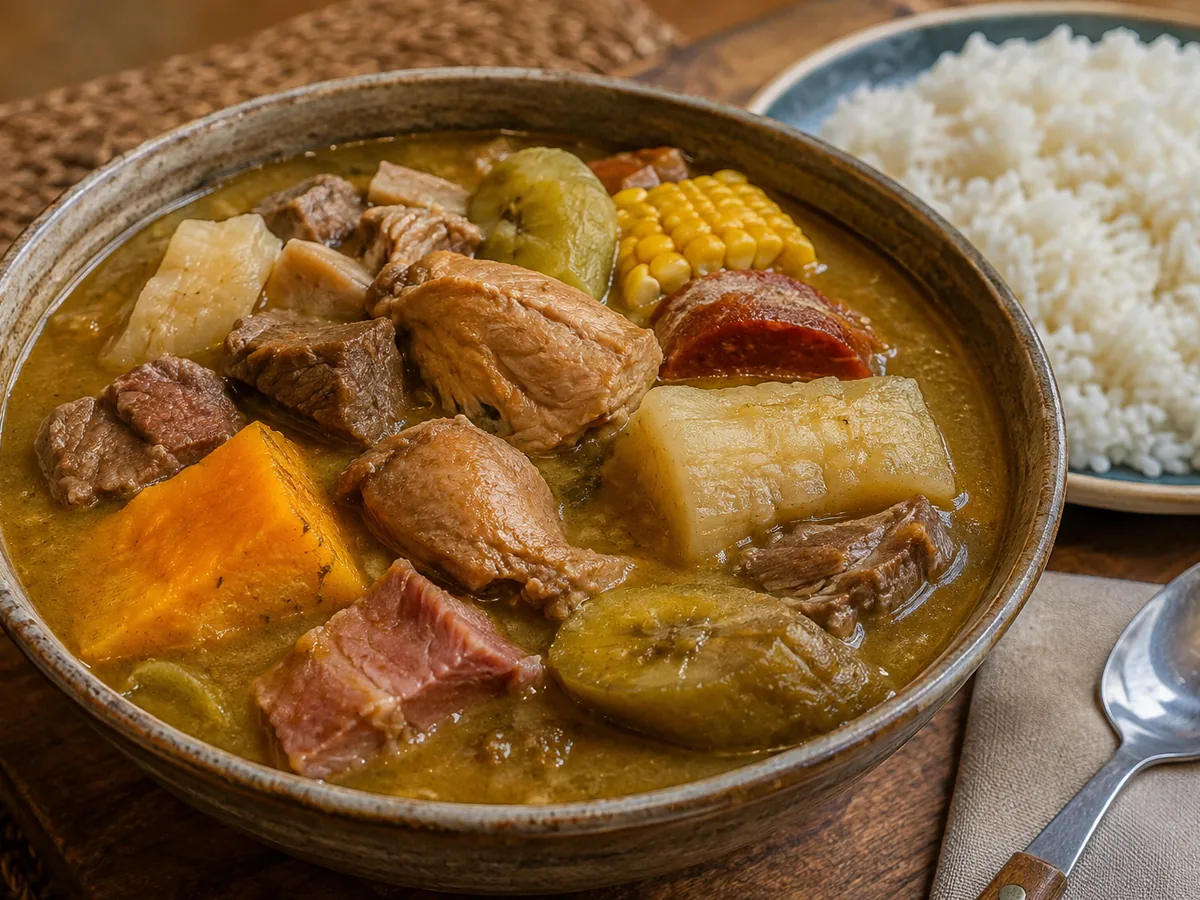
Sancocho de siete carnes is the summit of Dominican celebratory cooking — New Year’s Eve, national holidays, and days of torrential rain. It descends from the Spanish cocido by way of the African tradition of multi-meat root pottages, and it turns home cooking into ritual.
Seven meats go in: beef chuck or shank, bone-in pork ribs, country chicken, smoked pork chops, longaniza, goat and cured ham. They enter the caldero in sequence, ordered by how long their collagen takes, alongside the Taíno root crops — ñame, yautía, yuca, green plantain and sweet corn wheels.
What comes out is unctuous and thick with gelatinised tuber, perfumed with recao and wild oregano, and cut at the last moment by bitter orange.
The seven meats
- 700 g1.5 lbBeef chuck or bone-in shank, cut into 4 cm chunks, marrow bones kept
- 700 g1.5 lbBone-in pork ribs, cut into individual riblets
- 500 g1.1 lbBone-in goat meat (chivo), trimmed and cut into 4 cm pieces
- 700 g1.5 lbBone-in chicken thighs and drumsticks, skin removed, halved
- 450 g1 lbSmoked pork chops (chuletas ahumadas), cut into 2.5 cm pieces
- 350 g0.75 lbDominican longaniza pork sausage, sliced into 2.5 cm rounds
- 200 g0.45 lbCured country ham or salt pork (tocino), diced into 1 cm cubes
Seasoning
- 180 ml¾ cupNaranja agria (bitter Seville orange juice), freshly squeezeddivided between the marinades and the finish
- 45 g12 clovesGarlic, mashed to a paste with coarse salt
- 10 g1 TbspWild Dominican oregano (orégano poleo seco), crushed between the palms
- 25 g1½ TbspCoarse sea saltseasoned in stages
- 6 g2 tspBlack peppercorns, freshly crushed
- 45 ml3 TbspNeutral corn or vegetable oil
- 15 g1 TbspGranulated white sugar, for the searing caramel
Viandas and herbs
- 450 g1 lbYuca (cassava), peeled, woody core removed, cut into 4 cm chunks
- 450 g1 lbYautía blanca or amarilla (malanga / taro), peeled and cut into 4 cm chunks
- 450 g1 lbÑame (true Caribbean white yam), peeled and cut into 4 cm chunks
- 450 g2 mediumGreen plantains, peeled and cut into 2.5 cm rounds
- 3 ears3 earsSweet corn on the cob, husked and cut into 4 cm wheels
- 30 g8 leavesFresh recao / culantro, tied with kitchen twine
- 30 g1 large bunchFresh cilantro, tied with kitchen twine
- 30 g6 wholeAjí gustoso peppers, pricked with a knife point
- 4 L16 cupsHot water or rich unsalted beef stockadded in three stages
Stagger the meats or ruin them
Beef shank and goat carry dense type-I collagen that needs prolonged moist heat above 72 °C to hydrolyse into gelatin, so they go in first. Chicken and smoked chops have delicate fibres and would shred into dry threads over two and a half hours, so they are held back. Everything in at once gives you mush and dryness in the same pot.
Three tubers, three different starches
Yuca yields elastic amylose, yautía sheds fine-grained starch that stays in suspension, and ñame brings pectin. Held at 88–92 °C they form a stable colloidal emulsion with the gelatin and rendered fat — a glossy, viscous broth with no roux in it.
The citrus goes in at the end
Acid early lowers the broth pH, which tightens the pectin bonds in the tubers and stops them softening. The last 50 ml of bitter orange goes in for the final 15 minutes only.
Big chunks, gentle simmer
Cut the viandas into full 4 cm chunks and keep the pot at a controlled simmer. Small cubes at a violent boil dissolve into purée.
Scrape the bottom
Once the tubers are in, run a flat wooden paddle across the floor of the pot every 5 to 7 minutes to keep the starches in suspension. Yautía and ñame scorch and the acrid taste goes through everything.
Passive time, counted separately
The dense meats marinate at least 30 minutes, and the finished pot settles 15 minutes off the heat so the fat cap integrates. Neither is active work and both sit outside the times quoted above.
The five tastes on this plate
Salt is seasoned in stages and reinforced by cured ham and smoked chops. Fat is rendered pork belly and rib fat carrying the fat-soluble herb terpenes. Acid is bitter orange, at the marinade and at the finish, cutting the animal richness. Heat is ají gustoso and whole scotch bonnet, crushed garlic and peppercorns. Umami is seven-meat glutamates, beef marrow and root starch.
Equipment
- 14 to 16 qt heavy stockpot or large Dutch oven
- Separate skillet, for the second sear
- Long flat-edged wooden paddle
- Slotted spoon
- Kitchen twine
Traditionally a 16-to-20-quart cast-aluminium caldero gigante, often outdoors over a wood fire that lends a little smoke to the fat cap. A heavy 14-to-16 quart stainless stockpot or large enamelled Dutch oven works in a modern kitchen — what matters is a broad, heavy base, because dense root starches scorch on a thin one during the last 45 minutes.
Method
Marinate, in two bowls10 min
Rub the beef, pork ribs and goat with 100 ml bitter orange juice, 30 g mashed garlic, 7 g oregano, 1 Tbsp coarse salt and the crushed pepper. Leave at room temperature at least 30 minutes.
Separately, toss the chicken, smoked chops and longaniza with the remaining garlic, 30 ml bitter orange and the remaining oregano. Refrigerate.
Rub the beef, pork ribs and goat with 100 ml bitter orange juice, 30 g mashed garlic, 7 g oregano, 1 Tbsp coarse salt and the crushed pepper; leave at room temperature at least 30 minutes. Separately toss the chicken, smoked chops and longaniza with the remaining garlic, 30 ml bitter orange and the remaining oregano; refrigerate.
Sear the dense meats in caramel12 min
Set the caldero over medium-high heat with 45 ml oil and sprinkle in the 15 g sugar. Let it melt and foam to a dark mahogany bubble.
Immediately drop in the ham cubes, beef, pork ribs and goat, and sear vigorously 10 minutes, turning constantly, until deeply browned.
Heat 45 ml oil in the caldero over medium-high and sprinkle in 15 g sugar. When it melts and foams dark mahogany, add the ham cubes, beef, pork ribs and goat and sear 10 minutes, turning constantly, until deeply browned.
First water, primary braise45 min
Pour in 1.5 litres hot water. Add the tied culantro bundle and the whole ají gustoso.
Bring to a rolling boil, drop to medium-low, cover tightly and simmer 45 minutes until the beef and goat begin to yield.
Add 1.5 litres hot water, the tied culantro bundle and the whole ají gustoso. Boil, then reduce to medium-low, cover tightly and simmer 45 minutes until the beef and goat begin to yield.
Brown and add the second meats6 min
In a separate skillet over medium-high heat, brown the longaniza, chicken and smoked chops 6 minutes until lightly coloured.
Tip them and their pan drippings into the caldero, and add another 1.5 litres hot water.
In a separate skillet over medium-high, brown the longaniza, chicken and smoked chops 6 minutes. Tip them with their drippings into the caldero and add another 1.5 litres hot water.
Hard viandas and corn20 min
Add the corn wheels, green plantain rounds and yautía chunks.
Simmer uncovered over medium heat 20 minutes, so the hard vegetables begin to soften and release starch.
Add the corn wheels, green plantain rounds and yautía chunks. Simmer uncovered over medium 20 minutes so the hard vegetables soften and release starch.
The delicate tubers30 min
Add the ñame and yuca with the remaining 1 litre of hot water, making sure everything is submerged.
Simmer gently 30 minutes, scraping the bottom with a flat wooden paddle every 5 to 7 minutes.
Add the ñame and yuca with the remaining 1 litre hot water, keeping everything submerged. Simmer gently 30 minutes, scraping the bottom with a flat wooden paddle every 5–7 minutes.
Make the binder5 min
Once the yautía and some plantain are completely fork-soft, lift out 3 chunks of plantain and 3 of yautía.
Mash them smooth with a splash of hot broth, then whisk that slurry back into the pot.
When the yautía and some plantain are fork-soft, lift out 3 chunks of plantain and 3 of yautía. Mash smooth with a splash of hot broth and whisk back into the pot.
Citrus finish and reduction20 min
Pour in the remaining 50 ml bitter orange juice and add the tied cilantro bundle.
Simmer uncovered over medium-low 15 to 20 minutes, stirring often, until the broth turns from thin liquid into a glossy velvet sauce that heavily coats a spoon.
Add the remaining 50 ml bitter orange juice and the tied cilantro bundle. Simmer uncovered over medium-low 15–20 minutes, stirring often, until the broth becomes a glossy sauce that heavily coats a spoon.
Rest, adjust, serve
Discard the spent herb bundles and taste for salt — the cured ham and smoked chops will already have contributed a great deal.
Let the pot settle undisturbed 15 minutes so the fat cap integrates and the emulsion stabilises.
Ladle steaming bowls so everyone gets several meats, corn, yuca and plantain, with white rice, sliced avocado and extra bitter orange alongside.
Discard the herb bundles and taste for salt; the ham and smoked chops add a lot. Rest undisturbed 15 minutes. Ladle so each bowl gets several meats, corn, yuca and plantain, with white rice, sliced avocado and extra bitter orange.
Sensory cues of doneness
- Visual: a deep golden-amber opaque stew with a velvety sheen, large tender root chunks and distinct morsels of browned meat beneath a light emulsion flecked with herbs.
- Auditory: a heavy continuous chugging that shifts from thin splashing to a muted, thick thudding as the root starches gelatinise.
- Olfactory: a room-filling fragrance of braised beef, smoked pork, wild oregano poleo, sharp bitter orange, garlic and earthy roots.
Look for a deep golden-amber, velvety stew with tender root chunks and browned meat. The bubbling shifts from thin splashing to a thick, muted thud as the starches gelatinise; smell braised beef, smoked pork, oregano, bitter orange and garlic.
Troubleshooting
- Every meat is either mushy or dry.
The delicate meats went in with the tough ones. Beef, goat and ribs simmer 45 minutes alone before the chicken and sausage join them.
- An acrid, scorched flavour through the whole pot.
The bottom was not scraped once the roots broke down. Use a flat paddle every 5 to 7 minutes to keep the starch in suspension.
- The tubers dissolve into purée.
They were cut too small or boiled too hard. Full 4 cm chunks, and a controlled 88–92 °C simmer.
Substitutions
One-to-one global substitutions, with the technique adjustment each one requires.
Ingredient substitutions
| Ingredient | Replace with | Culinary impact and technique adjustment |
|---|---|---|
| Ñame | True African white yam, or russet potatoes | Not sweet potato. Real ñame is starchy, snowy white and neutral |
| Yautía | Taro root or eddo | The same dense, mucilaginous starch that thickens the liquor |
| Longaniza dominicana | Coarse fresh Spanish chorizo, or garlic pork sausage | Must be raw fresh sausage seasoned with garlic and oregano, not dry-cured |
Scaling
Half, for 5 to 6 servings
Halve the meats and tubers in an 8-to-10-quart Dutch oven and drop the water to 2.2 litres. Every simmer time stays the same — the collagen still needs it.
Double
Do not, in a home kitchen, without a 30-quart outdoor caldero and a propane burner. Overcrowding a 16-quart pot scorches the starches on the bottom while the tubers on top stay raw.
What to serve it with
- Arroz blanco, plus concón shards
- Ripe criollo avocado with sea salt and lime
- Ice-cold Presidente, or aged Dominican rum served neat with a lime peel
Questions
Can I use fewer than seven meats and still call it authentic?
Yes. Seven is the ceremonial standard, but everyday sancocho de tres carnes — res, cerdo y pollo — is entirely traditional. The structural key is beef for depth, pork for collagen fat, and poultry for sweetness.
Why does the bitter orange go in at the very end?
Citric acid brightens heavy animal fat, but added early it lowers the broth pH, which binds pectin in the tubers and stops them softening evenly. The final splash in the last 15 minutes keeps the acidity without disrupting the starch.
What are bollitos de plátano for?
Some cooks grate green plantain, season it with garlic and salt, and drop raw teaspoonfuls into the simmering pot. They absorb meat juices and shed surface amylose, working as edible internal thickeners.