La Bandera Dominicana
Lunch at noon, in every province. White rice for peace, red beans for the blood of the patriots, dark-glazed chicken for freedom. The chicken gets its colour from sugar taken to a mahogany foam in scorching oil — pyrolysis, not browning liquid — and the best part of the plate is the concón scraped off the bottom of the pot.
- Prep
- 35 min
- Cook
- 50 min
- Serves
- 6 servings
- Difficulty
- Medium
Researched · Kitchen testing pending
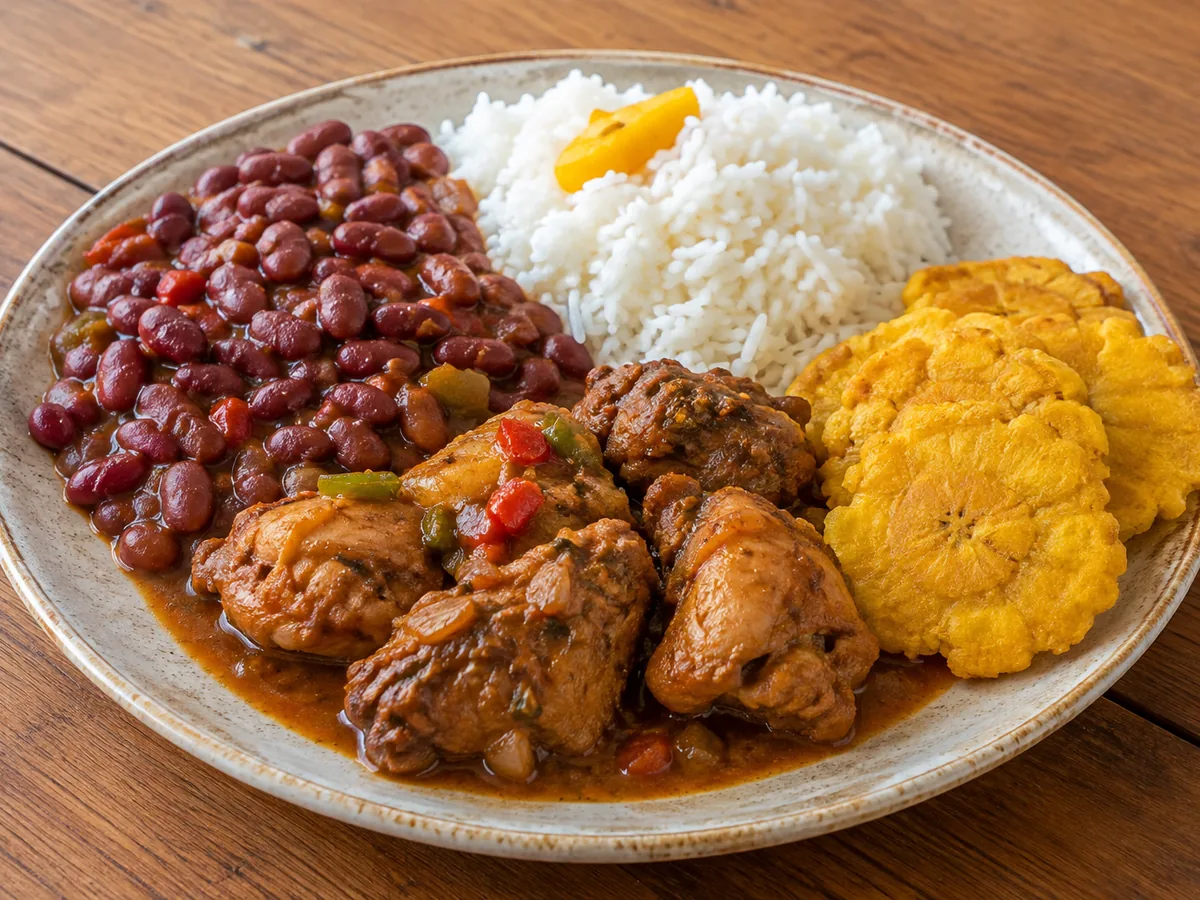
La Bandera is the Dominican lunch table, served at noon from Pedernales to Samaná. Its three elements mirror the national flag: white rice for peace, red stewed kidney beans for the blood of the patriots, and dark-glazed meat for freedom.
The foundation is pollo guisado, built on a Spanish-Taíno technique in which sugar is deliberately caramelised in scorching oil to a dark mahogany foam before the poultry goes in. That coats every fibre in a bitter-sweet bronze glaze no bottled browning liquid reproduces.
Beside the rice and the beans sits the concón — the crunchy golden crust formed against the bottom of the caldero — drizzled with bean liquor and served with shatteringly crisp twice-fried tostones.
Pollo guisado
- 1.8 kg4 lbWhole chicken cut into 10 bone-in pieces, trimmed of excess fat, washed with lime halves, skin on
- 60 ml¼ cupSeville sour orange juice (naranja agria) or fresh lime juice, strained
- 30 g8 clovesGarlic, crushed to a fine paste with sea salt
- 6 g2 tspWild Dominican oregano (orégano poleo seco), crushed between the palms
- 25 g2 TbspGranulated white sugar, dry, for the caramel
- 120 ml½ cupNeutral vegetable or corn oildivided between the calderos
- 45 g3 TbspDouble-concentrated tomato pastedivided between the chicken and the beans
- 18 g1 TbspFine sea saltdivided across the chicken, rice and beans
- 4 g1 tspFreshly ground black pepper, coarse
Sofrito and beans
- 150 g1 mediumRed onion, finely diceddivided
- 100 g1 mediumRed bell or Cubanelle pepper, seeded and cut into 1 cm dice
- 15 g4 leavesFresh culantro (recao ancho), bruised and tied into a bundle
- 20 g½ cupFresh cilantro leaves and tender stems, chopped fine
- 800 g4 cups cookedCooked red kidney beans with their cooking liquor, undrained
- 200 g7 ozAuyama (Dominican pumpkin) or kabocha squash, peeled and cut into 1 cm dice
- 20 g4 smallAjí gustoso peppers, whole, stems removed
Rice and tostones
- 600 g3 cupsLong-grain white rice, rinsed until the water runs clear and drained
- 840 ml3.5 cupsWater for the rice, at room temperature
- 900 g4 largeGreen plantains, peeled and sliced into 2.5 cm rounds
- 750 ml3 cupsFresh corn or peanut oil, for deep frying
- 5 g1 tspFlaky sea salt, to finish the tostones
The ten-second window
Sucrose dry-pyrolyses between 160 and 180 °C into furans and maltol, giving a bitter-sweet mahogany foam. Adding the cold chicken halts the pyrolysis and transfers that glaze onto the skin. The gap between golden caramel and black ash is about ten seconds — go in the moment reddish mahogany bubbles spread across the oil.
Why the beans thicken without flour
Mashing a quarter of the beans and the diced auyama against the pot wall releases amylose and vegetable pectin, which bind the liquor into a velvet gravy. Commercial thickeners have no place in it.
Concón is a construction, not an accident
Rice against the bare aluminium base above 120 °C drives off the last moisture and pushes the starch through retrogradation and dextrinisation into a rigid crust. Oil run around the perimeter seeps under the grain layer, and three minutes of direct medium heat at the very end contracts the crust away from the metal so it lifts in sheets.
Two fries for the tostones
160 °C gelatinises the plantain starch all the way through without hardening the outside, so it compresses instead of shattering. 190 °C then flashes off the surface moisture for crispness.
Passive time, counted separately
The chicken marinates 25 minutes while the sofrito vegetables are prepped. That sits outside the times quoted above.
The five tastes on this plate
Salt is in the rice, the chicken marinade, the bean sofrito, and flaky salt over hot tostones. Fat is oil for the sugar sear, for frying tostones and for toasting concón. Acid is sour orange or lime cutting the caramel glaze. Heat is black pepper, crushed garlic, raw onion and mild ají gustoso. Umami is tomato paste, bone-in chicken collagen, bean starch and the Maillard compounds in the rice crust.
Equipment
- Heavy cast-aluminium caldero, for the rice
- Wide caldero or enamelled Dutch oven, for the chicken
- Medium saucepan, for the beans
- Deep skillet or caldero, for frying
- Tostonera, or a heavy flat-bottomed mug
- Stiff flat spatula
Traditionally three calderos at once — a heavy cast-aluminium one for the rice, because that is what releases a proper concón. In a modern kitchen an enamelled cast-iron Dutch oven handles the chicken and beans, and a cast-iron skillet can make the concón, though it wants a little more oil and closer heat control to avoid bitter blackening.
Method
Marinate the chicken5 min
Massage the chicken pieces in a wide bowl with the sour orange juice, garlic paste, crushed oregano, 1 tsp salt and the black pepper.
Leave at room temperature 25 minutes while you prep the sofrito vegetables.
Massage the chicken with sour orange juice, garlic paste, crushed oregano, 1 tsp salt and black pepper. Leave 25 minutes at room temperature while preparing the sofrito vegetables.
Caramelise the sugar4 min
Set a heavy caldero over medium-high heat with 30 ml oil, and sprinkle the 25 g sugar into the centre. Do not stir.
Watch it melt from clear crystals to pale gold, then into a foaming, bubbling dark mahogany-amber liquid across the whole oil surface.
Heat 30 ml oil in a heavy caldero over medium-high. Sprinkle 25 g sugar in the centre without stirring; watch it melt from pale gold to dark mahogany-amber foam across the oil.
Sear and glaze5 min
The split second the foam reaches deep mahogany, slide the chicken in in a single layer with long tongs — stand back from the splatter.
Stir constantly 4 to 5 minutes until the caramel coats every piece with an intense bronze sheen. Do not let the sugar blacken.
Immediately when the foam turns deep mahogany, add chicken in one layer with long tongs, standing back from splashes. Stir constantly 4–5 minutes until every piece is bronze-glazed; never let the sugar blacken.
Braise the pollo guisado30 min
Add half the diced onion, half the diced pepper, 30 g tomato paste and 120 ml water. Cover tightly, drop to medium-low, and simmer 20 minutes, stirring occasionally and adding 60 ml water if it dries out.
Uncover, stir in half the cilantro, and simmer 10 minutes more, until the sauce reduces to a glossy clinging gravy and the chicken reads 74 °C / 165 °F.
Add half the onion and pepper, 30 g tomato paste and 120 ml water. Cover and simmer over medium-low 20 minutes, stirring occasionally; add 60 ml water if dry. Uncover, add half the cilantro and simmer 10 minutes until the gravy clings and chicken reaches 74°C / 165°F.
Start the rice10 min
Put a caldero over high heat with 30 ml oil and 8 g salt, pour in the 840 ml water and bring to a rolling boil.
Add the drained rice and stir once with a flat metal spoon to distribute the grains.
Boil uncovered over medium-high until the water drops below the surface and small steam craters appear, about 8 minutes.
Bring 840 ml water, 30 ml oil and 8 g salt to a rolling boil in a caldero. Add drained rice and stir once. Boil uncovered over medium-high about 8 minutes until water falls below the rice and steam craters appear.
Steam, then build the concón29 min
Gather the rice into a dome and drizzle 15 ml oil around the perimeter of the caldero. Turn the heat to its absolute lowest, cover tightly, and steam undisturbed 25 minutes.
Fluff the loose top rice onto a platter, leaving the bottom layer stuck to the pot. Raise the heat to medium under the empty caldero for 3 to 4 minutes until you hear sharp crackling and smell toasted popcorn, then peel the golden crust off in large shards with a stiff spatula.
Mound rice into a dome; drizzle 15 ml oil around the perimeter. Cover tightly and steam undisturbed on lowest heat 25 minutes. Remove the loose rice, leaving the bottom crust. Heat the pot over medium 3–4 minutes until sharply crackling and popcorn-scented; lift golden shards with a stiff spatula.
Stew the habichuelas26 min
In a saucepan, heat 15 ml oil over medium and sauté the remaining onion and pepper, the ají gustoso, the culantro bundle and 15 g tomato paste 3 minutes until aromatic.
Add the beans with all their liquor, the diced auyama and 240 ml water, and bring to a gentle boil. Simmer uncovered 18 minutes until the auyama is fork-tender.
Crush about a quarter of the beans and auyama against the pot wall with a masher, stir hard to work the starch in, and simmer 5 minutes more until silky. Stir in the remaining cilantro and season.
Sauté remaining onion and pepper, ají gustoso, bundled culantro and 15 g tomato paste in 15 ml oil over medium for 3 minutes. Add beans with liquor, auyama and 240 ml water; simmer uncovered 18 minutes until squash is fork-tender. Mash one-quarter of beans and squash against the pot; stir well and simmer 5 minutes. Add remaining cilantro and season.
Fry the tostones twice12 min
Heat the 750 ml oil to 160 °C / 320 °F and fry the plantain rounds in batches 3 to 4 minutes, turning once, until tender to a fork but still pale. Drain.
Press each hot round flat to about 6 mm in a tostonera, or under a heavy mug, between parchment.
Bring the oil to 190 °C / 375 °F and fry them again 60 to 90 seconds until blistered, rigid and golden. Drain and dust with flaky salt.
Heat 750 ml oil to 160°C / 320°F. Fry plantain rounds in batches 3–4 minutes, turning once, until fork-tender but pale; drain. Flatten hot rounds to 6 mm between parchment using a tostonera or heavy mug. Raise oil to 190°C / 375°F; fry 60–90 seconds until blistered, rigid and golden. Drain and salt.
Plate the flag
Mound white rice on wide plates and spoon the habichuelas across half of it, letting the brick-red gravy soak in.
Set two pieces of glazed chicken alongside with spoonfuls of the onion gravy, and crown the plate with concón shards and four or five hot tostones.
Mound rice on wide plates and spoon beans over half, letting the gravy soak in. Add two glazed chicken pieces with onion gravy, concón shards and four or five hot tostones.
Sensory cues of doneness
- Visual: glossy dark mahogany-bronze chicken skin; beans pooling as a brick-red sauce that coats a wooden spoon; rice grains separate like dry pearls under an unbroken amber-gold concón; tostones with blistered, cracked pale-golden rims.
- Auditory: a violent hiss as cold chicken meets bubbling sugar oil; a low rhythmic blop from the bean pot; dry crunching as a spoon scrapes the caldero base.
- Olfactory: toasted sugar turning savoury, crushed garlic, wild oregano, pungent culantro, and the nutty scent of the rice crust.
Check for mahogany-bronze chicken, spoon-coating brick-red bean sauce, separate rice grains, amber-gold concón and blistered golden tostones. Listen for gently bubbling beans and crisp rice crust; smell toasted sugar, garlic, oregano, culantro and nutty rice.
Troubleshooting
- The sugar burns to bitter black ash.
The heat was too high or the chicken went in late. Hold medium-high and go in the exact second the mahogany foam spreads.
- Acrid, blackened concón.
High heat stayed on after the water evaporated, or the perimeter oil was skipped. Drop to the lowest setting the moment the surface water vanishes.
- Tostones that crumble or stay rubbery.
They were under-cooked in the first fry, smashed cold, or the second fry was too cool. Soft all the way through, smashed hot, then 190 °C.
Substitutions
One-to-one global substitutions, with the technique adjustment each one requires.
Ingredient substitutions
| Ingredient | Replace with | Culinary impact and technique adjustment |
|---|---|---|
| Naranja agria | Equal parts fresh lime and fresh sweet orange juice | Replicates the acidity and floral oil profile of Caribbean bitter orange |
| Auyama | Japanese kabocha or Jamaican calabaza | The same dense, non-stringy flesh and starch the beans need to thicken |
| Ají gustoso | Ají dulce, or deseeded Cubanelle with a drop of habanero | Floral pepper aroma with no capsaicin burn |
Scaling
Half, for 3 servings
Halve the chicken, vegetables and beans. For the rice use 300 g and 420 ml water, steaming 22 minutes. Keep the caramel sugar at 15 g so it still coats the pan evenly.
Double, for 12 servings
Double everything, but brown the chicken in two batches — 3.6 kg of cold chicken in one caldero drops the temperature and boils the meat instead of searing it. Widen the rice caldero rather than heaping the grain.
What to serve it with
- Ensalada verde campesina — iceberg, plum tomato, cucumber and white onion with vinegar and olive oil
- Sliced Dominican criollo avocado, and pickled red onions
- Cerveza Presidente vestida de novia, or morir soñando — iced orange juice whipped with sweetened evaporated milk
Questions
Can I use brown sugar to brown the chicken?
You can, but the molasses and moisture make it caramelise faster and foam unpredictably. White granulated sugar gives you precise visual control over the exact moment of mahogany before it scorches.
How do the beans get creamy without flour or cornstarch?
By mashing the cooked auyama and about a quarter of the beans against the pot wall. The released amylose and pectin bind the liquid on their own. Commercial thickeners are never used.
Why won't my concón peel off the pot?
It needs an unsealed aluminium or seasoned cast-iron caldero and enough oil. Run a tablespoon around the perimeter when you dome the rice, and give it three minutes of direct medium heat at the end to contract the starch away from the metal.