Mangú con Los Tres Golpes
The national breakfast, and the trick is ice water. Beaten into scorching boiled green plantain along with butter, the thermal shock stops the amylose chains realigning, which is the difference between a pillowy purée and a rubbery block ten minutes later. The three hits are fried salami, fried cheese and a sunny egg.
- Prep
- 20 min
- Cook
- 25 min
- Serves
- 4 servings
- Difficulty
- Medium
Researched · Kitchen testing pending
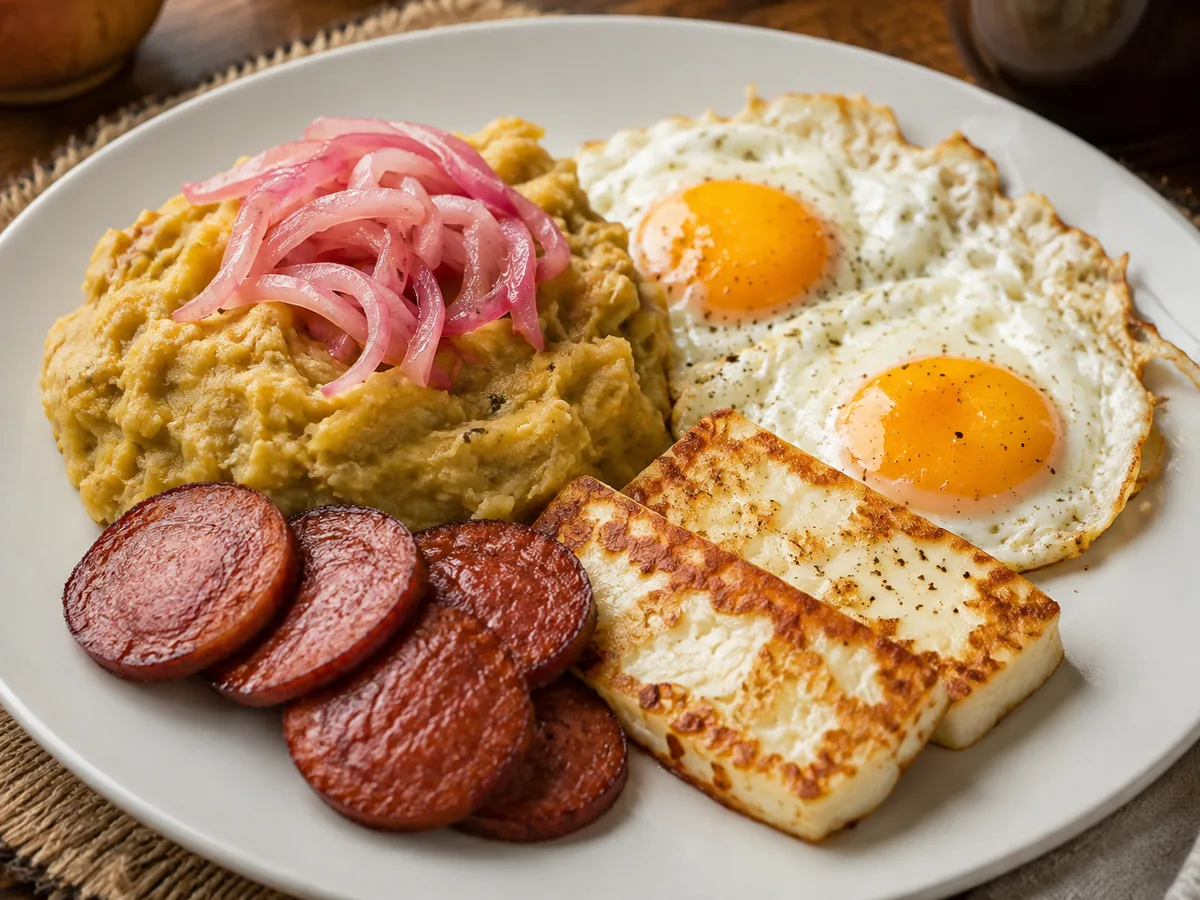
Mangú is the national breakfast of the Dominican Republic, inherited from West African fufu traditions and adapted to Caribbean plantain groves. Los Tres Golpes — the three hits — are the fried triumvirate beside it: thick-sliced Dominican salami fried until blistered, firm white frying cheese with a crunchy shell and molten core, and eggs fried sunny-side up with lacy edges. A magenta crown of red onions simmered in cane vinegar goes over the top.
The technical hallmark of real mangú is its silkiness. Unlike dense plantain pastes, it takes cold ice water beaten vigorously into the hot mash alongside butter.
That deliberate thermal shock emulsifies the starch and fat together, and the purée stays supple and velvety even as it cools on the plate.
Mangú
- 900 g4 largeGreen plantains, peeled and cut into 2.5 cm rounds
- 25 g1½ TbspCoarse sea salt, dissolved in the boiling water
- 60 g4 TbspUnsalted European butter, softened and cubed
- 180 ml¾ cupIce water, chilled with cubes and strained
- 120 ml½ cupReserved plantain cooking water, piping hot
Cebollas encurtidas
- 300 g2 mediumRed onions, peeled and cut into thin half-moons
- 60 ml¼ cupDistilled white cane vinegar or cider vinegar
- 30 ml2 TbspExtra-virgin olive oil or neutral oil
Los tres golpes
- 450 g1 lbDominican salami (salame de corte grueso), sliced into 1.2 cm rounds
- 450 g1 lbQueso blanco para freír, cut into 1.2 cm rectangular slabs
- 30 g2 TbspCornstarch, for a light dusting on the cheeseoptional, for extra crispness
- 4 large4 largeEggs, chilled
- 180 ml¾ cupNeutral corn or peanut oil, for frying
Never skip the ice water
Green plantain is almost entirely resistant starch and long-chain amylose. Boiling bursts the granules; mashing in air lets the amylose realign into hydrogen bonds — retrogradation — and the mash sets rigid. Cold water and butter beaten in together drive lipid between the amylose chains and coat the granules, holding a stable starch-lipid suspension that stays pillowy as it cools.
Cold water, not hot
Hot water keeps leaching and swelling the starch into a gluey wallpaper paste. Cold shocks it while the beating emulsifies the butter in.
The cheese has to resist melting
Queso para freír has high protein cross-linking and low moisture, so a Maillard crust forms at 190 °C before the casein inside liquefies. Under 90 seconds a side. Mozzarella or gouda will just puddle.
Macerate the onions first
Ten minutes in vinegar and salt breaks the cell walls, so they sweat tender and magenta instead of staying harsh and crunchy.
Dry the cheese
Pat the slabs completely dry before they go near hot oil — surface moisture causes severe spattering.
The five tastes on this plate
Salt is heavily salted boiling water, garlicky salami and naturally salty queso blanco. Fat is butter in the mash, rendering salami fat and frying oil. Acid is sharp cane vinegar in the pickled onions. Heat is the allicin bite of warm onion, black pepper in the salami, and ají picante if you want it. Umami is smoked salami, browned cheese crust and fried yolk.
Equipment
- Large stockpot or caldero
- Heavy wooden or stainless masher
- Large heatproof bowl
- Small skillet, for the onions
- 12 in heavy carbon-steel or cast-iron skillet
- Wire rack
Traditionally a deep aluminium caldero for boiling and a wooden majador for mashing, with a wide shallow caldero for the three hits in succession. A heavy stockpot, a sturdy wire masher and a 12-inch cast-iron skillet work in a modern kitchen — the skillet holds its heat through salami, cheese and eggs back to back.
Method
Boil the plantains25 min
Bring 2.5 litres of water to a rolling boil with the 25 g coarse salt.
Add the plantain rounds and cook over medium-high heat 20 to 25 minutes, until completely fork-tender and starting to split at the centre. Under-cooked plantain stays grainy in the mash.
Bring 2.5 litres water and 25 g coarse salt to a rolling boil. Add plantain rounds; cook over medium-high 20–25 minutes until completely fork-tender and beginning to split at the centre.
Pickle the onions15 min
While the plantains boil, toss the sliced onions with the 60 ml vinegar and a generous pinch of salt and leave 10 minutes, until bright magenta.
Heat 30 ml oil in a skillet over medium, pour in the onions with their vinegar, and sauté 4 to 5 minutes until soft and translucent with a little bite left. Keep warm.
Toss onions with 60 ml vinegar and a generous pinch of salt; leave 10 minutes until magenta. Heat 30 ml oil over medium; sauté onions with their vinegar 4–5 minutes until soft and translucent with a little bite. Keep warm.
Smash and emulsify6 min
Lift the hot plantain rounds into a large heatproof bowl with a slotted spoon, reserving the cooking water.
Add the 60 g softened butter straight away and mash vigorously. As the plantain breaks down, pour in 120 ml of the ice water in three additions, beating continuously, until it turns from dense chunks into a smooth, pillowy purée.
Transfer hot plantains to a heatproof bowl with a slotted spoon, reserving cooking water. Immediately mash vigorously with 60 g softened butter. Beat in 120 ml ice water in three additions until smooth and fluffy.
Adjust and hold2 min
If it feels stiff, alternate 60 ml of the hot cooking water and the last 60 ml of ice water, beating hard until glossy.
Season, cover, and hold over the lowest possible heat or a double boiler.
If stiff, alternate 60 ml hot cooking water with the remaining 60 ml ice water, beating until glossy. Season, cover and hold over the lowest heat or a double boiler.
Fry the salami6 min
Heat 60 ml oil in the skillet to 180 °C / 350 °F and lay the salami rounds in a single layer.
Fry 2 to 3 minutes a side until the edges curl, blister and go deep reddish-brown. Onto a rack.
Heat 60 ml oil to 180°C / 350°F. Fry salami in one layer 2–3 minutes per side until the edges curl, blister and turn deep reddish-brown. Transfer to a rack.
Fry the cheese4 min
Pat the cheese slabs bone-dry and dust lightly with cornstarch if using.
In the same oil, now at 190 °C / 375 °F, fry them 1 to 2 minutes a side until an unbroken golden crust forms and the inside is warm and squeaky-soft. Drain.
Dry cheese slabs completely; dust lightly with cornstarch if using. Heat the same oil to 190°C / 375°F and fry 1–2 minutes per side until the crust is unbroken and golden and the centre warm and squeaky-soft. Drain.
Fry the eggs3 min
Drop the heat to medium and crack the eggs into the hot oil.
Spoon hot oil over the whites to set them while the yolks stay glossy, 2 to 3 minutes, until the edges are lacy and golden and the yolk is liquid at about 71 °C / 160 °F. Salt the yolks lightly.
Reduce heat to medium and crack eggs into the oil. Spoon hot oil over the whites for 2–3 minutes until set with lacy golden edges, keeping yolks glossy and liquid at about 71°C / 160°F. Lightly salt the yolks.
Plate it
Spoon cloud-like mounds of hot mangú onto plates and crown each with the warm magenta onions and a drizzle of their vinegary oil.
Arrange the tres golpes around the plantain: two discs of blistered salami, two slabs of golden cheese, and a sunny egg poised to break over the mash.
Spoon hot mangú onto plates; top with warm magenta onions and their vinegary oil. Arrange two salami rounds, two golden cheese slabs and one sunny-side-up egg around each mound.
Sensory cues of doneness
- Visual: pale ivory-chartreuse mash, glossy and cloud-like, under magenta ribbons of onion; salami with crisp bubbled dark red rims; cheese with an unbroken golden crust; eggs with domed yolks in frilly golden skirts.
- Auditory: rhythmic wet squelching as the masher works ice water into the plantain, then loud popping as salami and cheese hit the oil.
- Olfactory: warm vinegar and red onion, sweet grassy plantain, browned butter, garlic salami and frying cheese curds.
Look for glossy pale ivory-green mash, magenta onions, blistered dark-red salami, golden cheese and frilly-edged eggs. The mash should squelch during beating; smell warm vinegar, plantain, butter, garlic salami and frying cheese.
Troubleshooting
- The mangú sets into a cement-like block on the plate.
The ice water and butter emulsion was skipped, so retrogradation set the paste rigid. Never skip it.
- The cheese melts into a puddle.
Wrong cheese, or lukewarm oil. Use genuine queso para freír, and get the oil to 190 °C so the crust forms in under 90 seconds.
- Harsh, crunchy pickled onions.
They were not macerated first, or they were boiled hard. Vinegar and salt for 10 minutes, then a gentle sweat.
Substitutions
One-to-one global substitutions, with the technique adjustment each one requires.
Ingredient substitutions
| Ingredient | Replace with | Culinary impact and technique adjustment |
|---|---|---|
| Queso blanco para freír | Halloumi, Greek kasseri or queso panela | Halloumi has the same high melting point and browns without collapsing |
| Dominican salami | Garlic-heavy kielbasa, or fresh smoked chorizo | Slice 1.2 cm thick and fry until the edges blister |
| Green plantains | Green cooking bananas (guineítos verdes) | Gives mangú de guineítos, a traditional variation with a lighter crumb |
Scaling
Half, for 2 servings
Halve everything; two plantains still boil 20 minutes. Use 30 g butter and 90 ml ice water, and mash in a medium bowl.
Double, for 8 servings
Double everything and boil in a wide 12-quart pot so the plantains cook evenly. Mash in two batches — eight plantains at once leaves cold pockets and lumps — and fry the salami and cheese in batches too.
What to serve it with
- Criollo avocado wedges with coarse sea salt
- Extra pickled red onions, and ají picante casero
- Café negro con azúcar, or morir soñando over cracked ice
Questions
Can I make mangú with ripe yellow plantains?
No. Mashed sweet plantain exists as plátano maduro machacado, but authentic mangú is defined by the green, savoury, starchy plantain. Its high starch and near-zero sugar are what make the emulsified texture possible.
Why ice water rather than hot water?
Hot water keeps swelling the starch into a sticky, gluey paste. Cold water shocks it, slowing gelatinisation while the beating emulsifies butter into the cells and keeps the mash light.
How is Dominican salami different from Italian?
It is a cured, fully cooked, garlic-forward smoked emulsified pork-and-beef sausage. Sliced thick and fried, it puffs, blisters and develops a savoury crisp rim — nothing like dry-cured Italian charcuterie.