Mofongo Dominicano con Chicharrón
A nocturnal institution in the Cibao valley. Green plantains fried to tender but still pale, then pounded in a wooden pilón while scorching hot with garlic paste, pork lard and chicharrón — the fat coats the free amylose so the mass binds into a coarse crumb instead of fusing into rubber.
- Prep
- 30 min
- Cook
- 30 min
- Serves
- 4 generous servings
- Difficulty
- Medium
Researched · Kitchen testing pending
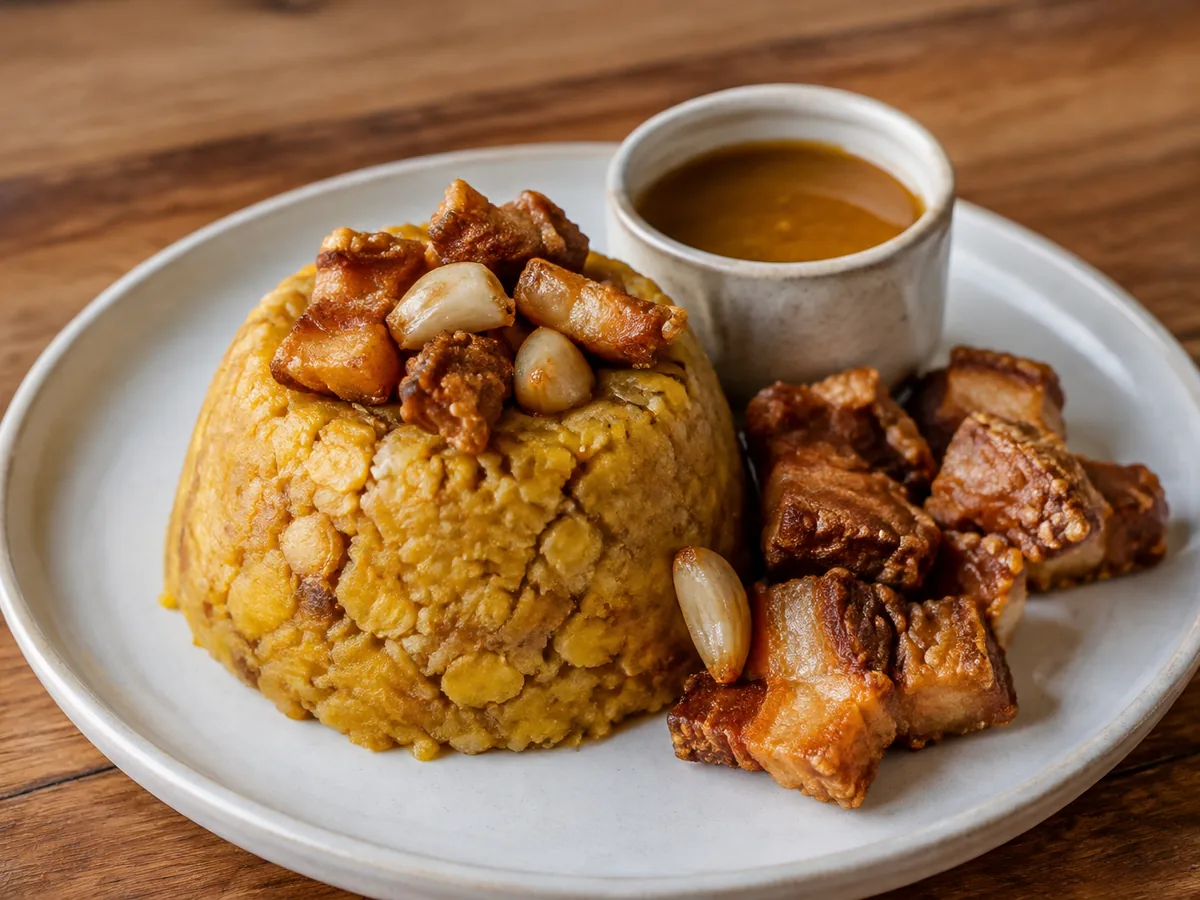
Mofongo has roots across the Greater Antilles, but the Dominican version became its own nocturnal institution — mastered in the Cibao valley, in Moca and Santiago de los Caballeros, and eaten late across Santo Domingo.
Unlike versions built on soft or boiled plantain, Dominican mofongo wants green plantains fried until golden and firm, then pounded with force inside a heavy wooden pilón carved from guayacán or oak. The star is artisanal chicharrón de cerdo — thick pork belly with brittle skin and unctuous meat both.
As the pestle falls, the hot plantain starch takes up the rendered pork fat and the garlic paste, and the result is a structured, coarse-grained dome, crisp at the edges and tender inside, always with a cup of hot chicken and garlic broth beside it.
The dome
- 900 g4 largeGreen plantains, peeled and cut into 2.5 cm rounds
- 450 g1 lbChicharrón de cerdo con carne — pork belly fried crisp, skin and meat both, chopped into rough 1.2 cm pieces
- 30 g8 clovesRaw garlic, peeled and crushed
- 25 g6 clovesRoasted garlic, softened in foil with oil
- 45 ml3 TbspPork lard (manteca de cerdo) or extra-virgin olive oil, melted and warm
- 12 g2 tspCoarse sea salt
- 750 ml3 cupsFresh neutral corn or peanut oil, for deep frying
Broth and finish
- 750 ml3 cupsRich chicken stock simmered with garlic, recao and salt, piping hot
- 10 g2 TbspFresh culantro or cilantro leaves, minced very fine
- 2 limes2 limesFresh limes, quartered
Fry them tender, not brown
165 °C gelatinises the amylose and amylopectin inside without building a hard surface crust. The rounds must be cooked through and pliable but still pale — a browned shell will not break down under the pestle.
Straight from the oil into the pilón
The interior starch needs to be around 90 °C when the pestle hits it. Hot pork fat and cracklings then coat the free amylose being released, so it binds as a coarse crumb rather than fusing into a rubbery solid.
Never a food processor
Blades shear the starch into a sticky glue. It has to be a mortar, with firm percussive vertical strokes.
Two kinds of garlic
Raw garlic alone turns aggressive and bitter. Raw for the punch, roasted for caramelised sweetness, pounded together with coarse salt and warm lard to mellow the allicin.
Two or three spoonfuls of stock per portion
That is the precise free water needed to keep the plantain fibres moist without dissolving them into mush.
It cannot be made ahead
The moment it cools the starch retrogrades and dries out. Fry the plantains and hold them at 95 °C for up to 15 minutes, then pound each portion as people sit down.
The five tastes on this plate
Salt is coarse salt pounded into the garlic paste and through the plantain. Fat is rendered pork lard carrying the allicin and coating dry starch granules. Acid is lime squeezed over the dome and into the caldo at the table. Heat is raw crushed garlic against mellow roasted garlic. Umami is pork cracklings, chicken collagen in the broth, and fried plantain sugars.
Equipment
- Heavy wooden pilón with a wooden pestle, or a granite molcajete
- Deep Dutch oven or caldero, for frying
- Oil thermometer
- Small saucepan, for the broth
- Small round bowl, for moulding
Traditionally a deep pilón de guayacán — dense lignum vitae — with a heavy wooden mano, and a cast-aluminium caldero for frying. A large granite molcajete or sturdy wooden mortar works in a modern kitchen. What does not work is any powered blade.
Method
Pound the garlic paste6 min
In the bottom of the pilón, pound the raw crushed garlic, the soft roasted garlic and 12 g coarse salt to a smooth, fragrant paste.
Work in the 45 ml warm melted lard to make an aromatic garlic emulsion, then divide it into four portions.
Pound raw and roasted garlic with 12 g coarse salt in a pilón until smooth. Work in 45 ml warm melted lard, then divide the paste into four portions.
Hold the broth hot5 min
Bring the 750 ml chicken stock to a gentle simmer with a crushed garlic clove and a culantro leaf.
Keep it covered on low at 82 °C / 180 °F so it is piping hot for both assembly and service.
Bring 750 ml chicken stock to a gentle simmer with a crushed garlic clove and a culantro leaf. Keep covered over low heat at 82°C / 180°F for assembly and serving.
Fry the plantain rounds12 min
Heat the 750 ml oil to 165 °C / 325 °F and fry the plantain rounds in two batches, 5 to 6 minutes, turning occasionally.
They must be completely tender to a knife tip but still pale yellow — no browning, no hard shell.
Heat 750 ml oil to 165°C / 325°F. Fry plantain rounds in two batches for 5–6 minutes, turning occasionally, until completely knife-tender but pale yellow, without browning or a hard shell.
Pound the first portion3 min
Work one portion at a time. Take about 6 or 7 hot rounds straight from the oil into the pilón with one portion of garlic paste.
Pound with firm vertical strokes until the plantain breaks into coarse, crumbly morsels.
Transfer 6 or 7 hot rounds straight from the oil into the pilón with one portion of garlic paste. Pound vertically into coarse crumbs; use a mortar, never a food processor.
Work in the chicharrón2 min
Add 100 g chopped chicharrón and 1 tsp minced cilantro, and keep pounding until the cracklings shatter and disperse through the plantain.
Drizzle in 30 ml of the simmering stock and pound 3 or 4 more times, until the mass is cohesive, warm and malleable.
Pound in 100 g chopped chicharrón and 1 tsp minced cilantro until evenly dispersed. Drizzle in 30 ml hot stock and pound 3 or 4 more times until cohesive, warm and malleable.
Mould and invert1 min
Oil a small round bowl, pack the mofongo in firmly, and invert the dome onto a warm plate.
Or leave it nested in a small wooden pilón for rustic service.
Oil a small round bowl, pack the mofongo firmly inside and invert onto a warm plate. Alternatively, serve it directly in a small wooden pilón.
Repeat, fast6 min
Work quickly through the remaining three portions while the fried plantains are still piping hot.
Repeat quickly for the remaining three portions while the plantains are still piping hot.
Serve
Crown each dome with reserved chicharrón shards and fresh cilantro.
Serve immediately with a small cup of steaming chicken broth and lime wedges.
Top each dome with the reserved chicharrón shards and fresh cilantro. Serve immediately with a small cup of steaming chicken broth and lime wedges.
Sensory cues of doneness
- Visual: a golden-amber textured dome studded with dark mahogany shards of pork skin, flecked green and ivory, beside a glossy cup of steaming broth.
- Auditory: the dull rhythmic thud of the pestle, and distinct cracking as crisp pork is crushed into the hot plantain.
- Olfactory: crushed raw garlic, roasted garlic paste, rendered cracklings and hot fried plantain starch.
Look for a textured golden-amber dome with dark pork-skin shards and green and ivory flecks beside steaming broth. Listen for the pestle thudding and cracklings snapping; smell raw and roasted garlic, pork and fried plantain.
Troubleshooting
- Bone-dry, crumbly mofongo.
No hot stock or fat went in, or the plantains cooled before pounding. Mash them scorching hot and beat in 2 to 3 tablespoons of hot stock and lard per portion.
- Greasy, gummy, rubbery mofongo.
A food processor was used, or the oil ran cold and the plantains drank it. Manual pilón only, and hold the oil at 165 °C.
- Aggressive, bitter garlic.
Only raw garlic was used. Combine raw with roasted, and pound thoroughly with coarse salt and warm lard.
Substitutions
One-to-one global substitutions, with the technique adjustment each one requires.
Ingredient substitutions
| Ingredient | Replace with | Culinary impact and technique adjustment |
|---|---|---|
| Chicharrón de cerdo | Crisp skin-on roasted pork belly, or carnitas with crisp skin | Must have both crunchy skin and moist savoury meat |
| Pork lard | Extra-virgin olive oil or rendered duck fat | Olive oil is common in coastal seafood mofongos; duck fat is exceptionally rich |
| Green plantains | Half green and half ripe sweet plantain | Gives mofongo mixto, a popular sweet-savoury variation |
Scaling
Half, for 2 servings
Halve everything and pound the two portions one after the other. Keep the stock at 500 ml so there is enough for dipping.
Double, for 8 servings
Double everything, but never mash eight plantains in one mortar. Fry in batches and pound one or two portions at a time to hold the temperature.
What to serve it with
- Tazas de caldo — cups of hot garlic chicken broth, for dipping
- Extra chicharrón, lime wedges, and mayoketchup
- Ice-cold Presidente, or a Cuba Libre with Dominican dark rum
Questions
Can I use bacon instead of chicharrón?
Bacon is too thin, salty and smoky, and it distorts the dish. If Dominican chicharrón is unavailable, roast or fry fresh skin-on pork belly until the rind is brittle and the meat tender, or buy good commercial cracklings.
What is mofongo de camarones?
The same fried plantain base, topped with shrimp simmered in a Dominican criollo sauce of tomato, garlic, bell pepper and white wine, instead of or alongside the chicharrón.
Can I make mofongo ahead for a dinner party?
No — it is à la minute. As it cools the starch retrogrades and dries. Fry the plantains and hold them in a 95 °C oven for up to 15 minutes, then pound each portion fresh as guests sit down.