Chivo Liniero
In the semi-arid Línea Noroeste the creole goats graze on wild orégano poleo, so the meat is seasoned before it is ever cooked. Washed with bitter orange, marinated in a fistful of that same oregano, seared in caramelised cane sugar, deglazed with aged dark rum, and braised slow with a whole scotch bonnet floating in it.
- Prep
- 40 min
- Cook
- 1 hr 45 min
- Serves
- 6 to 8 servings
- Difficulty
- Medium
Researched · Kitchen testing pending
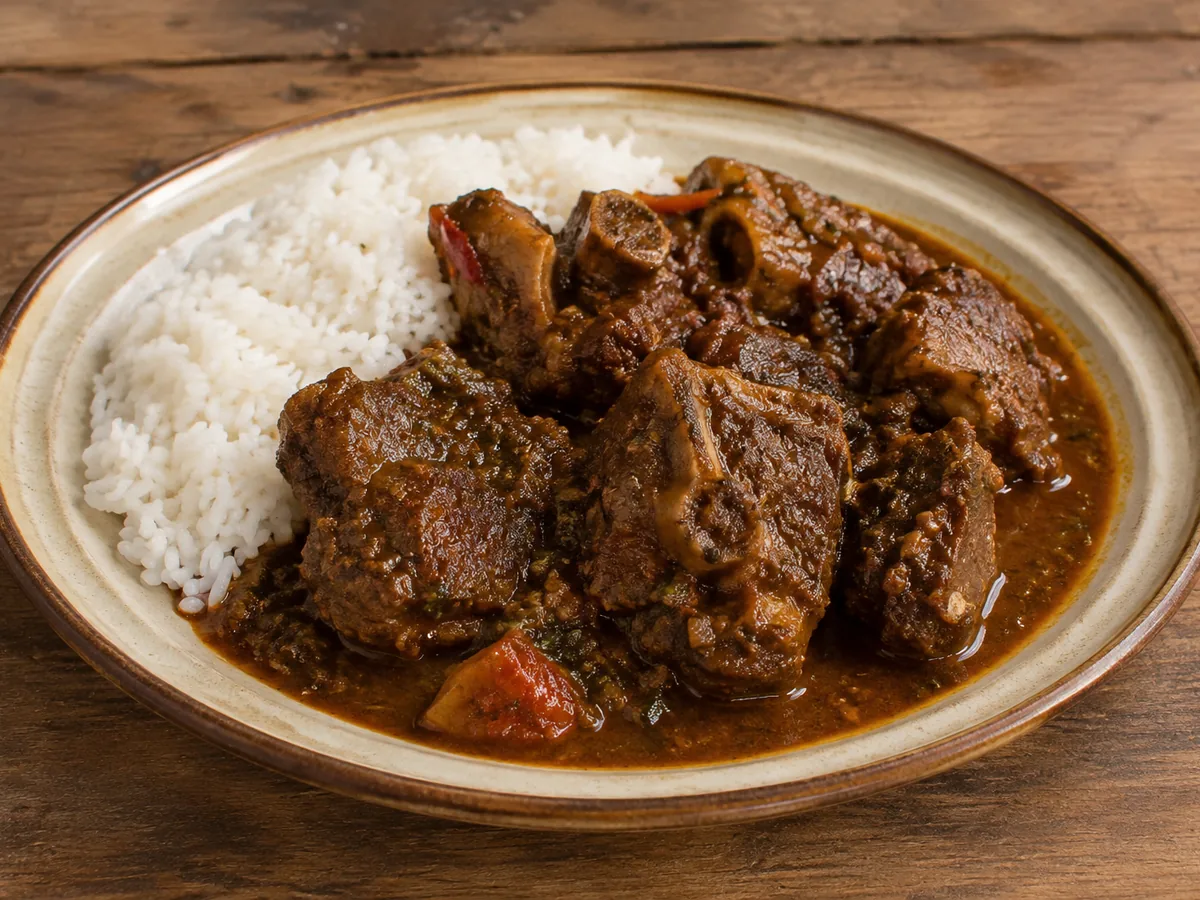
In the semi-arid, cactus-dotted plains of the Línea Noroeste — Montecristi, Dajabón, Mao, Santiago Rodríguez — herds of creole goats graze on aromatic wild shrubs, mostly orégano poleo and bayahonda pods. That foraging seasons the meat while the animal is still alive, and it is where chivo liniero gets its herbal character.
To make it properly the goat is washed with Seville bitter oranges, marinated with a fistful of wild oregano and ajíes gustosos, seared in smoking oil with caramelised cane sugar, deglazed with aged dark rum, and braised at a lazy simmer until the dense collagen softens.
What comes out is a succulent, glossy ragout with a whisper of scotch bonnet behind it — the epicurean treasure of Dominican countryside cooking.
Goat and marinade
- 1.8 kg4 lbBone-in goat shoulder and leg, cut into 4 cm chunks, trimmed of excess exterior fat
- 120 ml½ cupSeville sour orange juice (naranja agria) or fresh lime juicedivided between the wash and the marinade
- 15 g2 TbspWild Dominican oregano (orégano poleo seco), lightly toasted in a dry pan and crushed to powder
- 40 g10 clovesGarlic, mashed to a paste with coarse salt
- 120 ml½ cupAged dark Dominican rumhalf into the marinade, half to deglaze
- 18 g1 TbspCoarse sea salt
- 4 g1 tspFreshly cracked black pepper, medium grind
Sofrito and braise
- 200 g1 largeRed onion, finely dicedhalf into the marinade, half into the sofrito
- 30 g6 peppersAjí gustoso peppers, seeded and minced fine
- 1 whole1 wholeScotch bonnet pepper (ají chombo), stemmed, left whole
- 120 g1 mediumCubanelle or green bell pepper, cut into 1 cm dice
- 15 g4 leavesFresh culantro (recao), chopped fine
- 45 g3 TbspDouble-concentrated tomato paste
- 25 g2 TbspGranulated cane sugar, for the caramel
- 45 ml3 TbspNeutral vegetable or corn oil
- 750 ml3 cupsHot water or rich beef stockadded in two stages
Why the citrus wash matters
Mature goat carries branched-chain fatty acids — 4-methyloctanoic and 4-methylnonanoic — that make the characteristic buck aroma. Washing and marinating in bitter orange neutralises those volatile amines at the surface. Skip it and the whole pot tastes wild.
The oregano is not Mediterranean oregano
Orégano poleo is *Lippia micromera*, a verbena rather than a mint. Its thymol and carvacrol are concentrated enough that a teaspoon carries about three times the aromatic power of Greek oregano, and those compounds bind with the hydrolysing collagen as it braises.
Leave the scotch bonnet whole
Floated intact it gives floral, fruity aroma without releasing its seeds. Pierce or burst it and the sauce becomes inedible. Fish it out before serving.
Rum goes in twice, for two reasons
In the marinade, alcohol-soluble herb compounds penetrate the protein. In the pan, it lifts the caramelised fond and deposits oak vanillin and molasses solids into the gravy.
Keep the bones in
Goat is very lean. The marrow and connective tissue hydrolyse into gelatin that bastes the meat continuously through the braise.
Passive time, counted separately
The goat marinates at least 1 to 2 hours, and up to 6 refrigerated. That sits outside the times quoted above.
The five tastes on this plate
Salt is massaged into the fibres with the citrus, drawing juices into a savoury base. Fat is rendered goat fat and oil carrying the oregano's carvacrol. Acid is bitter orange, stripping the gamey notes and tenderising. Heat is scotch bonnet, garlic, black pepper and ají gustoso. Umami is caramelised muscle, marrow, tomato paste and rum-barrel oak.
Equipment
- Colander
- Large non-reactive bowl
- 6 to 8 qt enamelled cast-iron Dutch oven with a heavy lid
- Long tongs and a wooden spoon
- Instant-read thermometer
Traditionally a heavy cast-aluminium caldero with a fitted lid over gas or charcoal. A 6-to-8-quart enamelled cast-iron Dutch oven works in a modern kitchen — the heavy lid is what seals the steam in and keeps very lean goat from drying out over an hour and a quarter.
Method
Wash the goat6 min
Put the goat into a colander and pour 60 ml bitter orange juice and cold water over it, rubbing the cut bone to remove bone dust and excess tallow.
Drain thoroughly and pat dry.
Put the goat in a colander; rub with 60 ml sour orange juice and cold water, clearing bone dust and excess tallow from cut surfaces. Drain and pat dry.
Season and marinate10 min
In a large non-reactive bowl, rub the goat hard with the remaining 60 ml bitter orange, the garlic paste, 12 g crushed oregano, 12 g salt, the black pepper, half the diced onion, the minced ají gustoso and 60 ml dark rum.
Cover and marinate at room temperature at least 1 hour, or refrigerate up to 6 for deeper herbal penetration.
Combine goat with the remaining 60 ml juice, garlic paste, 12 g crushed oregano, 12 g salt, pepper, half the onion, minced ají gustoso and 60 ml rum. Cover; marinate at least 1 hour at room temperature or refrigerate up to 6 hours.
Caramelise the sugar4 min
Set the Dutch oven over medium-high heat with 45 ml oil and sprinkle in the 25 g cane sugar.
Let it melt and foam into a vigorous, bubbling dark mahogany caramel.
Heat 45 ml oil and 25 g sugar in a heavy pot over medium-high heat. Let the sugar melt and bubble vigorously until the caramel is dark mahogany.
Sear and glaze10 min
Drop the goat into the foaming caramel in a single layer with tongs, shaking off loose onion — keep the marinade.
Stir continuously 8 to 10 minutes over high heat. The meat releases its juices, takes up the caramel and turns glossy deep bronze.
Shake loose onion from the goat, reserving all marinade. Place meat in one layer in the caramel; stir over high heat for 8–10 minutes until coated in a glossy bronze glaze.
Deglaze with rum2 min
Pour the remaining 60 ml rum over the sizzling goat.
Let it boil furiously for 60 seconds, scraping the fond off the bottom with a wooden spoon.
Pour the remaining 60 ml rum over the sizzling goat. Boil for 60 seconds, scraping the browned deposits from the bottom with a wooden spoon.
Sofrito and aromatics4 min
Stir in the remaining onion, the Cubanelle, the culantro, the tomato paste, the whole scotch bonnet and the last 3 g of oregano.
Sauté 4 minutes until the vegetables soften and the tomato paste darkens.
Add the remaining onion, Cubanelle pepper, culantro, tomato paste, whole Scotch bonnet and remaining 3 g oregano. Sauté 4 minutes until the vegetables soften and the paste darkens; keep the hot pepper intact.
Braise low and slow1 hr 15 min
Pour in 500 ml hot water or stock plus the reserved marinade, and bring to a rolling boil.
Turn to low, cover tightly, and braise 1 hour 15 minutes, stirring every 20 minutes and adding the remaining 250 ml if it reduces too fast.
Add 500 ml hot water or stock and the reserved marinade; bring to a rolling boil. Cover tightly and simmer on low for 1 hour 15 minutes, stirring every 20 minutes. Add the remaining 250 ml liquid if drying too quickly.
Reduce15 min
Uncover. The meat should yield effortlessly to a fork at 85–90 °C / 185–194 °F.
Simmer uncovered over medium-low 10 to 15 minutes, until the juices reduce to a thick, velvety mahogany gravy that heavily coats a spoon. Adjust salt.
Check that the goat yields to a fork and reaches 85–90°C / 185–194°F. Uncover and simmer over medium-low heat for 10–15 minutes until the mahogany gravy coats a spoon. Adjust salt.
Serve
Fish out and discard the whole scotch bonnet.
Spoon the goat and its oregano-scented gravy over hot white rice, with boiled yuca in mojo and golden tostones alongside.
Remove and discard the whole Scotch bonnet without breaking it. Serve the goat and its thick gravy hot with rice, yuca con mojo and tostones.
Sensory cues of doneness
- Visual: a deep glossy mahogany-red stew, bone-in morsels coated in an unctuous reduction, flecked with green oregano and red pepper.
- Auditory: a violent crackling hiss as cold meat meets the foaming sugar, then an explosive sizzle as the rum hits, settling to a mellow simmer.
- Olfactory: wild mountain oregano, caramelised cane sugar, aged dark rum, roasted garlic and earthy braised meat.
Look for glossy mahogany-red meat and bones with oregano and red pepper. The caramel and rum sizzle should settle to a gentle simmer; the finished aroma combines oregano, caramel, rum, garlic and earthy goat.
Troubleshooting
- An unpleasantly pungent, buckish flavour.
The citrus wash was skipped, the meat was from an older animal, or the oregano marination was cut short. Wash with bitter orange, ask for young goat, and use real orégano poleo.
- Tough, stringy, dry meat.
It boiled too hard, or the meat was cut off the bone. Keep a gentle 88–92 °C simmer under a sealed lid, and leave the bones in.
- An inedibly fiery sauce.
The scotch bonnet was pierced or burst. Float it whole and discard it before serving.
Substitutions
One-to-one global substitutions, with the technique adjustment each one requires.
Ingredient substitutions
| Ingredient | Replace with | Culinary impact and technique adjustment |
|---|---|---|
| Bone-in goat | Bone-in lamb shoulder, or beef shank or short ribs | Lamb shoulder is closest in richness and collagen density |
| Orégano poleo | Mexican oregano (Lippia graveolens) | Same Lippia genus, same intense earthy carvacrol |
| Dominican dark rum | Any aged Caribbean dark rum | Molasses, vanilla and oak, without artificial flavouring |
Scaling
Half, for 3 to 4 servings
Halve everything, but braise about 1 hour 25 minutes so the collagen still breaks down fully, and keep one whole unpierced scotch bonnet for aromatic balance.
Double, for 12 to 16 servings
Double the ingredients in a wide 12-to-14-quart caldero and sear in two batches. Raise the liquid only to 1200 ml, not double, or the braise turns watery.
What to serve it with
- Arroz blanco, or moro de habichuelas negras
- Yuca con mojo — boiled cassava under garlicky red onion — and crisp tostones
- Aged Dominican rum over a large rock with an orange twist, or ice-cold Presidente
Questions
How is Dominican wild oregano different from Mediterranean oregano?
Orégano poleo is *Lippia micromera*, in the verbena family rather than the mint family. Its terpene profile is far more concentrated in thymol and carvacrol — roughly three times the aromatic power of Greek or Italian oregano by weight.
Can I make this with lamb or beef?
Yes. Lamb shoulder is the closest equivalent in fat structure and richness; bone-in beef shank or chuck also gives an excellent braise with the identical oregano-and-rum technique.
Why is the rum added twice?
The first addition, in the marinade, carries alcohol-soluble herb compounds deep into the meat. The second deglazes the caramelised fond and deposits toasted oak sugars and esters into the gravy.