Pescado Frito al Estilo Boca Chica
A whole red snapper, diamond-scored at 45 degrees right down to the spine so 185 °C oil can circulate around the bone, dusted in a paper-thin veil of flour — never a batter — and submerged whole. The fins and tail come out as edible chips; the flesh inside stays pearlescent.
- Prep
- 20 min
- Cook
- 15 min
- Serves
- 2 generous servings, or 4 tasting portions
- Difficulty
- Medium
Researched · Kitchen testing pending
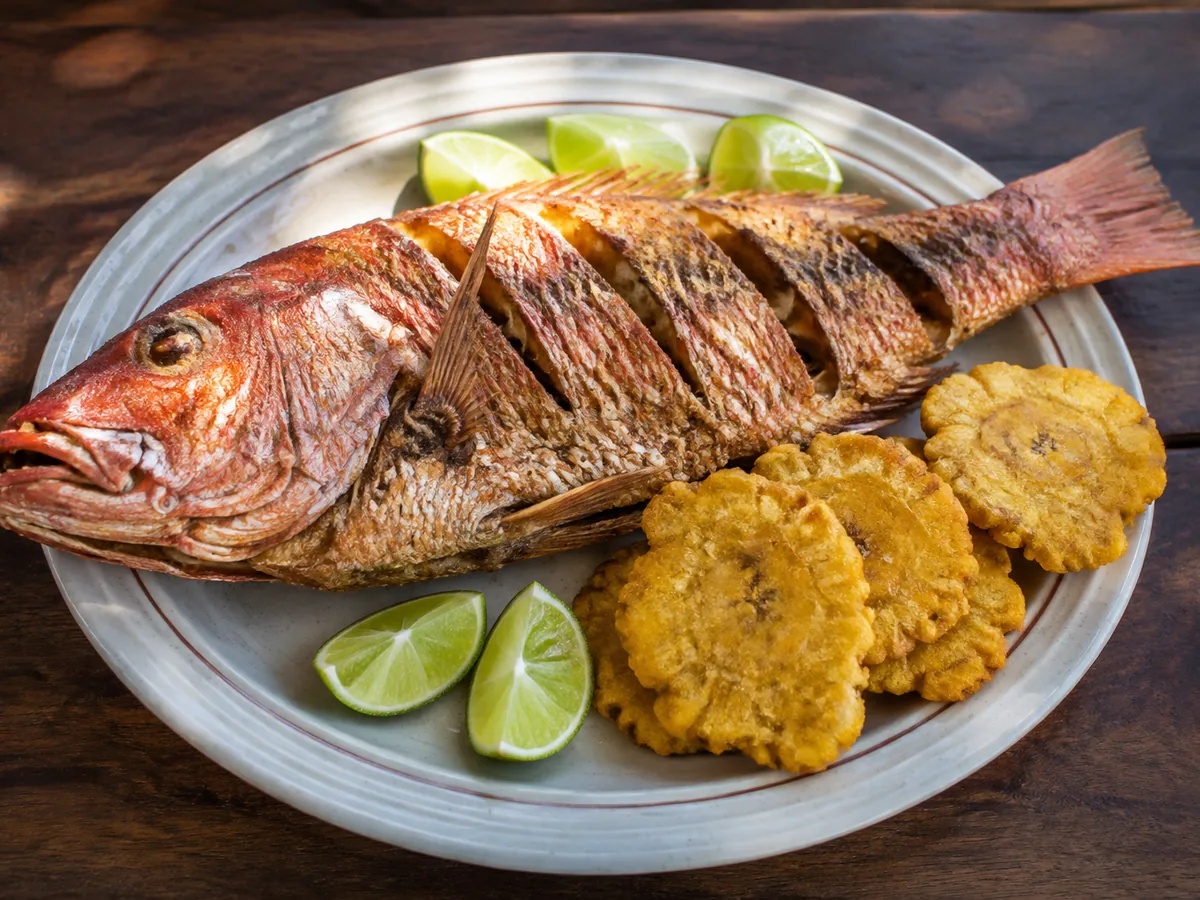
On the white sand of Boca Chica, just east of Santo Domingo, open-air wooden frituras have been running the same seafood ritual for over a century.
A whole fresh red snapper is deeply scored in diamond cross-hatching down to the spine, rubbed hard with crushed garlic, sea salt, black pepper and wild Dominican oregano, dusted in flour, and lowered whole into a caldero of bubbling oil. The scoring lets boiling oil crisp the skin and fins into brittle edible chips while the interior flakes stay moist.
It arrives on paper-lined platters under the palms, flanked by tostones, lime wedges and avocado — Dominican coastal cooking at its most direct.
The fish
- 1.2 kg2 fish, about 1.3 lb eachWhole fresh red snapper (chillo / pargo rojo), scaled, gutted, gills removed, rinsed and dried
- 30 g8 clovesGarlic, crushed to a smooth paste with coarse salt
- 45 ml3 TbspFresh lime juice
- 6 g2 tspWild Dominican oregano (orégano poleo seco), crushed to powder
- 15 g1 TbspCoarse sea saltdivided between the paste and the dredge
- 3 g1 tspFreshly ground black pepper, medium grind
- 120 g1 cupAll-purpose wheat flour or cornstarch, for a light dredge
- 1.5 L6 cupsNeutral corn, canola or peanut oil, for deep submersion frying
To serve
- 450 g2 plantainsGreen plantains, peeled and cut into 2.5 cm rounds, fried and smashed into tostones
- 2 whole2 limesFresh limes, cut into wedges
The scoring is the whole technique
Diamond cross-hatching at 45 degrees, an inch apart, cut down until the blade clicks against the vertebrae. It multiplies the surface area, lets moisture escape from the dense muscle, and gives 185 °C oil channels to circulate around the bone. Without it the spine stays raw while the outside burns.
A veil of flour, not a batter
The thin dusting is a sacrificial starch barrier: it absorbs surface water and dehydrates and dextrinises into a micro-blistered crust that reveals the snapper skin rather than hiding it. Shake the fish by the tail to lose every excess grain.
Do not touch it for five minutes
The skin sticks and tears if the oil is under 170 °C or if the fish is nudged before a rigid starch crust has formed.
One fish at a time
Two cold fish in a domestic caldero drops the oil temperature off a cliff and the result is greasy rather than brittle.
Rack, never paper
Drain on a wire rack over a tray. Flat paper towels trap steam and soften the underside.
Passive time, counted separately
The seasoned fish sits 15 minutes at room temperature before frying. That sits outside the times quoted above.
The five tastes on this plate
Salt is massaged deep into the incisions and seasoned into the dredge. Fat is clean neutral oil rendering the skin lipids into crackling. Acid is lime squeezed over the hot fish at the table. Heat is crushed garlic, cracked pepper, and scotch bonnet vinegar if you want it. Umami is fried fish skin, marrow along the spine and clean snapper meat.
Equipment
- Sharp chef's or boning knife
- Wide deep caldero, oval fish fryer or 7 qt Dutch oven
- Deep-fry thermometer
- Two wide metal spatulas, or a spider and tongs
- Wire rack over a baking sheet
Traditionally a deep cast-aluminium caldero hondo wide enough to take a whole fish without bending the tail, over a high-output propane burner. A 14-inch carbon-steel wok, an oval fish fryer or a 7-quart Dutch oven with at least 8 cm of oil works in a modern kitchen, with an accurate thermometer.
Method
Score the fish8 min
Pat the snappers completely dry, skin and cavity.
With a sharp knife at 45 degrees, make 3 or 4 deep diagonal incisions across the flank, cutting until the blade hits the backbone. Repeat in the opposite direction for a diamond cross-hatch, then do the other side of each fish.
Pat the snappers completely dry, skin and cavity. With a sharp knife at 45 degrees, make 3 or 4 deep diagonal cuts across each flank down to the backbone, then repeat in the opposite direction for a diamond pattern; do both sides of each fish.
Season deeply5 min
Mix the garlic paste, 45 ml lime juice, 6 g oregano, 10 g sea salt and the black pepper.
Rub it with your fingers into every diamond cut, into the head cavity and inside the belly, and leave the fish 15 minutes at room temperature.
Mix garlic paste, 45 ml lime juice, 6 g oregano, 10 g sea salt and the black pepper. Rub into every cut, the head cavity and the belly. Leave 15 minutes at room temperature.
Heat the oil8 min
Pour the 1.5 litres of oil into the caldero to a depth of at least 8 cm and bring it to exactly 185 °C / 365 °F.
Pour the 1.5 litres oil into the caldero, at least 8 cm deep, and heat to 185 °C / 365 °F.
Dredge2 min
Season the 120 g flour with 5 g salt in a shallow dish.
Dust one fish on both sides and inside, then shake it vigorously by the tail until only a paper-thin veil remains.
Season 120 g flour with 5 g salt in a shallow dish. Dust one fish inside and out, then shake it vigorously by the tail until only a thin veil of flour remains.
Fry the first side7 min
Holding it by the tail, slide the fish into the oil away from you. It will boil up violently.
Fry undisturbed 6 to 7 minutes, holding the oil between 175 and 180 °C.
Holding the tail, slide the fish into the oil away from you; it will boil up hard. Fry undisturbed 6–7 minutes, keeping the oil between 175 and 180 °C.
Flip and finish6 min
Turn the fish with two wide spatulas and fry 5 to 6 minutes more, until the skin is blistered and deeply golden, the scored flesh has curled outward, and the spine reads 63 °C / 145 °F.
Turn with two wide spatulas and fry 5–6 minutes more, until the skin is blistered and deep golden, the cuts have curled open and the spine reads 63 °C / 145 °F.
Drain and repeat2 min
Lift with a spider, let the oil drain back for 10 seconds, and set the fish on a wire rack over a tray.
Bring the oil back to temperature and repeat with the second snapper.
Lift out with a spider, drain 10 seconds and set on a wire rack over a tray. Return the oil to temperature and fry the second snapper the same way.
Serve on paper
Lay the whole snappers on platters lined with butcher paper or banana leaves.
Surround them at once with hot salted tostones, sliced avocado and an abundance of lime wedges. Hot sauce on the side.
Serve the whole fish on platters lined with butcher paper or banana leaves, with hot salted tostones, sliced avocado, plenty of lime wedges and hot sauce on the side.
Sensory cues of doneness
- Visual: golden-mahogany skin with curled paper-crisp fins and tail, and the diamond cuts opened like petals over snowy flakes.
- Auditory: a deafening roar as the fish enters the oil, settling into a rhythmic crackle as the surface water goes.
- Olfactory: toasted garlic, crisp marine skin, wild oregano, bubbling corn oil and cut lime.
Look for golden-mahogany skin, paper-crisp fins and cuts opened like petals over white flakes. The roar on entry settles into a steady crackle; smell toasted garlic, oregano and cut lime.
Troubleshooting
- The skin sticks and tears off.
The oil was under 170 °C, or the fish was moved too early. Get to 185 °C and do not touch it for the first five minutes.
- Soggy, greasy fish.
The caldero was crowded, or too much flour went on. One fish at a time, and shake off all the excess.
- Raw at the spine, burnt outside.
The scoring was too shallow. Cut until the knife clicks against the vertebrae so the oil heat can reach the bone.
Substitutions
One-to-one global substitutions, with the technique adjustment each one requires.
Ingredient substitutions
| Ingredient | Replace with | Culinary impact and technique adjustment |
|---|---|---|
| Red snapper | Black sea bass, porgy, dorada or branzino | Any whole firm white-fleshed saltwater fish scales and fries the same way |
| Orégano poleo | Mexican oregano, or Greek mountain oregano | Supplies the high-carvacrol backbone of the garlic marinade |
| Flour dredge | Cornstarch or fine rice flour | Gluten-free, and gives an even lighter, glassier crust |
Scaling
Half, for one fish
Fry a single 600 g fish, but keep the oil at 1200 ml so there is enough thermal mass for even submersion.
Double, for four fish
Scale the seasoning and plantains, and fry strictly one fish at a time — or use two calderos on separate burners. Hold finished fish on a rack in a 95 °C oven for up to 15 minutes.
What to serve it with
- Twice-fried tostones and crisp yaniqueques
- Sliced avocado, lime wedges and pickled spicy red onions
- Presidente vestida de novia, coconut water from the shell, or a Santo Libre
Questions
Can I use fillets instead of a whole fish?
You can fry fillets, but it is not Boca Chica style. The point is that the bones, head and skin insulate the white meat while the fins and tail fry into crunchy, salty delicacies.
What other fish work for this?
Yellowtail snapper, black grouper or sea bass are all excellent. Look for clear bright eyes and firm red gills.
Why flour rather than batter?
This is not a battered fish. The ultra-light dusting absorbs surface moisture and makes a wafer-thin crunch that shows off the snapper skin instead of burying it in dough.