Pastelón de Plátano Maduro
A tropical lasagna where the pasta sheets are silky mashed black-ripe plantain. Between them goes a beef picadillo with olives, capers and raisins, cooked down until it is completely dry — any free water and the whole casserole collapses into soup when you cut it — bound with beaten egg and baked under melted cheese.
- Prep
- 35 min
- Cook
- 50 min
- Serves
- 8 generous servings
- Difficulty
- Medium
Researched · Kitchen testing pending
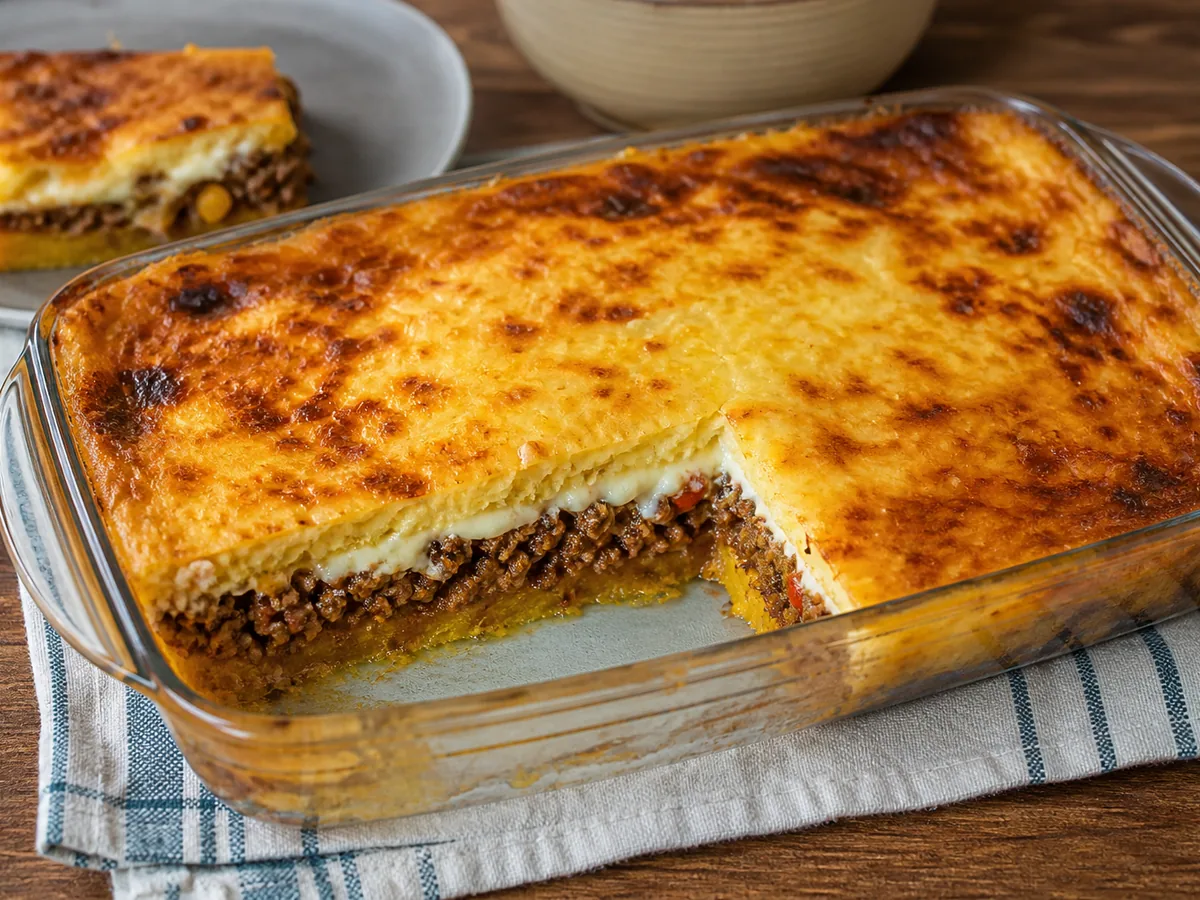
Pastelón de plátano maduro is the sweet-and-savoury centrepiece of Dominican family gatherings, Sunday reunions and Christmas Eve. It belongs to the layered casserole traditions of the Hispanic Caribbean, and gets compared to a tropical lasagna in which the pasta sheets are silky mashed yellow plantain.
The filling is a classic picadillo de carne — ground beef browned with a sofrito of onion, garlic and sweet pepper, simmered with tomato paste, briny green olives, capers and dark raisins.
Layered with melting Dominican gouda and baked until it bubbles, it balances the caramelised fruit sugar of the ripe plantain against the savoury, acidic, briny punch of the beef.
Plantain layers
- 1.8 kg6 largeVery ripe plantains, skins heavily mottled with black, peeled and cut into 5 cm chunks
- 60 g4 TbspUnsalted butter, softened
- 60 ml¼ cupWhole milk or heavy cream, warm
- 15 g1 TbspFine sea saltdivided between the boiling water and the picadillo
Picadillo
- 900 g2 lbLean ground beef, freshly ground chuck
- 30 ml2 TbspNeutral vegetable oil
- 150 g1 mediumRed onion, minced fine
- 100 g1 mediumCubanelle or green bell pepper, minced fine
- 25 g6 clovesGarlic, minced to a paste with salt
- 45 g3 TbspDouble-concentrated tomato paste
- 75 g½ cupPitted Spanish green olives with pimientos, chopped coarsely
- 20 g1 TbspCapers, drained and rinsed
- 60 g⅓ cupDark seedless raisins
- 4 g1 tspWild Dominican oregano (orégano poleo seco), crushed to powder
- 3 g1 tspFreshly ground black pepper
- 15 g¼ cupFresh cilantro leaves, chopped fine
Binder and top
- 3 large3 largeEggs, beaten with a pinch of salt
- 350 g3 cupsDominican queso de hoja, Gouda or mozzarella, shreddeddivided between the middle and the top
- 100 g1 cupCheddar, shredded, for the gratin
Stage 6 or 7 ripeness, no earlier
The peel must be heavily patched with black. That is the visible sign that the complex starches have enzymatically converted to fructose and sucrose. Green or pale-yellow plantain tastes starchy and faintly bitter here.
The picadillo has to be dry
Simmer it to a *seco* reduction. Free water in the meat layer turns to steam in the oven, waterlogs the plantain and makes the casserole collapse under the knife.
Egg is the structural binder
Brushed between the layers and over the top, ovalbumin denatures and coagulates above 70 °C into a protein matrix that locks the tiers into squares you can actually slice.
Keep the mash warm
Cold, stiff plantain drags and tears when you try to spread it over loose meat. Dollop spoonfuls first, then join them with an offset spatula dipped in warm water.
Passive time, counted separately
The baked casserole rests 15 minutes before slicing so the proteins and starches set. That sits outside the times quoted above, and skipping it undoes the work.
The five tastes on this plate
Salt is the plantain boil, the seasoned beef, briny alcaparrado and melting cheese. Fat is butter whipped into the mash, rendered beef fat and molten Gouda. Acid is tomato paste and pickled green olives. Heat is garlic, cracked pepper and wild oregano. Umami is seared beef, tomato glutamates, aged cheese and the plantain's own Maillard crust.
Equipment
- Large pot, for boiling
- Potato masher
- 12 in skillet, for the picadillo
- Offset spatula
- 23 × 33 cm ceramic or glass baking dish
- Pastry brush
Traditionally an aluminium caldero for the plantains and picadillo with a rectangular enamelled or Pyrex dish for baking. A 5-quart pot, a 12-inch skillet and a heavy stoneware or ceramic 23 × 33 cm dish work in a modern kitchen — heavy stoneware spreads the heat so the corners do not scorch before the middle sets.
Method
Boil and mash the plantains22 min
Bring 2.5 litres of water to a boil with 10 g salt and add the ripe plantain chunks.
Boil 15 to 18 minutes until completely soft to a fork. Drain in a colander 2 minutes so the surface steam escapes.
Mash in a wide bowl with the 60 g softened butter and 60 ml warm milk until completely smooth. Cover and keep warm.
Boil 2.5 litres water with 10 g salt; add the ripe plantain chunks and boil 15–18 minutes until fork-soft. Drain 2 minutes, then mash in a wide bowl with 60 g softened butter and 60 ml warm milk until smooth. Cover and keep warm.
Brown the picadillo11 min
Heat 30 ml oil in a 12-inch skillet over medium-high and sauté the onion, Cubanelle and garlic paste 3 minutes until fragrant.
Add the ground beef, breaking it up with a wooden spoon, and cook 6 to 8 minutes until browned.
Heat 30 ml oil in a 12-inch skillet over medium-high. Sauté onion, Cubanelle and garlic paste 3 minutes, then add the ground beef, breaking it up, and cook 6–8 minutes until browned.
Season and reduce it dry13 min
Stir in the tomato paste, olives, capers, raisins, oregano, pepper and the remaining 5 g salt, and cook 3 minutes.
Add 120 ml water, drop to medium-low, and simmer uncovered 10 minutes until the liquid has gone completely and the beef is coated in a thick glossy sauce with no runoff. Stir in the cilantro and cool slightly.
Stir in tomato paste, olives, capers, raisins, oregano, pepper and the remaining 5 g salt; cook 3 minutes. Add 120 ml water, reduce to medium-low and simmer uncovered 10 minutes until the liquid is gone and the beef is coated in a thick glossy sauce. Stir in cilantro and cool slightly.
Prepare the dish3 min
Preheat the oven to 190 °C / 375 °F and grease the base and sides of the baking dish generously with butter.
Preheat the oven to 190 °C / 375 °F. Butter the base and sides of the baking dish generously.
Layer it8 min
Spread exactly half the warm mashed plantain across the base with an offset spatula, and pour half the beaten egg over it.
Spoon the whole picadillo evenly on top, pressing it into a compact level tier, and scatter 150 g of the Gouda or mozzarella over it.
Spread half the warm mashed plantain over the base and pour half the beaten egg over it. Spoon all the picadillo on top in a compact, level layer and scatter 150 g Gouda or mozzarella over it.
Top and crust4 min
Dollop the remaining plantain across the meat and join it into a smooth blanket.
Brush the remaining beaten egg across the surface, then scatter the last 200 g of Gouda and the 100 g Cheddar over the top.
Cover with the remaining plantain, joined into a smooth layer. Brush with the remaining beaten egg, then scatter the last 200 g Gouda and the 100 g Cheddar on top.
Bake25–30 min
Bake uncovered on the centre rack 25 to 30 minutes, until the cheese has melted and is bubbling at the sides and the centre reads 74 °C / 165 °F.
Broil for the final 2 minutes for deep golden gratin blisters.
Bake uncovered on the centre rack 25–30 minutes, until the cheese bubbles at the sides and the centre reads 74 °C / 165 °F. Broil the final 2 minutes for deep golden blisters.
Rest, then cut
Rest the dish on a rack 15 minutes before slicing — this is what lets the proteins and starches set into clean rectangles.
Serve warm.
Rest on a rack 15 minutes before slicing so the layers set into clean rectangles. Serve warm.
Sensory cues of doneness
- Visual: a golden-amber top with bubbling blistered cheese patches, and a clean stratified cross-section of yellow plantain tiers against dark olive-studded beef.
- Auditory: a gentle bubbling sizzle around the edges of the dish as butter and cheese oils meet the hot ceramic.
- Olfactory: sweet roasted plantain, browned buttery cheese, savoury beef, oregano and briny olives.
Look for a golden-amber top with blistered cheese and clean yellow plantain layers against dark, olive-studded beef. Expect a gentle sizzle at the edges and the smell of sweet plantain, browned cheese, beef, oregano and olives.
Storing it
Assemble the whole casserole, cover with foil, and refrigerate up to 24 hours. Add 10 minutes to the bake so the chilled centre still reaches 74 °C / 165 °F.
Troubleshooting
- It collapses into an unsliceable soup.
The picadillo was still wet, or it was cut straight from the oven. Reduce the beef until dry, and rest the casserole at least 15 minutes.
- Bland, starchy, faintly bitter plantain.
The plantains were under-ripe. Use peels heavily speckled with black, or mostly black.
- The top plantain layer tears into the beef.
The mash went on cold and stiff. Keep it warm, dollop it in spoonfuls, and join them with a warm wet spatula.
Substitutions
One-to-one global substitutions, with the technique adjustment each one requires.
Ingredient substitutions
| Ingredient | Replace with | Culinary impact and technique adjustment |
|---|---|---|
| Ripe sweet plantains | Sweet potato (batata dulce) or roasted butternut squash | A similar sweet, dense purée to layer against the picadillo |
| Queso de hoja / queso geo | Young Dutch Gouda, Monterey Jack or whole-milk mozzarella | Melts smoothly and richly without turning greasy |
| Lean ground beef | Ground turkey, ground chicken or a plant-based picadillo | Identical technique with the sofrito, tomato paste and olives |
Scaling
Half, for 4 servings
Halve everything into a 20 cm square dish and bake 22 to 25 minutes at 190 °C.
Double, for 16 servings
Double everything into two separate 23 × 33 cm dishes rather than one very deep pan, which overcooks the edges before the centre heats through.
What to serve it with
- Ensalada verde — romaine, cucumber and tomato with a light lime vinaigrette
- White rice and sliced ripe avocado
- A chilled medium-bodied Merlot or Tempranillo, or jugo de chinola
Questions
Can I fry the plantain slices instead of boiling and mashing?
Yes — that variation is pastelón de plátano maduro en tajadas, sliced lengthwise and fried golden before layering like pasta sheets. It gives a firmer bite; the boiled-and-mashed method is the more melting one.
Why raisins in the beef?
They are the Caribbean balance. Their concentrated sweetness mirrors the sugar in the ripe plantain and plays against the salty olives and capers — the agridulce signature of the dish.
Can I assemble it ahead?
Yes. Assemble it completely, cover with foil and refrigerate up to 24 hours, then add 10 minutes to the bake.