Chicharrón de Pollo Dominicano
The premier social finger food of Santo Domingo and Santiago. Chicken chopped straight through the bone with a cleaver into 4 cm morsels, marinated in garlic, lime, dark rum and salsa china, then dredged in cornstarch rather than flour — no gluten, so the crust sets as a brittle glass film that stays crunchy for hours.
- Prep
- 25 min
- Cook
- 20 min
- Serves
- 4 to 6 servings
- Difficulty
- Medium
Researched · Kitchen testing pending
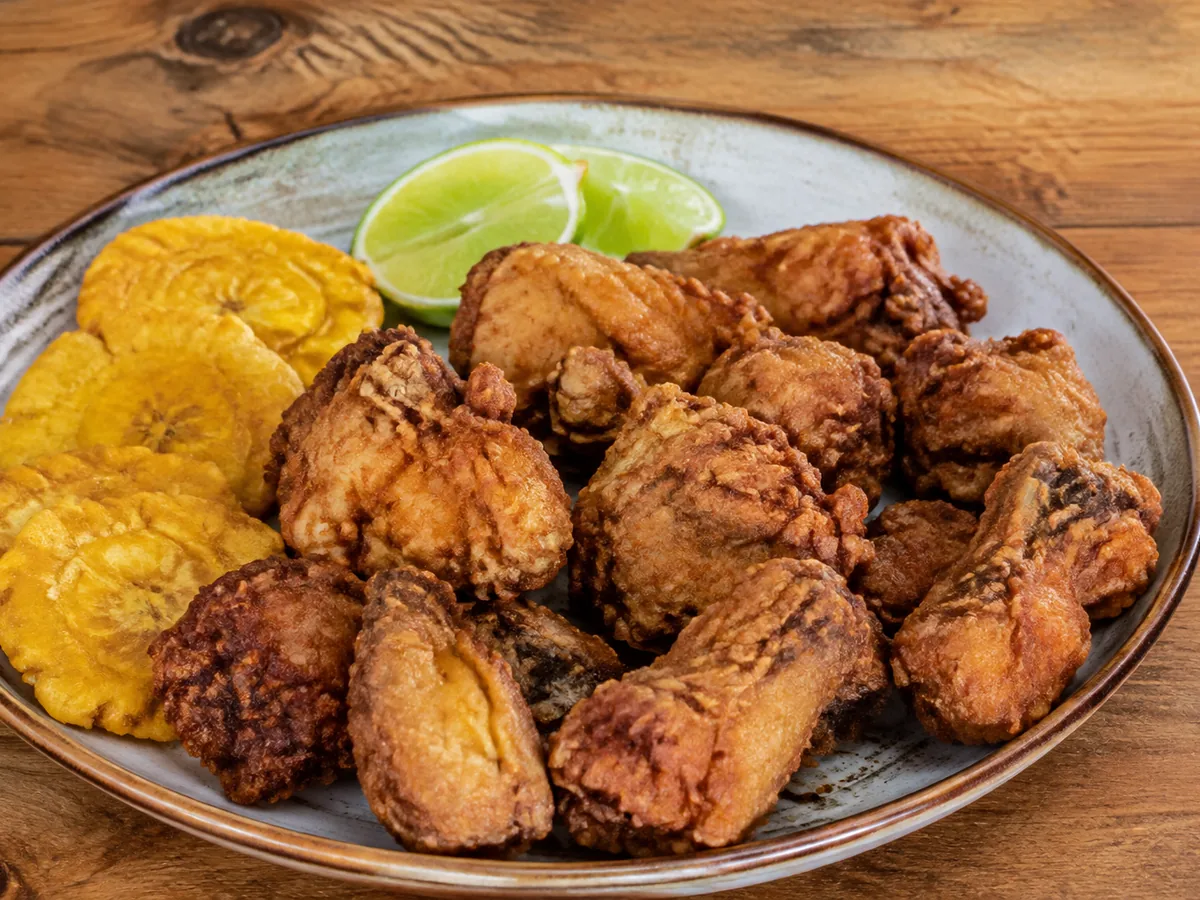
Across the roadside car-washes, bars and frituras of Santo Domingo and Santiago, chicharrón de pollo is the country’s premier social finger food.
Unlike American fried chicken, it is butchered with a heavy cleaver straight through the bones into compact 4 cm morsels. The bone and marrow stay in, and they feed savouriness back into the meat as it cooks. The chicken marinates in a punchy emulsion of garlic paste, lime, aged dark rum, wild oregano and a splash of soy sauce — salsa china, a long-standing Dominican staple.
Dredged in seasoned cornstarch rather than a heavy flour batter and fried in a smoking caldero, it comes out with a wafer-thin crust that stays crisp for hours.
Chicken and marinade
- 1.8 kg4 lbBone-in, skin-on chicken thighs and drumsticks, chopped with a cleaver into 4 cm chunks
- 60 ml¼ cupFresh lime juice
- 30 ml2 TbspAged dark Dominican rum
- 30 ml2 TbspDark soy sauce (salsa china)
- 30 g8 clovesGarlic, crushed to a smooth paste with salt
- 6 g2 tspWild Dominican oregano (orégano poleo seco), crushed to powder
- 12 g2 tspFine sea saltdivided between the marinade and the dredge
- 4 g1 tspFreshly ground black pepper, coarse grind
Dredge and fry
- 180 g1.5 cupsCornstarch (maicena)
- 45 g⅓ cupAll-purpose flour, for coating stability
- 1.2 L5 cupsFresh neutral corn or peanut oil, for deep frying
- 3 whole3 limesFresh limes, cut into wedges
Cornstarch, not flour
Cornstarch is about 25–28% amylose with zero gluten. In hot oil the granules gelatinise into a rigid, brittle three-dimensional film rather than the chewy glutenous crust wheat flour gives. That glass shell keeps the steam coming off the juicy interior from softening it. An 80/20 cornstarch-to-flour blend adds a little stability.
Cleaver cuts do real work
Cutting through the bone opens marrow canals for the acidic marinade to enter, and that marrow leaches savoury gelatin into the meat as it fries. It also means single decisive downward strokes on a hardwood block — sawing leaves dangerous splinters.
What the rum does
Ethanol carries fat-soluble garlic and herb compounds into the meat, then vaporises fast in hot oil, accelerating surface dehydration for a crisper crust.
Salsa china is authentic here
Dominican cooking has used dark soy sauce for over a century through Chinese immigrant influence. It gives glutamic depth and a rich amber colour without bouillon powder.
Rack, never paper
Drain on a wire rack over a tray. Flat paper towels trap steam and soften the starch shell within minutes.
Passive time, counted separately
The chicken marinates 30 minutes at room temperature, or up to 4 hours refrigerated. That sits outside the times quoted above.
The five tastes on this plate
Salt is sea salt and soy penetrating the meat. Fat is clean frying oil crisping the skin into crackling. Acid is lime in the marinade and squeezed over the hot chicken. Heat is garlic paste, cracked pepper, and scotch bonnet vinegar if you like. Umami is bone marrow from the cleaver cuts, dark soy, rum esters and chicken-skin Maillard.
Equipment
- Heavy cleaver and a hardwood block
- Deep 6 qt Dutch oven or caldero
- Oil thermometer
- Wide shallow pan, for dredging
- Wire strainer and a metal spider
- Wire rack over a rimmed baking sheet
Traditionally a deep cast-aluminium caldero hondo over a high-pressure gas burner, with a Chinese cleaver and a hardwood butcher block. A 6-quart enamelled cast-iron Dutch oven or a countertop fryer with good temperature recovery works in a modern kitchen — recovery is the point, because cold chicken drops the oil hard.
Method
Butcher with the cleaver12 min
On a heavy wooden block, chop the bone-in chicken into uniform 4 cm pieces with single, decisive, forceful strokes across the bones.
Wipe away any loose bone splinters with paper towels. Skin and bone both stay on.
On a hardwood board, chop the bone-in, skin-on chicken into uniform 4 cm pieces with decisive cleaver strokes. Wipe away loose bone splinters with paper towels.
Marinate6 min
Combine the chicken with the 60 ml lime juice, 30 ml rum, 30 ml dark soy, garlic paste, 6 g oregano, 8 g salt and the black pepper.
Massage it in vigorously so the marinade reaches the cut marrow, then leave 30 minutes at room temperature, or refrigerate up to 4 hours.
Mix 60 ml lime juice, 30 ml rum, 30 ml dark soy sauce, garlic paste, 6 g oregano, 8 g salt and black pepper. Massage into chicken; marinate 30 minutes at room temperature or refrigerate up to 4 hours.
Heat the oil8 min
Pour the 1.2 litres of oil into the caldero and bring it to 180 °C / 356 °F.
Heat 1.2 litres oil to 180°C / 356°F in a deep pot, checking with a thermometer before adding the chicken.
Dredge5 min
Whisk the 180 g cornstarch, 45 g flour and remaining 4 g salt in a wide shallow pan.
Lift the chicken out of the marinade in batches, shaking off the excess liquid, and toss until every crevice is coated. Shake hard in a wire strainer to lose the loose starch.
Mix 180 g cornstarch, 45 g flour and the remaining 4 g salt. Lift chicken from marinade in batches, shake off liquid, coat every crevice and shake away loose starch in a wire strainer.
Fry the first batch10 min
Lower half the pieces into the oil — it will bubble up intensely.
Fry 8 to 10 minutes, stirring occasionally with a spider so nothing sticks, holding the oil between 170 and 175 °C. Done when the crust is deep golden-amber, the skin blistered, and the meat at the bone reads 74 °C / 165 °F.
Carefully lower half the chicken into the bubbling oil. Fry 8–10 minutes, stirring occasionally with a spider and maintaining 170–175°C. Look for blistered amber-gold crust and 74°C / 165°F at the bone.
Drain and fry the second batch12 min
Transfer to a wire rack over a rimmed sheet — never flat paper towels.
Let the oil recover to 180 °C, then dredge and fry the remaining chicken the same way.
Drain on a wire rack over a rimmed tray, never directly on paper. Let the oil return to 180°C, then dredge and fry the remaining chicken the same way.
Serve at once
Pile the crackling chunks high on a wide board or platter and scatter lime wedges across it.
Serve piping hot with tostones, yuca frita and cold beer.
Serve immediately on a platter with lime wedges, tostones or yuca frita and cold beer. Keep the pieces piled loosely so the crisp crust stays dry.
Sensory cues of doneness
- Visual: a mountain of glossy deep amber-bronze chunks with micro-blistered wafer-thin skin, flecked with black pepper and oregano.
- Auditory: a bubbling roar as the cold dredged chicken goes in, then a hollow glass-like clatter when the fried pieces are shaken in a metal bowl.
- Olfactory: toasted garlic, sizzling chicken skin, evaporated rum and lime zest.
Look for glossy amber-bronze, finely blistered skin speckled with pepper and oregano. The pieces should clatter crisply after vigorous frying, with aromas of garlic, chicken skin, rum and lime.
Troubleshooting
- Jagged loose bone splinters in the pieces.
A dull blade, or sawing through the bone. Use a heavy sharp cleaver, strike once and firmly, then inspect and wipe before marinating.
- The crust falls off, or goes soggy in minutes.
The chicken was dredged soaking wet, or it was all-purpose flour. Shake off the marinade, and use the 80/20 cornstarch-to-flour blend.
- Dark outside, undercooked at the bone.
The oil was above 190 °C. Hold 170–175 °C so the heat reaches the bone before the soy-and-rum exterior burns.
Substitutions
One-to-one global substitutions, with the technique adjustment each one requires.
Ingredient substitutions
| Ingredient | Replace with | Culinary impact and technique adjustment |
|---|---|---|
| Dark soy sauce (salsa china) | Tamari, or standard Japanese dark soy | The same savoury depth and amber colour |
| Cornstarch | Tapioca starch or potato starch | Both are high in amylose and give the same glass-like crunch |
| Dominican dark rum | Any quality aged golden or dark rum | Avoid spiced rum with synthetic vanilla or cinnamon |
Scaling
Half, for 2 to 3 servings
Halve everything and fry in a single batch in 800 ml oil, holding 175 °C throughout.
Double, for 8 to 12 servings
Double everything and fry in four batches. Never put more than about 900 g of cold chicken into the caldero at once, or the oil plummets and the starch drinks it.
What to serve it with
- Hot tostones, yuca con mojo and fried sweet maduros
- Lime wedges, mayoketchup and garlic mojo for dipping
- Ice-cold Presidente in a frosted goblet, or a Cuba Libre
Questions
Can I make it with boneless breast?
You can, but it will not be true chicharrón de pollo. The marrow inside the cleaver-cut bones leaches savoury gelatin while frying and keeps the meat juicy; boneless white meat dries out fast under this method.
Why rum in the marinade?
Dark rum is a solvent. Its ethanol carries fat-soluble garlic and herb flavours into the meat, then vaporises quickly in the hot oil, speeding surface dehydration for a crisper crust.
Why soy sauce in Dominican chicken?
Salsa china has been part of Dominican home cooking for over a century through Chinese immigration to the Caribbean. It brings deep glutamic umami and a rich amber colour without artificial bouillon.