Habichuelas con Dulce
A dessert made of red kidney beans, and a Holy Week institution shared by the potful between neighbours. The beans are boiled soft, puréed, and pushed through a fine sieve until not one trace of skin remains — that straining is the whole dish — then simmered with coconut milk, evaporated milk, cinnamon, batata and raisins.
- Prep
- 30 min
- Cook
- 1 hr 30 min
- Serves
- 10 to 12 servings, about 3.5 litres
- Difficulty
- Medium
Researched · Kitchen testing pending
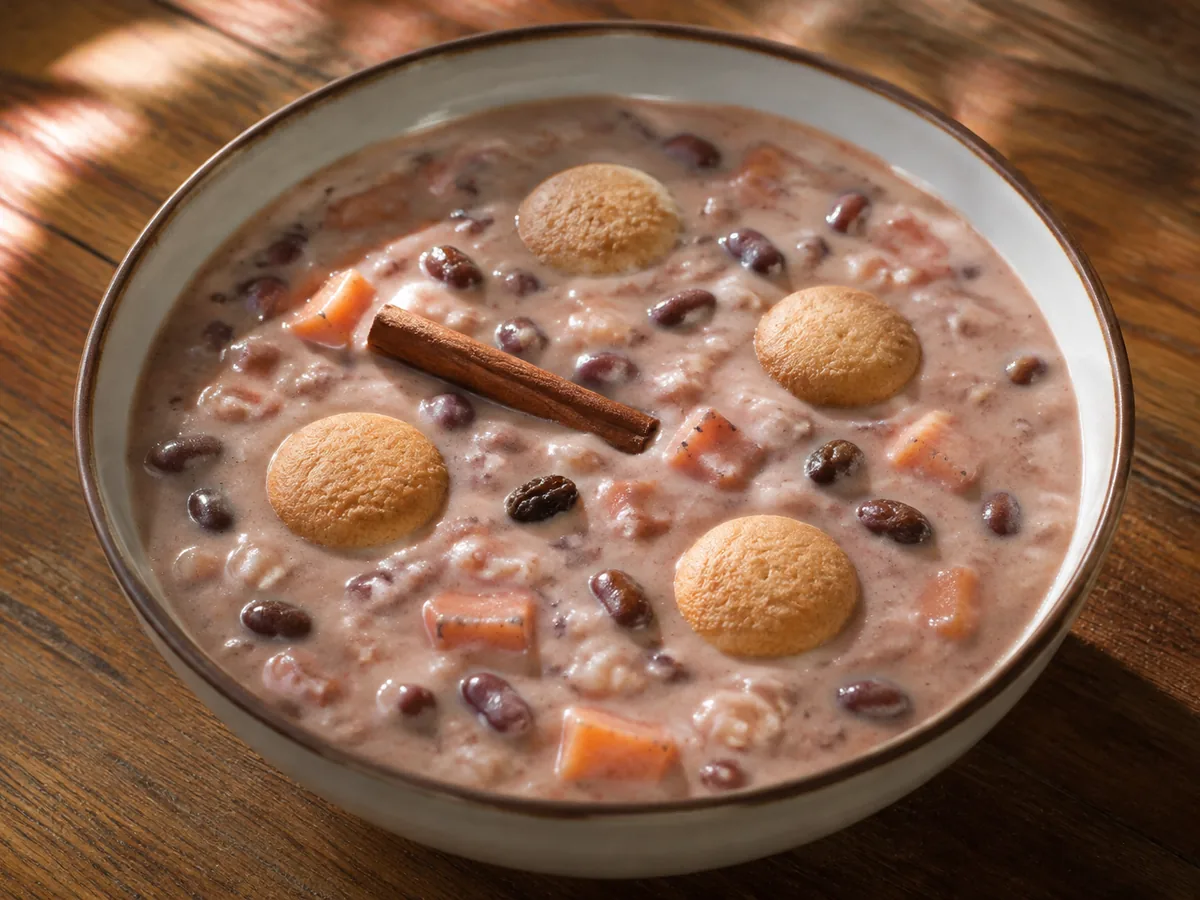
Habichuelas con dulce is a dessert unlike anything else in world cooking, and an emblem of the Dominican Republic during Lent and Holy Week. Its threads run through African bean-stewing traditions, French colonial influence from Saint-Domingue, Taíno cultivation of the native batata, and the Spanish introduction of evaporated dairy, cinnamon and cane sugar.
Dried red kidney beans are boiled until tender, puréed into a fine velvet liquor, and strained through a fine-mesh sieve to discard every trace of skin. That bean milk is then simmered with coconut milk, evaporated milk, dark brown sugar, cinnamon quills, cloves, nutmeg, sweet batata cubes and dark raisins.
Served cold or warm, always crowned with crisp cross-stamped milk cookies, it is shared by the potful between neighbours in every barrio and village in the country.
The bean milk
- 450 g1 lbDried red kidney beans, sorted, rinsed and soaked in cold water 8 hours or overnight
- 2.5 L10 cupsWater, for boiling the beans
- 3 large3 largeCinnamon sticks (Ceylon), whole quillstwo in the beans, one in the cream
- 8 whole8 wholeWhole clovesfour in the beans, four in the cream
The sweet cream
- 800 ml2 cansPure unsweetened full-fat coconut milk, shaken well
- 700 ml2 cansEvaporated whole milk, undiluted
- 400 g1 canSweetened condensed milk
- 200 g1 cup packedDark brown sugar, or grated raspadura / panela
- 6 g1 tspFine sea saltessential, not optional
- 2 g½ tspNutmeg, freshly grated
To finish
- 450 g1 lbBatata criolla or white sweet potato, peeled and cut into uniform 1.2 cm cubes
- 150 g1 cupDark seedless raisins, plump and whole
- 30 g2 TbspUnsalted butter
- 15 ml1 TbspPure vanilla extract
- 150 g1 packageGalletitas de leche con su cruz — crisp Dominican milk cookies
The straining is the dish
Dried beans hold dense starch granules inside tough cellulose seed coats. Blending breaks them down; passing the purée through a fine chinois removes every insoluble skin and leaves a suspension of bean starch and vegetable protein. Skip it and the whole thing is sandy in the mouth.
How it thickens without starch
Those bean starches act as natural hydrocolloids, taking up free water as the pot reaches 85 °C, while the batata sheds additional amylose as it simmers. There is no cornstarch or flour anywhere in it.
Stop while it is still loose
Bean starch retrogrades hard on cooling. Take the pot off the heat when the cream is a little thinner than melted ice cream; it will set into a luxurious custard by itself.
The salt is not optional
One teaspoon. Without it the earthy bean notes and heavy sugars go flat and cloying, and the cinnamon and clove lose definition.
Stir the bottom
Evaporated milk and sugar caramelise fast against the base. Go across the floor of the pot with a flat wooden paddle every 3 to 4 minutes.
Passive time, counted separately
The beans soak 8 hours or overnight, and the cooked beans cool 15 minutes before blending. Neither is active work and both sit outside the times quoted above.
The five tastes on this plate
Salt sharpens the sweetness and stops it cloying. Fat is coconut lipids and dairy butterfat. Acid is the slight natural acidity of unrefined brown sugar and plump raisins. Heat is warm aromatics — Ceylon cinnamon, clove, nutmeg and vanilla. Umami is the earthy legume protein of the strained beans.
Equipment
- 8 to 10 qt heavy Dutch oven or stockpot
- High-powered blender
- Fine-mesh sieve or chinois
- Ladle
- Flat wooden paddle
Traditionally a large cast-aluminium caldero that spreads heat evenly across the base, with a fine metal colador and a wooden paddle. An 8-to-10-quart enamelled cast-iron Dutch oven or multi-ply stainless stockpot works in a modern kitchen — the even base is what stops the dairy sugars scorching.
Method
Boil the beans1 hr 15 min
Drain the soaked beans into a large pot with 2.5 litres fresh water, 2 cinnamon sticks and 4 cloves.
Bring to a rolling boil, then cover and simmer over medium-low 1 hour to 1 hour 15 minutes, until the beans crush easily between thumb and finger. Discard the spices.
Soak the beans 8 hours or overnight, then drain. Add 2.5 litres fresh water, 2 cinnamon sticks and 4 cloves; bring to a rolling boil. Cover and simmer over medium-low 1–1¼ hours until easily crushed. Discard spices.
Purée6 min
Let the beans and their cooking water cool 15 minutes.
Working in batches, blend the beans with their hot liquid on high for 2 minutes, until completely pulverised and smooth.
Cool the beans and cooking water for 15 minutes. Blend in batches with their liquid on high for 2 minutes, until thoroughly pulverised and smooth.
El colado — the crucial straining10 min
Set a fine-mesh sieve over a clean heavy pot and pour the purée through it, pressing the liquid through with the back of a ladle.
Scrape out and discard the thick skins left behind. The liquor must be completely smooth, with no grit at all.
Pass the purée through a fine-mesh sieve into a clean heavy pot, pressing with a ladle. Discard the retained skins; the strained liquid must be completely smooth and grit-free.
Build the sweet cream6 min
Set the pot over medium heat and pour in the coconut milk, evaporated milk and condensed milk.
Add the brown sugar, the last cinnamon stick, the remaining 4 cloves, the 6 g salt and the grated nutmeg, and stir until the sugar dissolves.
Over medium heat, add coconut, evaporated and condensed milk, brown sugar, the remaining cinnamon stick and 4 cloves, 6 g salt and grated nutmeg. Stir until the sugar dissolves.
Simmer the batata30 min
Bring to a gentle, controlled simmer and add the diced batata.
Simmer uncovered over medium-low 25 to 30 minutes, stirring the bottom frequently with a flat paddle, until the cubes are tender all through but still intact.
Bring to a gentle simmer and add the 1.2 cm batata cubes. Cook uncovered over medium-low 25–30 minutes, scraping the bottom frequently with a flat paddle, until tender throughout but intact.
Raisins, butter, vanilla12 min
Stir in the raisins, the 30 g butter and the vanilla, and simmer gently 10 to 12 minutes more.
The raisins swell with the spiced milk and the cream reduces to a glossy, spoon-coating consistency. Remember it thickens a great deal more as it cools.
Add raisins, 30 g butter and vanilla; simmer gently 10–12 minutes until the raisins swell and the cream is glossy and coats a spoon. Stop while still loose: it thickens substantially as it cools.
Rest and serve
Off the heat, discard the cinnamon and cloves, and adjust the sweetness or salt.
Serve warm, at room temperature, or chilled — many Dominicans insist it is best ice-cold the next day. Ladle into wide bowls or glass goblets, making sure each gets batata and raisins, and float four or five galletitas de leche across the surface just before serving.
Remove from heat; discard cinnamon and cloves and adjust sweetness or salt. Serve warm, at room temperature or chilled, distributing batata and raisins evenly. Add four or five milk cookies to each bowl immediately before serving.
Sensory cues of doneness
- Visual: a silky cream in a warm rosy-terracotta, glossy and dotted with plump raisins and tender batata, heavily coating a wooden spoon.
- Auditory: a slow, deep, hypnotic plop-plop from the pot as it thickens, and cinnamon quills clinking against the walls.
- Olfactory: the Holy Week fragrance — warm cinnamon, clove, toasted coconut milk, vanilla and earthy legume.
Look for silky, glossy rosy-terracotta cream with plump raisins and tender batata, coating a wooden spoon. Listen for slow, deep bubbling; smell cinnamon, clove, coconut milk, vanilla and earthy beans.
Storing it
It keeps several days refrigerated and is widely considered better on the second day, served ice-cold. It will be much thicker straight from the fridge; loosen it with a splash of evaporated milk if you prefer.
Troubleshooting
- A gritty, sandy texture.
The straining was skipped and skins got into the pot. Every trace of cellulose has to come out through a fine-mesh sieve.
- Black burnt flecks through the cream.
The heat was too high or the pot was left alone. Gentle simmer, and stir the bottom every 3 to 4 minutes.
- It sets into a solid, unspreadable pudding.
It was reduced too far. Stop while it is slightly thinner than melted ice cream — bean starch firms up drastically as it cools.
Substitutions
One-to-one global substitutions, with the technique adjustment each one requires.
Ingredient substitutions
| Ingredient | Replace with | Culinary impact and technique adjustment |
|---|---|---|
| Batata criolla | Japanese white sweet potato (satsumaimo) or boniato | Firm, non-stringy ivory flesh that holds its shape in sweet liquid |
| Galletitas de leche | Galletas María, or animal crackers | Crisp, lightly sweet cookies that float on the cream |
| Raspadura / panela | Dark brown sugar or turbinado | Replicates the molasses and mineral notes of unprocessed cane |
Scaling
Half, about 1.75 litres
Halve everything in a 5-quart pot. The batata still simmers 25 minutes.
Double
Double everything in a 16-to-20-quart caldero, and stir vigilantly with a long paddle — a large volume of dairy sugar scorches on the base very easily.
What to serve it with
- Galletitas de leche con su cruz, plus extra batata and raisins
- Toasted casabe, the cassava flatbread
- A chilled glass of milk, or Dominican café negro
Questions
Can I use canned kidney beans?
In an emergency. Dried beans boiled from scratch give better starch and no metallic brine. If you use canned, rinse them thoroughly and simmer them in fresh water with a cinnamon stick before puréeing.
Why does a sweet dessert need salt?
Salt is a flavour potentiator. Without that teaspoon the earthy bean notes and heavy sugars taste flat and cloying, and the cinnamon and clove lose their edge.
What is habas con dulce?
In the south — San Juan de la Maguana, Barahona, Azua — white broad beans are used instead of red kidney beans, giving a paler, exceptionally creamy ivory version with identical spicing.