Sancocho de Gallina
A clear, chicken-rich broth with soft roots and sweet-starchy green plantain — hen or chicken, yuca, plantain, potato, corn on the cob and cilantro at the end. One coherent Valle-leaning pot, with the vegetables staggered so nothing turns to sludge.
- Prep
- 50 min
- Cook
- 1 hr 15 min
- Serves
- 6 generous servings
- Difficulty
- Medium
Researched · Kitchen testing pending
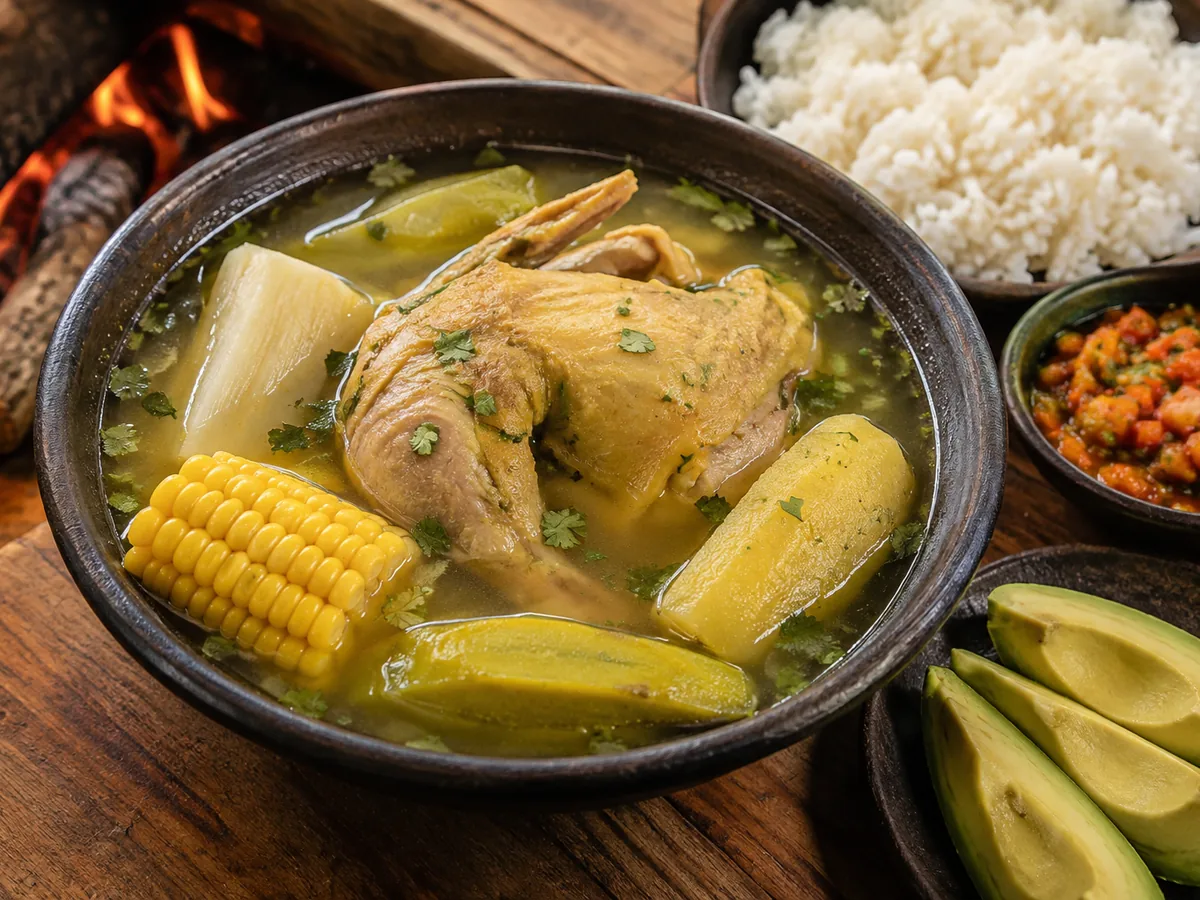
A clear, chicken-rich broth with soft roots and sweet-starchy green plantain is the whole argument of Colombian sancocho.
This is a Valle-leaning home pot: hen or chicken, yuca, green plantain, potato, corn on the cob, and cilantro at the end — one coherent bowl, not a Cuban ajiaco mash-up and not every coastal add-in at once. Stagger the vegetables so nothing turns to sludge while the bird finishes.
Ladle when the yuca yields to a knife and the chicken has cleared 74 °C / 165 °F — not when the rice still has ten minutes left. The broth can wait on a whisper of heat; the avocado cannot wait once it is cut, so slice that last.
Bird and broth base
- 1.6–1.8 kg3½–4 lbWhole chicken, cut into 8 piecesor 1.4 kg / about 3 lb bone-in thighs and drumsticks; traditionalists prefer gallina, a stewing hen, which needs a longer simmer and gives deeper broth
- 1 large1 largeWhite onion — half roughly chopped for the pot, half finely diced for the sofritoabout 250 g / 9 oz
- 4 cloves4 clovesGarlic, minced
- 22Scallions, cut into 5 cm / 2 in lengths
- 1 medium1 mediumRipe tomato, dicedabout 150 g / 5 oz; optional, but common in Valle-style pots
- 15 ml1 TbspNeutral oil
- 10 g2 tspFine sea saltplus more to taste
- 1 tsp1 tspGround cumin
- ½ tsp½ tspDried oregano, or 1 small sprig fresh
- ½ tsp½ tspGround achiote, or a pinch of annatto oiloptional, for a golden broth
- 2.5–3 L10–12 cupsCold waterenough to cover by about 3–4 cm / 1¼–1½ in
- 2 leaves2 leavesBay leaves
Roots, plantain and corn
- 450 g1 lbYuca (cassava), peeled and cut into 5 cm / 2 in chunksremove the long fibrous core
- 22Green, unripe plantains, peeled and cut into 4–5 cm / 1½–2 in piecesabout 400–450 g / 14–16 oz total
- 450 g1 lbPotatoes, peeled and halved or cut into large chunkspreferably yellow or waxy red
- 2 ears2 earsCorn, husked and cut into 3–4 rounds eachchoclo, or standard sweet corn on the cob
- 300 g10 ozÑame (yam), peeled and cut like the yucaoptional — dense and starchy, welcome when you find it
- 40 ga generous handfulCilantrostems tied in a bundle for the simmer, leaves chopped for the finish
At the table
- 300 g1½ cups rawLong-grain white rice, cooked separately
- 1–2 ripe1–2 ripeAvocados, sliced
- Ají — minced fresh chile, finely diced red onion, cilantro, lime juice and salt
- Lime wedges
- Extra cilantro leaves
Why staggered roots beat a dump-and-hope pot
Yuca and green plantain are dense and need a head start, or a long shared simmer. Potato cooks faster and collapses if it joins at minute zero with raw yuca. Corn wants enough time to perfume the broth, but not so much that the kernels turn to mealy mush. Cilantro stems can ride along for herbal depth, while the chopped leaves go in off the heat so the broth smells green rather than boiled-spinach dull.
On skimming and the cold start
Skimming early keeps the surface cleaner. A little fat is welcome and traditional — a crystal-clear consommé is not the goal, but grey foam is not flavour. Cold water at the start extracts cleaner chicken character than dropping meat into a violent boil.
On guascas
A small bunch is sometimes suggested, but that is more Bogotá ajiaco territory. Leaving them out keeps this clearly sancocho.
Equipment
- Large heavy pot, at least 6–8 L / 6–8 qt
- Instant-read thermometer
- Pot for the rice
- Fine strainer, for a cosmetic rescue if needed
- Wide serving bowls
Method
On the sofrito and bird — build the broth15–20 min
Season the chicken pieces lightly with about 1 tsp of the salt and half the cumin, and let them sit while you chop so the surface is not bland when it hits the pot.
Warm the oil in a large heavy pot over medium heat. Soften the finely diced onion 6–8 minutes with a pinch of salt until translucent and sweet, then add the garlic for 60 seconds. If using tomato, cook it 4–5 minutes until it softens and the raw edge fades — you want jammy sweetness and light acidity, not watery tomato soup.
Stir in the remaining cumin, the oregano and the optional achiote. The base should smell savoury and round. If anything scorches, splash in a spoon of water and scrape; burnt sofrito bitter-stains the whole broth.
Nestle the chicken pieces into the pot. Add the roughly chopped onion half, the scallions, bay leaves and the cilantro stem bundle, then pour in cold water to cover by 3–4 cm (1¼–1½ in).
Bring toward a simmer over medium heat. When bubbles break gently at the edges, with the liquid around 90–95 °C / 194–203 °F, skim the foam and grey scum for the first 10–15 minutes. Do not hard-boil — agitation emulsifies particles and muddies the pot.
Maintain a gentle simmer, partially covered. Young chicken pieces often need 35–45 minutes of total meat time; a true stewing hen may need 75–100 minutes before the meat loosens from the bone.
Season chicken with about 1 tsp salt and half the cumin. Soften diced onion in oil 6–8 minutes; add garlic 60 seconds, then optional tomato 4–5 minutes. Add remaining spices, chicken, rough onion, scallions, bay and cilantro stems. Cover by 3–4 cm (1¼–1½ in) cold water; simmer at 90–95 °C / 194–203 °F, skimming 10–15 minutes. Partially cover; allow 35–45 minutes for chicken or 75–100 minutes for hen.
On the roots — timed layered method35–45 min
Work from densest to fastest. These times assume the broth is already at a gentle simmer and the chicken has had at least 15–20 minutes alone — longer for hen, so get the bird tender first and then stage the vegetables to finish together.
Yuca, and ñame if using: add to the simmering pot and cook 20–25 minutes. Yuca is ready when a knife slides through with little resistance and the centre looks translucent-creamy rather than chalky-white. Undercooked yuca tastes raw-starchy and sits heavy. Always remove that woody central fibre when prepping, or guests will fight it.
Green plantain: add about 10 minutes after the yuca, or alongside it if the pieces are large and you are watching closely. Green plantain needs 20–30 minutes total to soften while staying intact — tender and lightly sweet-starchy, not banana-soft.
Corn rounds: add with the plantain, or 5 minutes after. They need roughly 15–25 minutes to perfume the broth and tenderise. The cob sections also give diners something to pick up, which is intentional.
Potato: add last among the roots, typically when the yuca has about 15 minutes left, since potato usually wants 15–20 minutes. Done interiors sit near 95–98 °C / 203–208 °F — a knife should meet slight resistance, then slide. If potato goes in with raw yuca, you get potato water and yuca rocks.
Chicken check: while the vegetables finish, probe the thickest piece. Pull it when it reads 74 °C / 165 °F and the juices run clear. If breast pieces hit temperature early, lift them onto a plate and tent loosely, then return them to the pot to rewarm at serving. Thighs can coast a little longer without the same dryness.
Total vegetable window after the first root goes in is about 35–45 minutes, and total pot time from water-on is often 70–100 minutes for chicken, longer for hen.
Give chicken 15–20 minutes first, longer for hen. Add peeled, cored yuca and optional ñame; cook until creamy and knife-tender, about 20–25 minutes. Add plantain about 10 minutes later for 20–30 minutes, corn alongside or 5 minutes later for 15–25 minutes. Add potato last for 15–20 minutes, until tender at roughly 95–98 °C / 203–208 °F. Remove chicken reaching 74 °C / 165 °F, tent and return to rewarm before serving. Allow roughly 35–45 minutes after the first root enters and 70–100 minutes total for chicken; hen takes longer.
Salt and balance
Taste the broth near the end. It should be chicken-forward and lightly salty, with cumin warmth and corn sweetness.
Bland means salt in small pinches, and plan on lime at the table. Flat wants more salt plus ají heat. Heavy or muddy means you boiled hard — skim more and simmer gentler next time. A greasy surface wants excess fat spooned off, but leave a sheen. A bitter green taste means cilantro stems boiled to death, or scorched sofrito: use stems earlier and leaves only at the end.
If the broth is thin after a long simmer, mash one piece of yuca against the pot wall to give it body, without turning the pot into purée.
Taste near the end and add salt in small pinches. Skim excess fat, leaving a light sheen; offer lime and ají for balance. If broth remains thin, mash one cooked yuca piece against the pot wall and stir.
On the rice and ají — sides that finish the bowl20 min
Rice: rinse 300 g (1½ cups) long-grain rice until the water runs clearer. Cook with about 540 ml (2¼ cups) water and a pinch of salt — boil, lid on, low heat 15–18 minutes, then rest 5 minutes off the heat and fluff. Hot rice matters; cold rice kills the broth temperature on the plate.
Ají: mix minced chile, a spoon of diced raw red onion, chopped cilantro, lime juice and salt. It should taste sharp, hot and bright — the bowl's sour and heat dial when the broth is rich.
Avocado: slice just before serving and salt lightly. The fat cools the heat and softens salt spikes.
Rinse 300 g (1½ cups) rice; boil with 540 ml (2¼ cups) water and a pinch of salt, cover and simmer 15–18 minutes. Rest off heat 5 minutes and fluff. Mix chile, a spoon of red onion, cilantro, lime and salt for ají. Slice and lightly salt avocado just before serving.
On the finish — cilantro and serve hot
Discard the bay leaves and the spent cilantro stem bundle. Fish out the scallion pieces if you prefer a cleaner bowl; some cooks leave them.
Stir in most of the chopped cilantro leaves off the heat, or in the last 30 seconds. The broth should smell fresh and herbal immediately.
Adjust the salt one last time, and add a grind of black pepper if you like. Keep the pot at a bare steam, with a serving temperature in the ladle around 85–90 °C / 185–194 °F so it stays hot beside the rice.
Remove bay leaves and cilantro stems, plus scallions if preferred. Stir in most cilantro leaves off heat or during the final 30 seconds. Adjust salt and optional pepper; keep soup gently steaming, around 85–90 °C / 185–194 °F in the ladle.
Plate it
Set a wide bowl with a piece of chicken, yuca, plantain, potato and a corn round, then ladle the broth over until the starch peaks through.
White rice goes in a separate small bowl, or as a mound at the side, stirred in only if the eater wants it. Avocado slices and ají on the table, and lime wedges are mandatory.
The bowl should look abundant and distinct: recognisable chunks, golden broth, green flecks — not a beige blender soup, and not a meat-and-vianda mash that forgot which country it came from.
Place chicken, yuca, plantain, potato and a corn round in each wide bowl; ladle broth around the visible chunks. Serve hot rice separately or alongside, with avocado, ají and lime wedges at the table.
Sensory checkpoints and temperatures
- Simmer: a gentle 90–95 °C / 194–203 °F, with quiet bubbles rather than a rolling fight.
- Chicken done: 74 °C / 165 °F at the thickest bone-in point, the meat moist and pulling with a fork.
- Yuca: knife-tender with a creamy look, no hard chalky core, the core fibre gone.
- Plantain: tender and holding shape, mildly sweet — still green plantain, not dessert.
- Potato: soft but intact, steaming when cut.
- Broth: savoury and chicken-deep with a light fatty sheen, cilantro-bright at the end, salted enough that the rice beside it does not go dead.
- Look: clear-ish amber to golden liquid with visible fat eyes — not cloudy grey, not sterile and fat-free.
- Smell at the finish: chicken, cumin, corn and fresh cilantro — not sulphur from a hard boil, not scorched onion.
Maintain a 90–95 °C / 194–203 °F simmer and check thickest chicken reaches 74 °C / 165 °F. Yuca should be creamy and knife-tender without woody fibre; plantain and potato tender but intact. Finish golden broth with a light fat sheen and fresh cilantro.
Storing it
Cool leftovers within 2 hours and store the broth and solids in shallow containers in the fridge at or below 4 °C / 40 °F for up to 3–4 days. Fat rises and solidifies — leave it as a seal, or lift some before reheating. Reheat until the liquid bubbles gently and the chicken centre reaches at least 74 °C / 165 °F again. Rice and avocado are best fresh, with leftover rice reheated separately until steaming hot throughout.
Broth and chicken freeze well up to 2 months; potato and yuca soften after thawing, which is acceptable for home reheating but not for company. Thaw overnight in the fridge. Do not leave the pot on a warm stove all afternoon in the danger zone. When reheating a full pot, bring it to a gentle simmer and stir so cold pockets at the bottom do not linger.
Troubleshooting
- Muddy grey broth.
A hard boil, or a skipped skim. Next time use a cold start, a gentle simmer and early skimming. For this pot, ladle through a fine strainer into a clean pot and return the solids — a cosmetic rescue only.
- A bland pot.
Under-salted, a weak sofrito, or too much water. Reduce uncovered 10 minutes, salt carefully, and serve with ají and lime.
- The yuca is still hard.
It needs more time, the pieces were too large, or the fibrous core was not removed. Keep simmering and check every 5 minutes. Do not panic-salt to fix hard yuca — heat and time fix it.
- The potato has disappeared.
Added too early. Add it later next batch; for now, accept some thickening and fish out the intact pieces for the bowls.
- Dry chicken.
Overcooked breast, or a violent boil. Use more dark meat, pull the breast at 74 °C / 165 °F, keep the heat gentle, and moisten carved meat with hot broth on the plate.
- The plantain fell apart.
Too ripe, or cooked too long. Use deep green plantains and cut larger chunks.
- A greasy mouthfeel.
Spoon off the excess fat and balance with lime and ají. Leave a little sheen — bone-dry broth tastes thin.
- A bitter or scorched note.
The sofrito caught on the bottom. It cannot be fully erased; avoid scraping dark bits into servings, and balance with lime and a pinch of salt.
- It tastes like Cuban ajiaco.
Too many overlapping viandas mashed soft, and perhaps pork and beef as the default. This pot stays chicken-forward with distinct chunks and Colombian seasoning — cumin, scallion, cilantro, a tomato-onion sofrito. Keep the identities separate in the bowl.
Substitutions
Traditional core, in this Valle-leaning home version: chicken or hen simmered with onion, scallion, garlic and cumin; yuca, green plantain, potato and corn; a cilantro finish; rice, avocado, ají and lime alongside. Regional Colombian sancochos vary — the Costa may push fish or different roots, and Santander and other interiors have their own habits — but the logic of bird plus starchy companions in one broth holds. This is one coherent home pot rather than a greatest-hits mash.
Accepted departures
Young chicken instead of hen when hen is unavailable. Optional ñame. Optional tomato in the sofrito. Achiote for colour. Pulling the breast early to protect its texture. A pressure cooker for the bird only, if you still stage the roots with care afterwards — and admit the broth will taste slightly different.
Departures that are not this sancocho
Cuban ajiaco with dried beef and a long root list mashed thick. A dump-everything pressure-cooker pot with no skim and no layering. Cream or milk in the broth. Curry powder as the perfume. Bouillon cubes as the only seasoning with no sofrito. Different soups — respect the name.
Scaling
For 3–4
About 1 kg (2¼ lb) bone-in chicken pieces, half the roots, and 1.75–2 L (7–8 cups) water. Same temperatures and doneness checks, though vegetables may finish slightly faster in a smaller pot — start checking 5 minutes early. Still make ají, and still serve rice.
For 10–12
Double the bird and vegetables, and use a wider stockpot so the simmer stays gentle. Season in stages and do not double the salt blindly; taste after the roots have shared their starch. Stagger the roots the same way. Hold the finished sancocho on the lowest heat and loosen with hot water if the starches thicken it as it sits. Cook rice in two pots so service is not bottlenecked, and keep avocado and lime as last-minute work.
What to serve it with
- White rice — non-negotiable
- Sliced avocado with salt
- Ají of chile, onion, cilantro and lime
- Lime wedges at every bowl
- Arepas or crusty bread if you want more starch, optional
- Cold beer, panela lemonade, or tinto with the leftovers at lunch
Keep side salads light; the bowl is already a full meal. Skip creamy soups as a starter — you are about to serve a broth-forward main.
Questions
Chicken or hen?
Hen gives deeper flavour and needs longer gentle cooking. Supermarket chicken works and is what most home cooks outside specialty markets will use — still excellent if you do not boil it to death. Label the plate honestly either way.
Can I use boneless breast only?
You can, but the broth suffers and the meat dries. Bone-in pieces are worth it. If you must use boneless, add a few wings or a backbone for body and pull the breast as soon as it hits 74 °C / 165 °F.
Green or ripe plantain?
Green for this sancocho. Ripe plantain is another dish's sweetness, and will melt into the broth.
Is ñame required?
No. It is a welcome dense root when available, but yuca, plantain, potato and corn already make a complete pot.
Why not throw everything in at once?
Because yuca and potato do not share a schedule. Layering is how you get distinct textures instead of starch porridge. The timed method is not fuss — it is damage control.
How do I keep the broth from tasting greasy?
Skim the foam early, simmer gently, spoon off excess fat at the end, and serve with lime and ají. A little fat is part of the pleasure; a slick on every spoonful is not.
Can I make it a day ahead?
Yes. Chill, reheat gently, and add fresh cilantro and avocado at serving. The flavour often deepens overnight as the fat and broth settle. The potato softens further, which is still fine for family.
What about leftovers with the rice mixed in?
Edible, but the rice drinks the broth and turns heavy. Store the rice separately when you can.
Is it gluten-free?
The pot itself is, if your achiote and seasoning blends are pure. Watch packaged ají, bouillon cubes and flavoured seasoning packets for wheat additives.
Is this the same as ajiaco santafereño?
No. Ajiaco leans on guascas, three potato types and a Bogotá identity, usually without the same plantain and yuca mix. A related family of soups, but a different plate. Do not swap the names.