Empanadas Colombianas
Yellow masarepa dough sealed by hand around a meat-and-potato filling built on hogao, then plunged into hot oil until the shell blister-crisps. Fried, corn-forward, and served with ají — not an Argentine baked wheat empanada wearing a different name.
- Prep
- 55 min
- Cook
- 25 min
- Serves
- About 20–24 medium empanadas
- Difficulty
- Medium
Researched · Kitchen testing pending
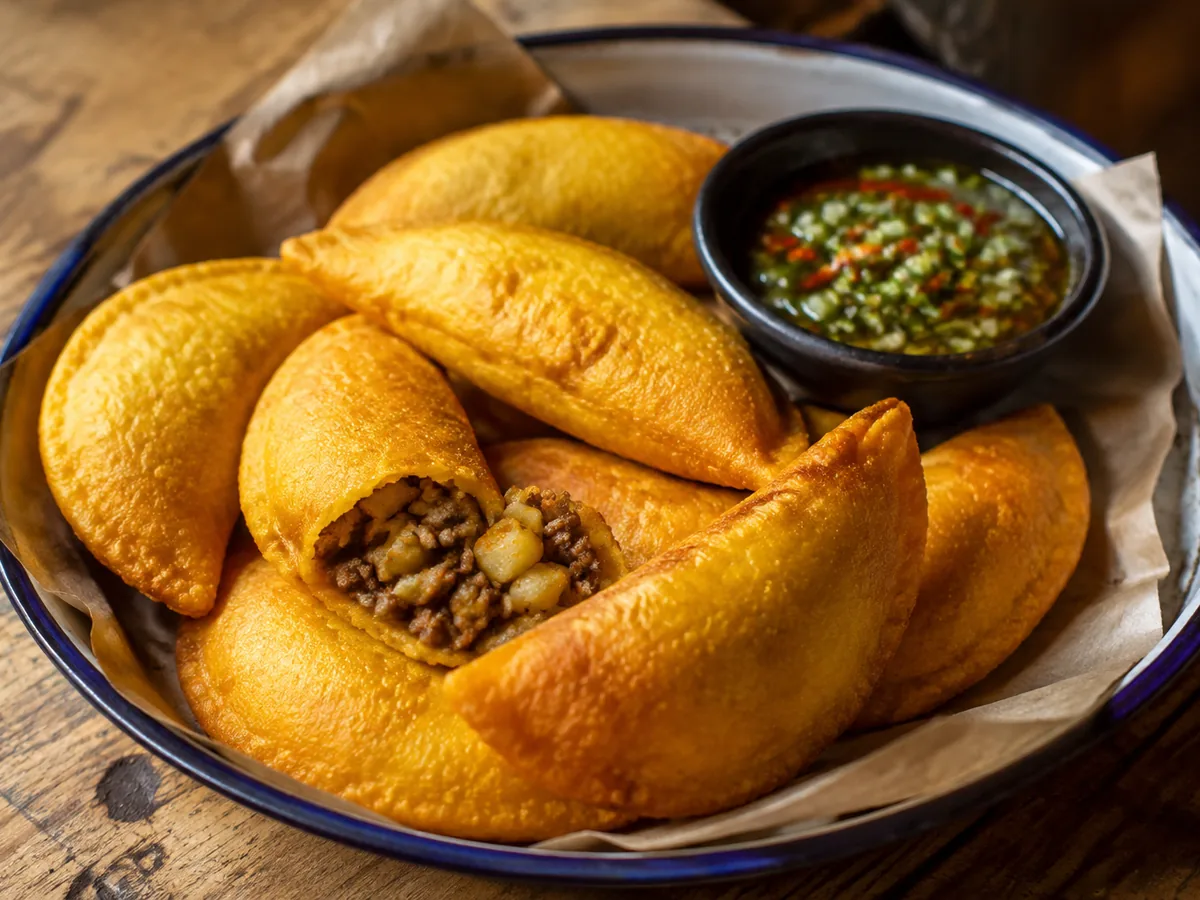
Forget wheat pastry. Colombian street empanadas are yellow corn — masarepa dough, sealed by hand and plunged into hot oil until the shell blister-crisps and the meat-potato filling steams inside.
If your mental picture is an Argentine baked empanada with a wheat tapa and a pretty repulgue, stop: that is a different country and a different food. These are fried, corn-forward, and they want ají on the side, not chimichurri.
The order is the one a Colombian home kitchen uses on a Saturday — hogao first, filling cooled, masa hydrated to a pliable paste that does not crack when you pinch it, then oil locked at 175–180 °C / 350–355 °F so the seals hold and the grease stays outside the shell.
Hogao (criollo sofrito — builds the filling)
- 30 ml2 TbspNeutral oil or pork fat
- 1 medium1 mediumWhite or yellow onion, finely dicedabout 150 g / 5 oz
- 2 medium2 mediumRipe tomatoes, finely dicedabout 250–300 g / 9–10 oz; peel them if you want silk
- 2–32–3Scallions, white and light green parts sliced
- 8–10 g2 clovesGarlic, minced
- ½ tsp½ tspGround cumin
- ½ tsp½ tspSweet paprikaoptional, for colour
- ½ tsp½ tspKosher saltplus more to taste
- Freshly ground black pepper
- 15 ml1 TbspCilantro stems, choppedoptional
Filling (meat and potato)
- 350 g12 ozGround beef, 85–90% leanor half beef and half pork for a richer street-cart note
- 400 g14 ozWaxy or all-purpose potatoes, peeledabout 2 medium
- 1 tsp1 tspKosher salt for the potato waterplus salt to taste for the filling
- ½–¾ tsp½–¾ tspGround cumin
- ¼ tsp¼ tspGround achiote or annatto, or a pinch of turmericoptional, for warm colour
- 60–80 ml¼–⅓ cupBeef broth or wateronly if the pan runs dry
- Freshly ground black pepper
- 15 g1 TbspDrained capers, or a spoon of cooked peasoptional regional home touches — label them if you use them
Corn masa (masarepa dough)
- 360 gabout 3 cups scoopedYellow masarepa — precooked corn flour for arepas and empanadasP.A.N. amarilla or equivalent. Not Mexican masa harina, not raw cornmeal, not wheat flour
- 480–540 ml2–2¼ cupsWarm waterplus a splash more as needed
- 6 g1 tspKosher salt
- 15 ml1 TbspNeutral oil or melted butterhelps plasticity and browning
- ¼ tsp¼ tspGround achiote, bloomed in the warm wateroptional, for a deeper yellow
Frying and serving
- 1.5–2 L6–8 cupsNeutral high-smoke-point oil — canola, soybean, peanut or sunflowerenough for 5–7 cm / 2–3 in depth in a heavy pot
- Ají for serving
- Lime wedges, optional
- A wire rack for draining — paper towels only underneath it, so steam does not soften the undersides
Ají (the non-negotiable table sauce)
- 60 ml¼ cupWhite vinegar, or a lime juice and vinegar mix
- 60 ml¼ cupWater
- ½ small½ smallWhite onion, minced
- 1–21–2Fresh ají, serrano or Fresno chiles, mincedseed them for milder
- Small handful of cilantro, chopped
- Pinch of salt
- Optional — a tiny dice of tomato
What masarepa is, and why gluten is irrelevant
Masarepa is precooked corn flour. You are rehydrating gelatinised starch into a paste that fries crisp outside and tender inside. There is no gluten to develop, so plasticity comes from water, fat and rest — not kneading technique.
Dry potato is the whole game
Excess water in the potato is enemy number one of sealed empanadas. Wet filling turns into steam bombs in hot oil. Boil the potatoes to just tender, drain well, and dice them while warm so the surface moisture escapes.
Season the filling harder than feels right
The corn shell is mild, so the interior needs to be a notch saltier and more aromatic than you think. Skimping on the hogao gives you bland meat and potato that the shell cannot rescue.
On the ají
Stir it together and rest 10 minutes. It should taste sharp, herbal and hot enough to cut fried corn — not a creamy dip.
Passive time, counted separately
The dough rests 10–15 minutes after hydrating, and the filling has to cool completely before assembly. Both are hands-off and sit outside the times quoted above; the whole session runs roughly 2–2½ hours, mostly assembly and frying rhythm.
Equipment
- Heavy pot or deep fryer
- Frying thermometer — clip-on, or an instant-read you trust in oil
- Mixing bowl for the masa
- Skillet for the hogao and filling
- Pot for the potatoes
- Baking sheet lined with parchment
- Plastic wrap or a zip bag for resting the dough
- Spider or slotted spoon
- Wire rack over a sheet pan
Method
On the hogao12–15 min
Warm the oil in a skillet over medium heat. Soften the onion and scallion 4–5 minutes until translucent and sweet-smelling, not browned hard, then add the garlic for 30–45 seconds until fragrant.
Add the tomato, cumin, optional paprika, salt and pepper. Cook 6–8 minutes, stirring, until the tomato collapses into a thick, jammy sauce and most of the free liquid cooks off. It should look glossy and spoonable, not like watery soup. Fold in the optional cilantro stems.
Taste: savoury, onion-sweet, tomato-forward, warm with cumin. Cool it slightly.
Soften onion and scallions in oil over medium heat 4–5 minutes; add garlic for 30–45 seconds. Stir in tomato, cumin, optional paprika, salt and pepper; cook 6–8 minutes until thick and glossy. Add optional cilantro stems, taste and cool slightly.
On the potato and meat filling25–30 min
Cover the peeled potatoes with cold salted water, bring to a boil, and simmer until just tender — a knife slips through with slight resistance, 12–15 minutes depending on size. Do not cook them to mash. Drain well and dice into 8–10 mm (⅓ in) cubes while warm.
In a wide skillet over medium-high heat, brown the ground meat, breaking it into small crumbles, 6–8 minutes. Season with cumin, salt, pepper and the optional achiote. Spoon off excess fat if the pan is swimming — a little fat is flavour, a lake makes greasy filling.
Stir in most of the hogao, reserving a spoon for tasting adjustments. Add the diced potato, and a splash of broth only if the mix looks dry and tight. Cook 2–3 minutes so the flavours marry.
The filling should hold in a spoon: moist crumbs and potato cubes, not a stew. Taste aggressively.
Cool completely before assembling. Warm filling softens masa and weakens seals.
Start potatoes in cold salted water; simmer 12–15 minutes until just tender. Drain thoroughly and dice warm into 8–10 mm (⅓ in) cubes. Brown crumbled meat 6–8 minutes; season with cumin, salt, pepper and optional achiote, draining excess fat. Add most hogao and potatoes, broth only if dry; cook 2–3 minutes, season generously and cool completely.
On the masarepa dough10 min, plus rest
In a bowl, stir the salt — and the optional achiote water — into 480 ml (2 cups) warm water, and add the oil.
Pour it onto the masarepa and mix with a spoon, then knead by hand 2–3 minutes until you have a soft play-dough texture that does not crack when you squeeze a ball and does not stick wetly to your palms. If it cracks at the edges when flattened, wet your hands and knead in water 1 tablespoon at a time; if it smears like batter, dust in 1–2 tablespoons masarepa.
Cover and rest 10–15 minutes so the corn fully hydrates. Resting is not theatre: dry-centred dough fissures on the seal line and bursts in oil.
Mix salt, optional achiote and oil into 480 ml (2 cups) warm water; combine with masarepa and knead 2–3 minutes. For cracks, add water 1 tablespoon at a time; for sticky dough, add 1–2 tablespoons masarepa. Cover and rest 10–15 minutes.
On shaping, and seals that do not burst25–35 min
Divide the dough into 20–24 balls, about 35–40 g (1¼–1½ oz) each. Keep unused dough covered with a damp cloth or plastic so skins do not form.
Working one ball at a time, flatten it between lightly oiled or damp palms, or between two sheets of plastic, into a disk about 10–12 cm (4–4¾ in) across and roughly 3–4 mm (⅛ in) thick — slightly thicker in the centre than at the rim helps.
Place 1 heaping tablespoon, about 20–25 g (¾ oz), of cooled filling in the centre. Do not overfill. Greed is the usual blowout cause.
Fold into a half-moon and pinch the edge firmly all the way around, pressing out air pockets as you go — trapped air expands in hot oil and splits seams. Crimp with a fork, or a tight thumb-and-finger rope. The seal must be continuous; any thin hairline becomes a vent.
The air-pocket rule: after sealing, the empanada should feel filled but not balloon-tight. Press gently along the curve to burp out air before the final crimp.
Set the shaped empanadas on parchment. If the dough softens mid-batch, chill the tray for 10 minutes.
Keep dough covered; divide into 20–24 balls of 35–40 g (1¼–1½ oz). Press disks 10–12 cm (4–4¾ in) wide, 3–4 mm (⅛ in) thick. Add 1 heaping tablespoon (20–25 g / ¾ oz) cold filling. Fold, expel air and seal continuously; crimp and set on parchment. Chill 10 minutes if softening.
On frying20–30 min
Heat the oil to 175–180 °C / 350–355 °F, and use a thermometer. Below about 165 °C / 330 °F the shell drinks oil and stays pale and greasy; above about 190 °C / 375 °F the outside browns before the masa sets and the seals fail spectacularly.
Maintain that window between batches — cold empanadas drop the oil temperature, so wait for recovery before the next round. Fry 3–5 at a time depending on pot size; crowding collapses the heat.
Lower them in gently with a spider. Fry 3–5 minutes, turning once, until deep golden and crisp when tapped. A steady moderate sizzle is correct; violent sputtering usually means wet surfaces or water in the oil.
Drain on a wire rack and rest 2–3 minutes — the filling is molten.
For leftovers: a brief return to 180 °C / 355 °F for 60–90 seconds re-crisps far better than a microwave ever will.
Heat oil to 175–180 °C / 350–355 °F; avoid below 165 °C / 330 °F or above 190 °C / 375 °F. Fry 3–5 empanadas for 3–5 minutes, turning once, until crisp and deep gold. Let oil recover between batches. Rack-drain and rest 2–3 minutes. To re-crisp leftovers, return to 180 °C / 355 °F for 60–90 seconds.
On the plate
Pile the golden half-moons on a platter with a bowl of ají in the centre.
The first bite should shatter the corn shell, then hit cumin-hogao meat and soft potato, then ají vinegar heat clearing the fat.
These are finger food, beer food, and "one more before we leave" food. Do not plate them like fine-dining crescents with microgreens — that is cosplay.
Arrange the golden empanadas on a platter around a bowl of ají. Serve as finger food, with the sharp sauce complementing the crisp corn shell and meat-and-potato filling.
Sensory checkpoints and why they matter
- Hogao done: thick enough that a spoon stands briefly, smelling of sweet onion and cooked tomato rather than raw. Watery hogao means watery filling means burst seals.
- Filling cooled: room temperature or cooler. Warm filling means steam and weak masa.
- Masa feel: soft clay. A flattened disk bends without cracking; cracks mean more water, or a longer rest.
- Seal: a continuous pinched edge, no filling peeking, no puffy air bladder.
- Oil: thermometer in the 175–180 °C / 350–355 °F band, shimmering rather than smoking hard.
- Sound: an even sizzle. Silence means too cool; screaming spit means wet dough or oil too hot.
- Colour: deep corn-gold — not blond, which is underfried, and not mahogany-black.
- Bite: crisp shell, tender interior masa, and a cohesive filling that does not dump out in one lump.
Check hogao is thick, filling completely cool and dough pliable without cracks. Expel air and seal edges without exposed filling. Maintain oil at 175–180 °C / 350–355 °F with a steady sizzle; fry to deep gold with a crisp shell.
Why the method is ordered this way
Hogao and filling come first so they can cool while you hydrate the masa — cold filling is a seal requirement, not a preference. The masa rests so the starch finishes taking water. Shaping happens only when both components are ready. Oil heat is last-minute, so you are not holding dead oil for an hour. Ají can be stirred at any point and improves with a short rest.
This order prevents the two classic failures: warm wet filling in fragile dough, and guessing oil temperature while distracted. The masarepa, the fry temperature and the seal are what make the recipe work.
Make hogao and filling first; cool while hydrating and resting the dough. Shape only when both are ready, then heat oil. Mix the ají ingredients at any point and rest 10 minutes for a sharp, herbal sauce.
Storing it
Fried empanadas are best within 2 hours. Refrigerate leftovers up to 2 days, and reheat on a rack at 180 °C / 350 °F for 8–12 minutes until hot in the centre — the filling should steam, and a thermometer should read 74 °C / 165 °F for reheated meat fillings.
During assembly
Do not leave meat filling at room temperature for more than 2 hours. Cool the filling before shaping, and refrigerate it if your kitchen is hot and assembly stretches long.
Make-ahead and freezing
Filling can be made 1 day ahead and refrigerated. Shaped raw empanadas keep a few hours in the fridge on parchment, loosely covered. Freeze shaped raw ones on a tray, then bag them up to 1 month; fry from frozen at 170–175 °C / 340–350 °F, adding 1–2 minutes, and do not thaw, because thawing wets the surface. Fry frozen ones thoroughly until piping hot inside — a centre that stays cool is a safety miss.
Used frying oil
Strain and cool it. Save it only if it is clean and not dark or bitter; heavily used oil makes off flavours.
Troubleshooting
- The empanadas burst in the oil.
Overfilled, air trapped, wet filling, a weak pinch, or oil so hot the steam turns violent. Use less filling, cool it fully, burp the air, reinforce the crimp, and hold 175–180 °C / 350–355 °F.
- A greasy, pale shell.
Oil too cool, or the pot crowded. Recover the temperature and fry fewer at a time.
- The dough cracked before frying.
Under-hydrated masa, or no rest. Knead in warm water and rest it covered 10 minutes more.
- A dense, cardboard shell.
Dough too dry, or fried too long at too low a temperature. Hydrate better and trust the thermometer.
- A bland interior.
Underseasoned filling and a timid hogao. Salt and cumin harder next round — the corn shell will not carry the flavour for you.
- The masa tastes raw or starchy.
The oil was too cool so the shell never properly fried, or the disks were too thick. Thin them slightly and keep the heat in band.
- You used Mexican masa harina by mistake.
Different grind and treatment, so the dough behaves wrong. Buy yellow masarepa labelled for arepas.
- They came out like the Argentine style.
You reached for wheat flour and an oven. These are fried corn — see the comparison table above.
Substitutions
Traditional spine: yellow masarepa dough, deep-fried, with a filling of meat — often beef, sometimes mixed — plus potato and hogao, served with ají. Ubiquitous in Colombian bakeries, street carts and home kitchens. Valle del Cauca and many Andean and coastal variants share the corn-fried identity even when the fillings shift.
Not Argentine — fence this hard
| Row label | Colombian (this recipe) | Argentine (a different dish) |
|---|---|---|
| Dough | Yellow masarepa, precooked corn flour | Wheat flour fat dough, or commercial tapas |
| Cooking | Deep-fried | Usually baked; some regions fry wheat ones, but still wheat |
| Colour and grain | Bright yellow corn shell | Pale wheat pastry |
| Filling spine | Beef or mixed meat, potato and hogao | Beef cut al cuchillo, onion, spices; regional variants |
| Condiment | Ají — cilantro, onion, chile, vinegar heat | Chimichurri or salsa criolla, not the Colombian dip |
| Shape and seal | Pinched or forked corn seal, rustic | The classic wheat repulgue braid |
Why the fence matters
Calling a baked wheat empanada "Colombian" because it has meat inside is how identity gets mushy. Keep the names honest.
Acceptable home departures
Half pork in the meat. A few peas or capers in the filling. Achiote for colour. Shaping with a tortilla press between plastic. Holding finished empanadas briefly in a 95 °C / 200 °F oven on a rack for a party.
Departures that change the identity
Wheat dough. Baking as the primary cook — a "baked Colombian empanada" is a fusion cousin, so say so. Skipping hogao for plain salted meat. Calling them Argentine. Air-fryer-only batches described as the same thing; that is a leftover reheating trick, not the real fry.
Scaling
Half batch
10–12 empanadas — still make the full quantity of ají, because it keeps.
Double batch
Double the filling and masa, and fry in more shifts. Keep the shaped trays in the fridge so early pieces do not dry while you fill the last ones. Oil temperature discipline matters more when the kitchen is busy — assign someone to watch the thermometer.
What to serve it with
Ají always. These sit happily next to a larger Colombian spread — bandeja pieces, arepas, soups — as the fried opener, not as a timid side.
- Ají, in a bowl in the middle of the platter
- Cold beer, aguardiente if that is your table, or panela lemonade
- A simple cabbage-and-carrot curtido-style slaw
- Lime wedges, optional
Questions
Masarepa, masa harina or cornmeal?
Masarepa is precooked corn flour for arepas and empanadas, and it is what this recipe uses. Masa harina is nixtamalised flour for tortillas and tamales — wrong behaviour here. Cornmeal or polenta is coarse and raw or only part-cooked, and will not form this shell.
Can I bake them?
You can brush them with oil and bake at 220 °C / 425 °F until coloured, but the shell will not match a true fry. Call it a baked corn empanada, not the Colombian street one.
Beef only?
Classic and fine. A beef-pork mix is common at home, and chicken with potato and hogao works as a labelled variant.
Is it gluten-free?
The masa is naturally wheat-free if your masarepa is pure corn — confirm the label. The ají and filling are gluten-free if your broth is.
Why potato?
Bulk, comfort, and moisture control when diced and dried properly. It is part of the expected bite, not a filler apology.
Fork crimp or finger pinch?
Both work. Continuity of the seal matters more than the pattern.
How spicy is the ají?
As hot as you build it. The empanadas themselves are usually mild; the ají is the dial.