Lechona
Tolima's festival roast, scaled to a home oven — a skin-on pork shoulder packed with yellow rice, peas and pork bits, roasted low until both meat and stuffing are safely hot, then blasted so the skin blisters into shatter sheets.
- Prep
- 1 hr 10 min
- Cook
- 4 hr 15 min
- Serves
- 8–12 hearty servings
- Difficulty
- Hard
Researched · Kitchen testing pending
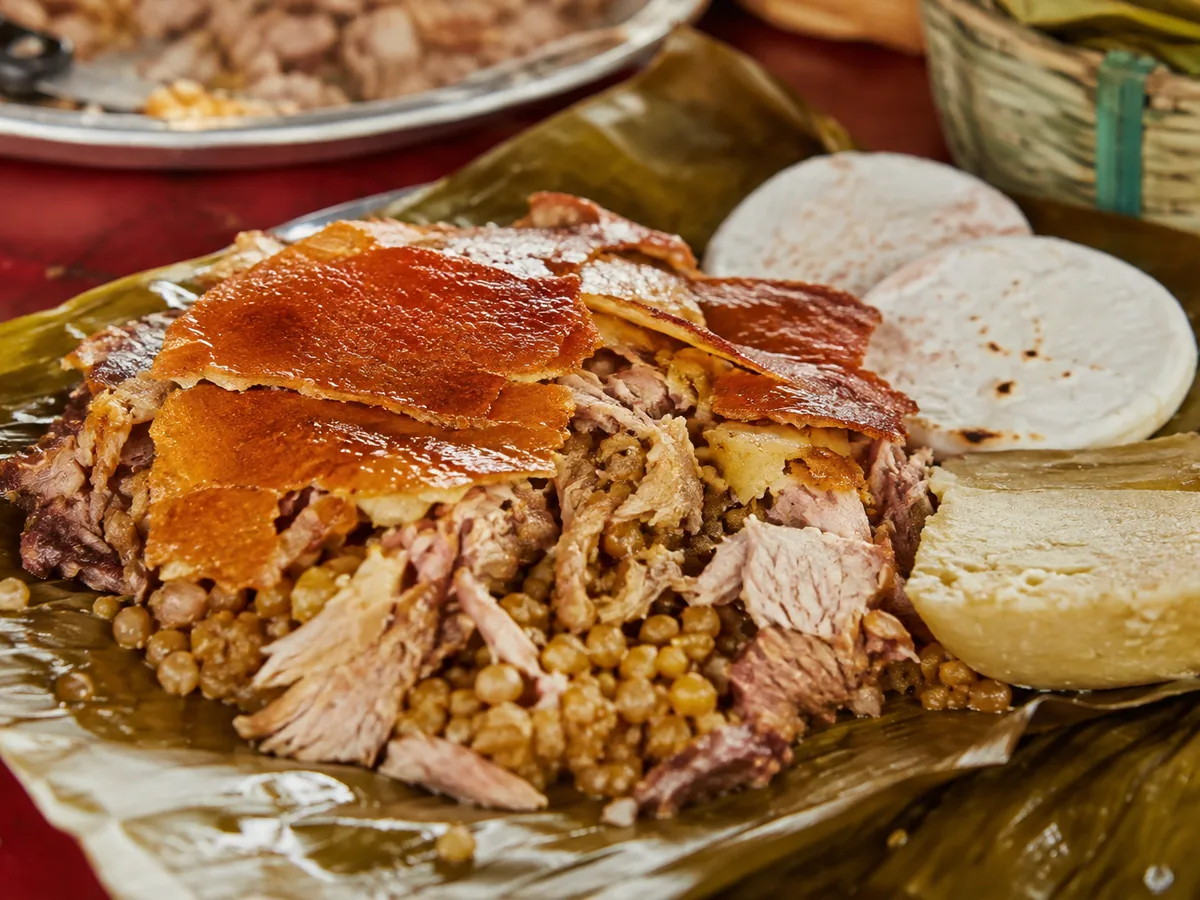
Lechona is festival food from Tolima: a whole pig emptied and packed with yellow rice, peas, pork pieces and enough garlic-cumin spice that the steam when you crack the skin smells like a town square at lunch.
Most kitchens do not have a whole hog, a courtyard fire pit, and fifty cousins arriving at noon. What follows is a home-scale lechona — stuffed pork shoulder, or a small suckling pig when you can get one — aimed at the same contract: shatter-crisp skin, seasoned rice stuffing cooked inside the roast, and pork and stuffing both safely hot.
The target is a plate where the skin snaps between your fingers, the rice exhales cumin and garlic, and the pork is festival-rich without requiring a pit. At that point the Tolima idea has travelled at the right scale, with no confusion with plain roast pork that never met a stuffing spoon.
Pork
- 4–5 kg9–11 lbSkin-on pork shoulderpreferred; or boneless shoulder 3.5–4.5 kg / 8–10 lb plus 800 g–1 kg / 1¾–2¼ lb skin-on pork belly to drape and crisp
- 36–45 g2–2½ TbspKosher salt, for the skin and exteriorplus more in the paste
- 1–2 tsp1–2 tspWhite vinegar or lime juice, to wipe the skinhelps clean and dry it
Spice paste (the garlic-cumin spine)
- 40–50 g10–12 clovesGarlic, mashed to a paste
- 12 g1½ TbspGround cuminlechona should announce cumin
- 18 g1 TbspKosher salt
- 2 tsp2 tspDried oregano
- 2 tsp2 tspSweet paprika, or ground achiote for colour
- 1 tsp1 tspFreshly ground black pepper
- ½ tsp½ tspGround allspice, or a pinch of clovesoptional home note
- 30 ml2 TbspWhite vinegar, or bitter orange, or an orange and lime mix
- 30 ml2 TbspNeutral oil
Rice stuffing (yellow rice, peas, pork bits)
- 400 g2 cupsLong-grain white rice, rinsed
- 700 mlabout 3 cupsLight chicken or pork brothor water with bouillon; plus a splash more if needed
- 200 gabout 1½ cupsGreen peasfrozen is fine — thawed and patted dry
- 250 g9 ozBoneless pork, cut smallshoulder trim, fresh belly bits, or ground pork
- 1 large1 largeWhite onion, finely dicedabout 200 g / 7 oz
- 4–54–5Scallions, sliced
- 3 cloves3 clovesGarlic, minced
- 1 tsp1 tspGround cumin
- 1 tsp1 tspGround achiote, or 15 ml / 1 Tbsp achiote oilfor the yellow colour
- 1½ tsp1½ tspKosher saltor to taste
- 30 ml2 TbspOil or pork fat
- Optional traditional stretchers — 150 g / 5 oz diced cooked potato, and 2 Tbsp chopped cilantro
For roasting
- Kitchen twine
- 240 ml1 cupWater or beer, for the pan bottomprotects the drippings from burning
- Foil, for tenting if the skin colours too fast before the interior is done
To serve
- Lime wedges
- Ají, or a sharp onion-tomato salsa
- Arepa or white bread, to catch the juices
- A simple avocado and cabbage salad, for freshness against the pork fat
Why parcook the rice only
The stuffing finishes inside the pork. Fully cooked rice goes mushy and wet over a long roast, while raw rice may stay chalky in the centre of a dense stuffing mass. Slightly underdone, seasoned, cooled rice is the path.
Cool the stuffing before it goes near raw pork
Warm stuffing packed into a raw cavity, followed by long sits at room temperature, is how bacteria get a head start. Spread the rice on a tray and let it come down before stuffing.
Thermometer discipline
Stuffed pork follows the same logic as stuffed poultry: the stuffing centre must reach 74 °C / 165 °F, not just the meat near the edge. A beautiful crackling over cool rice is a safety failure. An instant-read thermometer is required equipment here, not a nicety.
The spice paste is not a table sauce
Leftover paste that touched utensils used on raw pork gets discarded.
Passive time, counted separately
The skin wants 4–12 hours uncovered in the fridge to dry — that step is the difference between crackle and chew — and the roast rests 20–30 minutes before carving. Both are hands-off and sit outside the times quoted above. Plan a half-day, most of it passive oven time.
Equipment
- Sharp boning or chef's knife, for butterflying
- Large skillet for the stuffing base
- Saucepan for parcooking the rice
- Roasting pan with a rack
- Instant-read thermometer — required, since stuffed pork is not a guessing game
- Kitchen twine and foil
- Rimmed board for resting and carving
- Paper towels for drying the skin
Method
On drying the skin — start the night before if you can
If you are using skin-on shoulder, inspect the skin: scrape any stray hairs, wipe with vinegar or lime, rinse, and pat aggressively dry.
Score the skin in a crosshatch of shallow cuts about 1–1.5 cm (½ in) apart, cutting through skin and fat but not deep into the meat — go too deep and stuffing leaks while the skin fails to sheet-crisp evenly.
Salt the skin liberally and set the pork on a rack, uncovered, in the refrigerator for 4–12 hours. Cold circulating air dries the surface so oven heat can blister it. Wet skin steams and turns rubbery.
Remove stray hairs, wipe skin with vinegar or lime, rinse and dry thoroughly. Score skin and fat in shallow crosshatches 1–1.5 cm (½ in) apart without cutting into meat. Salt generously and refrigerate uncovered on a rack 4–12 hours.
On the spice paste5 min
Mash the garlic with the salt, then work in the cumin, oregano, paprika or achiote, pepper, the optional allspice, the vinegar and the oil, into a smearable paste.
It should smell sharp, garlicky and heavily cumin-forward. Taste a dab: salty, acidic, warm with spice.
This paste goes under the skin where you can reach, into the meat pocket, and lightly onto the interior surfaces that will face the stuffing.
Mash garlic and salt, then mix in cumin, oregano, paprika or achiote, pepper, optional allspice, vinegar and oil. Taste before raw-pork contact; spread under accessible skin and over interior meat surfaces. Discard leftover paste contaminated by raw-pork utensils.
On the rice stuffing — parcook, do not finish20–25 min
Warm the oil in a wide skillet over medium heat. Brown the small pork pieces 4–6 minutes until edged with colour. Soften the onion and scallion 5–6 minutes, then add the minced garlic, cumin, achiote and salt and cook 1 minute, until fragrant and the fat turns yellow-orange.
Stir in the rinsed rice until every grain is coated and smells toasty, 1–2 minutes. Add the broth, bring to a simmer, cover, and cook only until the liquid is mostly absorbed but the rice is still slightly firm in the centre — usually 10–12 minutes, short of done.
Fold in the peas, and the optional potato and cilantro. Spread the stuffing on a tray and cool it to room temperature before it goes anywhere near the pork.
Brown pork pieces in oil over medium heat 4–6 minutes; soften onion and scallions 5–6 minutes. Add garlic, cumin, achiote and salt for 1 minute. Coat rice 1–2 minutes, add broth and simmer covered 10–12 minutes until mostly absorbed but still firm. Fold in peas and optional potato and cilantro; spread on a tray and cool before stuffing.
On stuffing and tying the shoulder20–30 min
Butterfly the shoulder into an open slab, or cut a deep pocket from the meat side while keeping the skin side intact as a lid. The goal is a cavity that holds 4–6 cups of stuffing without forcing the seams open.
If you are using boneless shoulder plus belly, butterfly the shoulder, pack the stuffing, roll it, then drape the salted dry belly skin-side up and tie the whole thing as a single roast.
Rub the spice paste into the meat surfaces and under any loosened skin. Pack in the cooled stuffing firmly but without hydraulic pressure — overpacking splits seams as steam expands.
Roll or close the roast and tie it every 3–4 cm (1½ in) with twine so it holds a compact cylinder or oval. Wipe the skin dry again, and salt it once more.
Small suckling pig path: if you source a cleaned small pig, season the cavity with paste, pack the same cooled stuffing, sew or skewer it closed, dry and salt the skin, and roast on a rack. Times stretch longer, and you still verify the stuffing centre and thickest meat at 74 °C / 165 °F. This is advanced home territory for oven size and handling.
Butterfly or pocket the shoulder, keeping skin intact, to hold 4–6 cups filling. Rub meat with paste; add cooled stuffing without overpacking, close and tie every 3–4 cm (1½ in). For boneless shoulder, cover the roll with dry salted belly, skin-up. Dry and salt skin again. A small pig needs longer roasting; check stuffing and thickest meat at 74 °C / 165 °F.
On the long roast — crackle without raw stuffing3 hr 30 min – 5 hr
Pull the roast from the fridge 45–60 minutes before it goes in if it is ice-cold; the skin can stay dry and uncovered.
Preheat the oven to 160 °C / 320 °F with a rack in the lower-middle. Set the pork skin-up on a rack over a pan with water or beer below.
Roast low and steady until an instant-read thermometer reads 74 °C / 165 °F both in the centre of the stuffing and in the thickest meat, not touching bone or the pan. For a 4–5 kg stuffed shoulder this often lands in the 3½–5 hour range; start checking at 3 hours.
If the skin is darkening too fast while the interior lags, tent foil loosely over the top for the middle stretch, then remove it later.
Crackle finish: when the interior is near target, around 71 °C / 160 °F and climbing, raise the oven to 230–240 °C / 445–465 °F for the last 15–25 minutes, watching constantly, until the skin blister-puffs and sounds hollow when tapped. Some ovens need a brief broil — stay present, as pork skin still goes from perfect to burnt.
Rest the roast on a board 20–30 minutes. Carryover finishes the last degrees, the juices settle, and the skin sets into shatter sheets. Carve into slabs that each get skin, meat and stuffing, and spoon any fallen rice back onto the plates.
If ice-cold, remove roast 45–60 minutes before cooking. Roast skin-up over water or beer at 160 °C / 320 °F; check after 3 hours, typically allowing 3½–5 hours for 4–5 kg. Tent darkening skin loosely. Near 71 °C / 160 °F inside, raise oven to 230–240 °C / 445–465 °F for 15–25 minutes, watching constantly. Verify both stuffing centre and thickest meat reach 74 °C / 165 °F, avoiding bone. Rest 20–30 minutes, then carve skin, meat and stuffing together.
On the plate
Serve family-style: chunks of crisp skin, shreds or slices of seasoned pork, and a heap of yellow rice-pea stuffing glossy with roasting juices. Lime and ají on the side.
It should look abundant and a little unruly — festival energy on a home platter — not a tight restaurant fan of medallions.
The first sensory hit is skin crackle, then cumin-garlic steam from the rice.
Serve family-style with crisp skin, seasoned pork slices or shreds, and yellow rice-and-pea stuffing moistened with roasting juices. Put lime wedges and ají alongside to balance the rich pork.
Sensory checkpoints and why they matter
- Skin before the oven: dry, taut, salted. Soft or damp skin will not blister.
- Stuffing before packing: yellow and fragrant, grains separate, cool to the touch, slightly al dente.
- The tied roast: compact, seams closed, skin facing up and still dry.
- Mid-roast smell: roasting pork, cumin, garlic — not scorching fat. Add pan liquid if the drippings burn.
- Skin at the end: blistered, amber to deep gold, crackling under a tap. Pale means it needs more high heat; black means you waited too long on the blast.
- Thermometer: stuffing centre and thick meat both at or above 74 °C / 165 °F.
- Taste: savoury pork, cumin-forward rice, sweet peas, garlic through the fat — not plain roast pork beside rice cooked separately.
Before roasting, check dry salted skin, closed seams and cool, slightly firm rice. Add pan liquid if drippings scorch. Finish with blistered golden skin, and verify both stuffing centre and thickest meat are at least 74 °C / 165 °F.
Why the method is ordered this way
Skin drying starts early because moisture is the enemy of crackle and it needs fridge time. Paste and stuffing can happen on the day. Parcooked, cooled rice protects both texture and safety. Stuffing and tying happen when the components are ready, not while the rice is hot.
A low oven renders fat and cooks the dense stuffed mass without incinerating the skin, and the final blast is reserved for blistering once the thermometer says the interior is nearly safe. The rest is carving insurance, and ají and lime at the end cut the richness so a third helping is still possible.
Dry the skin ahead in the refrigerator; prepare paste and rice on cooking day. Cool the parcooked stuffing before filling and tying. Roast gently, apply high heat near the target temperature, then rest before carving and serve with ají and lime.
Traditional whole pig, against what you will actually cook
Traditional lechona is a whole pig, butchered carefully with the skin kept intact as a shell, the cavity packed with a huge batch of rice cooked with peas, scallion, garlic, cumin, pork bits and sometimes potato. The animal is sewn closed and roasted for many hours until the skin is a lacquered, blistered crust and the stuffing is steaming. Portions are slabs of skin with meat and a scoop of rice. It is catering scale and community scale — a communal roast for baptisms, elections, and Sundays that turn into evenings.
The home-scale path this recipe leads with
A large pork shoulder, picnic or Boston butt style, skin-on if you can find it, butterflied or pocketed, packed with the same style of rice stuffing, tied, and roasted until the skin crackles and both meat and stuffing hit 74 °C / 165 °F. If skin-on shoulder is unavailable, use skin-on pork belly draped over a stuffed boneless shoulder, or roast a small pig when you have the oven space and the experience.
Honest naming
Call the shoulder version "lechona-style stuffed pork, Tolima-inspired home roast." Save "whole lechona" for the actual pig. The flavours and the crackling goal still earn a place on a Colombian top ten.
Storing it
Refrigerate leftovers within 2 hours of serving, keeping stuffing and meat in shallow containers for up to 3–4 days. Reheat to 74 °C / 165 °F. The skin re-crisps best on a rack at 220 °C / 425 °F for 8–12 minutes; a microwave softens crackling, so use it only for meat and rice destined for bowls. Freeze carved meat and stuffing up to 2 months, and thaw overnight in the fridge.
On stuffing ahead
Cool the stuffing first. Refrigerate the stuffed roast only if your fridge is properly cold and you roast within a day; many food-safety educators prefer stuffing just before roasting. When in doubt, stuff on the day you cook.
Troubleshooting
- Rubbery skin.
Never dried, scored too shallow or not at all, the oven too cool at the end, or tented the whole time. Dry it uncovered in the fridge, finish hard and hot, and do not baste the skin with watery juices.
- Skin burnt, interior underdone.
High heat too early. Keep the long phase moderate at 160 °C / 320 °F, save the blast for the end, and foil-tent mid-roast if needed.
- Mushy stuffing.
The rice was fully cooked before packing, or the stuffing was packed wet. Parcook only, cool it spread out, and drain the peas well.
- Chalky, underdone rice.
Too raw going in, or dense cold packing slowed the heat. Parcook further next time, and after the stuffing centre hits 74 °C / 165 °F give the grains time to finish softening.
- Dry meat.
Overshot the temperature badly, or used a very lean cut with no fat cap. Use shoulder, pull soon after 74 °C / 165 °F once the stuffing is safe, and rest before carving.
- The seams burst.
Overstuffed. Pack firmly rather than aggressively, and tie at tighter intervals.
- No lechona aroma.
Timid cumin and garlic. Increase the paste, and do not skip the scallion in the rice.
- Only boneless skinless shoulder is available.
Still make the stuffing and spice paste and roast to temperature, then crisp diced pork skin or store-bought chicharrón separately as a topping. Label it as a compromise plate.
Substitutions
Traditional spine: a whole pig, rice-pea-pork stuffing built on garlic, cumin, onion and scallion, a long roast, crisp skin, and communal carving. Tolima pride with nationwide fame.
Acceptable home departures
Skin-on shoulder or a small pig instead of a full-size hog. A belly drape for crackling when shoulder skin is unavailable. Fridge drying overnight. An oven instead of an outdoor pit. Frozen peas. Achiote oil for colour. A party hold in a warm oven after carving, with skin pieces re-crisped on a rack.
Departures that change the identity
Plain roast pork with rice cooked on the side and no stuffing ritual. Skipping the cumin and garlic. Soft steamed skin with no attempt at crackle. Calling any pulled pork "lechona." A sweet barbecue glaze as the main flavour.
Scaling
Small household, 4–6
A 2–2.5 kg (4½–5½ lb) skin-on roast and half the stuffing recipe. Watch the temperatures early — smaller roasts finish faster.
A crowd of 15 or more
Two shoulders beat one oversized roast, for even cooking and stuffing safety. Or commission a traditional whole lechona from a Colombian caterer, and cook this recipe another weekend for practice.
Extra stuffing
You can bake more in a covered dish at 180 °C / 350 °F until it reaches 74 °C / 165 °F, for guests who want extra rice. But the soul of the dish is the portion that cooked inside the pork.
What to serve it with
Keep the sides light; the roast is the parade.
- Ají and lime wedges
- Arepas or crusty bread, to catch the juices
- A crisp avocado and cabbage salad
- Cold beer; sweet panela drinks or aguardiente appear at many Colombian tables
Questions
Do I need a whole pig?
No. A whole pig is traditional festival scale. Skin-on shoulder, or shoulder plus belly skin, delivers the home-scale experience.
Why 74 °C / 165 °F for the stuffing?
Stuffed meats can harbour bacteria in the dense centre. That temperature is the clear home-kitchen safe target for stuffing and pork in this preparation.
Can I use brown rice?
Not for the classic texture. It takes longer and stays chewier. Stick to long-grain white for the Tolima profile.
What if I have no achiote?
Paprika for colour plus cumin for flavour. The yellow look is traditional, but brown-spiced rice still tastes like the dish if the garlic and cumin are right.
Convection oven?
Reduce the set temperatures by about 10–15 °C (roughly 25 °F), or check early. Convection helps dry the skin.
Can I cook the rice separately and serve it under the pork?
That is roast pork with rice, not lechona-style. The stuffing-inside step is what matters.
The skin did not blister even at high heat.
It was wet, unscored, or heavily tented. Next time, a longer fridge dry, better scoring, and an uncovered finish. To salvage, cut the skin off in sheets and press it under a broiler on a rack for 3–5 minutes.
Are the peas optional?
Peas are part of the classic look and sweetness. Omitting them is a minor departure — say so.