Tamal Colombiano
Tolima-style parcels wrapped in banana or bijao leaf — masa seasoned with hogao and meat broth rather than whipped lard, filled with pork, chicken, potato, carrot and peas, then steamed until the masa pulls clean from the leaf. Not the corn-husk Mexican cousin.
- Prep
- 2 hr
- Cook
- 1 hr 45 min
- Serves
- 10–12 large tamales
- Difficulty
- Hard
Researched · Kitchen testing pending
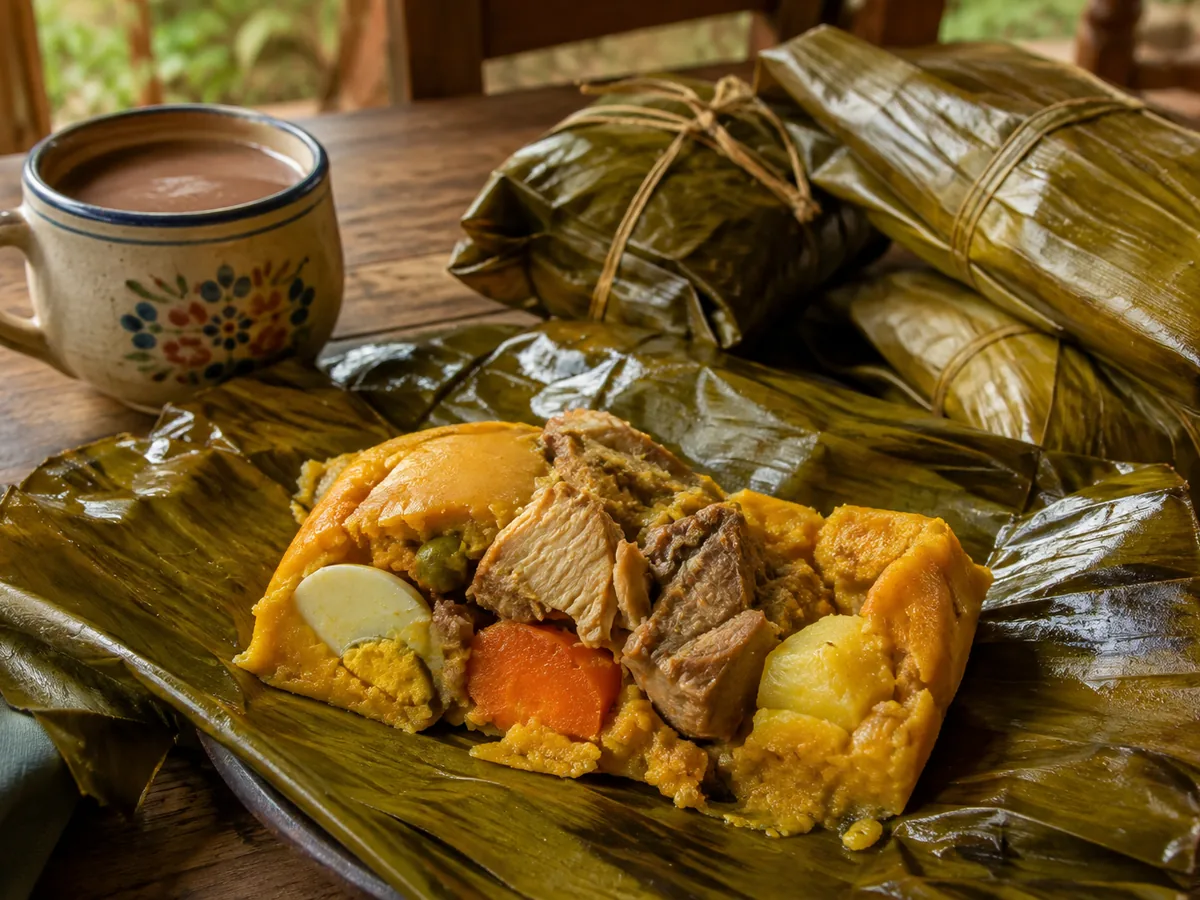
Banana leaf hits steam and the kitchen smells like wet green wood and pork fat before anyone unwraps a parcel. That is the tell for Colombian tamales, as against the corn-husk Mexican cousins they keep getting confused with at the potluck.
Tolima-style parcels are bigger, the masa is seasoned with hogao and broth rather than whipped lard alone, and the filling carries potato, pea and carrot in the same bite as pork and chicken. The wrap is softened bijao or banana leaf, steamed until the masa pulls clean from the leaf — a dry corn-husk cigar does not go by this name.
Leaves and ties
- 12–14 large12–14 largeBanana or bijao leaves, thawed if frozenabout 800 g–1 kg / 1¾–2¼ lb total; keep extras for patching tears
- 12–14 lengths12–14 lengthsKitchen twine, cut to about 60 cm / 24 incorn husk strips work as backup ties if the twine runs short
Hogao (seasoning base for masa and meats)
- 45 ml3 TbspNeutral oil or pork lard
- 2 medium2 mediumWhite or yellow onions, finely dicedabout 400 g / 14 oz total
- 44Ripe tomatoes, seeded and finely dicedabout 500 g / 1.1 lb; peel if the skins are tough, or use 400 g / 14 oz drained canned whole tomatoes, chopped
- 12 g4 clovesGarlic, minced
- 2 g1 tspGround cumin
- 2 g1 tspSweet paprika, or colorante / bijoloptional, for a warm orange tint — common in home batches
- 8 g1½ tspKosher saltplus more to taste
- Freshly ground black pepper
- 15 g½ cup loosely packedCilantro leaves and tender stems, chopped
Meats and broth
- 700 g1½ lbBoneless pork shoulder or country-style ribs, cut into 3–4 cm / 1¼–1½ in chunks
- 500 g1.1 lbBone-in chicken thighs, skin removed, cut into large serving piecesor boneless thighs at a similar size
- 10 g2 tspKosher salt, divided
- 2 g1 tspGround cumin
- 1.5 L6⅓ cupsWaterplus more as needed
- 2 leaves2 leavesBay leaves
- 2 cloves2 clovesGarlic, smashed
- ½½Onion, left in a chunk for the pot
Vegetables for the filling
- 3 medium3 mediumYellow potatoes, peeled and cut into 1.5 cm / ⅝ in cubesabout 450 g / 1 lb; hold them in cold water
- 2 medium2 mediumCarrots, peeled and cut into 1 cm / ⅜ in rounds or small sticksabout 200 g / 7 oz
- 150 g1 cupGreen peas, fresh or frozen
- Optional Tolima-leaning extras — 2 hard-boiled eggs halved, 100 g / ⅔ cup cooked white rice, a few cooked chickpeas. Use them if your family expects them, skip them for a cleaner parcel
Masa
- 500 gabout 4 cupsPrecooked white corn flour (harina de maíz precocida)PAN blanca or equivalent. Not Mexican masa harina for tortillas, not polenta, not cornmeal
- 800–950 ml3⅓–4 cupsWarm strained pork-and-chicken brothheld around 50–55 °C / 120–130 °F
- 80–100 g⅓–scant ½ cupSoft pork lard, or a mix of lard and the oil from the hogao
- 120–150 gabout ½–⅔ cupCooled hogao, packed
- 8 g1½ tspKosher saltor to taste, against the salted broth
- ½ tsp½ tspBaking powderoptional, for a slightly loftier crumb — a home departure
To serve
- House ají — minced chile, cilantro, scallion, lime and salt
- Hot chocolate or tinto for breakfast service; plain rice is optional at lunch
Hydration is the whole game
Precooked corn flour is already gelatinised. You are not developing gluten, and you are not whipping air into cold lard the Mexican way. You are hydrating starch with seasoned fat and broth so steam can set a moist, sliceable crumb. Under-hydrated masa steams into dry chalk that cracks off the leaf; over-hydrated masa weeps and turns pasty.
Do not chase the float test
Mexican masa is often whipped with a high load of lard until a lump floats in cold water, seasoned more simply, and spread thinner on corn husks. Colombian interior tamales run larger, fold more filling into a thicker masa bed, and wrap in leaf. Chase spreadability and seasoning instead.
Taste the raw masa
It should already taste of hogao, salt and corn. Bland masa never gets interesting in the steamer.
Why par-cook the vegetables
Soft vegetables going into the wrap turn to mash, while hard-raw potato stays chalky even after a long steam, because the dense masa buffers the heat. Just shy of tender is the target.
Passive time, counted separately
The leaves need softening before you start, the masa rests 10 minutes after mixing, and the steamed parcels rest 10 minutes off the heat. All of that sits outside the times quoted above; the whole session runs roughly 3½ to 4 hours plus leaf softening.
Equipment
- Wide steamer, or a large stockpot with a rack that keeps parcels above 4–5 cm / 1½–2 in of simmering water
- A tight lid
- Large bowl for the masa
- Tongs and a kitchen scale
- Clean towel for wiping the leaves
- Twine, and a tray for the assembled tamales
Method
On the leaves — soften without tearing15 min
Frozen banana leaves go straight into a sink of hot tap water, about 50–60 °C / 122–140 °F, until pliable — 10–15 minutes. Or pass each leaf quickly over a medium gas flame or electric burner until the surface turns shiny and flexible, 5–10 seconds per pass, keeping the leaf moving so it does not scorch into brittle brown. Fresh bijao often needs only a wipe and a brief flame pass.
Cut the leaves into rectangles about 30 × 35 cm (12 × 14 in) and wipe both sides dry with a clean towel. Water left on the leaf thins the masa and causes leaks. Stack the cut leaves under a damp towel so they stay soft while you assemble, and tear a few soft scraps for patching holes.
Sensory check: a ready leaf bends double without cracking and smells green and clean, not of mildew. A stiff leaf will split when you fold, and dump masa into the steamer water.
Soften frozen leaves in 50–60 °C / 122–140 °F water for 10–15 minutes, or pass over medium heat 5–10 seconds at a time, moving constantly. Cut 30 × 35 cm (12 × 14 in) rectangles, wipe both sides dry and keep under a damp towel; reserve patches. Leaves should fold without cracking.
On the hogao — cook it first22–27 min
Heat the oil or lard in a wide skillet over medium until it shimmers, around 160–170 °C / 320–340 °F. Add the onions with a pinch of salt and cook 8–10 minutes until translucent and sweet at the edges. Add the garlic and stir for 30 seconds.
Add the tomatoes, cumin, the paprika or colorante if using, the remaining salt and black pepper. Cook 12–15 minutes, stirring often, until the mixture thickens, oil beads at the edges, and the raw tomato smell is gone. Fold in the cilantro off the heat and cool it to warm.
You need a spoonable sofrito, not soup — watery hogao wrecks the masa hydration.
Set aside about half for mixing into the masa, and half for coating the meats and dabbing into the parcels.
Heat fat to 160–170 °C / 320–340 °F; soften onions with a pinch of salt 8–10 minutes, then garlic 30 seconds. Add tomatoes, cumin, optional paprika, remaining salt and pepper; cook 12–15 minutes until thick. Add cilantro off heat and cool; reserve about half for masa and half for meats and parcels.
On the meats — simmer for broth and tenderness45–60 min
Season the pork and chicken with 10 g salt and 1 tsp cumin. In a pot, combine the meats, water, bay leaves, smashed garlic and the onion chunk.
Bring to a boil over medium-high heat, skim the foam, then drop to a steady simmer around 90–95 °C / 195–205 °F. Cook until the pork is fork-tender and the chicken pulls from the bone with little fight — usually 45–60 minutes at these chunk sizes. Do not boil hard; aggressive boiling clouds the broth and tightens the meat.
Lift the meats to a tray and strain the broth, discarding the solids. Keep 800–950 ml warm for the masa, and reserve the rest for topping up the steamer and moistening fillings.
Toss the warm meat pieces with a few spoonfuls of hogao so they shine. Taste: salted and cumin-warm, not bland.
Season pork and chicken with 10 g salt and 1 tsp cumin; add water, bay, garlic and onion. Boil, skim and simmer gently at 90–95 °C / 195–205 °F for 45–60 minutes until pork is fork-tender and chicken releases from bone. Remove meats; strain broth, keeping 800–950 ml warm for masa. Coat meats with a few spoonfuls of hogao.
On the vegetables — par-cook8–10 min
Drain the potatoes. Simmer the potato cubes and carrot in salted water until just shy of tender — a knife meets slight resistance, about 8–10 minutes. Drain hard.
Peas stay raw if fresh or frozen; they will heat through in the steam.
Drain potatoes and simmer with carrots in salted water 8–10 minutes, stopping just before fully tender, with slight knife resistance. Drain thoroughly. Leave fresh or frozen peas uncooked for steaming inside the parcels.
On the masa15 min
Put the precooked corn flour in a wide bowl and add the salt and the optional baking powder. Rub in the soft lard with your fingers until the flour looks lightly sandy and smells of fat, then work through the reserved hogao.
Pour in about 800 ml (3⅓ cups) warm broth in three additions, mixing with a sturdy spoon or your hand until you get a soft, spreadable paste that falls slowly from the spoon — thicker than pancake batter, looser than cookie dough.
Rest 10 minutes. Precooked flour keeps drinking liquid; if the masa tightens to a stiff clay, beat in more warm broth 30 ml (2 Tbsp) at a time until it spreads easily with the back of a wet spoon.
Mix precooked corn flour, salt and optional baking powder; rub in soft lard and reserved hogao. Add 800 ml (3⅓ cups) broth at 50–55 °C / 120–130 °F in three additions to make a soft, spreadable paste. Rest 10 minutes; loosen with warm broth in 30 ml (2 Tbsp) additions. Taste for hogao and salt; judge spreadability, not flotation.
On the wrap — timed assembly25–30 min
Work one leaf at a time, shiny side up if there is a sheen, so the duller face ends up outside.
Lay a leaf rectangle on the board, patching any split with a scrap leaf underneath.
Spoon about 80–100 g (⅓–scant ½ cup) masa into the centre and spread it into a rough oval about 12 × 15 cm (5 × 6 in), leaving a border.
Nestle in one or two pieces of pork and a piece of chicken. Add 3–4 potato cubes, 2–3 carrot pieces, a spoon of peas and a dab of extra hogao, plus the optional egg half or rice.
Fold the long sides of the leaf over the filling so they meet or overlap, then fold the short ends in to make a flat rectangular packet — snug, not strangling. The leaf should enclose completely, with no masa peeking.
Tie with twine like a gift: one wrap lengthwise, one crosswise, knotted firm but not crushing. Loose ties unravel in steam; tourniquet ties squeeze filling out the ends.
Keep going until the fillings are gone. Extra masa can become a flat test packet, so you can open one early without sacrificing a whole tamal.
Lay patched leaves shiny-side up. Spread 80–100 g (⅓–scant ½ cup) masa into a 12 × 15 cm (5 × 6 in) oval with a border. Add 1–2 pork pieces, 1 chicken piece, 3–4 potato cubes, 2–3 carrot pieces, a spoon of peas, hogao and optional egg or rice. Fold long sides over, then ends; tie lengthwise and crosswise firmly without crushing. Wrap spare masa as a test parcel.
On the steam — time and doneness cues1 hr 30 min – 2 hr
Pour 4–5 cm (1½–2 in) water into the steamer pot and bring it to a lively simmer. Arrange the packets on the rack in loose layers — do not jam them into a solid block, or the centres stay wet. Cover tightly.
Steam 1 hour 30 minutes to 2 hours, checking the water every 30 minutes and topping up with hot water only; cold water collapses the steam and extends the time.
Done cues: a test packet feels firm and springy when pressed through the leaf, not soft like wet clay. Unwrap carefully — the masa should pull away from the leaf in a clean sheet, look set and moist rather than glossy-raw or dry-cracked, and taste fully cooked with no chalky raw-flour centre. Internal masa sits near 90–95 °C / 194–203 °F if you probe a test parcel. The chicken and pork are already cooked from the simmer; the steam finishes texture and marries flavours.
If the masa still sticks in a gummy film to the leaf and tastes pasty, reseal and steam 15–20 minutes more. If the leaf is dry and scorched where it touched the pot wall, your water ran low — add water and finish.
Bring 4–5 cm (1½–2 in) steamer water to a lively simmer. Arrange parcels loosely on the rack, cover tightly and steam 1½–2 hours. Check water every 30 minutes, adding only hot water. Carefully open a test parcel: masa should release cleanly, feel set and moist, and reach about 90–95 °C / 194–203 °F. If gummy, reseal and steam 15–20 minutes more.
Unwrapping without mush10 min
Rest the steamed tamales 10 minutes off the heat with the lid cracked. The rest firms the crumb so you do not dig into wet masa.
Cut the twine and open the leaf like a book on the plate — do not peel the leaf off by scraping. Serve in the leaf as a boat, or slide the tamal onto the plate if your table prefers it bare.
A knife and fork work. Attacking with a spoon while it is lava-hot turns the potato and masa into porridge.
Rest tamales off heat 10 minutes with the lid ajar to firm the crumb. Cut twine and open each leaf on the plate without scraping; serve in the leaf or slide out gently, using knife and fork.
Sensory checkpoints and temperatures
- Leaf before wrapping: pliable, dry surface, green aroma.
- Hogao: thick with the oil separated, cooked-tomato sweet rather than raw.
- Broth for the masa: warm at 50–55 °C / 120–130 °F, tasting of meat and salt.
- Masa feel: a soft spreadable paste, where a trough drawn with a spoon slowly closes.
- Steamer: steady steam, never a dry pot. A lid dripping from the inside is normal.
- Finished tamal: set crumb, moist, hogao-forward, meats tender, and the peas still green enough to notice.
- Holding for service: keep the wrapped tamales in a low oven around 90 °C / 195 °F, or in the steamer on the lowest steam, for up to 45 minutes.
Check leaves are pliable and dry, hogao thick and masa spreadable using broth at 50–55 °C / 120–130 °F. Keep steady steam and sufficient water. Finished masa should be moist and set. Hold wrapped tamales at 90 °C / 195 °F or on the lowest steam up to 45 minutes.
Why the method is ordered this way
Hogao comes first so the meats and masa share one seasoning language. The meats simmer next because their broth is the masa liquid — water-only masa tastes flat. Vegetables par-cook so the steam time can target the masa set without gambling on raw potato. The masa mixes after the broth exists, and the leaves soften while other pans work.
Wrap only when every component is ready, so parcels do not sit wet. The long steam sets the starch, and a short rest lets you unwrap without mush.
When the twine is cut and the leaf falls open on hogao-stained masa, pork, chicken and a bright pea, the first smell should be leaf steam and cumin-tomato, not generic corn paste.
Cook hogao first, then simmer meats to supply the masa broth. Parcook vegetables, mix masa and soften leaves while other pans work. Wrap only when everything is ready; steam thoroughly and rest before opening so the crumb stays intact.
Storing it
Cool leftovers still wrapped so the masa does not dry. Refrigerate within 2 hours in shallow containers, up to 3–4 days at or below 4 °C / 40 °F. Reheat by steaming 15–20 minutes until the centre is hot, at least 74 °C / 165 °F. A microwave works in a pinch — loosen the leaf, cover with a damp towel and heat in bursts — but the texture suffers. Freeze wrapped tamales up to 2 months, thaw overnight in the fridge, then steam to reheat.
Do not let raw parcels sit
Filled raw parcels are a bacterial playground; do not leave them at room temperature for hours before steaming. If you assemble ahead, refrigerate and steam the same day, adding 10–15 minutes to the steam time if the parcels go in cold. The pork and chicken must be fully cooked from the simmer before wrapping — the steam step finishes the masa, not a raw-meat cure.
Troubleshooting
- The masa is dry and crumbly.
Under-hydrated, or steamed with too little fat. Next batch, more warm broth and a spoon more lard. This batch, serve with ají and a spoon of hogao on top — it will not fully recover.
- The masa is gummy and sticks to the leaf.
Under-steamed, or over-hydrated. Steam longer, and next time thicken the masa slightly before wrapping.
- A packet leaked into the water.
A leaf tear, or a loose fold. Patch better, tie snug, and keep the water below the rack.
- The potato is still hard.
It went in fully raw, or was cut too large. Par-cook next time.
- Bland.
Under-salted hogao, weak broth, or masa that was never tasted before wrapping. Season in layers.
- It tastes like a Mexican tamal.
You whipped masa harina with heavy lard, skipped the potato, pea and carrot, and used corn husks. Different dish — rename it honestly.
- A soggy bottom layer.
The packets sat in water. Raise the rack, reduce the water, and rotate layers halfway if your steamer is crowded.
- The leaf smells sour or off.
The leaves were poorly stored. Discard them; do not steam mildew into food.
Substitutions
Traditional spine, Tolima and the interior: a banana or bijao leaf wrap; precooked corn flour masa hydrated with meat broth and hogao; pork and chicken; potato, carrot and peas; a long steam; served in the leaf with ají. Larger than Mexican street tamales.
Acceptable departures
Frozen banana leaves. Boneless chicken. A little cooked rice or egg in the filling, if that is your family's Tolima memory. Colorante for colour. Baking powder for loft. Jarred tomato in the hogao in winter.
Identity-breakers
Corn-husk-only Mexican technique with chile-rojo shredded pork and whipped masa harina, sold as "Colombian." A purely vegetarian tamal without saying so. Masa made from plain cornmeal that never gelatinises properly.
Scaling
For 4–6 tamales
Halve the meats, masa and vegetables, but keep the hogao ratios tasty — do not under-season a small batch. Steam time stays in the same window; parcel size, not count, drives doneness.
For 20–24
Double everything, and mix the masa in two bowls so hydration stays even. Steam in two pots, or in staggered batches. Keep assembled parcels cold if they wait more than 30 minutes.
Party rhythm
Cook the meats and hogao the day before. Soften the leaves and mix the masa the morning of. Assemble and steam so they finish close to service — rest 10 minutes, then open.
What to serve it with
- House ají — cilantro, scallion, chile and lime — on every table
- Hot chocolate and bread, for a classic Colombian breakfast plate
- Tinto, if chocolate is too heavy
- A simple green salad at lunch, to cut the richness
Skip drowning the tamal in bottled hot sauce that tastes only of vinegar — let the hogao and ají speak.
Questions
Banana leaf or bijao?
Both are traditional wrappers. Banana leaf is what most cooks outside Colombia can buy frozen; bijao is prized where available. The technique is the same: soften, dry, wrap, tie, steam.
Can I use Mexican masa harina?
It is a different grind and treatment. You can force a parcel, but the hydration and flavour shift. Prefer harina precocida labelled for arepas or tamales colombianos.
What if I have no lard?
Use a neutral oil plus a spoon of butter for aroma, or all oil. The crumb will be slightly less classic.
Why potato and pea?
They mark the interior Colombian style against many Mexican fillings. Leaving them out makes a meat-and-masa packet — still fine, less regional.
Can I bake instead of steam?
Not for this texture. Dry oven heat skins the leaf and dries the masa. Steam is the method.
How do I know they are done without opening all of them?
Sacrifice a small test packet at 90 minutes. After that, trust a firm spring through the leaf.
Are these gluten-free?
The corn flour and listed fillings are; check the colorante and any broth additives. Twine and leaves are not food — remove them before eating.