Frijoles Antioqueños
Cargamanto beans simmered soft with hogao bloomed in the pot, optional pork for collagen, carrot for sweetness and often a coin of ripe plantain. The beans plate itself — a deep bowl with rice and avocado, not the crowded bandeja tray.
- Prep
- 50 min
- Cook
- 1 hr 45 min
- Serves
- 6 generous bowls, about 2.5–3 L / 2.6–3.2 qt finished beans
- Difficulty
- Medium
Researched · Kitchen testing pending
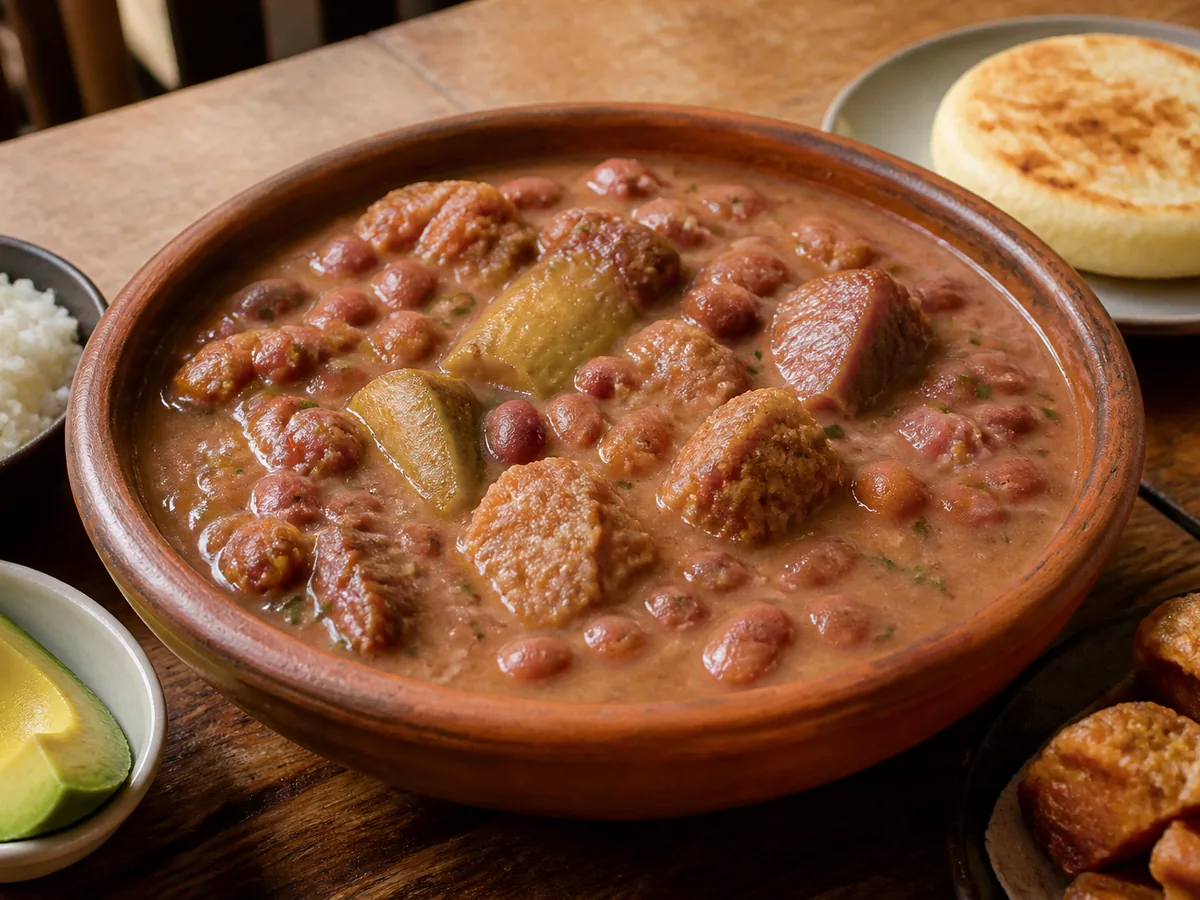
Cargamanto beans should crush between tongue and palate with a creamy centre and a skin that still holds its shape — not chalk at the core, and not blown into mush that turns the broth into beige paste.
Frijoles antioqueños is a bowl of beans first: hogao bloomed in the pot, optional pork for collagen and savour, carrot for sweetness, sometimes a plantain coin that softens into the broth. Rice, avocado and chicharrón can ride alongside. Bandeja paisa puts these beans on a crowded platter with much more; this is the beans plate itself, the one you ladle into a deep bowl and finish with a spoon.
When the hogao has gone jammy, the cargamanto yields creamy without splitting into mush, and the broth coats the spoon with quiet pork silk or honest bean body, the pot is where it should be. Salt late, simmer soft, serve hot with rice and avocado — and let bandeja be an option, not a hostage demand.
Beans
- 500 gabout 1 lb / 2½ cupsDried cargamanto beans, sorted and rinsedcranberry, Roman or borlotti-type speckled beans
- Water for soaking, enough to cover by 8 cm / 3 in
- 2.5–3 L10–12 cupsFresh water for cooking, to startyou will adjust
Optional pork (collagen and savour)
- 500–700 g1–1½ lbPork hock (codillo), meaty pork ribs, or a mixskin-on hock preferred when you want body in the broth
- 100 g3½ ozSalted pork belly or tocino, dicedoptional; rinse it if very salty
Hogao (the Antioquian sofrito that defines the pot)
- 45 ml3 TbspNeutral oil or pork fat
- 2 medium2 mediumRipe tomatoes, finely diced or grated on the large holesabout 300 g / 10 oz
- 2 medium2 mediumWhite or yellow onions, finely dicedabout 300 g / 10 oz total
- 3–4 cloves3–4 clovesGarlic, minced
- 2–3 stalks2–3 stalksScallion — white and light green minced, dark greens sliced for the finish
- ½–1½–1Ají or mild green chile, mincedoptional — paisa hogao is savoury, not a heat bomb
- 2.5 ml½ tspGround cumin
- Fine sea salt and freshly ground black pepper — salt late for the beans, but a pinch in the hogao bloom is fine
Pot vegetables
- 2 medium2 mediumCarrots, cut into thick coins or batonsabout 200 g / 7 oz
- 1 ripe1 ripePlantain (plátano maduro), peeled and cut into 3–4 cm / 1¼–1½ in chunksoptional, but traditional in many home pots; adds gentle sweetness
- 1 leaf1 leafBay leaf
- 1 small1 smallPotato, peeled and chunkedabout 150 g / 5 oz; optional, for extra body if you skip the pork
To finish and serve
- Cooked white rice
- Ripe avocado, sliced
- Chicharrón or crisp fried pork skin, broken into pieces, optional
- Reserved hogao, spooned on top
- Lime wedges, cilantro or extra scallion greens, optional
- An arepa on the side, if you are building toward bandeja territory without committing to the full tray
Why soak
Dried cargamanto beans rehydrate unevenly if you throw them straight into a hard boil. An overnight soak plumps the cotyledon so heat reaches the centre before the skin ruptures. Soft creamy interiors with intact skins come from gentle simmering after a proper soak, not from violent boiling that explodes beans into the broth.
When to salt
Salt early in the bean water slows softening in some hard-water kitchens and can leave tough skins if you dump a heavy handful at the start. Season the hogao lightly, then salt the pot late — after the beans crush easily — so the seasoning lands in a finished texture instead of fighting the cook.
What the pork does
Hock and ribs contribute collagen that melts into gelatin as the pot holds near a soft simmer, roughly 90–95 °C / 194–203 °F in the liquid. That gelatin gives the broth a light coat on the spoon without flour. Skip the pork and the beans still stand — mash a ladle against the pot wall near the end for body without meat.
What hogao does
Hogao is not a raw tomato salsa stirred in at the end. Tomato, onion, garlic and scallion bloom in fat until sweet and jammy, and that concentrate is what makes Antioquian beans taste like themselves rather than plain boiled legumes with onion floated on top.
Passive time, counted separately
The beans need an 8–12 hour soak, or a 1-hour hold after a quick-soak boil. That is hands-off and sits outside the times quoted above: either an overnight soak and a next-day simmer, or a same-day quick-soak and simmer if you start early.
Equipment
- Heavy pot, Dutch oven or deep cazuela
- Skillet for the hogao
- Colander and a tray for sorting beans
- Ladle for skimming
- Deep warm bowls for serving
Method
On the beans — soak or quick-soak
Spread the dried beans on a tray and pick out stones, dirt clumps and shrivelled orphans. Rinse in a colander under cold water until it runs clearer.
Overnight soak, preferred: cover with cold water by at least 8 cm (3 in) in a non-reactive bowl and soak 8–12 hours at cool room temperature. If the kitchen runs above about 27 °C / 80 °F, soak in the fridge. Ready beans look plump, and a gentle squeeze splits the skin to show a hydrated interior.
Quick-soak, the honest same-day path: cover the sorted beans with water by 8 cm (3 in) in a pot, bring to a hard boil for 2–3 minutes, then kill the heat, cover and hold 1 hour. Drain. The texture is close to overnight for reasonably fresh beans; very old beans may still need a longer simmer.
Drain the soak water and start the cook in fresh water. Discarding the soak water keeps the pot cleaner-tasting; the flavour gets built with hogao and pork instead.
Sort and rinse beans; cover by 8 cm (3 in) cold water and soak 8–12 hours, refrigerating if above 27 °C / 80 °F. Alternatively, boil under the same water depth 2–3 minutes, cover off heat 1 hour. Drain and use fresh cooking water.
On the pork — rinse, simmer for collagen30–45 min if simmered separately
If you are using hock or ribs, rinse them under cold water and pat dry. If the hock is heavily salted or smoked, a 30–60 minute cold-water soak with one change helps, so the beans do not go salty before they soften.
You can simmer the pork alone in a separate pot of water for 30–45 minutes first, skimming the foam, then add the meat and some of that liquid to the beans — a cleaner broth with slightly more control. Or add the rinsed pork directly with the drained beans and fresh water for a one-pot path. Both are home-kitchen honest.
The target is meat that pulls from the bone after the full bean simmer, and a broth that feels lightly viscous when cool on a spoon. Collagen conversion wants time at a gentle simmer, not a brief hard boil.
Rinse and dry optional hock or ribs; soak heavily salted or smoked hock in cold water 30–60 minutes, changing water once. Simmer separately 30–45 minutes, skimming, then add meat and some broth to beans, or cook together from the start. Continue until meat pulls from bone.
On the hogao — bloom without scorching16–22 min
Warm 45 ml (3 Tbsp) oil or pork fat in a skillet over medium heat until it shimmers — about 160–170 °C / 320–340 °F at the surface, not smoking.
Add the diced onion and a pinch of salt, and cook 6–8 minutes, stirring, until translucent and sweet-smelling with the edges just turning gold. Rushing leaves raw onion in a sauce that should taste round.
Add the garlic and the white and light-green scallion, and stir 60–90 seconds until fragrant, not brown-bitter.
Add the tomato, cumin, optional chile and black pepper. Cook 8–12 minutes, stirring often, until the tomato collapses, the water cooks off, and the mixture looks jammy and oil-tinted red. It should smell sweet-savoury and cooked, not sharply raw. If it sticks and darkens toward bitter brown, lower the heat and splash in a spoon of water — you want bloom, not burn.
Taste. It should be concentrated enough that a spoonful could season rice on its own. Reserve 2–3 Tbsp for finishing the bowls if you like a red ribbon on top; the rest goes into the bean pot.
Heat 45 ml (3 Tbsp) fat to 160–170 °C / 320–340 °F. Soften onion with a pinch of salt 6–8 minutes; add garlic and scallion whites 60–90 seconds. Add tomato, cumin, optional chile and pepper; cook 8–12 minutes until jammy. If sticking, lower heat and add a spoon of water. Reserve 2–3 Tbsp for serving.
On the pot — timed simmer1 hr 15 min – 2 hr 15 min
Put the drained beans in a heavy pot with fresh water to cover by about 5 cm (2 in), and add the bay leaf. Add the pork now if you are taking the one-pot path, or add already-simmered pork with some of its broth.
Bring toward a boil over medium-high heat, then immediately drop to a gentle simmer — small bubbles breaking, the liquid around 90–95 °C / 194–203 °F, not a rolling chaos that blows skins. Skim the foam in the first 10–15 minutes.
Partially cover and simmer 45–60 minutes before adding the carrot and the optional plantain and potato. Hard vegetables added early can over-soften if the beans are old and need 2 hours; if your beans are young and soften fast, add the carrot earlier so it is tender when the beans are done.
Add the carrot coins and plantain chunks, and continue simmering until the beans crush easily between tongue and palate with creamy interiors — a total simmer often 1¼–2¼ hours from the start for soaked cargamanto. Taste every 20 minutes after the first hour. Skins should be tender, not plastic; interiors paste-soft, not chalky.
Stir in most of the hogao and simmer uncovered 15–25 minutes, so the concentrate marries the broth and the liquid reduces to a spoon-coating consistency — not watery tea, not refried-bean paste.
Salt now, tasting first, because the pork and hogao already contributed. Add fine salt in 2–3 g (about ⅓–½ tsp) increments, stirring and tasting. Black pepper to finish. If the broth tastes flat once the salt is right, a squeeze of lime in the bowl at service wakes it more than more salt in the pot.
Pull the pork bones out for cleaner bowls, shredding or chopping the meaty bits back into the pot, and discard the bay leaf. Adjust the thickness: mash ½–1 cup of beans against the pot wall and stir for body, or add hot water in 60 ml (¼ cup) splashes if it is too tight.
Cover drained beans by 5 cm (2 in) fresh water; add bay and optional pork. Bring toward boiling, then simmer at 90–95 °C / 194–203 °F, skimming 10–15 minutes. Partially cover 45–60 minutes; add carrots and optional plantain and potato, earlier for fast-softening beans. Cook until creamy, checking every 20 minutes after the first hour. Add hogao; simmer uncovered 15–25 minutes. Salt in 2–3 g (⅓–½ tsp) increments and add pepper. Remove bones and bay, return meat; mash ½–1 cup beans or add 60 ml (¼ cup) hot water to adjust thickness.
Plate it
Ladle the beans into a deep warm bowl so the broth pools. Rice goes beside, or under a lighter ladle. Avocado slices on top, chicharrón crumbled over for crunch if you have it, a spoon of the reserved hogao, scallion greens, and lime on the rim.
That is a standalone Antioquian bean bowl. If someone asks for bandeja you are halfway there — add egg, arepa, more protein — but the crowded tray is not required for the beans to count.
Ladle hot beans and broth into warm bowls with rice beside or underneath. Top with avocado, optional crisp chicharrón, reserved hogao and scallion greens; serve lime wedges and an optional arepa alongside.
Sensory checkpoints and temperatures
- Soak done: beans plump, the skin slipping with a gentle pinch.
- Simmer liquid: a soft bubble at 90–95 °C / 194–203 °F, smelling earthy-bean and sweet with hogao, not of a scorched bottom.
- Bean done: creamy interior, skin intact, no chalk; a crushed bean thickens the broth slightly.
- Hogao: jammy red and sweet-savoury with the oil separated in a tiny sheen — not watery salsa, not bitter brown.
- Broth: coats a spoon lightly. The pork path feels silkier from gelatin as it cools a few degrees.
- Pork: pulls from the bone, the edible bits moist rather than stringy-dry.
- Serving: the bowl hot enough that steam rises, with the avocado cool against it for contrast.
Check soaked beans are plump; simmer gently at 90–95 °C / 194–203 °F until creamy inside with tender intact skins. Hogao should be jammy, broth lightly coat a spoon and pork pull moistly from bone. Serve steaming hot with cool avocado.
Pressure-cooker departure — label it
This moves beans from perfect to blown in a narrow window, so watch it closely. It is a labelled shortcut, not the lead method.
Pressure, then finish open40–50 min
After the soak, cook the drained beans with water to cover by 3 cm (1¼ in), the bay leaf and the pork, at high pressure for 25–35 minutes, with a natural release of 15 minutes.
Finish open on the stove with the hogao, then the carrot and plantain, simmering until tender, and salt late as in the main method.
After soaking, cover drained beans by 3 cm (1¼ in) water; add bay and pork. Cook at high pressure 25–35 minutes, then release naturally 15 minutes. Finish uncovered with hogao, then carrot and plantain; simmer until tender and salt late.
Storing it
Cool leftovers within 2 hours and refrigerate in shallow covered containers at or below 4 °C / 40 °F for up to 4 days. Beans thicken overnight — loosen with water or unsalted stock when reheating. Reheat on the stove over medium-low until steaming throughout, at least 74 °C / 165 °F in the centre, stirring so the bottom does not catch. A microwave works in bursts, stirring between.
Freeze bean-and-broth portions up to 2 months and thaw overnight in the fridge; the plantain softens further after freezing, which is still fine in a home bowl. Avocado, rice and chicharrón are best fresh at service, so store them separately. Pork and beans are moist, protein-rich leftovers — do not leave the pot on the counter all afternoon after the party.
Troubleshooting
- The beans are still hard after hours.
Old beans, hard water, or acid and tomato added too early in a long cook without enough time after. Keep simmering gently. A tiny pinch of baking soda, about ⅛ tsp, can help stubborn pots — use it sparingly, or the flavour turns soapy. Next time soak longer and buy fresher cargamanto.
- Skins blown, broth muddy.
A rolling boil, or overcooking after doneness. Keep a soft simmer and stop when the interiors go creamy. Mash intentionally if you want thickness, rather than boiling past the window.
- Chalky centres with soft skins.
Under-soaked, or uneven heat. Extend the soak, maintain an even simmer, and cut the salt even later.
- The broth is thin and sad.
A short cook, no pork collagen, or too much water. Simmer uncovered to reduce, mash a ladle of beans, and next time include a hock.
- Too salty.
Salted pork, or heavy salt too early. Dilute with unsalted cooked beans and water, and serve with plain rice and avocado. Next time rinse the pork and salt late.
- Flat flavour.
The hogao was under-bloomed, or omitted. Cook a quick fresh hogao in a skillet and stir it in; cumin and scallion at the end help.
- A bitter edge.
Scorched hogao, or a burned pot bottom. Do not scrape black bits into the beans — transfer to a clean pot, and balance with a little sweet plantain if it is already in.
- A greasy surface.
Fatty pork without enough simmer time to emulsify, or excess oil in the hogao. Skim it; next time trim, or pour off the excess after the first pork simmer.
Substitutions
Traditional: Antioquian cargamanto, or a similar cranberry-type bean, simmered with a hogao of tomato, onion, garlic and scallion; often pork hock or ribs; carrot common; ripe plantain in many home pots. Served as beans with rice and sides, and famously as the bean component of bandeja paisa without being identical to the full tray.
Accepted departures
Cranberry, Roman or borlotti beans when labelled cargamanto is unavailable. Quick-soak. A pressure cooker with an open finish. A vegetarian pot with extra mashed beans and a splash of oil for body. Frozen hogao base made ahead. Smoked hock when fresh is scarce — watch the salt.
Departures that are not traditional
Canned chilli-style beans with cumin-heavy Tex-Mex seasoning called antioqueños. A black-bean-only feijoada swap without renaming it. Sugar-heavy barbecue sauce in the pot. Skipping hogao entirely and relying on bouillon cubes. Those are other bowls.
Scaling
For 2–3 bowls
250 g (½ lb) beans, half the hogao and carrot, and a small rib portion — or skip the pork and mash for body. Water volume is not perfectly linear, so keep the beans covered and reduce at the end by eye.
For 10–12 people
Double the beans and hogao, and use a wide pot so the simmer stays even. Bloom the hogao in two skillets if crowded. Do not double the salt automatically — season late, after tasting. Collagen from one large hock may be enough for a double bean batch; two hocks make a meatier pot.
Holding it
Hold finished beans on the lowest heat, loosening with hot water as they thicken. Hogao can be made a day ahead and refrigerated.
What to serve it with
Keep the bowl the star; do not bury it under five competing sauces.
- White rice, the default starch
- Sliced avocado
- Chicharrón, for crunch
- Arepa and a fried egg, if you are nodding at bandeja without plating the whole tray
- Sweet ripe plantain on the side, if you kept plantain out of the pot
- Hogao on the table, for anyone who wants more red savour
- Panela water, fresh juice, or a cold beer
Questions
Cargamanto, or another bean?
Cargamanto, a cranberry type, is the Antioquian classic: mottled, and creamy when done. Borlotti, Roman or cranberry beans are the usual substitution. Navy or black beans change the identity — rename the bowl if you switch.
Must I use pork?
No. Vegetarian frijoles with a full hogao and a mashed-bean finish are honest home food. Pork adds collagen and savour; it is not a legal requirement.
When do I salt?
Late, after the beans are tender. Light salt in the hogao is fine. Heavy salt in the soak, or at minute zero, fights softening and risks tough skins.
Soak or no-soak?
An overnight soak is the default for creamy centres and intact skins. Quick-soak works. True no-soak needs more water, more time and more attention, and the skins blow more easily — dumping dry beans into a short weeknight boil will not give Antioquian texture.
Can these be the bandeja beans?
Yes. This pot is what belongs on bandeja paisa next to rice, egg, chicharrón, avocado and arepa. Here they are plated as the beans bowl so the recipe stays focused.
Plantain in the pot, or on the side?
Both exist. In the pot it sweetens and softens into the broth; on the side it stays a distinct sweet contrast. Pick one path so the bowl does not go dessert-sweet.
How do I know the collagen did its job?
Chilled leftover broth should tremble lightly, like thin aspic at the edge of a spoon, without setting into rubber. Hot, it just feels silky and coats.