Buñuelos
Fresh cheese bound with cornstarch and yuca starch, rolled into spheres and fried until the shell blisters gold and the centre opens into a light hollow. A savoury-leaning cheese fritter with a sweet edge — not a yeast doughnut hole, and not a syrup soak.
- Prep
- 15 min
- Cook
- 30 min
- Serves
- About 20–24 medium buñuelos
- Difficulty
- Medium
Researched · Kitchen testing pending
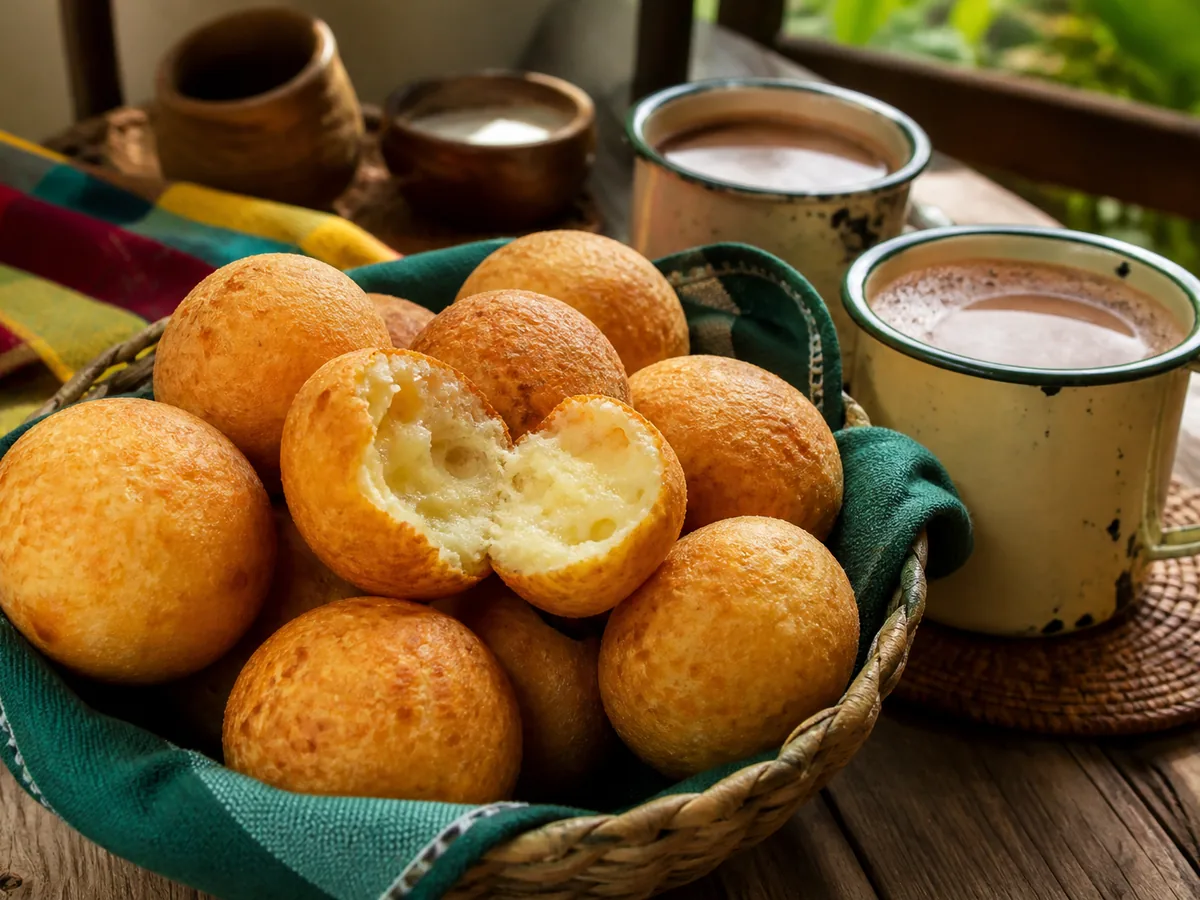
A Colombian buñuelo should crackle at the shell and give way to a light, almost hollow interior that smells of fried cheese and clean starch — not a dense dough cannonball, not a yeast doughnut hole, and not a Spanish wine fritter wearing a borrowed name.
Cuajada or queso fresco goes into cornstarch and yuca starch to make a dough that rolls or pipes into spheres, then fries at 175–180 °C / 350–355 °F until the surface blisters gold and the centre opens into that signature airy pocket. Christmas tables claim them next to natilla, but street carts and home kitchens fry them year-round. This is the cheese fritter, not a sugar-syrup soak.
When the oil holds its window, the shell blisters gold, and the first break shows that light hollow instead of a dough brick, the batch is right. Keep the cheese milky, the starches balanced, and the spheres sealed. The crackle does the rest.
Dough
- 250 gabout 9 ozCuajada or firm queso fresco, finely grated or crumbledsee the cheese note below
- 120 g1 cupCornstarch (maicena)
- 120 g1 cupYuca, tapioca or cassava starch (almidón de yuca)not wheat flour as the main body
- 100–110 g2 largeEggs, at room temperatureweight without shells
- 15–30 ml1–2 TbspWhole milk or wateronly as needed to bring the dough together
- 8 g1½ tspFine sea saltreduce it if the cheese is very salty
- 10 g2 tspGranulated sugara traditional whisper of sweetness, not dessert dough
- 5 ml1 tspBaking powderoptional, but common in modern home batches for lighter hollows
- 15 g1 TbspSoft unsalted butter, or a spoon of rich milkoptional, for tenderness
For frying
- 1.5–2 L1½–2 qtNeutral high-smoke-point oil — canola, sunflower or vegetableenough for 5–7 cm / 2–3 in depth in a heavy pot; the volume depends on pot width
- A thermometer — clip-on deep-fry, or an accurate instant-read. Strongly recommended
The cheese note — read this before shopping
Traditional lean is Colombian cuajada, a fresh milk curd cheese: mild, milky, slightly tangy, moist but not wet. Firm queso fresco that you can grate is the closest widely available stand-in.
Labelled substitutions
150 g (5 oz) queso fresco plus 100 g (3½ oz) low-moisture mozzarella, finely grated, for mildness and a slight stretch. Or 180 g (6 oz) queso fresco plus 70 g (2½ oz) finely grated Parmesan for salt and savour, cutting the dough salt to match. Avoid wet fresh mozzarella in brine, and avoid cream cheese as the main cheese — both make greasy, flat fritters. Ricotta must be drained heavily in cheesecloth until crumbly-dry or the dough turns to batter, and even then it is a departure.
Taste the cheese first
If it is bland, keep the full salt. If it is briny, cut the salt in half and adjust after a test fry.
Why starch and cheese, not wheat flour
Buñuelos colombianos lean on cornstarch and yuca starch, not a gluten network. Cornstarch crisps and lightens; yuca starch gelatinises and helps the interior pull open into a hollow rather than baking into a cake crumb. Cheese provides fat, protein and the savoury perfume that makes the fritter Colombian, and the eggs bind. Milk loosens only if the cheese was dry.
How the hollow forms
Hollow centres appear when surface starch sets fast in hot oil while steam and expanding gases inflate the interior before the wall hardens. Oil that is too cool lets the sphere drink fat and stay dense; oil that is too hot browns the shell before the centre inflates, giving burnt cannonballs with raw hearts. The 175–180 °C / 350–355 °F window is where this dough belongs.
Equipment
- Mixing bowl and a sturdy spoon, or clean hands
- Digital scale — cups of starch pack inconsistently, so weight wins
- Deep heavy pot or Dutch oven for frying
- Clip-on thermometer
- Spider or slotted spoon
- Piping bag with a large round tip, 15–18 mm, optional
- Wire rack set over a tray, or paper towels
Method
On the dough — mix until it rolls or pipes15–20 min
Whisk the cornstarch, yuca starch, salt, sugar and baking powder, if using, until evenly combined with no baking-powder pockets.
Add the grated cheese and toss so every starch grain meets cheese. The mixture should look like damp sand with white flecks.
Make a well, add the eggs and the optional butter, and mix with a spoon and then your hands until a soft, cohesive dough forms. It should feel like soft play-dough or thick cookie dough — pliable and slightly tacky, not sticky soup and not dry rubble.
If it is dry and cracking when squeezed, add milk or water 5 ml (1 tsp) at a time. If it is wet and smearing, add cornstarch and yuca starch in equal spoonfuls, about 1 Tbsp each, until it holds a ball. Cheese moisture varies — chase texture, not a fixed liquid number.
Knead gently for 30–60 seconds in the bowl, until smooth enough to roll. Do not work it like bread; there is no gluten to develop, and overworking can tighten the mass.
Rest it covered 10–15 minutes at room temperature if the dough springs back hard when rolled — it relaxes and seals cleaner. Or proceed immediately if it already shapes without cracks.
Taste firm, dry cheese first; halve salt if briny. Mix starches, salt, sugar and optional baking powder; add cheese, eggs and optional butter. Adjust dry dough with 5 ml (1 tsp) milk or water; wet dough with 1 Tbsp each starch. Knead gently 30–60 seconds; rest covered 10–15 minutes only if springy.
Shaping — roll or pipe10–15 min
Roll path, the classic hand method: pinch 35–40 g (about 2 Tbsp) portions and roll them between lightly oiled or starch-dusted palms into smooth balls with no deep cracks. Cracks open in the fryer and drink oil. Do not compress them into rock-hard spheres — dense packing fights the hollow.
Pipe path, for a crowd: load a piping bag with a large round tip and pipe 3–4 cm (1¼–1½ in) mounds onto a lightly starch-dusted tray, then roll each briefly between oiled palms to seal the seams into spheres.
Roll 35–40 g (about 2 Tbsp) portions into smooth, loosely formed balls using lightly oiled or starch-dusted palms. Seal cracks without compressing. Alternatively, pipe 3–4 cm (1¼–1½ in) mounds onto a starch-dusted tray, then roll to seal.
On the oil — heat and hold the window10 min
Pour oil to a depth of 5–7 cm (2–3 in) and clip on the thermometer. Heat over medium to medium-high until it reads 175–180 °C / 350–355 °F. The surface should shimmer, and a tiny dough scrap should sizzle immediately and rise with lively bubbles — not sink in silence, and not explode in violent foam.
Adjust the burner to hold that window. Adding cold dough drops the temperature, so let it recover between batches. Frying below about 165 °C / 330 °F greases the crumb; above about 190 °C / 375 °F darkens the shell before the centre opens.
Have the rack or towel tray ready before the first ball goes in. Once frying starts, you stay at the pot.
Heat 5–7 cm (2–3 in) oil to 175–180 °C / 350–355 °F and monitor continuously. Let temperature recover between batches; avoid below 165 °C / 330 °F or above 190 °C / 375 °F. Prepare a draining rack and stay beside the pot.
On the fry — timed method for hollow shells6–9 min per batch
Lower 4–6 balls into the oil gently with the spider or a spoon. Do not crowd — crowding collapses the temperature and fuses fritters together.
They should sink briefly, then rise and bob. Turn them every 1–2 minutes so the colour evens out. Total fry time is usually 6–9 minutes depending on size. Listen for a steady sizzle, and smell toasted cheese and clean starch rather than acrid smoke.
Visual cue: the exterior turns deep ivory to light gold with tiny blisters. When you lift one it feels light for its size, and sounds faintly hollow if you tap it with a spoon after a brief drain. A dense, heavy feel means it is underinflated, or the dough was too wet or too tight.
Sacrifice one early and break it open. The interior should show an airy cavity, or an open crumb with thin walls — not a wet dough plug, and not a solid cheese brick. If the centre is raw-doughy, the oil may be too hot, so the shell set too fast, or the balls too large. Drop the temperature about 5 °C (10 °F) and fry 1–2 minutes longer next batch, or roll slightly smaller.
Drain on the rack. The salt is already in the dough; a tiny extra pinch outside is optional and untraditional. Serve hot or warm.
Between batches, skim the crumbs so they do not burn and flavour the oil, and recheck 175–180 °C / 350–355 °F before the next load.
Gently fry 4–6 balls for 6–9 minutes, turning every 1–2 minutes until light gold and airy. Open one to check for a cooked, hollow or open centre. If doughy, lower oil 5 °C (10 °F) and extend the next batch 1–2 minutes, or shape smaller. Rack-drain; skim crumbs and restore 175–180 °C / 350–355 °F between batches.
Plate it
Pile the buñuelos in a warm basket lined with a clean cloth, so steam does not sog the bottoms.
They belong on the table with coffee, hot chocolate, or — especially in December — beside a bowl of natilla. That cinnamon-scented cornstarch custard is the classic partner, and it belongs on its own recipe card rather than this one.
Year-round, the fritters stand alone as a savoury-leaning snack with a sweet edge.
Place warm buñuelos in a warm basket lined with a clean cloth so the bottoms do not become soggy. Serve with coffee, hot chocolate or a separate bowl of natilla.
Sensory checkpoints and temperatures
- Dough: soft and cohesive, rolling without deep cracks, smelling milky-cheesy and starchy.
- Oil: 175–180 °C / 350–355 °F held steady, with a lively sizzle on contact.
- During the fry: even gold, steady bobbing, a cheese-toast aroma.
- Done: light in the hand, crisp shell, hollow or open interior, and no grease puddle inside when broken.
- Failure smells: burnt starch or cheese means the oil is too hot, or crumbs were left in it. Raw dough means underfried, or oversized.
- Eating window: best within 20–30 minutes of frying, while the shell still crackles.
Check smooth dough, steady oil at 175–180 °C / 350–355 °F and evenly golden fritters. Break one open: it should feel light, with a crisp shell and airy cooked interior, without pooled grease. Serve within 20–30 minutes for the best crunch.
Storing it
Buñuelos are at their peak fresh. Hold them at room temperature, uncovered or loosely covered, for a few hours; they soften as they sit. Re-crisp on a rack in a 180 °C / 350 °F oven for 5–8 minutes. Microwaving makes them briefly soft and then tough — avoid it if you care about the shell.
Refrigerate leftovers in a shallow container up to 2 days, and reheat in the oven or air fryer until hot in the centre, at least 74 °C / 165 °F for safety-conscious service. Freezing after frying works: cool completely, freeze in a single layer, and bag up to 1 month; reheat from frozen at 180 °C / 350 °F for 10–14 minutes.
Raw dough, and hot oil
Dough with egg refrigerates covered up to 24 hours; bring it toward cool room temperature before rolling so the spheres seal. Fry only in stable oil, never leave a hot pot unattended, keep a lid nearby for flare-ups, and discard oil that smells burned or smokes early.
Troubleshooting
- Dense, with no hollow.
Oil too cool, dough too wet, balls packed too hard, or the baking powder omitted when the cheese was very heavy. Hold 175–180 °C / 350–355 °F, dry the dough slightly, roll gently, and try the optional baking powder next batch.
- Greasy and heavy.
Oil under about 165 °C / 330 °F, or an overcrowded pot. Recover the temperature and fry fewer at a time.
- Dark outside, raw inside.
Oil above about 190 °C / 375 °F, or balls too large. Lower the heat, roll 30–35 g, and extend the time slightly within the correct window.
- Cracks that drink oil.
Dough too dry, or seams not sealed. Add a teaspoon of milk and roll until smooth.
- Flat discs.
Dough too wet — wet mozzarella or ricotta — or oil far too cool. Drain the cheese, add starch, and fix the temperature.
- Bland.
The cheese was too mild and the salt too low. Next batch, bump the salt slightly, or blend in a little Parmesan as a labelled departure.
- Too salty.
Briny queso, or heavy Parmesan. Cut the dough salt, and serve with unsalted chocolate or coffee to balance.
- Hollow, but with thick tough walls.
Overfried, or the dough was overworked. Pull at light gold, and mix gently next time.
- They deflate after draining.
Rare with this starch dough — it usually means an underfried shell. Return them to the oil for 1–2 minutes.
Substitutions
Traditional: Colombian cheese buñuelos from cuajada, or a similar fresh cheese, bound with cornstarch and yuca starch, shaped into balls and deep-fried until light and hollow-crisp. A Christmas icon alongside natilla, and also everyday street and home food.
Accepted departures
Queso fresco with mozzarella or Parmesan blends when cuajada is unavailable, named as substitutes. Optional baking powder. Piping for speed. An air fryer only as a distant cousin, for reheating or for people who will not deep-fry — the texture will not match a true hollow fry.
Departures that are not traditional
Yeast-raised doughnut holes tossed in cinnamon sugar and renamed. Wheat-flour-only batter fritters. Cream-cheese filling injected after frying and sold as "the Colombian one." Baking-powder biscuits cut round and fried without a cheese-starch dough. Different fritters, different names.
Scaling
Small batch, 8–10
Halve everything, and use a smaller pot so the oil depth still covers.
Party double batch
Mix the dough in two bowls so hydration stays even, and keep unfried balls covered so they do not dry and crack. Fry in relays, holding finished ones in a 95 °C / 200 °F oven on a rack for up to 20 minutes. Do not double the salt blindly — cheese varies.
On oil volume
It depends on pot width, not dough mass. Keep the depth at 5–7 cm (2–3 in) whatever the batch size.
What to serve it with
Skip heavy frosting or syrup baths; these are cheese fritters, not glazed yeast doughnuts.
- Natilla, the classic Christmas partner — cook it from its own recipe
- Hot chocolate, or tinto, year-round
- Sugar cane water or a panela drink
- A simple fruit plate, if the table is already rich
Questions
Cuajada or queso fresco?
Cuajada is the Colombian ideal: fresh curd, mild, gratable. Firm queso fresco is the practical substitute. Soft, watery "fresh cheese" must be drained or the dough fails.
Cornstarch and yuca starch — can I use only one?
Both together is the traditional balance: corn for light crisp, yuca for stretch and hollow. All cornstarch works in a pinch but fries more fragile and chalky; all yuca starch fries chewier. Fifty-fifty is the default.
Why 175–180 °C / 350–355 °F?
Hot enough to set the shell and inflate the centre, cool enough to cook through without burning. That window is the difference between hollow-crisp and greasy-dense.
Hollow centres against dense balls — what went wrong?
Dense usually means cool oil, wet dough, or hard packing. Hollow-crisp comes from the correct temperature, smooth sealed balls, and a dough that holds its shape without smearing.
Do I have to serve natilla?
No. Natilla is the classic December partner, not a legal requirement for every batch. Fry buñuelos in July without apology.
Can I bake them?
You get a cheese puff, not the blistered fried shell and hollow. If you bake them, call it a baked cheese ball departure — do not pretend it is a street buñuelo.
Are they gluten-free?
As written, with pure starches and cheese, there is no wheat. Confirm the labels on your baking powder and starches if you cook for celiac guests, and avoid flour-dusted surfaces.
How far ahead can I work for a gathering?
Mix the dough the morning of, and roll and fry close to serving. Or fry, cool and re-crisp in the oven just before guests eat. Fresh from the oil is still king.