Ajiaco Santafereño
Bogotá in a pot — chicken, three potatoes doing three different jobs, corn on the cob, and guascas until the kitchen smells like the highlands. Cream, capers and avocado go on the side so each person finishes their own bowl. Not Cuban ajiaco.
- Prep
- 45 min
- Cook
- 1 hr 15 min
- Serves
- 6 generous bowls
- Difficulty
- Medium
Researched · Kitchen testing pending
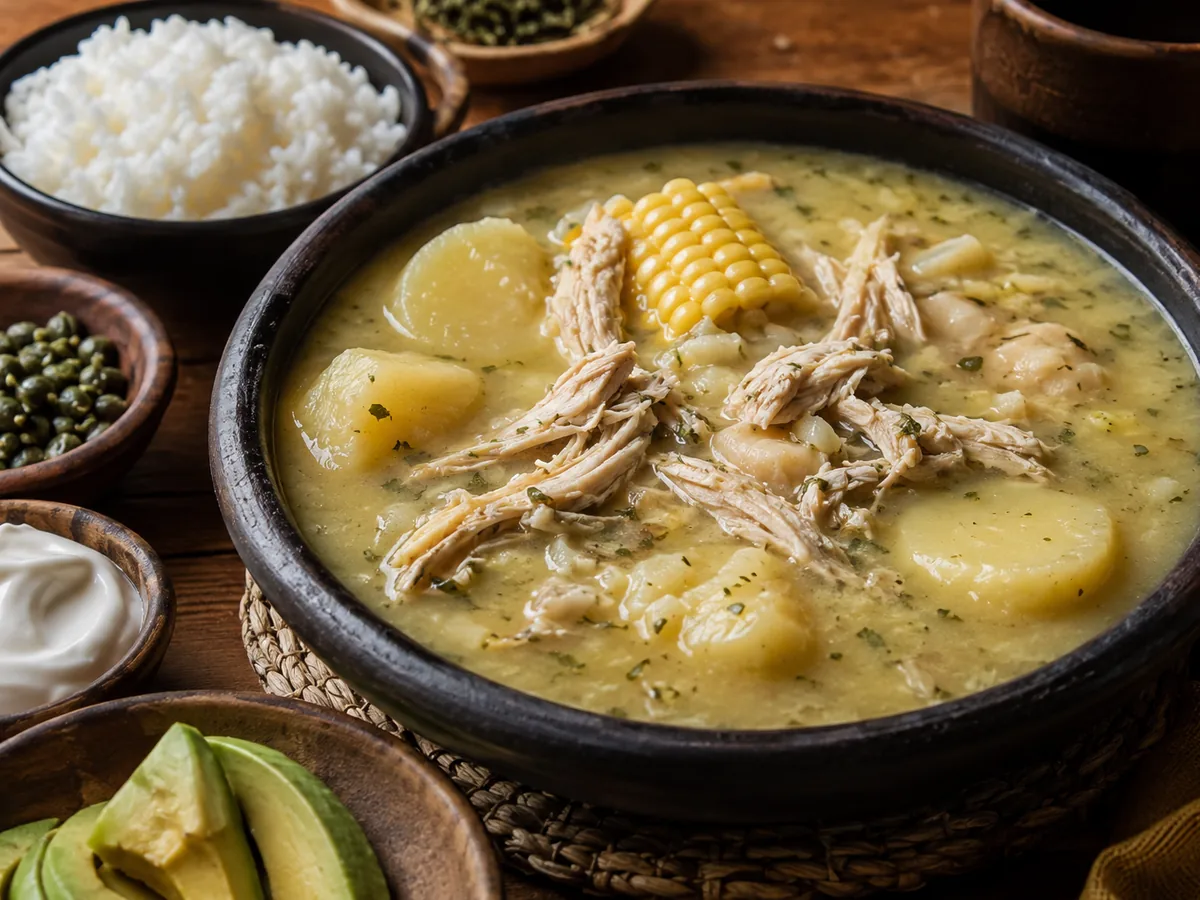
This is Bogotá in a pot: chicken, three potatoes that do three different jobs, corn on the cob, and guascas in the broth until the kitchen smells like the highlands.
It is not Cuban ajiaco — no pile of yuca, malanga and pumpkin, no tasajo. Here the body comes from pastusa starch breaking down, the spoonfuls of whole potato from sabanera that hold their shape, and the yellow colour-sweetness from criolla. Cream, capers, avocado and more guascas go on the side, so each person finishes their own bowl.
The pot is right when the guascas hit the steam and the broth turns from “chicken soup” into Bogotá — then the cream ribbons in, and a caper cracks salt against the soft yellow potato.
Chicken and broth
- 1.5 kgabout 3⅓ lbBone-in chicken piecesthighs and drumsticks mixed with a breast or two; skin-on for flavour, skim later if you want a cleaner surface
- 2.5 Labout 10½ cupsCold waterplus more as needed to keep everything covered
- 1 large1 largeWhite onion, peeled and halved250 g / 9 oz
- 4 cloves4 clovesGarlic, smashed
- 22Scallions, whole60 g / 2 oz
- 10 g2 tspFine saltplus more to taste
- 4 g1 tspWhole black peppercornsor 1 g / ¼ tsp ground
- Optional — 1 small bunch of cilantro stems, with the leaves reserved for garnish
Three potatoes (the roles matter)
- 500 g1.1 lbPapa pastusa, peeled and cut into large chunks about 4 cm / 1½ inrusset or baking potato as a substitute; this is the one that breaks down and thickens
- 500 g1.1 lbPapa sabanera or papa negra, peeled and cut into medium chunks about 3 cm / 1¼ inYukon Gold or red potato as a substitute; this one holds its shape
- 400 g14 ozPapa criolla, halved if larger than a walnutsmall yellow Andean potatoes, sold frozen in many Latin markets; colour and sweet-earthy flavour
Corn, guascas, finish
- 2 ears2 earsFresh corn, shucked and cut into rounds 4–5 cm / 1½–2 inor 300 g / 10 oz frozen corn-on-the-cob pieces
- 5–8 g2–3 Tbsp loosely packedDried guascas, crumbledor a generous handful of fresh guascas if you can find them
- Freshly ground black pepper
Table accompaniments (do not skip)
- 120 ml½ cupHeavy cream or Colombian table cream (crema de leche), in a small pitcher
- 40 g¼ cupCapers, drained
- 2 ripe2 ripeHass avocados, sliced
- Extra dried guascas in a small dish
- 200 g1 cup rawWhite rice, cooked plainoptional, but common in many Bogotá homes
- Ají or hot sauce, optional
Why three potatoes
Ajiaco santafereño thickens without flour or cream in the pot. Pastusa, a floury highland potato, sheds starch into the broth and partially collapses — that is the body. Sabanera stays intact so every ladle has recognisable potato. Criolla is smaller, yellow and perfume-sweet; it softens faster and stains the broth gold. Using only one type gives you either glue or clear soup, which is why they go in on a staggered clock.
Why guascas
Guascas is the herb that makes this bowl read Bogotá rather than "chicken and potato soup." Dried guascas smell faintly of green hay, and they bloom in hot broth. Leave them out and guests will ask what is missing even if they cannot name it.
The side dishes are part of the dish
Capers add salt-acid pops, cream softens the herbal edge, and avocado adds cool fat. Those three are part of the eating ritual, not garnishes for photographs.
If the soup tastes bland
Salt the broth first, then add a pinch more guascas, then pass the capers. Do not dump cream into the pot to "fix" thin flavour.
Equipment
- Large heavy pot, 6–8 L / 6–8 qt
- Fine sieve
- Second clean pot, or a washed one, for the strained broth
- Instant-read thermometer
- Warm bowls, and small dishes for the table accompaniments
Method
On the chicken — clear, rich broth first35–45 min
Place the chicken in a large heavy pot with the cold water, onion halves, garlic, scallions, peppercorns, the cilantro stems if using, and 10 g (2 tsp) salt. A cold start extracts a cleaner broth than dumping meat into boiling water.
Bring to a boil over high heat, and skim the grey-beige foam aggressively for the first 8–10 minutes. This keeps the finished ajiaco from tasting muddy.
Drop to a gentle simmer — small bubbles, the pot around 90–95 °C / 195–203 °F at the surface — and partially cover. Cook 35–45 minutes, until the thickest piece reads 74 °C / 165 °F, the juices run clear, and the meat pulls from the bone with a firm tug without yet falling into shreds.
Transfer the chicken to a bowl. Strain the broth through a fine sieve into a clean pot, discarding the spent onion, garlic, scallions, stems and peppercorns. You should have roughly 2–2.2 L (8–9 cups) of clear golden broth; add water if you are short. Taste it: chicken-forward and lightly salted. Under-seasoned broth cannot be saved by potatoes alone.
When the chicken is cool enough to handle, pull the meat from the bones in large bite-size pieces. Discard the skin for a lighter bowl, or chop some back in for richness. Cover the meat so it does not dry out — it returns at the end, so it does not shred to nothing in a long potato simmer.
Combine chicken, cold water, aromatics and 10 g (2 tsp) salt. Boil, skimming 8–10 minutes; partially cover and simmer at 90–95 °C / 195–203 °F for 35–45 minutes, until chicken reaches 74 °C / 165 °F. Strain broth, topping up to 2–2.2 L (8–9 cups). Debone cooled chicken and cover.
On the potatoes — staggered for texture40–50 min
Bring the strained broth back to a lively simmer.
Pastusa first, at 0:00: add the pastusa chunks and simmer uncovered 15–20 minutes. The edges should start looking soft and frayed, and a few pieces may begin to collapse. Stir occasionally, scraping the bottom so the starch does not scorch. The broth turns from clear to lightly cloudy and coats a spoon more thickly.
Sabanera next, at 0:15–0:20: add the sabanera chunks and the corn rounds, and simmer 15 minutes more. The sabanera should pierce with a knife but still hold its cubes, and the corn turns bright and smells sweet.
Criolla last, at 0:30–0:35: add the papa criolla and simmer 10–15 minutes until tender and the pastusa has noticeably thickened the pot. Some pastusa will have melted into the liquid; that is correct.
Total potato time is roughly 40–50 minutes from pastusa-in. If the broth is still thin, mash two or three pastusa chunks against the pot wall and stir. If it is glue-thick, loosen with hot water or unsalted stock, 60–120 ml (¼–½ cup) at a time.
Simmer pastusa uncovered 15–20 minutes, stirring and scraping the bottom. Add sabanera and corn; simmer 15 minutes, then add criolla for 10–15 minutes until tender. Mash 2–3 pastusa chunks if thin; loosen thick soup with hot water or unsalted stock, 60–120 ml (¼–½ cup) at a time.
On the guascas and the reunion8–13 min
Crumble the dried guascas between your fingers into the pot — start with 5 g (about 2 Tbsp), and you can add more. Stir and simmer 5–8 minutes. The aroma should shift: greener, distinctly ajiaco.
Taste the broth and add salt until a spoonful alone tastes complete. Black pepper to taste.
Return the pulled chicken to the pot and simmer gently 3–5 minutes only, long enough to heat it back above 74 °C / 165 °F. Do not boil hard, or the meat turns stringy.
Kill the heat and rest 5 minutes. Surface fat can be skimmed for a leaner bowl, though a little left in carries flavour.
Crumble in 5 g (2 Tbsp) dried guascas; simmer 5–8 minutes and adjust salt and pepper. Return chicken for 3–5 minutes, heating above 74 °C / 165 °F without boiling hard. Rest off heat 5 minutes; skim excess fat if desired.
On the table — cream, capers, avocado
Warm the bowls. Ladle in broth, potatoes, a piece of corn and chicken. The liquid should be opaque and lightly creamy from potato starch — not a clear consommé, not wallpaper paste.
Pass the cream, capers, avocado slices and extra guascas. Each diner adds cream in a swirl, a spoon of capers, and avocado on top or to the side.
Optional white rice goes in a separate small bowl, or under the soup in some households. Alongside is the safer choice, so it does not drink the broth before the spoon gets there.
Eat while piping hot. Ajiaco cools fast in Bogotá-thin air and in air-conditioned kitchens alike.
Ladle hot soup, potatoes, corn and chicken into warm bowls. Serve cream, capers, avocado and extra guascas separately for diners to add; offer optional white rice alongside so it does not absorb the broth.
Sensory checkpoints and temperatures
- Simmer, not boil: steady small bubbles. Hard boiling emulsifies the scum back in and breaks the potatoes too fast.
- Chicken done: 74 °C / 165 °F internal before it leaves the first simmer, and heated through again at the end.
- Pastusa: fraying edges and some collapse, with the broth visibly thicker and cloudier after 20 minutes or more.
- Sabanera: intact cubes, tender centres.
- Criolla: soft and yellow, holding shape loosely, the broth tinted gold.
- Guascas: a green-herbal lift within minutes of adding. If you smell only chicken and potato, add another pinch and simmer 3 minutes.
- Finished consistency: the ladle leaves a light coat on the back of a spoon, corn and potato pieces are visible, and the chicken is in moist chunks.
Keep a gentle simmer and check chicken reaches 74 °C / 165 °F. Look for collapsing pastusa, tender intact sabanera, soft yellow criolla and broth lightly coating a spoon. If guascas aroma is weak, add a pinch and simmer 3 minutes.
Storing it
Cool leftovers quickly in shallow containers and refrigerate at or below 4 °C / 40 °F within 2 hours. Keeps 3 days. Reheat to a full simmer, at least 74 °C / 165 °F throughout — potato soups thicken hard when cold, so loosen with water or stock while reheating and re-check the salt and guascas, since dried herb aroma fades. Freeze the broth-and-potato base up to 2 months; the potatoes soften after thawing but it is still good. Freeze it without cream, avocado or capers, and add those fresh when reheating.
Raw chicken
Separate board, and wash hands and tools with hot soapy water. Do not taste-test the broth with a spoon that goes back in after touching undercooked chicken. Keep the pot out of the danger zone, 4–60 °C / 40–140 °F; if serving buffet-style, hold above 60 °C / 140 °F. Cream and avocado are table add-ins — do not leave a cream-enriched communal pot at room temperature.
Troubleshooting
- The broth tastes weak.
Under-salted, or made with boneless skinless chicken only, or the cold start and skim were skipped. Reduce uncovered 10 minutes and add salt. Bones and skin matter for body.
- The broth is muddy or grey.
The foam was not skimmed, or the boil was too violent. Skim early and keep a gentle simmer. You can strain again through cheesecloth, but prevention is better.
- The soup is too thin.
Not enough pastusa, pastusa added too late, or too much water. Mash additional cooked pastusa into the pot and simmer uncovered 10–15 minutes. Do not add flour — it tastes like cafeteria soup.
- The soup is gluey.
Too much pastusa collapse, or a vigorous boil after the starch released. Loosen with hot broth or water; next time cut the pastusa larger and avoid a rolling boil.
- Only one potato texture.
You used a single variety. Blend the types, and stagger the additions.
- It tastes like chicken soup, not ajiaco.
Missing or stingy guascas. Add more and simmer 5 minutes. Pass capers and cream — without them the ritual is incomplete and the bowl reads plain.
- The chicken is dry and stringy.
Overcooked after shredding, or breast meat simmered to death. Use bone-in thighs in the mix, pull the chicken early, and return it only to warm.
- A bitter or grassy off-note.
Too many cilantro stems left in too long, or guascas burned in a dry pan — never toast them dry for this, bloom them in liquid. Strain, and balance with salt and a bit more potato.
- The capers dominate.
Rinse salty brine-packed capers once if they are aggressive, and serve them on the side so control stays with the diner.
- It tastes flat after reheating.
Starch mutes aroma overnight. Re-salt carefully, add a pinch of guascas while reheating, and refresh with avocado and capers.
Substitutions
Traditional core: chicken broth; papa pastusa, sabanera and criolla; corn on the cob pieces; guascas; served with cream, capers and avocado. Bogotá and Cundinamarca identity — not a root-vegetable Caribbean stew.
Departures
Frozen papa criolla when fresh is impossible, thawed before adding and cooked gently. Russet for pastusa and Yukon Gold for sabanera when the Andean names are not on the shelf — say so out loud. Optional white rice on the side. Skin removed after the simmer for a cleaner bowl.
This is not Cuban ajiaco
No long list of tropical tubers as the backbone, and no dried beef as the lead protein. If someone wants that stew, cook that stew, under its own name.
No guascas at all?
Order dried guascas online or from a Latin market before you cook. Substituting oregano plus bay is a last-ditch approximation only — call the result chicken-potato soup, not ajiaco santafereño.
Scaling
For 3–4
1 kg (2.2 lb) chicken and 1.6–1.8 L (7–7½ cups) water, with potatoes scaled to roughly 300 g pastusa, 300 g sabanera and 250 g criolla, plus 1 large ear of corn. Start with half the guascas and taste. Same temperatures and staggered timing.
For 10–12
Double the chicken and water in a wider stockpot, or two pots, and double the potatoes. Keep pastusa first on the same stagger so the starch develops. Pull the chicken in batches to avoid cooling the pot too long. Hold the finished ajiaco on the lowest simmer, or in covered pots in a 90 °C / 195 °F oven, and pass the accompaniments in multiple small bowls so the end of the table is not orphaned.
The banquet mistake
Adding all the potatoes at once at a hard boil "to save time." You get either broken mush or underdone cubes, and a thin broth.
What to serve it with
- White rice, as an optional side
- Ají, or a simple chile-lime sauce, for heat lovers
- Hot chocolate or tinto afterwards — a Bogotá habit in cooler weather
- Soft bread or an arepa only if you need more starch; the potatoes already lead
Do not garnish with cheddar, sour cream dolloped like a baked potato, or tortilla strips — wrong vocabulary.
Questions
Is this the same as Cuban ajiaco?
No. Cuban ajiaco is a mixed root-and-meat stew. Ajiaco santafereño is chicken, three potatoes, corn and guascas, with cream, capers and avocado on the side. Same word, different dish, different country.
Must I use bone-in chicken?
Strongly preferred — the bones build the broth. Boneless works in a rush if you start with good unsalted stock, but the pot will taste flatter.
Dried or fresh guascas?
Both work. Dried is what most cooks outside Colombia can find: crumble and bloom it in the hot soup. Fresh is brighter — use a larger handful, added in the last 5 minutes.
What if I only find two potato types?
Prioritise one floury for the pastusa role and one waxy for the sabanera role, then add a few halved fingerlings or small yellows for a criolla echo. Explain the compromise.
Can I use a pressure cooker?
You can cook the chicken and broth under pressure in about 20 minutes, then finish the potatoes open on the stove with the stagger. Full pressure with all the potatoes at once destroys the texture map.
Cream in the pot, or on the side?
On the side. Traditional service lets each person decide, and cream in the pot muddies leftovers and can split if you boil hard later.
How thick should it be?
Between soup and light stew — a spoon should coat lightly. If a fork stands up in it, you overshot the pastusa.
What is the safe chicken temperature?
74 °C / 165 °F in the thickest part. Check before you pull the chicken from the first simmer, and again after reheating leftovers.
Can I make it a day ahead?
Yes, and it is often better. Cool, chill, reheat gently, refresh the guascas, and put out fresh avocado, cream and capers. The potatoes will be softer; that is acceptable.