Bandeja Paisa
Antioquia on a plate — red beans in their own liquor, white rice, powdered or grilled beef, blistered chicharrón, grilled chorizo, a runny-yolked egg, sweet maduro, a thick arepa and avocado to cool the fat. A composed tray, not a stew.
- Prep
- 2 hr
- Cook
- 2 hr
- Serves
- 4 composed plates
- Difficulty
- Hard
Researched · Kitchen testing pending
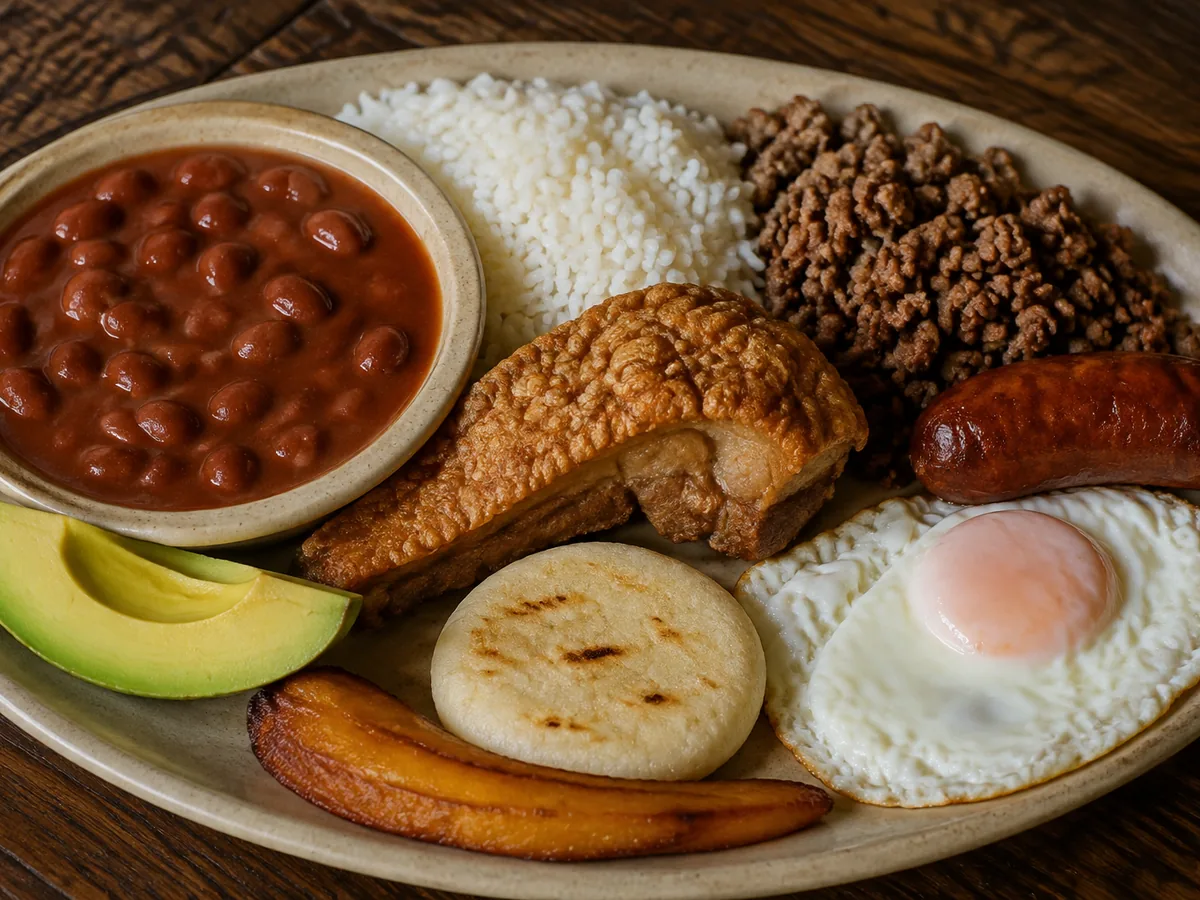
This plate is built like a small kitchen brigade, not like a single pot. The beans need hours, the hogao needs patience, and the chicharrón needs dry heat and nerve. Everything else — rice, egg, plantain, arepa, avocado — is timing, so the tray hits the table hot and composed. If one component steams while another waits cold, you get a cafeteria tray.
The target is Antioquia on a plate: red beans in their own liquor, white rice, powdered or grilled beef, blistered chicharrón, grilled chorizo, a fried egg with a runny yolk, sweet maduro, a thick arepa, and avocado to cool the fat.
When the yolk breaks over the rice and runs into the beans, and the chicharrón still ticks as it cools, the tray is doing its job — sweet, salty, soft and loud in the same bite.
Frijoles (cargamanto or cranberry beans)
- 400 g14 ozDried cargamanto, cranberry or red mottled beans, sorted and rinsed
- Water for soaking, enough to cover by 8 cm / 3 in
- 1.5 Labout 6⅓ cupsFresh water or unsalted stock, for cookingplus more as needed
- 150 g5 ozPork belly, or a piece of smoked pork hockoptional but traditional, for body
- 1 small1 smallOnion, halved100 g / 3½ oz
- 2 cloves2 clovesGarlic, smashed
- 5 cm2 inGreen plantain piece, peeledoptional — some Antioquia kitchens add it to thicken
- 8 g1½ tspFine salt, added late
- Freshly ground black pepper
Hogao (criollo sauce)
- 30 ml2 TbspNeutral oil or lard
- 1 medium1 mediumWhite or yellow onion, finely diced180 g / 6 oz
- 3 medium3 mediumRipe tomatoes, seeded and finely diced400 g / 14 oz total; peel them if the skins bother you
- 2 cloves2 clovesGarlic, minced
- 2 g½ tspGround cumin
- 3 g½ tspFine saltplus more to taste
- Freshly ground black pepper
- 15 g¼ cup loosely packedCilantro leaves, choppedoptional finish
Carne en polvo, or grilled steak
- 450 g1 lbLean beef — flank, eye of round or top roundfor carne en polvo; or 4 sirloin or flank steaks of about 120 g / 4 oz each if grilling
- 1 leaf1 leafBay leaf
- 1 clove1 cloveGarlic, smashed
- 5 g1 tspFine salt
- 2 g½ tspGround cumin
- 15 ml1 TbspOil for the pan, if grilling
- Water to cover, if boiling for carne en polvo
Chicharrón
- 500 g1.1 lbPork belly with skin, cut into strips about 3 × 8 cm / 1¼ × 3 inskin scored lightly
- 5 g1 tspFine salt
- 60 ml¼ cupWater, for the initial render
- Optional — a pinch of baking soda on the skin the night before for extra blister; rinse and dry before cooking
Chorizo and egg
- 44Colombian-style chorizosabout 400 g / 14 oz total, or Spanish-style fresh chorizo
- 4 large4 largeEggs
- 30 ml2 TbspOil, or residual fat, for frying the eggs
Rice
- 300 g1½ cupsLong-grain white rice, rinsed until the water runs clearer
- 480 ml2 cupsWater
- 5 ml1 tspOil
- 4 g¾ tspFine salt
Sweet plantain (maduro)
- 2 very ripe2 very ripePlantains, peels black-yellow, sliced on a bias 1.5 cm / ⅝ in thickabout 450 g / 1 lb total
- 60–90 ml4–6 TbspOil for frying, or enough for a shallow pan
Arepa and avocado
- 44White corn arepas, homemade or good packagedabout 10–12 cm / 4–5 in each; or 200 g / 7 oz masarepa with water and salt to form 4 discs
- 2 ripe2 ripeHass avocados, halved and sliced just before plating
- Lime wedge and salt for the avocado, optional
Why the tray works, and when it fails
Bandeja paisa is a composed plate, not a stew, and each element carries a job: beans bring earth and soft starch; rice is the neutral bed; carne adds chew and roasted beef; chicharrón is salt-fat crunch; chorizo is spice and smoke; egg yolk is sauce; maduro is caramel sweet; avocado is cool fat and green; arepa is corn chew; and hogao is the tomato-onion bridge that ties beans and rice together.
The science that matters here
Beans need a long, gentle simmer so the starches hydrate without blowing the skins, and salt early toughens some dried beans and slows softening — salt in the last 20–30 minutes. Pork skin for chicharrón needs moisture driven off before high heat, or the skin stays rubbery while the fat scorches. Plantain sugars caramelise above roughly 160 °C / 320 °F at the surface; underripe fruit never gets that candy edge. A soft-set yolk is roughly 63–65 °C / 145–149 °F in the centre — pull before the white goes rubbery.
If the tray tastes flat
Five tastes are in play: salt from beans, chicharrón and chorizo; fat from pork, avocado and egg; acid from hogao tomato and optional lime; heat from chorizo spice; and umami-sweet from browned beef, slow beans and maduro. A flat tray usually needs acid — brighter hogao, lime on the avocado — or more salt in the beans. Not another fried thing.
Passive time, counted separately
The beans need an 8–12 hour soak, done the night before or that morning. That is hands-off and sits outside the times quoted above; the active work spreads across the day, with the beans mostly looking after themselves.
Equipment
- Heavy pot for the beans
- Skillet for the hogao
- Heavy skillet for the chicharrón, plus a rack for draining
- Grill pan or cast iron, if you take the steak route
- Pot for the rice
- Griddle for the arepas
- Frying pan for the maduro and eggs
- Instant-read thermometer
- Large warmed plates or shallow oval trays
Method
On the beans — soak, simmer, finish with hogao1 hr 30 min – 2 hr 30 min
The night before, or that morning: cover the sorted beans with cold water by 8 cm (3 in) and soak 8–12 hours. If the kitchen is above 27 °C / 80 °F, soak them in the fridge. Drain. The skins should look plump, and a squeezed bean should feel tender under the coat.
Put the drained beans in a heavy pot with 1.5 L (6⅓ cups) fresh water, the optional pork piece, the onion halves, smashed garlic and the optional plantain chunk. Bring to a boil over high heat, skim the foam for 5 minutes, then drop to a steady simmer — small bubbles, not a hard roll.
Simmer partially covered for 1½–2½ hours, until the beans mash easily between tongue and palate with no chalky core. Add hot water if the level drops below the beans. The liquid should thicken from thin tea to a light gravy that coats a spoon.
In the last 20–30 minutes, stir in the salt and black pepper. Taste the broth: earthy, lightly meaty if you used pork, and seasoned enough that a spoonful alone is pleasant. Under-salted beans make the whole bandeja taste unfinished.
Fish out the onion halves and spent garlic. Mash a ladle of beans against the pot wall to thicken further if the liquor is still thin. Keep warm on the lowest flame, and stir in half the hogao 10 minutes before plating so the sauce blooms into the beans. Reserve the rest for the table or the rice.
Soak beans 8–12 hours under 8 cm (3 in) water; refrigerate above 27 °C / 80 °F. Drain; add 1.5 L (6⅓ cups) fresh water, onion, garlic and optional pork and plantain. Boil, skim 5 minutes, then simmer partially covered 1½–2½ hours until creamy, topping up hot water. Season in the last 20–30 minutes; remove aromatics, mash if thin and add half the hogao 10 minutes before serving.
On the hogao — slow onion, ripe tomato25–30 min
Heat the oil or lard in a skillet over medium until it shimmers, a surface near 160–170 °C / 320–340 °F if you check. Add the diced onion and cook 8–10 minutes, stirring, until translucent and sweet-smelling with soft edges — not browned hard, not raw-crisp.
Add the garlic and cumin and stir 45–60 seconds until fragrant. Burnt garlic turns bitter and dulls the tomato.
Add the diced tomato, salt and pepper. Cook 12–18 minutes over medium-low, stirring often, until the tomato collapses into a thick, glossy sauce and most of the free liquid is gone. It should smell sweet-savoury, not watery or raw.
Taste: salt first, then a pinch more cumin if it is flat, then a few drops of lime only if the tomatoes were dull. Fold in the cilantro at the end if using, and hold it warm.
Hogao is the acid-umami bridge. Without it, beans and rice taste separate.
Heat fat to 160–170 °C / 320–340 °F; soften onion 8–10 minutes. Stir in garlic and cumin 45–60 seconds, then tomato, salt and pepper. Cook medium-low 12–18 minutes until glossy and thick. Adjust seasoning, add optional cilantro and keep warm.
On the carne — polvo or grilled60–90 min
Carne en polvo, the traditional powdered beef: put the beef in a pot with the bay, smashed garlic and water to cover. Bring to a simmer and cook gently 60–90 minutes, until a fork twists shreds with little resistance. Internal feel matters more than a probe here; past 90 °C / 194 °F is typical for shreddable lean cuts.
Drain, reserving a little broth, and cool until you can handle it. Shred finely, then chop or pulse briefly in a food processor to a fluffy, dry mince — not a paste. Season with salt, cumin and 30–45 ml (2–3 Tbsp) of the reserved broth if it is dry. In a dry skillet over medium heat, toast the meat 5–8 minutes, stirring, until lightly browned and aromatic. It should taste beefy, salted and cumin-warm. Keep it warm.
Grilled steak alternative: season the steaks with salt, cumin and a slick of oil, and rest 15 minutes at room temperature. Heat a grill pan or cast iron until very hot, so a water droplet skitters. Sear 2–3 minutes per side for medium-rare on 2 cm (¾ in) steaks — pull around 52–55 °C / 125–131 °F for medium-rare, 57–60 °C / 135–140 °F for medium. Rest 5 minutes and slice against the grain. This is a clean departure many home cooks prefer when they refuse powdered beef.
Simmer beef with bay, garlic and covering water 60–90 minutes until shreddable, typically above 90 °C / 194 °F. Drain, cool, shred and finely chop; season with salt, cumin and 30–45 ml (2–3 Tbsp) broth if dry. Toast 5–8 minutes. Alternatively, season and oil 2 cm (¾ in) steaks, rest 15 minutes, sear 2–3 minutes per side to 52–55 °C / 125–131 °F or 57–60 °C / 135–140 °F; rest 5 minutes and slice across the grain.
On the chicharrón — render, then blister30–50 min
Pat the pork belly dry and salt all sides. An optional overnight uncovered rest in the fridge gives a better blister.
Place the strips skin-side down in a cold heavy skillet and add 60 ml (¼ cup) water. Set over medium heat. The water heats, the fat begins to render, and the skin starts to soften — 10–15 minutes. When the water evaporates, you are frying in the pork's own fat.
Continue over medium heat, turning occasionally, for 20–35 minutes more, until the fat is golden and the skin starts to blister and crackle. For a final blister, raise the heat briefly or finish under a hot broiler for 2–4 minutes, watching constantly.
Done chicharrón sounds hollow when tapped, the skin is amber-blistered, and the meat is cooked through — the pork safety target is 63 °C / 145 °F with a rest for whole cuts, and belly strips are typically well past that.
Drain on a rack and salt lightly while hot. Hold warm in a low oven at 95 °C / 200 °F if needed, uncovered — cover it and steam softens the skin.
Dry and salt pork; rinse off optional overnight baking soda before drying. Start skin-down in a cold skillet with 60 ml (¼ cup) water; render over medium heat 10–15 minutes. Turn and fry 20–35 minutes; optionally broil 2–4 minutes, watching constantly. Check blistered skin and cooked meat, at least 63 °C / 145 °F with rest. Rack-drain, salt and hold uncovered at 95 °C / 200 °F.
The final wave — rice, arepas, chorizo, maduro, egg, avocado25 min
Rice, starting about 25 minutes before assembly: heat the oil in a pot and toast the rinsed rice for 1 minute. Add the water and salt, boil, cover, and simmer low 15–18 minutes. Rest off the heat 5 minutes, then fluff. The grains should be separate and hot.
Arepas: if using masarepa, mix with warm water and salt to a soft dough, form discs 1 cm (⅜ in) thick, and cook on a lightly oiled griddle over medium heat 5–7 minutes per side until speckled and cooked through. Packaged arepas just need warming on the griddle until hot and lightly toasted.
Chorizo: grill or pan-sear over medium heat 8–12 minutes, turning, until browned and cooked through — 74 °C / 165 °F internal for fresh sausage. Rest briefly, then slice or leave whole.
Maduro: heat oil in a skillet over medium to 165–175 °C / 330–350 °F, so a plantain edge sizzles at once. Fry the slices 2–3 minutes per side until deep gold-caramel with darkened sugar spots, then drain on a rack. They should smell like caramelised banana and taste sweet, with a soft centre and a lightly crisp edge. Pale plantain means underripe fruit, or oil too cool.
Egg, last: in a slick of oil over medium heat, fry the eggs sunny-side or over-easy. Whites set, edges lightly crisp, yolk still runny — the centre roughly under 65 °C / 149 °F. Salt the white. One egg per plate.
Avocado: slice and season with salt and a squeeze of lime right before plating, so it does not brown or weep.
Toast rice in oil 1 minute; add water and salt, boil, cover and simmer 15–18 minutes; rest 5 minutes. Griddle 1 cm (⅜ in) arepas 5–7 minutes per side. Cook chorizos 8–12 minutes to 74 °C / 165 °F. Fry maduro at 165–175 °C / 330–350 °F for 2–3 minutes per side; drain. Fry eggs last with set whites and runny yolks below about 65 °C / 149 °F; salt whites. Slice avocado and add salt and lime.
On the tray — assemble hot20–25 min
Work fast, and warm large plates or shallow oval trays if you have them.
On each plate arrange a ladle of beans with their liquor, about 180–220 ml (¾–1 cup); a mound of rice, about 150 g (¾–1 cup cooked); a portion of carne en polvo or sliced steak; one piece of chicharrón; one chorizo; two or three maduro slices; one arepa; avocado slices; and the fried egg on top or beside the rice.
Spoon a ribbon of the remaining hogao over the beans and rice.
Everything should still be steaming except the avocado.
On each warm tray arrange 180–220 ml (¾–1 cup) beans, 150 g cooked rice, beef, one chicharrón, one chorizo, 2–3 maduro slices, one arepa, avocado and one fried egg. Spoon remaining hogao over beans and rice; serve everything hot except avocado.
Sensory checkpoints and temperatures
- Beans: soft throughout, liquor lightly thickened, salted late; a gentle 95–98 °C / 203–208 °F surface bubble.
- Hogao: thick and glossy, sweet onion and ripe tomato, with no raw tomato water.
- Carne en polvo: dry-fluffy, toasted, cumin-scented — not a wet mash.
- Steak alternative: browned crust, pink or just-pink centre as preferred, rested before slicing.
- Chicharrón: blistered skin that cracks, rendered fat golden rather than burnt black.
- Chorizo: 74 °C / 165 °F internal, casing browned.
- Maduro: deep caramel colour, oil at 165–175 °C / 330–350 °F.
- Egg: set white, runny yolk, plated immediately.
- Whole-tray aroma: pork fat, cumin-tomato hogao, sweet plantain, clean rice. If you only smell oil, something is under-seasoned or cold.
Check beans are creamy at a gentle 95–98 °C / 203–208 °F simmer, hogao glossy, beef fluffy, pork skin crisp and chorizo at 74 °C / 165 °F. Maduro should caramelize in 165–175 °C / 330–350 °F oil; plate set-white, runny-yolk eggs immediately.
Storing it
Beans keep 3–4 days refrigerated at or below 4 °C / 40 °F in their liquor; reheat to a simmer, at least 74 °C / 165 °F. Hogao keeps 3 days cold. Cooked carne en polvo keeps 2–3 days and reheats in a dry skillet. Chicharrón is best the same day — reheat uncovered in a hot oven at 200 °C / 400 °F to re-crisp. Cool rice quickly, refrigerate at or below 4 °C / 40 °F and reheat steaming hot; do not leave cooked rice at room temperature for hours, because of the Bacillus risk. Cooked chorizo keeps 2–3 days cold. Fried eggs and sliced avocado are same-moment foods.
Raw pork and beef
Separate boards, and wash hands and knives in hot water. Pork belly and sausage to the safe temperatures noted above. Do not leave the fully assembled tray in the danger zone, 4–60 °C / 40–140 °F, for more than 2 hours — or 1 hour if the room is hot.
Troubleshooting
- The beans are still chalky after 2 hours.
Old beans, hard water, or acid added too early. Keep simmering, and add a pinch of baking soda only as a last resort — it softens but can muddy the flavour. Salt only late.
- The bean liquor is thin and watery.
Under-reduced, or nothing mashed. Simmer uncovered 15 minutes and mash a cup of beans into the pot. Fat from pork belly also rounds the mouthfeel; a lack of fat reads as "thin" even when the starch is there.
- The hogao tastes flat.
Underripe, undercooked or under-salted tomatoes. Cook longer to concentrate, add salt, and a few drops of lime for acid. A pinch of sugar only if the tomatoes were truly green-sour.
- The hogao is bitter.
The garlic burned, or the onion browned too hard before the tomato. Start again on medium-low, with the garlic going in after the onion softens.
- The chicharrón skin is rubbery.
Not enough dry time or water-render phase, and the heat jumped to a scorch before the moisture left. Start in a cold pan with a little water, be patient, and finish hot only once the fat has rendered.
- The chicharrón is burnt outside and under-rendered inside.
Heat too high too early. Medium heat for the long render, and blast only at the end.
- The carne en polvo is pasty.
Over-processed in the machine. Pulse briefly, and finish the texture in the skillet by toasting.
- The steak is tough.
Wrong cut sliced with the grain, or cooked past medium without a tender cut. Slice thin against the grain, and use sirloin or flank.
- The maduro is greasy and pale.
The oil was too cool, or the plantain not ripe enough. Wait for black-yellow peels, and verify the oil sizzles before adding.
- The egg is rubbery with a hard yolk.
Heat too high, or cooked too long. Medium heat, and pull when the white sets.
- The tray tastes heavy and one-note.
Missing acid and green. Hogao on the beans, lime on the avocado, cilantro if you like — and do not skip the avocado. Salt the beans properly so you are not chasing salt with more fried pork.
- Everything is cold when plated.
The components were cooked in the wrong order. Hold the beans and rice warm, run the chicharrón, chorizo, plantain and egg in the last 15 minutes, and assemble at once.
Substitutions
Traditional core: red cargamanto-style beans, white rice, carne en polvo, chicharrón, grilled chorizo, fried egg, sweet plantain, avocado, arepa and hogao, served as a generous composed platter from Antioquia.
Departures
Grilled steak as an honest alternative when someone refuses powdered beef. Optional plantain in the bean pot, a regional habit rather than a universal one. Packaged arepas when masa from scratch is not happening on a weeknight.
On canned beans
They work in a pinch if rinsed and simmered 20 minutes in hogao and stock, but the liquor will not match dried beans — so say which you used.
What is not a bandeja
Rice, egg and a sausage alone. Without beans and a pork crunch element, it is breakfast with ambitions.
Scaling
For 2
Halve the beans to 200 g dried, and use 2 eggs, 2 chorizos, 1 plantain, 250 g pork belly, 225 g beef and 150 g rice. The hogao halves cleanly. Same temperatures — do not drop pan heat because the batches are small.
For 8
Double the beans in a wider pot, or two pots, and double the hogao. Cook the carne in two batches and the chicharrón in two skillet waves so nothing steams. Hold finished chicharrón and arepas on racks in a 95 °C / 200 °F oven. Fry the eggs in two pans at the end so the yolks stay runny. Assembly needs two people, or a clear staging counter.
The banquet mistake
Frying every plantain and egg an hour early "to get ahead." Sweet plantain waits maybe 10 minutes; eggs wait zero.
What to serve it with
- Ají, or a simple Colombian hot sauce, on the table — heat stays guest-controlled
- Extra hogao in a bowl
- Mazamorra or a cold guarapo if you are going full Antioquia; cold beer otherwise
- Black coffee after, not during
Do not add cheese sauce, fries or ketchup. The plate is already complete.
Questions
Can I use canned beans?
Yes, as a shortcut: drain two 425 g (15 oz) cans and simmer 20 minutes with hogao, a little stock and optional pork. Label it a departure — the texture and liquor will be lighter.
Cargamanto or kidney beans?
Cargamanto and cranberry are the classic mottled choice. Dark red kidney beans work but are firmer and less creamy. Pinto is closer in creaminess than black beans, which read more Caribbean than paisa on this plate.
Carne en polvo or steak — which is correct?
Powdered beef is the older bandeja identity in many homes and fondas, and grilled steak is widely accepted now. Both are given here; polvo is the fuller nostalgic tray.
How ripe should the plantains be?
Peels mostly black with yellow undertones. Green or bright yellow is savoury frying — tostón territory, not maduro candy.
Do I need an arepa if I have rice?
Different starch, different chew, so yes. Skip it only if you must, and do not call the skip traditional.
Can I use skinless pork belly?
You get tasty pork cubes, not true chicharrón. Buy it skin-on, and ask the butcher.
Can I make components ahead?
Beans and hogao yes, the day before. Carne en polvo yes. Chicharrón is best the same day with an oven re-crisp. Rice the same day. Eggs and avocado à la minute.