Butter Tarts
The Ontario farm-bakery tart, descended from French sugar pie and Scottish treacle tart. A lard pastry shell holding butter, dark brown sugar, maple syrup, cream and egg, baked hot for sixteen minutes so the top crackles while the centre stays runny enough to drip.
- Prep
- 30 min
- Cook
- 18 min
- Serves
- 12 tarts, muffin-tin size
- Difficulty
- Medium
Researched · Kitchen testing pending
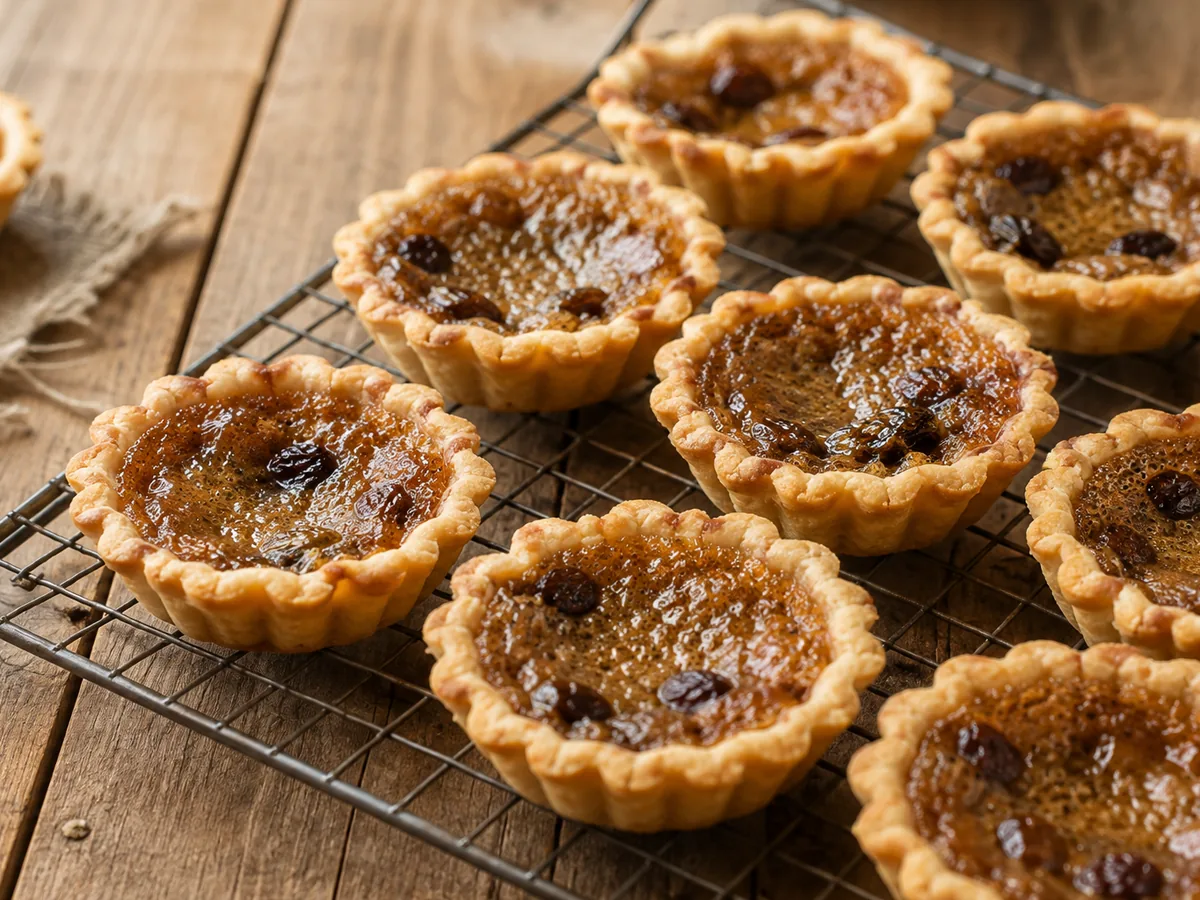
In the rural Ontario bakeries along the Butter Tart Trail the arguments run fierce: runny or firm, raisins or plain, walnuts or pecans. The core does not move. Born in pioneer farm kitchens in the late nineteenth century from the French tarte au sucre and the Scottish treacle tart, a butter tart is a small pastry shell packed with butter, brown sugar, egg and pure maple syrup.
The shell is cold lard, flaky and crisp enough to hold its shape without going soggy. Baked hot, the surface of the filling forms a crackling sugar crust that gives way to a gooey, half-liquid centre that threatens to drip down your chin on the first bite.
Pastry
- 250 g2 cupsPlain flour, sifted
- 120 g½ cup + 1 TbspLeaf lard, chilled hard and cubedor cold unsalted butter
- 30 g2 TbspUnsalted butter, frozen and grated
- 3 g½ tspFine sea salt
- 80 ml⅓ cupIce-cold water with 1 tsp lemon juice
Filling
- 115 g½ cupUnsalted butter, melted and warm, not hot
- 200 g1 cup packedDark brown sugar
- 60 ml¼ cupPure Canadian maple syrup, amber or dark
- 60 ml¼ cupHeavy cream
- 2 large2 largeEggs, room temperature, lightly beaten
- 5 ml1 tspPure vanilla extract
- 5 ml1 tspApple cider vinegaressential, it cuts the sweetness
- 2 g¼ tspFine sea salt
- 80 g½ cupSeedless raisins or chopped pecansoptional, and the subject of a long argument
Why the vinegar
A teaspoon of acid inverts some of the sucrose into glucose and fructose, which stops the filling setting into gritty fudge and takes the edge off the sweetness. Cream does similar work by interfering with recrystallisation.
Sixteen minutes, not twenty
Eggs set between 75 and 82 °C. A hot 200 °C oven flash-bakes the pastry and boils the outer filling into a crackled skin while the centre only reaches about 85 °C, enough to set the rim and leave the core runny. Past 20 minutes you have a firm pie.
The five tastes on this plate
Salt is in the lard pastry and a pinch in the filling. Fat is melted butter, cream and the lard shell. Acid is cider vinegar in the filling and lemon in the dough. Heat is warm vanilla and toasted pecans if used. Umami is browned butter, dairy and dark molasses.
Equipment
- 12-cup muffin tin, lightly buttered
- Pastry blender and box grater
- 10 cm round cutter
- Thin offset spatula
- Wire rack
Bakeries use blackened steel tins. A standard non-stick muffin tin works; butter the cups lightly so boiled-over sugar does not weld the tarts to the metal.
Method
Make the lard pastry1 hr
Whisk the flour and salt. Cut in the chilled lard to pea-sized crumbs, add the grated frozen butter, and toss. Drizzle in the ice water and lemon juice, stirring with a fork until the dough comes together. Form a flat disc, wrap, and chill 1 hour.
Mix flour and salt; cut cold lard to pea-sized crumbs and toss in frozen grated butter. Fork-mix ice water with 1 teaspoon lemon juice until dough comes together. Form a flat disc, wrap and chill 1 hour.
Roll and line the tins10 min
Roll the pastry to 3 mm and cut twelve 10 cm rounds. Press each into a muffin cup, flush against the bottom and up the sides. If using raisins or pecans, put a teaspoon in the bottom of each shell. Refrigerate while you make the filling.
Roll the pastry to 3 mm and cut twelve 10 cm rounds. Press each into a muffin cup, flush against the bottom and up the sides. If using raisins or pecans, put a teaspoon in the bottom of each shell. Refrigerate while you make the filling.
Whisk the filling5 min
Whisk the melted butter, brown sugar and maple syrup until smooth. Whisk in the eggs, cream, vanilla, vinegar and salt until glossy. Do not beat air into it; bubbles make a pale foam on top.
Whisk warm, not hot, melted butter with brown sugar and maple syrup until smooth. Add eggs, cream, vanilla, vinegar and salt; whisk glossy without beating in air.
Fill the shells3 min
Heat the oven to 200 °C with a rack in the lowest position. Pour the filling into the chilled shells to two-thirds or three-quarters full. Any more and the sugar boils over the rim and sticks.
Heat the oven to 200 °C with a rack in the lowest position. Pour the filling into the chilled shells to two-thirds or three-quarters full. Any more and the sugar boils over the rim and sticks.
Bake and watch16 to 18 min
Bake on the lowest rack at 200 °C for 16 to 18 minutes. The filling boils, puffs, and wrinkles into caramel crusts. For a runny centre pull the tin at 16 minutes while the middle still wobbles. For a firmer set go to 18 to 20.
Bake on the lowest rack at 200 °C for 16–18 minutes until filling puffs and forms wrinkled caramel crusts. For runny centres, remove at 16 minutes while wobbling; for firmer filling, bake 18–20 minutes.
Cool and release30 min
Rest the tin on a rack 10 minutes. While still warm, run a thin offset spatula around each rim so no sugar sticks. Cool 20 minutes more in the tin, then lift onto a rack to cool completely.
Rest the tin on a rack 10 minutes. While still warm, run a thin offset spatula around each rim so no sugar sticks. Cool 20 minutes more in the tin, then lift onto a rack to cool completely.
Sensory cues of doneness
- Visual: golden, flaky rims and a puffed, wrinkled, caramel-spotted surface with a slight wobble in the centre.
- Auditory: furious high-pitched bubbling at the edges of the shells inside the oven.
- Olfactory: caramelised brown sugar, boiling maple, toasted butter and lard pastry.
Look for flaky golden rims and puffed, wrinkled caramel tops with a slight central wobble. Expect vigorous edge bubbling and aromas of caramelised brown sugar, maple, butter and lard pastry.
Storing it
Airtight at room temperature they stay moist 4 days. They freeze well for up to 3 months.
Troubleshooting
- A firm, set pie with no runny centre.
Baked past 20 minutes. Pull the tin while the middle still jiggles.
- Tarts welded to the tin.
Overfilled. Sugar boiled over the rim. Fill two-thirds full and run a spatula round while warm.
- Flat, artificial flavour and a grainy set.
Pancake syrup was used. Only pure maple syrup has the flavour and the right sugars.
Substitutions
One-to-one swaps, with the technique change each one needs.
Ingredient substitutions
| Ingredient | Replace with | Culinary impact and technique adjustment |
|---|---|---|
| Leaf lard | Unsalted butter or vegetable shortening | One-to-one. Butter is richer; lard gives the flakiest shell |
| Dark maple syrup | Amber maple syrup or golden cane syrup | One-to-one. Dark maple gives the deepest caramel flavour |
| Dark brown sugar | Light brown sugar plus 1 tsp molasses | One-to-one. Restores the molasses depth |
Scaling
Half, for 6
Halve everything. Bake time stays at 16 to 18 minutes.
Double, for 24
Double the ingredients and bake two tins on separate racks, rotating halfway.
What to serve it with
- Strong black coffee or Earl Grey, to cut the sweetness
- A scoop of vanilla ice cream beside a warm tart
- A rye whisky sour
Questions
Why apple cider vinegar in a sweet filling?
The mild acid inverts some of the sugar, which prevents gritty crystallisation and keeps the sweetness in check.
Raisins or no raisins?
The argument is legendary along Ontario's Butter Tart Trail. Purists go plain; traditionalists want raisins or pecans. The recipe supports both.
How long do they keep?
Four days airtight at room temperature, or three months frozen.