Montreal Smoked Meat
The Saint-Laurent Boulevard deli brisket. A whole packer dry-cured for ten days with salt, cracked pepper, coriander and a measured dose of curing salt, smoked over sugar maple to 68 °C, then steamed for three hours until the collagen melts, and sliced thin across the grain onto caraway rye with yellow mustard.
- Prep
- 45 min
- Cook
- 6 hr
- Serves
- 8 sandwiches, from one 3 kg brisket
- Difficulty
- Hard
Researched · Kitchen testing pending
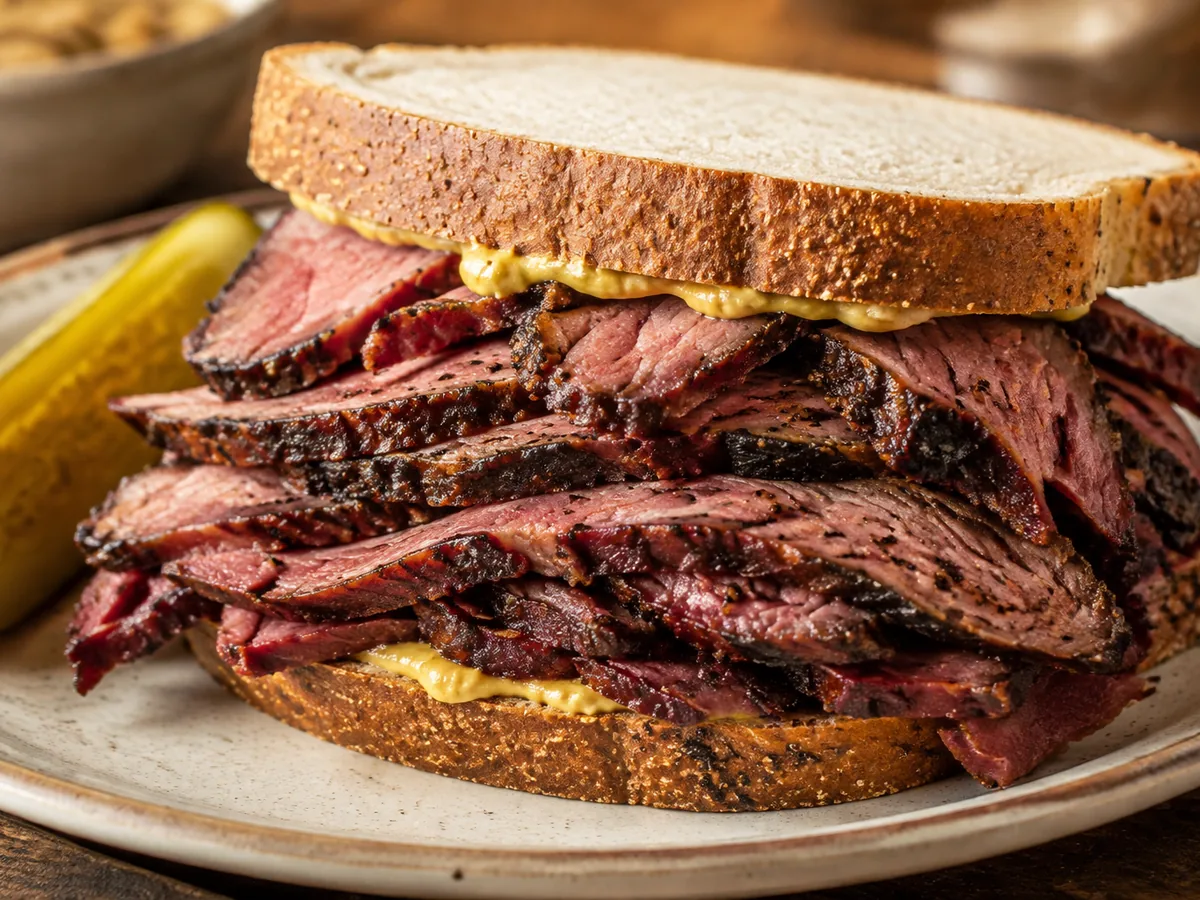
On Saint-Laurent Boulevard, steam billows behind the counter at Schwartz’s while carvers shave warm brisket into paper-thin, mahogany-edged ribbons. Romanian Jewish immigrants brought the method to Montreal early in the twentieth century, and it differs from New York pastrami in almost every way.
Pastrami is navel cured with heavy sugar. Montreal smoked meat is the whole brisket, point and flat, dry-cured with salt, cracked pepper, coriander, garlic and mustard seed and almost no sugar. After the cure it is smoked over sugar maple, steamed for three hours until the connective tissue melts, and sliced warm across the grain onto seeded rye with yellow mustard.
Cure and rub
- 3 kg6.6 lbWhole beef brisket, packer cut, with a 6 mm fat cap
- 60 g¼ cupCoarse kosher salt
- 6 g1 tspPrague Powder #1, pink curing salt at 6.25 percent sodium nitritemandatory for safety and colour; never use #2
- 30 g2 TbspGranulated or brown sugar
- 45 g⅓ cupWhole black peppercorns, coarsely cracked
- 40 g⅓ cupWhole coriander seeds, coarsely cracked
- 15 g1 TbspYellow mustard seeds, cracked
- 15 g1 TbspGarlic powder
- 10 g1 TbspOnion powder
- 5 g1 tspGround allspice
- 3 g1 tspGround bay leaf
Smoke and serve
- 4 to 6 chunks4 to 6 chunksSugar maple and oak wood, for smoking
- 16 slices16 slicesSeeded caraway rye bread
- 120 ml½ cupPrepared yellow mustardnever Dijon
What the cure does
Salt draws moisture out by osmosis while the nitrite in the pink salt binds to the myoglobin, fixing the rosy colour and protecting against botulism through a long, cool cure and a low smoke. The exact quantity matters; measure it, do not eyeball it.
Crack, do not grind
Coriander is rich in linalool and pinene. Cracked coarse, it releases those oils into the fat and builds the bark. Ground fine, it turns to mud.
The steam is the point
The smoker gets the brisket to 68 °C and a black bark. Steaming at 95 to 100 °C for three hours takes the core to 93 °C, where the collagen becomes gelatin, without washing the crust off. Meat straight from the smoker is leathery.
The five tastes on this plate
Salt is the dry cure reaching the centre. Fat is the marbling and the cap rendering through the steam. Acid is the vinegar in yellow mustard. Heat is cracked pepper, coriander, mustard seed and garlic. Umami is cured beef, maple smoke and hydrolysed collagen.
Equipment
- Large food-grade vacuum bag or heavy zip bag
- Charcoal smoker or pellet grill
- 11 to 12-quart roasting pan with an elevated rack
- Heavy-duty foil
- Long, razor-sharp slicing knife
- Instant-read thermometer
The deli does this in a smokehouse and holds the meat in steam drawers. At home the smoker does the first three hours and a foil-sealed roasting pan with a rack over boiling water does the steam in a 140 °C oven.
Method
Mix the cure5 min
Combine the kosher salt, pink curing salt, sugar, cracked pepper, cracked coriander, mustard seeds, garlic powder, onion powder, allspice and bay. Mix thoroughly.
Measure the 6 g Prague Powder #1 precisely; never substitute #2. Thoroughly mix with kosher salt, sugar, coarsely cracked pepper and coriander, mustard seeds, garlic and onion powders, allspice and bay.
Dry-cure ten days10 days
Pat the brisket dry. Rub 60 percent of the cure hard into every surface and crevice. Seal in the bag and refrigerate at 3 to 4 °C for exactly 10 days, flipping the bag once a day.
On day 10, rinse the brisket thoroughly under cold water and pat dry. Press the remaining 40 percent of cracked pepper and coriander over the surface to form the outer bark.
Dry brisket; rub 60 percent of the cure into every surface and crevice. Bag, seal and refrigerate at 3–4 °C exactly 10 days, turning daily. On day 10, rinse cold and dry; press on the remaining 40 percent pepper and coriander.
Smoke over maple3 hr
Bring the smoker to 110 °C with lump charcoal and maple chunks. Smoke the brisket fat side up, undisturbed, for about 3 hours until the crust is dark mahogany-black and the core reads 68 °C.
Bring the smoker to 110 °C with lump charcoal and maple chunks. Smoke the brisket fat side up, undisturbed, for about 3 hours until the crust is dark mahogany-black and the core reads 68 °C.
Steam3 hr
Pour 4 cm of boiling water into the roasting pan and set the rack above it; the meat must never touch the water. Set the brisket on the rack, seal the pan with three overlapping layers of foil, crimped tight, and put it in a 140 °C oven for 3 hours, until fork-tender at 93 to 96 °C.
Put 4 cm boiling water in a roasting pan; rack brisket above it without water contact. Seal tightly with three overlapping foil layers. Steam in a 140 °C oven 3 hours until fork-tender at 93–96 °C.
Rest and carve across the grain15 min
Rest 10 minutes in the foil. Slice strictly across the grain into 3 mm slices with a long, sharp knife. Thin slices are what make the sandwich bite through cleanly.
Rest 10 minutes in the foil. Slice strictly across the grain into 3 mm slices with a long, sharp knife. Thin slices are what make the sandwich bite through cleanly.
Build the sandwich
Spread yellow mustard generously on two slices of rye. Mound about 200 g of warm smoked meat on the bottom slice, close, cut diagonally, and serve with a full sour dill pickle and fries.
Spread yellow mustard generously on two slices of rye. Mound about 200 g of warm smoked meat on the bottom slice, close, cut diagonally, and serve with a full sour dill pickle and fries.
Sensory cues of doneness
- Visual: a thick black-and-tan spice crust around a rosy, glistening interior that trembles when jiggled.
- Auditory: a steady boil under the rack, and a soft yield as the knife glides through.
- Olfactory: maple smoke, cracked coriander, sharp pepper, cured beef and caraway rye.
Look for a thick dark spice crust and rosy, glossy interior that trembles. Expect steady boiling beneath the rack, easy slicing and maple smoke, coriander, pepper, cured beef and caraway aromas.
Storing it
Whole steamed brisket keeps wrapped in the fridge for 5 days. Reheat slices in a covered pan over a splash of water to restore the steam.
Troubleshooting
- Tough, leathery meat.
It was eaten straight from the smoker. The three-hour steam is what turns the collagen into gelatin.
- Chewy, stringy slices.
Cut along the muscle fibres. Slice strictly across the grain.
- The sandwich tastes wrong.
Dijon or brown mustard was used. The coriander rub wants plain yellow prepared mustard.
Substitutions
One-to-one swaps, with the technique change each one needs.
Ingredient substitutions
| Ingredient | Replace with | Culinary impact and technique adjustment |
|---|---|---|
| Beef brisket | Beef navel, plate or chuck roast | One-to-one. Brisket remains the standard |
| Prague Powder #1 | InstaCure #1, also 6.25 percent nitrite | One-to-one. Never Prague Powder #2, which carries nitrates for dry salami |
| Sugar maple wood | Red oak, hickory or apple | One-to-one. Maple gives the traditional sweetness |
Scaling
Half
Cure a 1.5 kg flat for 7 days. Smoke about 2½ hours; the steam stays at 3 hours.
Double
Cure two 3 kg briskets in separate bags, smoke them side by side, and steam in two roasting pans.
What to serve it with
- A full sour garlic dill pickle fermented in barrel brine
- Skin-on russet fries and vinegar-dressed coleslaw
- Cott black cherry soda, or a non-alcoholic spruce beer
Questions
How is this different from pastrami?
Pastrami uses beef navel, a sugary rub and often hickory smoke. Montreal smoked meat uses the whole brisket, almost no sugar, and a coarse, coriander-forward pepper rub smoked over maple.
Why the pink curing salt?
Sodium nitrite makes a long, cool cure and a low-temperature smoke safe, and it fixes the classic deli-pink colour.
Can I order lean, medium or fatty?
Slicing from the flat gives lean, from the point gives fatty, and from where the two muscles overlap gives medium.