Bannock
The hearth and campfire bread of First Nations, Inuit and Métis kitchens. Flour, lard, salt and water with baking powder, mixed for thirty seconds and never kneaded, fried low in a cast-iron skillet to a blistered golden crust over a pillowy crumb, and served with a warm wild blueberry and maple compote.
- Prep
- 15 min
- Cook
- 20 min
- Serves
- 8 wedges, from one 25 cm skillet bread
- Difficulty
- Easy
Researched · Kitchen testing pending
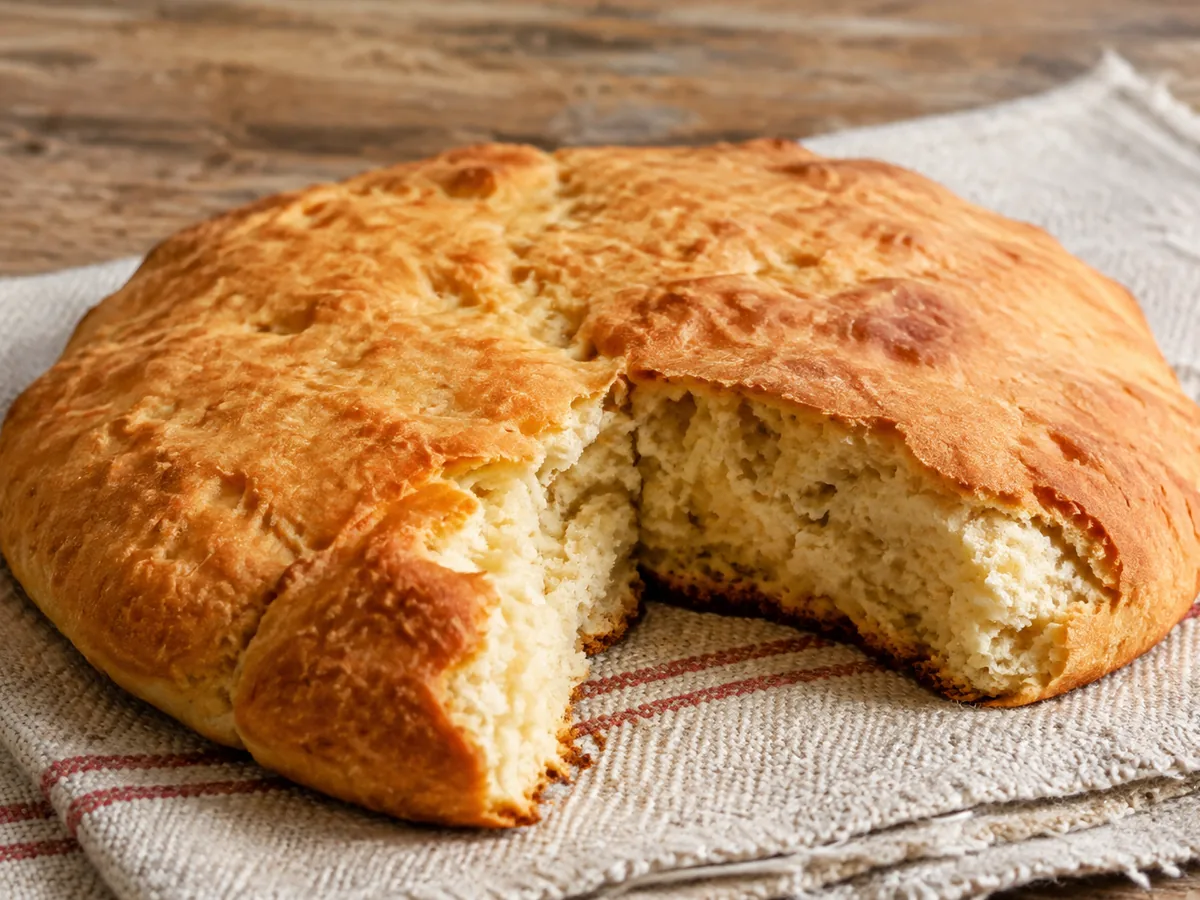
Across First Nations, Inuit and Métis communities from the Northwest Territories to the plains, bannock, sapoiyiko in Blackfoot and galette to the Métis, is the universal bread of hearth and campfire. Scottish fur traders brought wheat flour to the Hudson’s Bay posts in the eighteenth century, but Indigenous cooks had long made flatbreads from ground roots, camas and bracken.
Modern bannock is elemental: flour, fat, salt and water, leavened with baking powder. Fried in hot lard in a smoking cast-iron skillet, or wound round a green stick over the embers, it comes out golden with a brittle, blistered crust and an airy inside, and it is eaten hot with butter and wild berry compote.
Bannock
- 500 g4 cupsPlain flour, sifted
- 20 g1½ TbspBaking powder, double-acting and fresh
- 10 g2 tspGranulated sugaroptional, for light browning
- 8 g1½ tspFine sea salt
- 60 g4 TbspCold leaf lard, beef tallow or unsalted butter, cubed
- 350 ml1½ cupsLukewarm water or whole milk, about 38 °C
- 60 ml4 TbspLard or neutral oil, for frying
Compote
- 300 g2 cupsWild blueberries or saskatoon berries, fresh or frozen
- 60 ml¼ cupPure dark maple syrup
- 15 ml1 TbspFresh lemon juice
- 1 g¼ tspGround cinnamon
Do not knead
Worked like a yeast dough, the flour builds a dense, rubbery gluten network and the bread turns to a tough biscuit. Rubbing cold fat into the flour coats the proteins, and a thirty-second stir plus a ten-minute rest hydrates the starch without any shear.
Two rises from one powder
Double-acting baking powder reacts once with the water in the bowl and again past 60 °C in the pan, so the bread puffs in the hot fat while the lard fries the surface into a blistered crust.
The five tastes on this plate
Salt is in the dough against the rich frying fat. Fat is lard crisping the crust in cast iron. Acid is lemon in the berry compote. Heat is a whisper of cinnamon. Umami is toasted wheat and the lard fond.
Equipment
- 10 to 12-inch seasoned cast-iron skillet
- Small saucepan, for the compote
- Two metal spatulas
- Fork, for pricking
Cast iron holds a steady low heat so a 2.5 cm thick round cooks through to the centre without scorching. Traditionally it was a skillet buried in the coals, or the dough wound around a green willow stick over the fire.
Method
Simmer the wild blueberry compote10 min
Combine the berries, maple syrup, lemon juice, cinnamon and 30 ml water in a small saucepan. Simmer over medium-low 10 minutes, mashing half the berries with a fork, until glossy and spoonable. Keep warm.
Combine the berries, maple syrup, lemon juice, cinnamon and 30 ml water in a small saucepan. Simmer over medium-low 10 minutes, mashing half the berries with a fork, until glossy and spoonable. Keep warm.
Mix the dough gently12 min
Whisk the flour, baking powder, sugar and salt. Rub in the cold lard with your fingertips until it looks like coarse cornmeal with pea-sized bits. Pour in all the warm water at once and stir with a fork for 30 seconds to a soft, shaggy dough. Do not knead. Add a tablespoon of water if it is dry. Rest 10 minutes.
Mix flour, baking powder, sugar and salt. Rub in cold lard to coarse crumbs with pea-sized pieces. Add all water at about 38 °C; fork-stir 30 seconds. Do not knead. Add 1 tablespoon water if dry; rest 10 minutes.
Heat the skillet3 min
Set the skillet over medium-low heat, add the frying lard, and heat until it shimmers, about 180 °C.
Set the skillet over medium-low heat, add the frying lard, and heat until it shimmers, about 180 °C.
Shape the round2 min
Tip the dough onto a floured board and press gently with floured hands into a 20 cm disc about 2.5 cm thick. Prick the top all over with a fork so the steam vents evenly.
Tip the dough onto a floured board and press gently with floured hands into a 20 cm disc about 2.5 cm thick. Prick the top all over with a fork so the steam vents evenly.
Fry low and slow18 min
Slide the round into the hot fat and reduce the heat to low. Cook undisturbed 8 to 10 minutes; the underside should be deep golden and crisp. Flip with two spatulas and cook 8 to 10 minutes more until golden and a skewer in the centre comes out clean, about 95 °C inside. Or bake at 200 °C for 20 minutes.
Slide into hot fat; lower heat. Fry undisturbed 8–10 minutes until deep golden underneath. Flip with two spatulas; cook 8–10 minutes until golden, a skewer comes out clean and centre reaches about 95 °C. Alternatively, bake 200 °C, 20 minutes.
Rest and serve5 min
Lift onto a board, rest 5 minutes, and cut into 8 wedges. Serve hot with cold butter and the warm compote.
Lift onto a board, rest 5 minutes, and cut into 8 wedges. Serve hot with cold butter and the warm compote.
Sensory cues of doneness
- Visual: a golden-amber disc with deep blisters and a split, rustic crust; a pale, fluffy crumb inside; violet compote alongside.
- Auditory: a lively sizzle as the dough lands in the fat, and a hollow drum-like tap on the finished crust.
- Olfactory: rendered lard, toasted wheat, a little wood smoke, and maple blueberries.
Look for blistered golden-amber crust and a pale fluffy crumb. Tap for a hollow sound; expect toasted wheat, rendered lard, light wood smoke and maple-blueberry aromas.
Troubleshooting
- Tough, chewy bread.
The dough was kneaded. Stir only until the flour is wet and shape with a light hand.
- Black outside, raw and pasty inside.
The heat was too high. Keep the flame low so the heat reaches the centre of a thick round.
- A distorted, bubbled shape.
The top was not pricked. Fork the surface so the steam vents evenly.
Substitutions
One-to-one swaps, with the technique change each one needs.
Ingredient substitutions
| Ingredient | Replace with | Culinary impact and technique adjustment |
|---|---|---|
| Pork lard | Unsalted butter, beef tallow or vegetable shortening | One-to-one. Butter is richer; lard gives the traditional crispness |
| Wild blueberries | Saskatoon berries, huckleberries or blackberries | One-to-one. Wild berries carry more acid than cultivated |
| Maple syrup | Birch syrup or honey | One-to-one. Birch gives the boreal wood note |
Scaling
Half
Halve everything for a 20 cm skillet bread and fry 7 minutes a side.
Double
Double the ingredients and cook two 25 cm breads one after the other.
What to serve it with
- Warm wild blueberry or saskatoon compote with maple
- Thick slices of cold salted farmhouse butter
- Labrador tea, or strong black campfire tea
Questions
Can I bake it instead?
Yes. Set the shaped round on a parchment-lined sheet and bake at 200 °C for 20 to 25 minutes until golden.
Can I make individual buns?
Divide the dough into 8 balls, flatten to 8 cm discs, and fry 4 minutes a side for fry breads.
What fat is traditional?
Rendered bear grease, deer tallow, or pork lard from the trading posts. Shortening or butter both work today.