Cedar-Planked Sockeye Salmon
The British Columbia method the coastal First Nations have used for millennia, moved to a grill. A soaked western red cedar plank shields wild sockeye from the flame while its oils steam into the flesh, under a glaze of dark maple, grainy mustard and cider vinegar, pulled at 52 °C so it flakes without a trace of white albumin.
- Prep
- 20 min
- Cook
- 18 min
- Serves
- 6
- Difficulty
- Medium
Researched · Kitchen testing pending
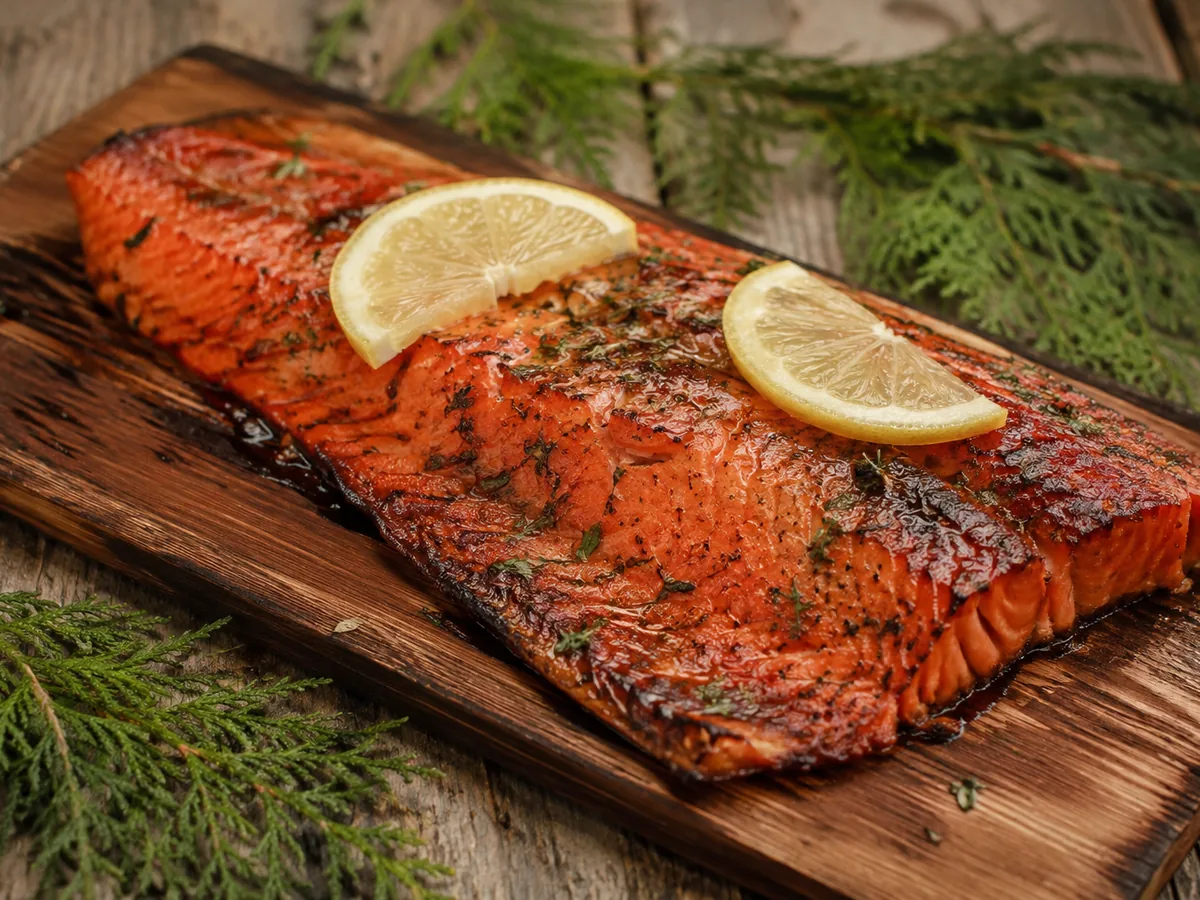
In the rainforests of British Columbia, the Coast Salish, Haida and Nuu-chah-nulth have roasted wild Pacific salmon on split western red cedar stakes over open fires for thousands of years. The plank method is one of Canada’s great gifts to outdoor cooking.
A thick slab of untreated cedar is soaked, set over the coals until it crackles, and topped with a side of wild sockeye or Chinook. The wood is a heat shield and a flavouring at once: it keeps the flame off the fish while its oils steam into the flesh. Brushed with dark maple, grainy mustard and cider vinegar, the salmon roasts to a moist, pearlescent flake with caramelised edges.
- 1 side, about 900 g1.8 to 2 lbWild sockeye or Chinook salmon fillet, skin on, pin bones removed
- 1 or 21 or 2Untreated western red cedar grilling planks, about 38 by 18 cm, soaked 2 hours
- 60 ml¼ cupPure dark Canadian maple syrup
- 30 g2 TbspCoarse whole-grain Dijon mustard
- 15 ml1 TbspApple cider vinegar
- 15 ml1 TbspExtra-virgin olive oil or melted butter
- 2 cloves2 clovesGarlic, minced to a paste
- 5 g1 tspSmoked paprika
- 8 g1½ tspFine sea salt
- 2 g½ tspFreshly ground black pepper
- 1 medium1 mediumLemon, sliced paper-thin
- 15 g2 TbspFresh dill or chives, chopped, to finish
Pull it at 52 °C
Wild sockeye is leaner than farmed Atlantic salmon. Past 55 °C its fibres clench, push out moisture, and force white albumin onto the surface like chalky curd. Off the heat at 50 to 52 °C it carries over to a medium-rare 54.
What the plank does
Two hours of soaking waterlogs the wood. Over the grill that water vaporises out through the plank as a cool steam layer that shields the skin from direct flame, while the charring underside gives off cedar oils into the steam.
The five tastes on this plate
Salt is sea salt on the flesh and the brine-soaked wood. Fat is the sockeye's own oils and the olive oil in the glaze. Acid is cider vinegar and the lemon slices. Heat is grainy mustard, black pepper and garlic. Umami is wild salmon, caramelised maple and cedar smoke.
Equipment
- Charcoal or gas grill with a lid, set for medium indirect heat
- Fish pliers, for pin bones
- Small bowl and whisk
- Heatproof gloves and a heatproof platter
- Instant-read thermometer
Coastal nations planted split cedar stakes at an angle over beach embers. In a home oven, set the soaked plank and salmon on a foil-lined tray at 200 °C and expect the aroma without the smoke.
Method
Soak the planks2 hr
Submerge the planks in warm water with a tablespoon of salt, weighted under a heavy pot, for a full 2 hours. Dry cedar catches fire within minutes on a grill.
Submerge the planks in warm water with a tablespoon of salt, weighted under a heavy pot, for a full 2 hours. Dry cedar catches fire within minutes on a grill.
Prepare the salmon5 min
Run your fingers along the fillet to find the pin bones and pull them out with the grain using fish pliers. Pat the skin and flesh dry and season the flesh with the salt and pepper.
Run your fingers along the fillet to find the pin bones and pull them out with the grain using fish pliers. Pat the skin and flesh dry and season the flesh with the salt and pepper.
Whisk the maple-mustard glaze3 min
Whisk the maple syrup, mustard, vinegar, olive oil, garlic and smoked paprika until smooth.
Whisk the maple syrup, mustard, vinegar, olive oil, garlic and smoked paprika until smooth.
Char the plank3 min
Heat the grill to medium-high, about 200 °C. Set the drained plank on the grate and close the lid for 3 minutes until it dries, crackles and gives off thin wisps of smoke. Flip it; the charred side is now the cooking surface.
Heat grill to medium-high, about 200 °C. Place drained plank on grate; close lid 3 minutes until dry, crackling and lightly smoking. Flip so the charred side faces up.
Glaze and plank-roast12 to 15 min
Lay the salmon skin side down on the charred side. Brush on half the glaze and lay the lemon slices down the centre. Close the lid at once. Roast 12 to 15 minutes, brushing with the remaining glaze at 10 minutes. Probe the thickest part and pull the plank at 50 to 52 °C.
Place salmon skin-down on charred plank. Apply half the glaze and lemon slices; close lid. Roast 12–15 minutes, adding remaining glaze at 10 minutes. Probe thickest flesh; remove the plank at 50–52 °C.
Serve on the plank
With heatproof gloves, lift the whole smouldering plank onto a heatproof platter. Scatter with dill and chives and serve family-style from the wood, with lemon wedges.
With heatproof gloves, lift the whole smouldering plank onto a heatproof platter. Scatter with dill and chives and serve family-style from the wood, with lemon wedges.
Sensory cues of doneness
- Visual: deep coral-ruby flesh under a glossy amber lacquer with no white albumin, and a plank charred black at the edges.
- Auditory: quiet crackling and popping from the underside of the wet plank, and a gentle sizzle as the fat renders onto the wood.
- Olfactory: cedar smoke, boiling maple, toasted mustard seed, embers and fresh dill.
Look for coral-ruby flesh with glossy amber glaze, no white albumin and blackened plank edges. Expect gentle wood crackling and sizzling, with cedar, maple, mustard, ember and dill aromas.
Troubleshooting
- Chalky flesh weeping white albumin.
Cooked past 55 °C. Pull wild sockeye at 50 to 52.
- The plank caught fire.
It was not soaked long enough. Two hours minimum, so the water becomes steam rather than flame.
- An off, chemical taste.
Construction lumber was used. Only untreated, food-grade cedar grilling planks.
Substitutions
One-to-one swaps, with the technique change each one needs.
Ingredient substitutions
| Ingredient | Replace with | Culinary impact and technique adjustment |
|---|---|---|
| Wild sockeye | Wild Chinook, coho or Arctic char | One-to-one. Char has a similar colour and fat |
| Maple syrup | Birch syrup or wild honey | One-to-one. Birch gives the boreal sweetness |
| Whole-grain mustard | Dijon or stone-ground mustard | One-to-one. Supplies the tang |
Scaling
Half, for 3
Roast a 450 g fillet on one small plank. Time stays at 12 to 14 minutes.
Double, for 12
Two whole sides on two large planks side by side on a wide grill.
What to serve it with
- Canadian wild rice pilaf with dried cranberries and toasted almonds
- Grilled asparagus with olive oil, salt and lemon
- An Okanagan Pinot Noir, or a crisp cool-climate Chardonnay
Questions
Can I reuse a plank?
If it is not heavily charred or cracked, scrub it with hot water and no soap and use it once more. Most cooks discard planks after one use for the fullest smoke.
Can I do this in the oven?
Yes. Soaked plank and salmon on a foil-lined sheet at 200 °C for 15 to 18 minutes. You get the cedar aroma without the smoke.
What is the white stuff?
Albumin, a protein that leaks out when the fibres contract from too much heat. Gentle plank roasting keeps it inside.