Yellow Split Pea Soup
Soupe aux pois, the sugar-shack winter staple that came over with Champlain's men. Yellow split peas simmered two hours with a smoked ham hock, salt pork lardons, mirepoix, bay and summer savory until they dissolve into a thick golden potage, salted only at the end.
- Prep
- 20 min
- Cook
- 2 hr
- Serves
- 8
- Difficulty
- Medium
Researched · Kitchen testing pending
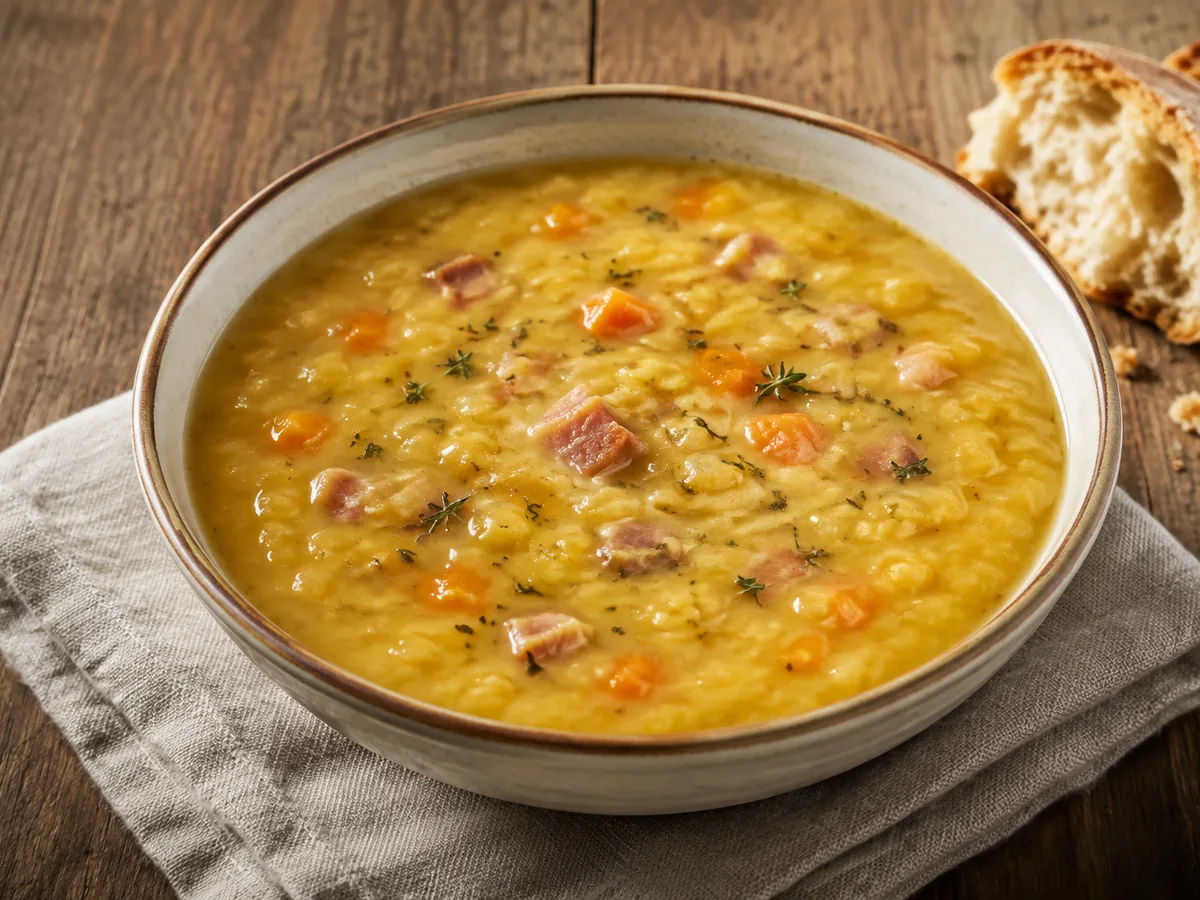
Across Quebec’s sugar shacks and farmhouse hearths, yellow split pea soup has carried families through winters since New France. Champlain’s men brought dried yellow peas and salted pork across the Atlantic, and the soup has not changed much since.
It is made strictly with yellow peas, never green. They simmer low with a smoked ham hock, salt pork, carrot, celery and onion, scented with summer savory and bay, until they dissolve over two hours into a thick, golden potage studded with shreds of tender smoked ham.
- 500 g2½ cupsDried yellow split peas, sorted and rinsedno soaking needed
- 1 whole1 largeSmoked ham hock, about 700 g, rind scored
- 200 g7 ozSalt pork belly or thick-cut bacon, in 1 cm lardons
- 2.5 L10.5 cupsCold water or light chicken stock
- 2 large2 largeYellow onions, diced fine
- 3 cloves3 clovesGarlic, minced to a paste
- 2 large2 largeCarrots, cut into 5 mm dice
- 2 stalks2 stalksCelery with leaves, in 5 mm dice
- 4 g1½ TbspDried summer savoryor wild thyme
- 2 whole2 wholeBay leaves
- 10 g2 tspFine sea saltadded only at the end; the pork is salty
- 3 g1 tspCoarsely ground black pepper
- 30 g½ cupFlat-leaf parsley, finely chopped, to garnish
No soak, no salt until the end
Split peas have lost their seed coat, so water gets in fast and they cook to a purée in about ninety minutes. Salt or acid added early keeps the cell walls firm and leaves chalky peas. Season in the last fifteen minutes.
How it thickens itself
Between 92 and 95 °C the hemicellulose walls break down, the starch granules swell and burst, and free amylose goes into the broth. The hock sheds gelatin at the same time. A few shears with a masher at the end emulsify pork fat and pea starch into a velvety potage with no roux or cream.
Yellow, never green
Green split peas taste grassy and vegetal. The French-Canadian soup is yellow peas only.
The five tastes on this plate
Salt is the cured pork and the hock's brine. Fat is rendered lardons and smoked pork collagen. Acid comes at the table, a splash of cider vinegar or pickled onions. Heat is black pepper, garlic and peppery savory. Umami is ham hock collagen, dissolved pea protein and sweated mirepoix.
Equipment
- 8-quart enamelled cast-iron Dutch oven
- Flat wooden spoon
- Potato masher or immersion blender
Cast iron spreads the heat so the heavy pea starch does not settle and scorch. At a sugar shack it is a cast-aluminium chaudron over a wood stove.
Method
Render the pork and sweat the mirepoix16 min
Cook the lardons in the Dutch oven over medium heat 6 to 8 minutes until golden and rendered. Add the onions, carrots, celery and garlic to the fat and sweat 8 minutes, stirring often, until soft and translucent with no browning.
Cook the lardons in the Dutch oven over medium heat 6 to 8 minutes until golden and rendered. Add the onions, carrots, celery and garlic to the fat and sweat 8 minutes, stirring often, until soft and translucent with no browning.
Build the pot5 min
Add the rinsed peas. Score the hock's skin and nestle it into the peas. Add the savory, bay leaves, black pepper and 2.5 litres cold water. Add no salt yet.
Add the rinsed peas. Score the hock's skin and nestle it into the peas. Add the savory, bay leaves, black pepper and 2.5 litres cold water. Add no salt yet.
Simmer low and slow1 hr 30 min
Bring to a gentle boil over medium-high and skim the foam for 10 minutes. Reduce to low, set the lid slightly ajar, and simmer at 90 to 92 °C for 1 hour 30 minutes, stirring the bottom every 20 minutes so the starch does not stick.
Bring to a gentle boil over medium-high; skim for 10 minutes. Lower heat, leave lid ajar and simmer at 90–92 °C for 1 hour 30 minutes, stirring the bottom every 20 minutes to prevent sticking.
Shred the ham and half-purée10 min
Lift the hock onto a board. Discard the rind, bones and gristle and shred the pink meat with two forks. Return it to the pot. Break down about half the peas with a masher, or three pulses of an immersion blender, leaving the rest rustic.
Lift the hock onto a board. Discard the rind, bones and gristle and shred the pink meat with two forks. Return it to the pot. Break down about half the peas with a masher, or three pulses of an immersion blender, leaving the rest rustic.
Finish and season15 min
Simmer uncovered on low 15 minutes, stirring along the bottom, until it coats a spoon. Taste and add salt only now, about a teaspoon depending on the ham. Discard the bay leaves.
Simmer uncovered on low 15 minutes, stirring along the bottom, until it coats a spoon. Taste and add salt only now, about a teaspoon depending on the ham. Discard the bay leaves.
Serve
Ladle into deep bowls, top with crisp lardons and parsley, and serve hot with crusty bread.
Ladle into deep bowls, top with crisp lardons and parsley, and serve hot with crusty bread.
Sensory cues of doneness
- Visual: a thick golden potage holding shreds of pink ham, carrot dice and flecks of savory, with no watery separation.
- Auditory: heavy, slow plops from a viscous soup on low heat.
- Olfactory: wood smoke, sweet yellow peas, curing brine, dried savory and simmered hock.
Check for thick golden soup holding ham shreds, carrots and savory without watery separation. Expect slow heavy bubbling and aromas of smoke, sweet yellow peas, curing brine, savory and ham.
Storing it
It thickens dramatically in the fridge and keeps 4 days. Reheat gently with a splash of water or stock.
Troubleshooting
- Hard, chalky peas after two hours.
Salt or acid went in at the start and stopped the cell walls softening. Season only in the last 15 minutes.
- Scorched taste from the bottom of the pot.
Pea starch settled on the hot metal. Stir the base every 15 minutes with a flat wooden spoon.
- A grassy, wrong-tasting soup.
Green split peas. Use yellow.
Substitutions
One-to-one swaps, with the technique change each one needs.
Ingredient substitutions
| Ingredient | Replace with | Culinary impact and technique adjustment |
|---|---|---|
| Smoked ham hock | Smoked pork shank, a ham bone, or a smoked turkey leg | One-to-one. Turkey leg gives smoke and gelatin for a pork-free pot |
| Salt pork | Thick-cut slab bacon or pancetta | One-to-one. Renders savoury fat |
| Summer savory | Dried thyme with a pinch of marjoram | One-to-one. Same peppery herbal backbone |
Scaling
Half, for 4
Halve everything in a 4-quart Dutch oven and simmer 90 minutes.
Double, for 16
Double the ingredients in a 16-quart stockpot and stir the bottom diligently.
What to serve it with
- A slice of warm tourtière afterwards, the classic Quebec pairing
- Thick sourdough with salted butter, for dipping
- A malty Quebec amber ale such as Boréale Rousse, or dry sparkling cider
Questions
Do yellow split peas need soaking?
No. With the seed coat removed, water penetrates quickly and they cook to velvet in about 90 minutes.
Can I use a slow cooker?
Yes. Cook on low 7 to 8 hours with the hock, then shred the meat and stir it back in.
How does it keep?
Very well. It thickens a lot in the fridge; loosen with water or stock when reheating.