Bobó de camarão
Manioc cooked until it turns translucent and heavy, then loosened with coconut milk and dendê until it ribbons on the spoon. The shrimp finish in that heat, not the other way around.
- Prep
- 40 min
- Cook
- 50 min
- Serves
- 4 as a main, with rice
- Difficulty
- Medium
Researched · Kitchen testing pending
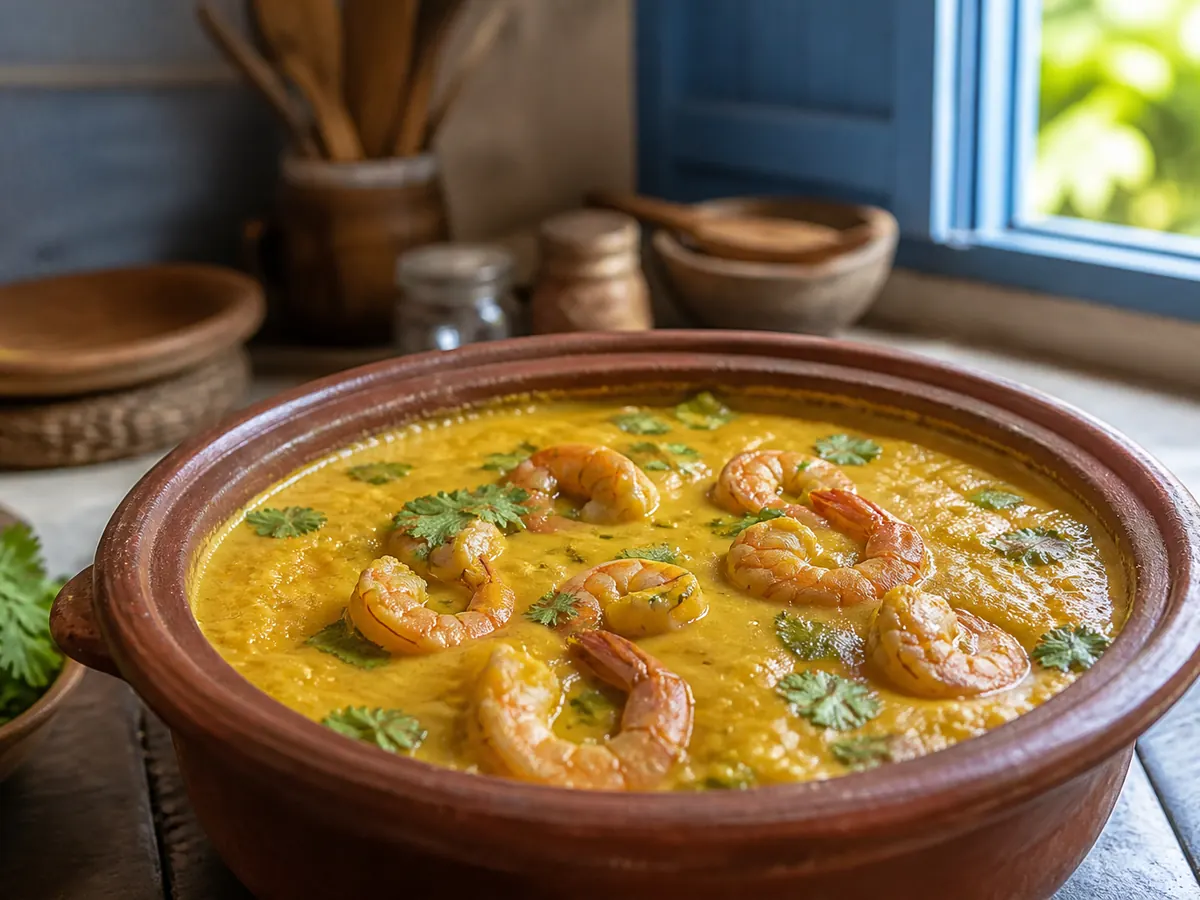
Manioc turns translucent and heavy on the spoon before it ever meets the shrimp. That is the hinge of bobó de camarão: a purée cooked long enough to go from chalky and watery to glossy and elastic, then loosened with coconut milk and dendê until it coats rice without pooling.
If the cassava is undercooked, or dumped in cold, the pot stays thin and grainy no matter how much coconut you pour in afterwards.
This is a Bahia-leaning weeknight stew for four generous plates, not a party cauldron. Creamy is the goal. Watery is the failure mode the whole method is built to avoid — cook the manioc until it is heavy, marry it with coconut and dendê until it ribbons, then let the shrimp finish in that heat.
The manioc base
- 700 g1½ lbFresh manioc (cassava, yuca), peeled, in 3 cm chunksor the same weight frozen manioc, thawed
- 500 ml2 cupsWater, plus more to submerge
- 200 ml¾ cup plus 1 tbspFull-fat coconut milkused in two halves — 100 ml into the purée, 100 ml at the marriage
- 1 tsp1 tspFine salt, plus more to taste
The soffritto
- 3 tbsp3 tbspDendê (red palm oil)2 tbsp to cook in, 1 tbsp to finish. Add 1 tbsp neutral oil if your dendê is very assertive
- 150 g1 mediumOnion, finely diced
- 11Green bell pepper, finely diced
- ½½Red bell pepper, finely dicedfor colour and a mild sweetness
- 3 cloves3 clovesGarlic, minced
- 1 ripe1 ripeTomato, peeled, seeded and dicedor 120 g / ½ cup drained canned tomatoes, chopped
- 1 tbsp1 tbspTomato paste
- 1 tsp1 tspSweet paprikaoptional, for depth of colour
- 1 small1 smallFresh chilli — malagueta, Scotch bonnet or serrano — mincedseed it for less heat
The shrimp
- 600 g1⅓ lbMedium raw shrimp, peeled and deveinedtails optional. Raw only — pre-cooked shrimp toughen and cloud the pot
- 30 ml2 tbspLime juice, from 1 lime
- 2 cloves2 clovesGarlic, minced
- ½ tsp½ tspSalt, with ¼ tsp ground black pepper
To finish and serve
- 100–150 ml⅓–⅔ cupExtra coconut milk or reserved manioc liquidto adjust the body at the end
- 2 tbsp2 tbspCilantro, chopped, with 2 tbsp scallion
- 300 g1½ cupsLong-grain white rice, cooked plainsteamed dry enough that the grains stay separate under the stew
- 11Lime, in wedges
The dish is decided in the purée pot
Manioc starch only gelatinizes when the core actually reaches temperature. A lukewarm simmer leaves a chalky heart, and no amount of coconut milk poured in afterwards will fix it. Cooked properly it goes translucent and heavy on the spoon. That is the hinge of the whole recipe.
Fresh shrimp against frozen
Fresh — never frozen, or thawed the same day from a counter you trust — give cleaner sweetness and a firmer snap. Frozen raw shrimp are honest pantry protein if handled well: thaw cold, drain thoroughly, pat very dry. Ice glaze left on the meat waters down the stew the moment it hits the pan. Discard any that smell sharply ammoniated after thawing. Do not use pre-cooked cocktail shrimp. They turn tough when reheated in the stew and release cloudy liquid.
Size
Medium, roughly 31–40 per pound, cook evenly in the short finish window. Jumbo look dramatic but need careful timing, and the purée over-reduces while you wait for their centres.
Peeling manioc without losing half of it
Trim the ends, quarter lengthwise if it is thick, then cut the peel away with a sharp knife from under the bark — a thin peeler alone will not get the pinkish under-layer. Work under running water or in a bowl of water so the flesh does not brown.
Equipment
- A pot for boiling the manioc
- A potato masher, food mill, or immersion blender
- A wide heavy sauté pan or Dutch oven for the soffritto
- A thermometer helps, but the spoon tells you most of it
An immersion blender is the difference between good and silky. A masher alone gives a rustic purée that is perfectly correct; the blender is a labelled departure toward silk.
Method
Marinate the shrimp, then leave them cold20–40 min, passive
Toss the peeled shrimp with the lime juice, minced garlic, ½ tsp salt and the pepper. Refrigerate while you build everything else.
The acid seasons and firms the surface slightly. Do not go much beyond an hour in lime or the texture turns mealy at the edges.
Use raw shrimp; thaw cold if frozen, drain and pat very dry, discarding any with an ammonia smell. Toss with lime juice, garlic, ½ tsp salt and pepper. Refrigerate 20–40 minutes; avoid much beyond 1 hour in lime.
Boil the manioc properly25–35 min
Peel deeply enough to take the pinkish under-layer as well as the bark, cut into chunks, and pull out the fibrous core string if there is one.
Into a pot with the 500 ml of water plus enough to submerge by 2 cm, and 1 tsp salt. Bring to a boil, then simmer uncovered at a steady bubble — about 95–100 °C / 203–212 °F — for 25 to 35 minutes, until a fork slides through with no chalky resistance.
Undercooked manioc stays white and hard. Overcooked is fine, so long as it looks glassy and smells mild and earthy rather than sour.
Peel manioc through the pink layer, cut into 3 cm chunks and remove fibrous cores. Add 500 ml water plus enough to cover by 2 cm and 1 tsp salt. Boil, then simmer uncovered at 95–100 °C / 203–212 °F for 25–35 minutes until translucent and fully fork-tender.
Mash into the body of the dish10 min
Drain, reserving about 250 ml of the cooking liquid.
While it is still hot, mash thoroughly, or pass it through a food mill. For a silkier bobó, blend with an immersion blender, adding cooking liquid a splash at a time.
What you want: a thick, spoon-coating purée — denser than mashed potato, looser than dough. Stir in 100 ml of the coconut milk and taste for salt.
Keep it warm over the lowest heat, loosely covered, stirring so no skin forms. Treat it like polenta you must not scorch.
Drain, reserving about 250 ml cooking liquid. Mash hot or blend, adding liquid in splashes, to a thick spoon-coating purée. Stir in 100 ml coconut milk, check salt and keep loosely covered over lowest heat, stirring to prevent scorching.
Bloom the dendê, build the soffritto15 min
Warm 2 tbsp dendê — plus the optional neutral oil — over medium until it liquefies and smells toasty and fruity, about a minute. Roughly 150–160 °C / 300–320 °F: warm enough to bloom the colour, not smoking. Burnt dendê turns bitter and a dull brown.
Onion and both peppers with a pinch of salt. Cook 8 to 10 minutes until soft, glossy and sweet. The edges may take faint colour, but this is a soften-and-sweat stage, not a sear.
Garlic and chilli, 1 minute. Then tomato paste and paprika, 1 to 2 minutes, until the paste darkens and sticks slightly. Then the diced tomato, 3 to 4 minutes, until it collapses and the whole thing looks jammy rather than watery.
That jammy stage is why the finished bobó stays creamy instead of splitting into oil and thin liquid.
Warm 2 tbsp dendê and optional neutral oil at 150–160 °C / 300–320 °F without smoking. Soften onion, peppers and salt 8–10 minutes; add garlic and chilli 1 minute, tomato paste and paprika 1–2 minutes, then diced tomato 3–4 minutes until jammy.
Marry them5–8 min
Soffritto into the manioc purée — or the purée into the wider pan, if that is easier to stir.
Medium-low heat, so the sauce quivers at about 90–95 °C / 195–203 °F. Not a rolling boil: boiling splits the coconut and scorches the starch.
Add the remaining 100 ml of coconut milk and stir continuously for 5 to 8 minutes, until it is warm orange-gold and ribbon-thick — a spoon dragged through leaves a slow trail that does not fill in instantly.
Stiff: loosen with reserved liquid or coconut milk, 1–2 tbsp at a time. Thin: cook uncovered to evaporate. The target is a mound that slowly spreads on rice.
Combine sofrito and purée over medium-low at 90–95 °C / 195–203 °F; avoid boiling hard. Stir in remaining 100 ml coconut milk for 5–8 minutes until ribbon-thick. Loosen with reserved liquid or coconut milk, 1–2 tbsp at a time; reduce uncovered if thin.
The shrimp go in last3–5 min
Taste and adjust the salt before the shrimp go in — once protein is in the pot you have far less room to boil off a mistake.
Raise to medium. Fold in the shrimp and their juices. Cook 3 to 5 minutes, stirring gently, until opaque and curled into a loose C — about 60–63 °C / 140–145 °F in a thick one.
Proteins set tender in that band. Past about 70 °C / 158 °F they go rubbery, and a tight O-curl means overcooked. Residual heat keeps working after the pan leaves the burner.
Adjust salt before adding shrimp. Raise heat to medium, fold in shrimp and their juices, and cook gently stirring 3–5 minutes until opaque and loosely C-shaped, about 60–63 °C / 140–145 °F in a thick shrimp. Allow for carryover cooking. Avoid exceeding about 70 °C / 158 °F; tight O-shaped curls indicate overcooking.
Finish off the heat2 min
Off the heat, fold in most of the cilantro and scallion, keeping a little back for the top.
Drizzle the last tablespoon of dendê over the surface and marble it in once or twice — ribbons of colour and aroma rather than a stirred-through wash.
Lime gets squeezed at the table, not into the pot in bulk. Too much late acid thins the perception of richness.
Off the heat, fold in most cilantro and scallion, reserving some for garnish. Drizzle the final tablespoon of dendê and swirl once or twice. Serve with rice and lime wedges; squeeze lime at the table.
Checkpoints
The manioc
Translucent, fork-tender, no chalky core, simmered at 95–100 °C. Raw starch never turns creamy later.
The dendê bloom
Fragrant, deep orange, not smoking — around 150–160 °C.
The purée, before the shrimp
Ribbon-thick, shiny, dendê-gold, held at 90–95 °C. Matte and pasty means it needs more liquid and low-heat stirring.
The soffritto
Sweet onion and peppers, jammy tomato, no raw garlic bite. A watery soffritto dilutes the purée.
The shrimp
Pearly opaque and tender, 60–63 °C. Grey centres are underdone; chalky tightness is overdone.
The finished bowl
Orange-gold, smelling of coconut and dendê, thick enough to cling to rice. Creamy, never watery.
Storing it
Keeping it
Cool within 1 to 2 hours and refrigerate sealed up to 2 days. The shrimp soften on day two — still good, not peak. Reheat low with a splash of coconut milk or water until steaming, about 74 °C / 165 °F. Avoid a hard boil. Bobó thickens as it sits. That is normal, and a splash of liquid brings it back.
Freezing
Freeze the purée without the shrimp, up to 1 month, and add fresh-cooked shrimp when you reheat. Freezing the finished dish softens the seafood and loosens the emulsion.
Safety
Keep raw-shrimp boards away from the herbs. Store rice separately, 1 to 2 days. Discard anything that smells ammoniated or sour. No more than 2 hours at room temperature, or 1 hour above about 32 °C / 90 °F.
Troubleshooting
- Watery bobó.
Not enough evaporation, watery tomatoes, or wet shrimp. Simmer uncovered while stirring. Next time cook the soffritto drier and dry the shrimp properly.
- Grainy purée.
The manioc was undercooked or poorly mashed. Cook it longer next round, and blend it hot with some of the cooking liquid.
- A bitter or harsh oil flavour.
The dendê was overheated, or it is poor quality. Use gentler heat, and finish with a fresh drizzle off the heat.
- The surface split and went oily.
Heat too high after the coconut went in, or the liquid is unbalanced. Stir over low heat and add a spoonful of plain purée to re-emulsify it.
- Rubbery shrimp.
Overcooked, or pre-cooked shrimp reused. Pull them at the opaque C-shape, and start with raw shrimp only.
- Bland.
An undersalted purée and timid dendê. Salt in layers, and finish with both dendê and lime.
- Too spicy.
The chilli was stronger than expected. Serve extra rice and coconut milk alongside, and seed the chilli next time.
Substitutions
Traditional
Manioc purée, coconut milk, dendê, peppers and shrimp, served with rice. The proportions of dendê and heat vary by cook and by how coastal or how home-style the pot is. Some versions run looser; this one aims for spoonable creaminess.
Departures I accept, with labels
A mix of bell peppers for colour when malagueta is scarce. A spoon of tomato paste for a deeper red-gold. Immersion blending for silk. A little neutral oil cut into the dendê for cooks who find pure palm oil heavy.
Different dishes, not variations
Potato instead of manioc — a related comfort stew, but you lose the elastic glossy body that makes this bobó. Skipping dendê entirely — a pleasant coconut shrimp stew, missing the Bahian signal. If you have to, say so at the table rather than pretending paprika oil is the same thing. Thinning it into a soup.
Scaling
Manioc cooking time follows chunk size, not batch size. Cut to a consistent 3 cm and the clock holds.
Half, for two
350 g manioc, 300 g shrimp, half the coconut and peppers — but keep 1½ to 2 tbsp of dendê. Cutting the dendê proportionally is what makes a halved batch taste timid.
Double, for eight
A wider pot for the manioc and a large Dutch oven for the soffritto and purée. Add the shrimp in two waves if the pan is crowded, or they steam instead of setting. Salt in layers. Start the dendê at 4 to 5 tbsp and still finish with a drizzle.
What to serve it with
Hot plain white rice — a dry grain bed, so the creaminess shows against it.
- Lime wedges, and more cilantro or scallion
- Farofa, for crunch, if you want it
- Pepper sauce on the side
- Cold beer, or coconut water
Keep the pot fragrant more than fiery unless someone asks otherwise. Coconut rice is a pleasant variation but not required.
Questions
What if I cannot find fresh manioc?
Frozen peeled manioc from a Latin or African market works well. Thaw, cook as directed, drain well. Do not substitute a cornstarch slurry — you lose the characteristic body entirely.
Is dendê mandatory?
For a bobó that reads as Bahian, yes. Without it you have a coconut-manioc shrimp stew, which is a good thing but a different thing.
Can I use pre-cooked frozen shrimp?
Not recommended. They toughen and release a cloudy liquid into the pot. Start with raw.
Can I make it ahead?
Yes — take it through the combined purée and soffritto up to a day ahead, chill, then reheat gently and cook the shrimp just before serving. That keeps the seafood tender.
How do I keep it creamy rather than watery?
Fully cook the manioc, dry the shrimp, cook the soffritto to jammy, and hold the purée at 90–95 °C until it ribbons before the shrimp go anywhere near it.
Anything to flag for allergies?
It contains shellfish and coconut. Dendê is a tree-fruit oil rather than a nut oil, but check labels if cross-contact matters in your kitchen.