Baião de dois
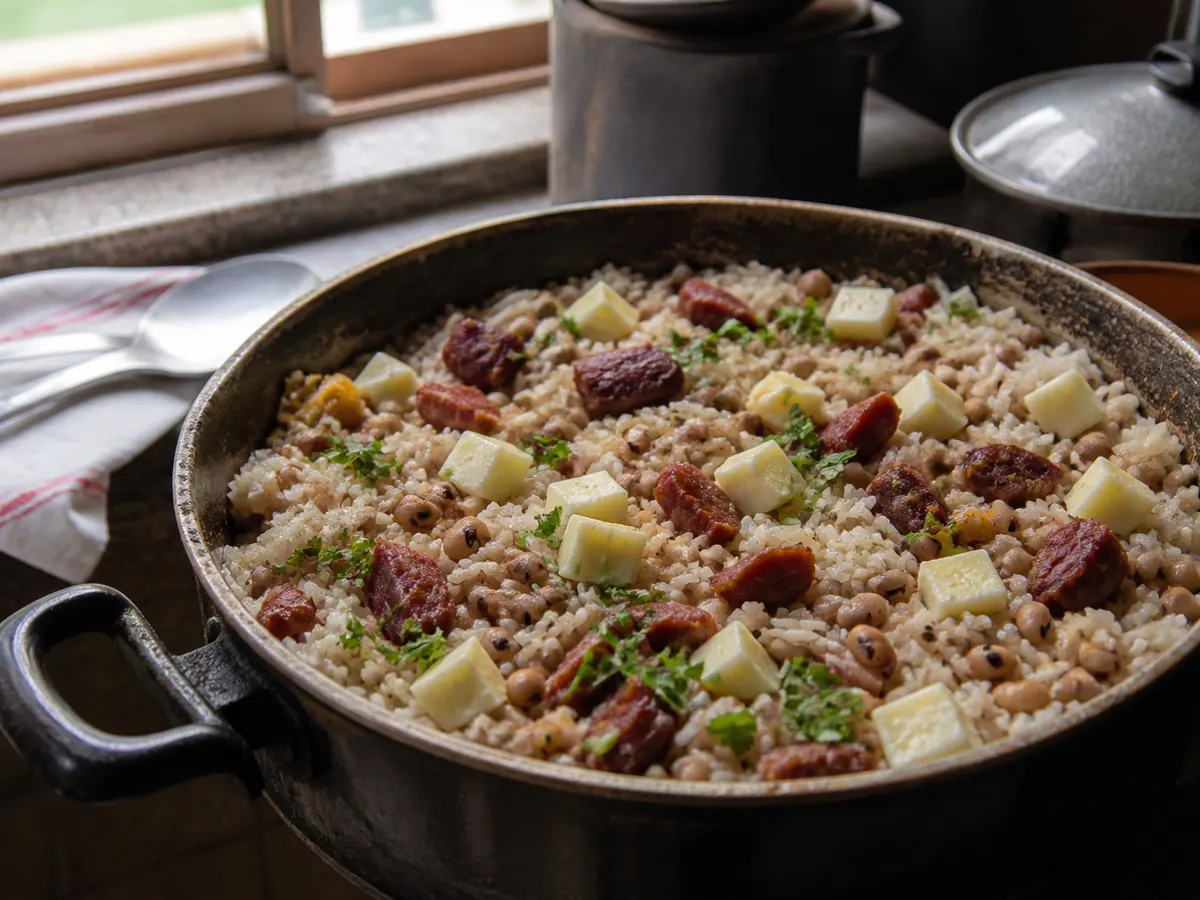
Rice and black-eyed peas cooked together in the bean liquor until they cling, with carne de sol soaked back to life and queijo coalho seared until it squeaks. One pot, one rhythm.
- Prep
- 55 min
- Cook
- 45 min
- Serves
- 6 generous plates as a main
- Difficulty
- Medium
Researched · Kitchen testing pending
I hear the manteiga de garrafa hit the hot pan before I smell it — a soft crackle, then that nutty, almost toasted dairy perfume that tells me this pot is going Northeast.
Baião de dois is not a side dish pretending to be dinner; it is the dinner. Rice and beans cooked together until they cling, with queijo coalho that squeaks and browns, carne de sol soaked back to life, and enough fat to make every grain glossy.
When this is right, the plate smells of butter and beef before you taste the cilantro, and the coalho gives you chewy, grilled pockets against soft beans.
Beans and meat
- 400 g14 ozDried feijão de corda (black-eyed peas / cowpeas), picked over
- 300 g10.5 ozCarne de sol (sun-dried salted beef)in thick strips if you can get them
- 1.5 L6⅓ cupsWater, for soaking the meatchanged once or twice if the meat is heavily salted
- 2 L8½ cupsWater or light stock, for cookingstart here and add more, hot, if the pot looks thirsty
- 2 leaves2 leavesBay leaves
Aromatics and fat
- 60 ml4 tbspManteiga de garrafa (Brazilian bottle butter)45 ml for the sofrito, 15 ml for the cheese. Substitute 45 g butter plus 15 ml neutral oil if you cannot find it
- 30 g2 tbspUnsalted butterfor the cheese stage
- 200 g1 largeYellow onion, finely diced
- 4 cloves4 clovesGarlic, minced
- 150 g1 mediumGreen bell pepper, diced smalloptional, but traditional in many Ceará home pots
- 1 tsp1 tspFreshly ground black pepper
- ½ tsp½ tspGround cumina light hand — this is not a cumin dish
- to tasteto tasteSalt, only at the end if neededthe carne de sol and the coalho both carry salt already
Rice and cheese
- 400 g2 cupsLong-grain white rice, rinsed until the water runs mostly cleardrained well
- 250 g9 ozQueijo coalho, in 1.5 cm cubeshalloumi is the closest widely available stand-in for the browning behaviour; the flavour is milder
- 60 g2 ozFresh cilantro, choppedplus a little more for the table
- 22Scallions, thinly sliced, white and green
- 15 ml1 tbspLime juice, from half a limeoptional, to finish
This is dinner, not a side
Rice and beans cooked together until they cling, with cheese that squeaks and browns and enough fat to make every grain glossy. It should eat as a complete plate.
A boundary worth drawing
This is not Cuban moros y cristianos. Different beans, different seasoning logic, different fat culture. Here we are chasing coalho and manteiga de garrafa, not sofrito and a cumin-forward Cuban rice.
Soak the two things separately
Beans need hydration for even cooking; carne de sol needs desalting. Mixing those jobs in one bowl muddies both. You are not trying to strip every grain of salt from the meat — only enough that the finished pot does not taste like a salt lick.
Which style this is
A Ceará-leaning cordel version, built on feijão de corda rather than the green-bean-pod style you find further inland. Other Northeast styles use fresh or semi-fresh pods; that is a different, fresher, less earthy pot.
Equipment
- A large heavy pot or Dutch oven, 5–6 L, with a lid
- A separate bowl for soaking the meat
- A separate skillet for the cheese — worth it for browning control
- A wooden spoon
- An instant-read thermometer helps, but is not required
Sear the coalho in its own pan. Raw cubes dropped into a wet stew weep whey and turn the texture pasty, and you lose the contrast that makes the dish feel finished.
Method
The night before — soak with intention8–12 hours, passive
Rinse the beans and cover with at least three times their volume of cold water. Leave at cool room temperature 8 to 12 hours.
Separately, cover the carne de sol with cold water and refrigerate, changing the water once or twice if the label or your nose says it is heavily salted.
By morning the beans should look plump, and the meat should smell clean and beefy rather than aggressively briny. Drain both.
Soak rinsed beans in at least three times their volume of cold water, 8–12 hours at cool room temperature. Separately refrigerate meat covered with cold water, changing it once or twice if heavily salted. Drain both.
Cook the beans and the meat together35–45 min
Drained beans and drained carne de sol into the heavy pot with 2 L of fresh water, the bay leaves, and a few grinds of pepper.
Bring to a vigorous boil, skimming foam for the first 5 minutes, then drop to a steady simmer — frequent small bubbles, roughly 95–98 °C / 203–208 °F — partially covered, for 35 to 45 minutes.
A bean should be tender with a slight chalky centre still acceptable at this stage; the rice will add more time. The meat should shred at the edges but still hold together.
If the water drops below the solids, top up with hot water in 120 ml splashes. Cold water shocks the simmer and toughens the meat.
Boil drained beans and meat with 2 L fresh water, bay and pepper; skim for 5 minutes. Simmer partially covered at 95–98 °C / 203–208 °F for 35–45 minutes, until nearly tender. Keep solids covered with 120 ml additions of hot water.
Shred the meat back in5 min
When the beans are nearly tender, lift the meat onto a board, shred or chop it into bite-size pieces, and return it to the pot.
Taste the cooking liquid. It should taste seasoned from the meat but not harsh. Leave the beans in that liquid — the starchy broth is what will cook and perfume the rice.
Lift out the meat when beans are nearly tender. Shred or chop into bite-size pieces and return to the pot. Taste the broth and retain it with the beans to cook the rice.
Build the fat base in a separate pan10–12 min
Warm 45 ml of the manteiga de garrafa over medium until it shimmers and smells toasted, 1 to 2 minutes. Do not let it darken — it goes from fragrant to bitter fast.
Onion and a pinch of pepper, 6 to 8 minutes, until translucent and sweet at the edges. Green pepper, 3 minutes more. Garlic and cumin, 45 to 60 seconds, until the raw garlic smell rounds out.
You are smelling for dairy fat, onion sweetness, and a faint warm spice.
Scrape the whole thing into the bean pot and stir. Why not just cook the aromatics in the bean water from the start: you want browning on the onion and the nutty butter notes. Boiling them from cold steams instead.
Warm 45 ml manteiga de garrafa over medium 1–2 minutes without darkening. Cook onion and pepper 6–8 minutes, green pepper 3 minutes, then garlic and cumin 45–60 seconds. Scrape everything into the beans and stir.
The rice goes in — the one-pot marriage18–22 min
Check the liquid first. After the rice goes in, it should sit about 1.5–2 cm above the solids. If you are short, add hot water or unsalted stock.
Stir the rinsed rice through thoroughly so every grain is wet and distributed among the beans.
Back to a lively simmer over medium-high, then down to low, covered. Cook 18 to 22 minutes, and do not lift the lid for the first 15.
If you peek at minute 16 and see bare dry rice on top, sprinkle 60–80 ml of hot water around the edges, cover, and give it 4 more minutes.
What you want: rice tender, beans soft, liquid mostly absorbed, the whole thing still moist and cohesive. Not soupy, not dry.
Stir in rinsed, drained rice; liquid should cover solids by 1.5–2 cm. Add hot water or unsalted stock if needed. Simmer, cover and cook low 18–22 minutes; leave closed for 15. If dry at minute 16, add 60–80 ml hot water around edges and cook covered 4 minutes.
Rest, covered8 min
Off the heat, lid on, 8 minutes.
The steam finish equalizes the moisture so the top grains catch up with the bottom.
Remove the pot from the heat and leave covered for 8 minutes, allowing the trapped steam to finish the upper grains and distribute moisture evenly.
Sear the coalho while the pot rests5 min
Dry the cheese cubes with a towel. Heat a skillet over medium-high until a drop of water skitters, then add the last 15 ml of manteiga de garrafa plus the 30 g of butter.
When the foam settles — shimmering, not smoking — add the coalho in a single layer. Do not crowd it.
Sear 1 to 2 minutes a side until deep golden patches form and the cubes squeak when you press them. They should smell like browned butter crossed with grilled cheese. Onto a plate.
Dry cheese cubes. Heat a skillet over medium-high; add remaining 15 ml manteiga de garrafa and 30 g butter. Once foam settles, without smoking, sear cheese in an uncrowded layer 1–2 minutes per side until golden and squeaky. Transfer to a plate.
Fold, do not mash3 min
Fluff the rice and beans gently with a fork. Fold in most of the cilantro, the scallions, and the seared coalho.
Taste — and only now consider salt. Usually you need little or none.
If it tastes flat rather than under-salted, it wants acid, not sodium: the optional lime juice wakes up the fat and the bean starch. A last teaspoon of manteiga de garrafa adds gloss.
Serve hot in wide bowls. The surface should look creamy-starchy with distinct grains, speckled green, golden cheese visible.
Gently fluff rice and beans; fold in most cilantro, scallions and seared cheese. Taste before adding salt. Add optional lime juice for brightness and a final teaspoon of manteiga de garrafa for gloss; serve hot.
Checkpoints
The bean simmer
Frequent small bubbles, 95–98 °C, partially covered. Top up with hot water only.
The aromatics
Dairy fat, sweet onion, a faint warm spice. If you smell bitterness, the butter or the garlic went too far.
The pot before resting
Moist and cohesive, liquid mostly absorbed. Soupy needs a few more minutes uncovered; dry needs hot water round the edges.
The cheese
Deep golden patches, and an audible squeak under the press of a spoon.
Done, without a thermometer
Rice tender to the tooth with no hard white core, beans creamy, and a moist scoopable mass that holds on a spoon without dripping like soup.
Storing it
Keeping it
Cool within 1 hour and refrigerate in shallow containers up to 3 days. The cheese softens on reheating; that is fine. Freeze up to 1 month airtight and thaw overnight in the fridge. Reheat gently with a splash of water or stock and a teaspoon of butter, covered, over low heat, stirring gently. Do not leave the pot out for hours. Cooked rice dishes are not picnic-safe without care.
Troubleshooting
- The beans are still hard after 45 minutes.
Old beans, or hard water. Keep simmering and add hot water as needed — and do not add the rice until the beans are nearly tender. Acid early slows softening, which is why the lime waits until the end.
- Mushy rice, intact beans.
Too much liquid, or too much stirring after the rice went in. Measure the liquid more tightly next time, stir once to distribute, then leave it alone under the lid.
- The pot is too salty.
The carne de sol was under-soaked, or the coalho is assertive. Stir in a little plain cooked rice to dilute, and serve with unsalted sides. Prevention beats rescue: taste the bean broth before the rice goes in.
- Rubbery or weepy cheese.
The pan was too cool, so it steamed instead of searing — or the cubes were wet. Pat them dry, get the pan hotter, crowd it less, and keep the contact short.
- Tight, dry leftovers.
Normal starch set. Reheat with a splash of water or stock and a teaspoon of butter, low and covered.
- It smells bitter.
Burnt garlic, or scorched manteiga de garrafa. There is no clean fix — scrape off what you can and lean on fresh cilantro and lime. Lower the heat at the aromatics stage next time.
Substitutions
The spine I keep
One pot. Feijão de corda or a similar cowpea. Rice cooked in the bean liquor. Carne de sol, queijo coalho, manteiga de garrafa, cilantro, and an onion-garlic base. Sticky, savoury, dairy-rich, and a complete plate.
Departures in this write-up
The optional green pepper — common in many homes, not universal. A whisper of cumin, where some cooks use no spice at all. Lime at the end, which not every grandmother would approve of. Halloumi as a named substitute when coalho is unavailable. Searing the cheese separately rather than stirring raw cubes into the simmer. I also rinse the rice, where plenty of cooks use whatever is in the house unrinsed. Rinsing keeps the pot from going gluey while you are learning it.
What I will not do here
Turn it into a tomato-heavy stew. Make bacon the primary meat — carne de sol is the point. Rebrand it as a generic rice-and-beans skillet without the Northeast fat and cheese logic.
Scaling
The liquid-to-rice ratio is the thing that does not scale by feel. Measure the depth above the solids rather than eyeballing the pot.
Smaller
Halves cleanly. Use a narrower pot so the liquid still sits 1.5–2 cm above the solids when the rice goes in — a wide pan at half volume runs shallow and the rice dries before it is tender.
Larger
Beans and meat scale directly. Sear the cheese in batches regardless of pot size, and add hot water rather than cold at every top-up.
What to serve it with
Wide bowls, and extra manteiga de garrafa on the table.
- Farofa, if you keep it around
- Hot sauce or malagueta on the side
- More cilantro
I do not cook chilli into the pot for this version — heat belongs beside it, not in it. Eat it the day you make it if you can; reheated is still good, but the first pass with the cheese just seared is the point.
Questions
Can I use canned black-eyed peas?
Yes, for speed. Drain and rinse two 425 g cans, simmer the carne de sol alone until tender first, then add the peas at the rice stage so they do not disintegrate. The flavour will be a notch less deep than dried.
What if I cannot get carne de sol?
Well-rinsed soaked jerked beef, or a lightly salted dried beef product. As a weaker substitute, browned stewing beef cooked until shreddable, salted carefully. The sun-dried character will be missing — say so to yourself and adjust expectations.
No manteiga de garrafa?
Butter plus a spoon of oil gets you the fat and the browning, but you lose the specific toasted dairy note. Ghee is a closer cousin than margarine.
Can I make it vegetarian?
Skip the meat and cook the beans in salted water or vegetable stock, keeping the coalho and the manteiga de garrafa. It becomes a different dish emotionally, but it still respects the rice-bean-cheese core.
Can I use a pressure cooker?
For the soaked beans and meat, yes — follow your cooker's guidance, often 15 to 20 minutes at pressure for soaked cowpeas. Then finish the rice on the stovetop in the open pot so you can control the liquid.
Why rinse the rice?
Surface starch plus bean starch can glue the pot shut. Rinsing gives you distinct grains that still cling.