Acarajé
Black-eyed peas soaked, peeled, ground, and beaten until the paste holds a peak, then fried in dendê and split open for vatapá, salad, and pepper sauce. The fritter you smell before you see.
- Prep
- 1 hr 30 min
- Cook
- 35 min
- Serves
- 8–10 fritters, 4 generous servings
- Difficulty
- Hard
Researched · Kitchen testing pending
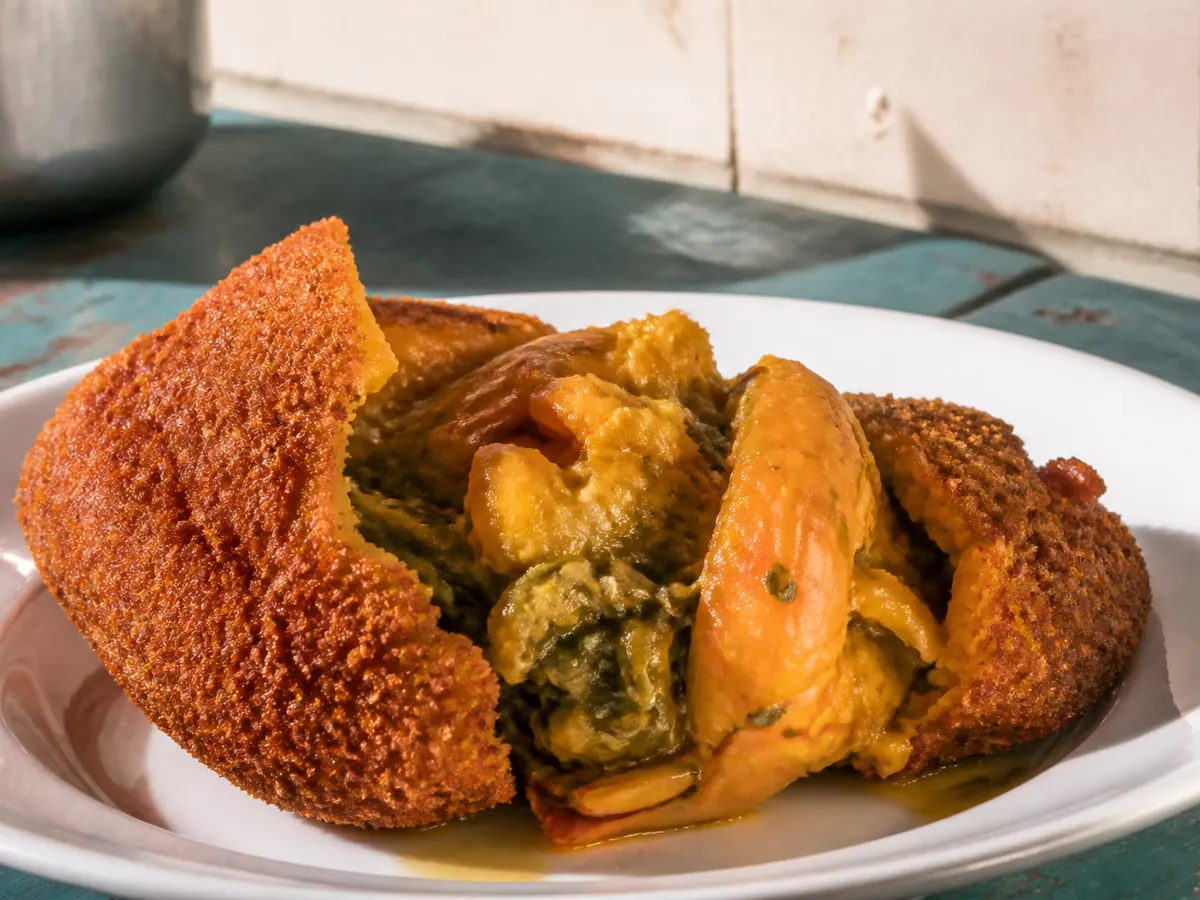
I start this plate the way Bahian cooks do when the street is still quiet and the oil has not yet shimmered: with dry black-eyed peas under cold water, skins waiting to slip.
Acarajé is the fritter you smell before you see — dendê at a rolling heat, batter that holds a soft peak, and a split pocket ready for vatapá, caruru, tomato salad, and a streak of pepper sauce.
This is a home method, timed at each stage so you know when to peel, when to grind, and when the oil is honest.
I end where I began: peas peeled clean, oil at a true 175–180 °C, and a split fritter that smells like Bahia before the first bite. Fill it, share it hot, and let the crisp shell and the soft vatapá argue pleasantly on the tongue.
The batter
- 500 g1 lb 2 ozDried black-eyed peas (feijão-fradinho)about 2½ cups. Dried only — see the FAQ on canned
- 150 g1 mediumOnion, grated or very finely minced
- 2–3 cloves2–3 clovesGarlic, mincedoptional, but common in home kitchens
- 8–10 g1½–2 tspFine salt, plus more to taste
- a few turnsa few turnsFreshly ground black pepper
- 1–2 tbsp1–2 tbspCold wateronly if the batter needs loosening
For frying
- 750 ml–1 L3–4 cupsDendê (red palm oil)enough for 5–7 cm / 2–2½ in of depth in a heavy pot. Up to 25% neutral oil can stretch it if dendê is scarce — the flavour comes out milder
A simple vatapá, to fill them
- 100 g3½ ozDried shrimp, rinsed and roughly choppedor 80 g / 3 oz cooked shrimp, chopped
- 80 g⅔ cupUnsalted roasted peanuts or cashews, ground
- 60 g½ cupDried breadcrumbs, or crumbs from a day-old French roll
- 200 ml¾ cup plus 1 tbspCoconut milk
- 1 small1 smallOnion, minced
- 1 clove1 cloveGarlic, minced
- 2–3 tbsp2–3 tbspDendê
- ½ tsp½ tspFresh ginger, gratedoptional
- to tasteto tasteSalt, black pepper, and hot water to loosen
To finish the plate
- 22Ripe tomatoes, diced, with ½ small red onion sliced thinwith cilantro, lime, and salt — the tomato-onion salad
- to tasteto tasteMolho de pimentamalagueta or similar chilli mashed with vinegar, a pinch of salt, and a spoonful of the frying oil if you like
- optionaloptionalCaruru (okra stew), if you have it
Why this fritter works
Black-eyed peas mash into a paste that traps air when you beat it. That air expands in hot dendê and gives you a crisp shell with a tender, almost cake-like centre. Dendê is not a neutral frying oil. Its aroma and colour are part of the dish — swap to vegetable oil alone and you lose the Bahia signal entirely.
Peeling is not a formality
Skins left on make the batter speckled and slightly bitter, dull the colour of the fried shell, and make the fritters crack more. Plan real time for the soaking and the rubbing. Rushing here shows up later as dense, muddy fritters.
On the vatapá here
This is a compact cook-with filling so the plate is complete — enough creamy paste to spoon into split fritters, not a market-scale vatapá and not a second full recipe.
A line of lineage
In Bahia, acarajé is also food offered in Candomblé, where the fritter honours the orixá Iansã (Oyá). That sacred thread runs beside the street-food craft, and it does not need a lecture from me to be respected.
Equipment
- A large bowl for soaking and peeling
- A food processor or sturdy blender — street stalls often use a mill; at home a processor is fine
- A heavy Dutch oven or deep saucepan
- An instant-read or candy thermometer — the oil temperature is non-negotiable here
- A slotted spoon or spider
- A wire rack over a tray
A heavy pot holds its temperature between batches far better than a thin pan, and oil temperature is most of this recipe.
Method
Soak, the night before8–12 hours passive
Rinse the dried peas under cold water and cover them by at least 8 cm / 3 in. Leave them 8 to 12 hours at room temperature.
They should plump, with the skins loosening at the edges.
Why cold and long: heat softens unevenly and can cook the outer layer before the centre hydrates, which fights clean peeling in the morning.
Rinse the dried peas with cold water, cover by at least 8 cm / 3 in, and soak at room temperature for 8–12 hours, until plump with loosening skins.
Peel the peas45–70 min
Drain. Working in batches in a large bowl of fresh cold water, rub handfuls between your palms. The skins slip off as pale flakes and float; the intact peas sink.
Skim the skins with a small sieve, or pour off the cloudy top water carefully, refill, and rub again. Repeat until most of the skins are gone — aim for 90% or better.
Peeled peas look creamy ivory, not mottled. Drain them well. If you are not grinding immediately, cover and refrigerate up to 4 hours.
Drain and rub handfuls in fresh cold water. Skim floating skins, refill and repeat until at least 90% are removed. Drain well; cover and refrigerate up to 4 hours if grinding later.
Grind, then beat by hand15–20 min
Pulse the peeled peas in the food processor to a thick, slightly grainy paste — not baby food. Scrape the bowl often. Add the grated onion, the garlic if using, salt, and pepper, and process again until it looks cohesive and pale.
Onion goes in now because its moisture and sulfur compounds help the batter emulsify and season all the way through the crumb.
Transfer to a wide bowl and beat the paste 3 to 5 minutes with a wooden spoon or your hand. It should lighten slightly and hold soft peaks when you lift the spoon — like a stiff hummus that breathes.
The processor cuts; your arm incorporates the air that becomes the fritter's interior holes. Do not skip this.
Cement-thick: cold water, a teaspoon at a time. Soupy: you over-watered or under-drained — fold in a spoonful of dry breadcrumbs as an emergency fix. Taste a pea-sized bit for salt.
Pulse peas to a thick, slightly grainy paste, scraping often; process in onion, optional garlic, salt and pepper. Beat by hand 3–5 minutes to soft peaks. Loosen with cold water by teaspoons; rescue soupy batter with a spoonful of breadcrumbs.
The vatapá, while the oil heats20–25 min
Warm 2 tbsp dendê in a small saucepan over medium until it smells nutty and looks vividly orange, about 1–2 minutes. Do not smoke it.
Soften the onion and garlic 4 to 5 minutes until translucent and sweet. Dried shrimp for 2 minutes until aromatic. Then the ground nuts, breadcrumbs, coconut milk, and ginger.
Simmer gently 8 to 10 minutes, stirring, until a spoon leaves a brief trail. Loosen with hot water if it seizes. Season.
It should smell of shrimp, coconut, and dendê together, taste rich but not oily, and mound on a spoon without running. Hold it warm on the lowest heat, or covered off the heat.
Warm 2 tbsp dendê over medium 1–2 minutes without smoking. Soften onion and garlic 4–5 minutes; add shrimp for 2 minutes, then nuts, breadcrumbs, coconut milk and ginger. Simmer, stirring, 8–10 minutes until spoonable; loosen with hot water, season and keep warm.
Bring the oil to a true 175–180 °C10 min
Dendê into the pot to a depth of 5–7 cm / 2–2½ in. Heat over medium to 175–180 °C / 347–356 °F, and use the thermometer.
Below about 165 °C / 329 °F the fritters drink oil and stay pale. Above about 190 °C / 374 °F the shell darkens before the centre sets and the edges turn bitter.
Dendê darkens as it cooks and that is normal. Burnt dendê smells acrid — if it does, start with fresh oil rather than push through.
Heat 5–7 cm / 2–2½ in of dendê over medium to a thermometer-confirmed 175–180 °C / 347–356 °F. Let the temperature recover between batches; replace oil that smells acrid or burnt. Avoid oil below 165 °C / 329 °F, which makes greasy fritters, or above 190 °C / 374 °F, which darkens the shell before the centre sets.
Shape and fry25–35 min
With wet hands or two oiled spoons, form oval mounds of about 70–90 g each, roughly the size of a large egg. The street shape is a plump oval, not a flat patty. Wet hands keep the surface smooth so the crust seals evenly.
Slip 3 or 4 into the oil without crowding. It should bubble steadily around them, not explode. Fry 4 to 6 minutes a side, turning once, until deep golden-orange and crisp — 8 to 12 minutes in the oil altogether depending on size.
A skewer should meet slight resistance and then soft crumb. Raw centres feel pasty and cool.
Drain on the rack and rest 2 to 3 minutes so the steam finishes the interior. Hold finished fritters on a rack in a 95 °C / 200 °F oven, uncovered, while you fry the rest.
Shape smooth 70–90 g ovals with wet hands or oiled spoons. Fry 3–4 at a time, 4–6 minutes per side, until crisp orange-gold with soft, non-pasty centres. Rack-drain 2–3 minutes; hold uncovered at 95 °C / 200 °F.
Split and fill5 min
Split each fritter almost through, like a pita.
Warm vatapá into the pocket. A spoon of the tomato-onion salad. A ribbon of caruru if you have it. Pepper sauce to taste — Bahia heat is part of the conversation, not an afterthought.
Serve immediately, while the shell still crackles.
Split fritters almost through. Fill with warm vatapá, tomato-onion salad seasoned with cilantro, lime and salt, optional caruru, and pepper sauce to taste. Serve immediately while crisp.
Quick reference
The soak
Cold water, a room-temperature kitchen, 8 to 12 hours.
The batter
A thick paste that softens under beating and holds soft peaks.
The fry
A steady 175–180 °C / 347–356 °F. Let it recover between batches.
The finished fritter
Deep orange-gold, fragrant with dendê, crisp shell, moist pale interior.
The vatapá
Thick and spoonable, smelling of shrimp and coconut, warm when it goes into the pocket.
Storing it
The peas and the batter
Peeled peas: refrigerate covered under water up to 24 hours, changing the water once. Or drain and freeze up to 1 month, thawing in the fridge before grinding. Batter: best fried the day you grind. Refrigerate tightly covered up to 12 hours and beat it again before frying to restore the air. Do not freeze batter — the texture collapses.
Fried fritters
Best within 30 minutes of leaving the oil. Leftovers cool, then airtight in the fridge up to 2 days. Reheat on a rack at 180 °C / 350 °F for 8 to 10 minutes to re-crisp. The microwave softens the shell and there is no undoing that.
The vatapá
Refrigerate up to 3 days and reheat gently with a splash of coconut milk or water. Freezes up to 1 month — thaw overnight and refresh it with a little dendê.
Troubleshooting
- The skins will not come off.
Soak longer — a full overnight. Rub under water, never dry. A brief second soak in warm, not hot, water for 10 minutes helps stubborn skins; then go back to rubbing in cold water.
- The batter is too wet, and the fritters flatten and go greasy.
The peas were not drained enough, or the onion released too much juice. Squeeze the grated onion in a cloth, or beat in 1–2 tbsp breadcrumbs, and chill the batter 20 minutes to firm it.
- Stiff batter, dense centres.
Beat longer to work in air, and add water by the teaspoon. Do not over-process into glue — stop while a little grain remains.
- The oil temperature keeps swinging.
Fry fewer at a time and let it climb back to 175–180 °C between batches. A heavy pot holds heat far better than a thin one.
- A bitter or burnt taste.
Oil too hot, or reused past its life. Dendê that has smoked hard should be discarded rather than fried in again.
- Pale and oily fritters.
The oil was too cool. Wait for a true 175 °C before the next drop, every time.
- Cracked shells.
Batter too dry, or skins left in. Smooth the surface as you shape, and peel more carefully next time.
- The vatapá went grainy or broke.
Simmer it gently, and whisk in a splash of coconut milk off the heat. The ground nuts should be fine, not chunky gravel.
Substitutions
Traditional
Peeled feijão-fradinho, fried in dendê, shaped into ovals, filled at the stall with vatapá, caruru, salada, and pimenta.
Home departures I accept
A food processor instead of a stone mill. A small percentage of neutral oil mixed into the dendê when supply is limited. Garlic in the batter. A simplified vatapá cooked in one pan as a serve-with. Holding finished fritters briefly in a low oven.
Departures I avoid for this plate
Skipping the peel. Baking instead of frying — that is different food. Calling vegetable-oil-only fritters "acarajé" without saying so. Stuffing them with unrelated fillings that erase the Bahia set.
Not a cousin
Argentine and other South American fritters are not relatives of this one. This is specifically Bahian black-eyed pea and dendê craft.
Scaling
As street food, one large stuffed fritter is a meal. At home I plan two smaller ones per hungry adult, with salad on the plate.
Working smaller
Halve the peas and the vatapá, but keep the oil depth at 5–7 cm — depth is what holds temperature, and a shallow pot of oil swings wildly the moment cold batter hits it.
Working bigger
The peeling, not the frying, is the bottleneck. Peel the night before and refrigerate the peas under water. Fry in small batches regardless of how many you are feeding.
What to serve it with
A split fritter, vatapá inside, salad, and pepper sauce on the side.
- The tomato-onion salad, always
- Caruru, when you have it
- Molho de pimenta on the side, not stirred through
- Ice-cold lager, guaraná soda, or fresh limeade
Coffee afterwards, if you are ending the afternoon the Bahian way.
Questions
Can I use canned black-eyed peas?
Not for this method. Canned peas are already cooked and waterlogged, and they will not beat into a fryable batter. Dried, soaked, and peeled is the path.
Is dendê the same as any palm oil?
No. Dendê here means red palm oil with its characteristic colour and flavour. Refined colourless palm oil is not a substitute for the aroma.
Do I have to serve both vatapá and caruru?
No. Vatapá with salad and pepper sauce makes a complete home plate. Caruru is welcome when you have it.
Can I judge doneness by colour?
Not on its own — some of that colour is the oil staining the crust. Use time, temperature, and the feel of the crumb. A pale fritter at the right temperature just needs longer; a dark one out of overheated oil can still be raw inside.
Can I air-fry them?
You can experiment, but you will not get acarajé. The dish is defined by immersion in dendê. If you air-fry for dietary reasons, brush with dendê, accept a drier crust, and call it a black-eyed pea fritter inspired by acarajé.
How spicy should the pepper sauce be?
Your table's call — offer it on the side. Traditional plates expect heat to be available, not mandatory in every bite.