Brigadeiro
Condensed milk, cocoa, and butter cooked until the paste pulls from the pan in a clean sheet, then cooled and rolled in chocolate sprinkles. Birthday tables across Brazil run on this fudge.
- Prep
- 20 min
- Cook
- 14 min
- Serves
- 30–35 brigadeiros
- Difficulty
- Easy
Researched · Kitchen testing pending
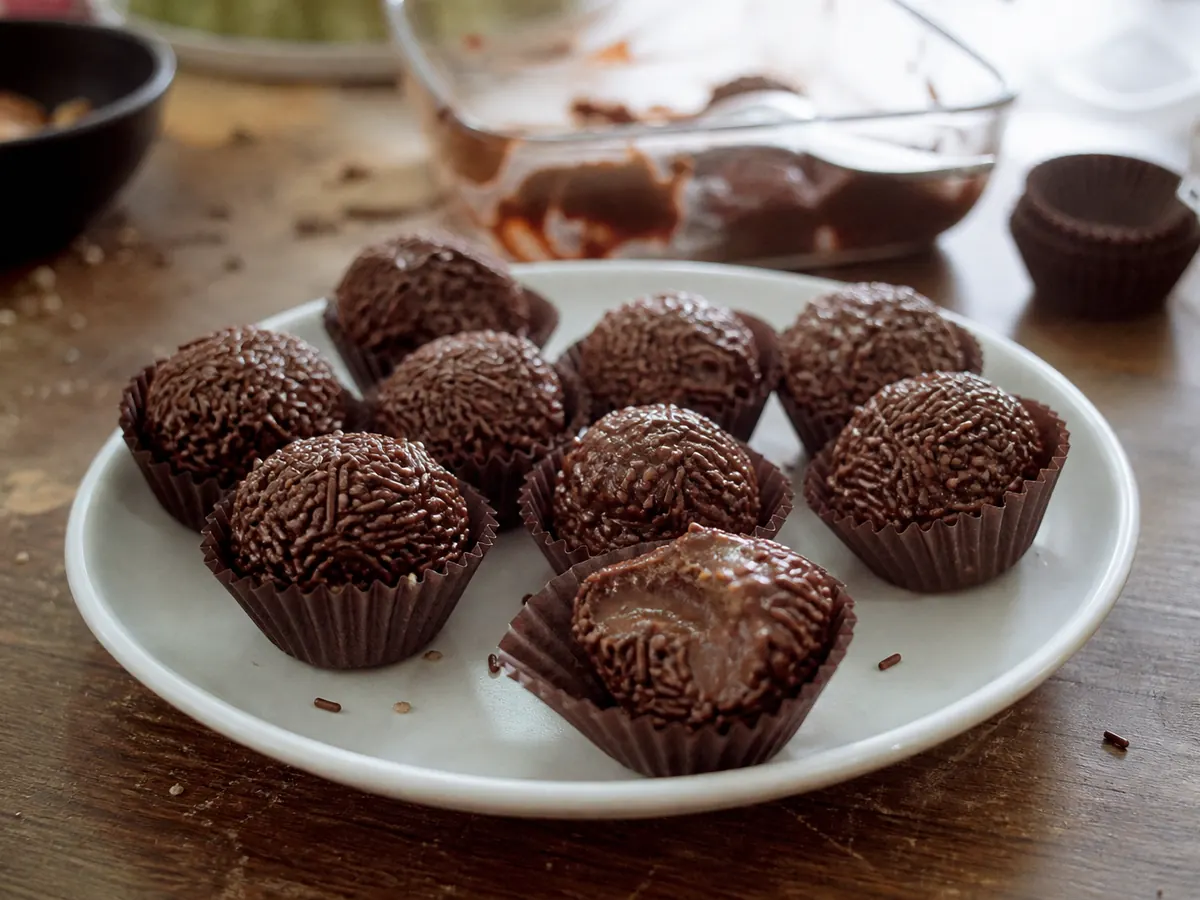
Brigadeiro is condensed milk, cocoa, and butter cooked until the paste pulls from the bottom of the pan in a clean sheet, then cooled and rolled in chocolate sprinkles. Pull it too early and the balls slump. Cook it too far and they crack.
Constant stirring is not optional exercise — milk sugars and proteins want to stick, and the black flecks from a scorched bottom taste bitter and ruin the colour of the whole batch. If brown flecks start forming while the mass is still glossy and loose, the heat is too aggressive: pull the pan off for thirty seconds, stir hard, and go back at a lower setting.
The sprinkles are not decoration. They add the texture contrast, and they keep a sticky surface from taking a fingerprint off every guest.
I still judge a party by whether someone quietly takes a second brigadeiro before the cake is cut. When the scribble on the pan bottom holds just long enough, I already know they will.
The fudge
- 395 g1 can (14 oz)Sweetened condensed milkfull sweetened, not "lite" — the lite cans will not set
- 20–22 g3 tbspUnsweetened cocoa powderDutch-process or natural both work. Dutch gives a darker, rounder taste
- 14 g1 tbspUnsalted butterplus more for greasing the plate and your hands
- a pincha pinchFine saltoptional, but it sharpens the chocolate
The coating
- 100–120 g¾–1 cupChocolate sprinkles (granulado)the thin, crunchy Brazilian kind if you can find them. US jimmies work
- a littlea littleSoft butter, for your palms
Why condensed milk, and not something else
Condensed milk is both the sweetener and the structure — its milk solids and sugar cook into a fudge with no eggs and no cream. Evaporated milk plus sugar is a different cook with crystallization risks. Use the can.
Why cocoa powder, and not melted chocolate
Cocoa gives chocolate flavour without adding the liquid and fat that melted chocolate would. Melted chocolate changes the set and can turn the balls sticky and greasy. Drinking-chocolate mix is not a substitute — the sugar and starch in it throw off both the set and the taste.
On sprinkles
Brazilian granulado is thinner and crunchier than most US ice-cream sprinkles. Thick jimmies still work; the bite is just chunkier. Avoid nonpareils — those tiny hard balls — as the only coating. They feel sandy against the fudge. Cocoa powder as a coating is a modern twist, bitter and pretty, but it is not what this recipe finishes as.
A cousin, in one sentence
Beijinho is the coconut twin — the same condensed-milk cook, white, rolled in grated coconut and often finished with a clove on top. Same doneness logic, different coating.
Equipment
- A heavy-bottomed saucepan, 18–20 cm / 7–8 in
- A silicone spatula or wooden spoon
- A buttered plate or shallow dish, for cooling
- Mini paper cups — optional, but traditional for a party
- A cold plate, for the smear test
A thin aluminium pan hot-spots and scorches the condensed milk while the centre still looks thin. Heavy stainless or enamel spreads the heat. Medium-low on a gas stove is not medium-low on a powerful induction burner — learn your stove on the first batch and watch the mixture, not the knob.
Method
Mix it cold2 min
Set the saucepan on the counter, off the heat. Condensed milk in. Sift or sprinkle the cocoa over it and stir until no dry pockets remain — cocoa lumps that survive into the heat become bitter freckles.
Butter and the pinch of salt.
It will look like thick chocolate pudding and smell raw and milky. That is correct.
Off the heat, stir sifted unsweetened cocoa into full-fat sweetened condensed milk until no dry pockets remain. Add butter and optional salt; the mixture should resemble thick chocolate pudding.
The cook — this is the whole game10–14 min
Medium-low heat. Stir constantly, working the bottom and the corners so nothing sits and browns. I keep the spatula in a figure-eight that hits the corners every few strokes.
For the first 3–4 minutes nothing dramatic happens: the butter melts, the mix thins slightly, steam starts to rise. Keep the heat honest — too high and you scorch the milk sugars before the water has cooked out.
Around minute 5–7 the mass thickens and darkens a shade. It burbles in slow, lazy bubbles, and the sound shifts from a watery simmer to a thicker, quieter plop. The spatula leaves a brief trail that fills back in within a second.
Toward the end the workout gets real and the mass fights the spoon. That resistance is information — you are close.
Cook over medium-low, stirring constantly across the bottom and corners to prevent scorching. During the first 3–4 minutes the mixture loosens, then thickens and darkens around 5–7 minutes; continue until slow bubbles and increasing resistance signal it is ready for testing.
The scribble, and three other teststhe decision point
You are cooking to soft-ball territory, but Brazilian home cooks judge by how the pan behaves, not by a dial. Use all four tests:
1. The scribble. Drag the spatula firmly across the pan bottom. The mixture should part and leave a clean path for 2–3 seconds before flowing back. Fills instantly: keep cooking. Path stays open and the mass looks stiff and matte: you have gone too far toward hard candy.
2. The tilt. Tilt the pan. The fudge should slide as one slow sheet, not run like sauce.
3. The thermometer, as backup. About 112–115 °C / 234–239 °F. I still trust the scribble more than a dial on a thin pan.
4. The cold plate. Drop a pea of the mixture onto a cold buttered plate. After 20 seconds it should hold a soft mound and not puddle. If it puddles, cook 1–2 minutes more.
Check all four signs: a spatula path stays clear 2–3 seconds; tilted fudge slides as one sheet; temperature is about 112–115 °C / 234–239 °F; a pea-sized drop on a cold buttered plate holds a soft mound after 20 seconds. If it puddles, cook 1–2 minutes more.
Off the heat, onto the plate1 min
When the scribble holds, kill the heat immediately.
Transfer the mass to the buttered plate and spread it about 1 cm / ⅜ in thick so it cools evenly. Do not leave it in the hot pan — carryover heat keeps cooking and can tip you past the soft point after you thought you were finished.
As soon as the spatula path holds, turn off the heat and transfer immediately to a buttered plate. Spread about 1 cm / ⅜ in thick; leaving it in the hot pan would continue cooking it.
Cool30–45 min
Cool until it is just warm or at room temperature — cool enough not to burn your palms, warm enough that it still shapes. Under about 35 °C / 95 °F, comfortable on bare skin.
Fifteen to twenty minutes in the fridge speeds this up. Do not freeze it solid or rolling becomes cracking work.
The surface should look set and slightly dull, not glossy-wet. In a kitchen above about 28 °C / 82 °F, move the plate to the fridge after twenty minutes.
Cool until set, slightly dull and comfortable to handle, below about 35 °C / 95 °F. Refrigerate 15–20 minutes to speed cooling; do not freeze solid. Above 28 °C / 82 °F room temperature, refrigerate after 20 minutes.
Roll and coat15–20 min
Sprinkles into a shallow bowl. Butter your hands lightly — too much and the sprinkles will not stick; too little and the fudge glues to your skin.
Scoop about 1 tbsp, 15–18 g, per ball. Roll between your palms into a smooth sphere about 2.5 cm / 1 in across, drop it into the sprinkles, and roll to coat completely. Into a paper cup if you have them.
If the mass softens from the warmth of your hands, chill it 5 minutes and carry on.
Serve at cool room temperature. They should yield to the tooth with a dense, creamy chew — not chalky, not runny.
Lightly butter palms. Roll 1 tbsp / 15–18 g portions into smooth 2.5 cm / 1 in balls; coat completely in chocolate sprinkles and place in paper cups. Chill softened mixture 5 minutes as needed. Serve at cool room temperature.
What soft ball means here
The candy-chart version
Soft-ball is the stage where a drop of syrup in cold water forms a soft ball you can flatten between your fingers.
Why the water test is less useful here
Brigadeiro is denser than a clear sugar syrup because of the milk solids. The idea still holds — enough water cooked out that the candy keeps its shape when cool, not so much that it shatters.
The home-cook translation
The scribble on the pan bottom is that stage made visible. Viscosity rises as water evaporates, and the clean path is what rising viscosity looks like. Trust it, and confirm with the cold-plate smear until your hands learn the look.
The other signal
I listen for the bubbles slowing. When the kitchen smells deeply of cooked cocoa and sweet milk — not raw condensed milk, not burnt toast — I start testing scribbles every thirty seconds. That last minute is where the batch is won.
Making them ahead for a party
The Friday-night cook
For a Saturday party I cook the fudge Friday, cool it on the buttered plate, cover it loosely once the steam has stopped, and refrigerate. Saturday afternoon it sits out twenty minutes, then I roll and coat.
Rolled ahead
Freshly rolled brigadeiros look brighter. Day-old rolled ones are still excellent if sealed airtight so the sprinkles do not take on fridge smells. Do not stack uncovered trays next to onions.
The assembly line
Set the paper cups out in rows on the tray *before* you butter your hands, or the line stalls with sticky fingers hunting for cups. A light film of butter on the cooling plate stops a glued-on disaster when you go to scoop.
Transport
A pyramid on a cake stand with parchment between layers, paper removed on arrival. Heat and humidity are the enemies; air conditioning is the friend.
Storing it
Keeping them
Airtight at cool room temperature up to 2 days, or refrigerated 5 to 7 days. Cold brigadeiros firm up — let them sit 15 to 20 minutes before serving so the centre softens. Layer with parchment if you stack them, or the sprinkles weld together. Freezing works up to 1 month, well wrapped. Thaw in the fridge, then bring them toward room temperature. Never leave them in a hot car. They melt into sad chocolate puddles with sprinkles floating in them.
The unrolled fudge
Leftover cooked fudge keeps 3 days refrigerated and rolls later. Warm it slightly if it has gone too stiff.
Heat safety
The fudge reaches about 112–115 °C / 234–239 °F. Keep children away from the pan until the mass is cool enough to roll — sugar burns are serious. Rolling is the part they can help with. Discard any batch that smells sour after storage.
Troubleshooting
- Scorched, with black bits through it.
Heat too high, or the stirring skipped the corners. For a light scorch, pour the mass into a clean bowl without dragging the burnt layer along, then taste — if it is bitter, start over. Prevention beats rescue here.
- Too soft — it will not hold a ball.
Undercooked. Back into the pan for 2 to 4 minutes to a firmer scribble, then cool again. Adding more cocoa does not fix a water-content problem.
- Too hard, crumbling as you roll.
Cooked past soft-ball. Warm a spoonful of condensed milk or a small knob of butter into the mass over very low heat to soften it, or accept denser candy brigadeiros. Pull earlier next time.
- The sprinkles will not stick.
Hands too buttery, or the fudge surface too cold and dry. Warm each ball briefly in your hands before rolling it in the granulado, and use less butter on your palms.
- Grainy texture.
Lumpy cocoa, or sugar crystallizing from inconsistent stirring after a hard boil. Sift the cocoa next time and keep the heat moderate.
- Pale and bland.
Another tablespoon of cocoa next time, or a darker cocoa. The pinch of salt is what makes chocolate read as chocolate.
- The scribble never holds.
Heat too low, so you are drying it forever — or a thin mix in a humid kitchen. Raise the heat slightly and keep stirring; patience and a heavier pan usually fix it. Also confirm you used full sweetened condensed milk, not lite.
Substitutions
Traditional
Condensed milk, cocoa powder, and butter cooked to the soft fudge point, cooled, rolled in chocolate sprinkles, and served in tiny paper cups at birthdays, weddings, and office parties. Traditional chocolate brown is what I reach for when the tray has to look like every birthday I remember. Coloured sprinkles turn up at kids' parties.
Departures I make, and label
The optional pinch of salt. A thermometer range as backup to the scribble. US jimmies when Brazilian granulado is scarce.
A different doneness, not a variation
Brigadeiro de colher — spoon brigadeiro — is delicious, but you stop the cook earlier and skip the rolling entirely. Serve it in cups and label it, so nobody expects a ball.
Not this recipe
Cream cheese in the base. Condensed coconut milk as the base for a classic brigadeiro. Baking the mixture into brownies and calling it the same thing. Gourmet shops now pipe soft brigadeiro into cups or flavour it with pistachio, coffee, or couverture chocolate. Good things — different things.
Scaling
Party math: 2 to 3 per guest alongside cake, or 4 to 5 if they are the main sweet on the table.
Half and double
Half, about 15–18 balls: roughly 200 g / 7 oz condensed milk, with the cocoa and butter halved. The scribble often arrives in 8 to 11 minutes, so watch the pan. Double, about 60–70 balls: a wider heavy pan, or two pans. Expect 14 to 18 minutes. Cool on two plates at about 1 cm / ⅜ in thick.
Do not triple in a small pot
The centre scorches while the edges lag. Cook in batches instead — a wider pan keeps evaporation even, and even evaporation is the whole recipe.
Half cans
Half a can of condensed milk is awkward to store. I prefer full batches and freeze the extras.
What to serve it with
Mini paper cups on a tray — the classic birthday look.
- A simple cake nearby
- Cafezinho for the adults, cold milk for the kids
- Beijinho on the same tray, for white-and-brown contrast
- Spoon brigadeiro in cups, if you stopped a second pan earlier
For gifts, pack them in small tins with parchment and a note that they are best within a few days at cool room temperature. Label the allergens — milk, and check the sprinkles for soy lecithin.
Questions
Can I use drinking chocolate mix instead of cocoa?
No. Those mixes carry sugar and starch that throw off both the set and the taste.
What about melting real chocolate into it?
That makes a different candy, closer to some of the gourmet shop versions. Cocoa is what gives classic brigadeiro its texture.
Why condensed milk rather than evaporated milk and sugar?
Condensed is already sweetened and thick. Evaporated plus sugar is a different cook with real crystallization risk. Use the can.
Are they gluten-free?
Usually, if your cocoa and sprinkles are. Check the labels — some sprinkles use wheat starch.
Can kids help?
With the rolling, once the fudge is cool. Keep them clear of the pan during the cook.
How is this different from a truffle?
A truffle is ganache — cream and chocolate — chilled and coated. Brigadeiro is a milk fudge cooked on the stove. Related party energy, different technique, different taste.