Picanha
The sirloin cap with its fat left on, coarse-salted and cooked over managed coals until the fat renders and the centre stays pink. Churrasco at home, without the rodízio spit.
- Prep
- 25 min
- Cook
- 50 min
- Serves
- 4–6 as a main
- Difficulty
- Medium
Researched · Kitchen testing pending
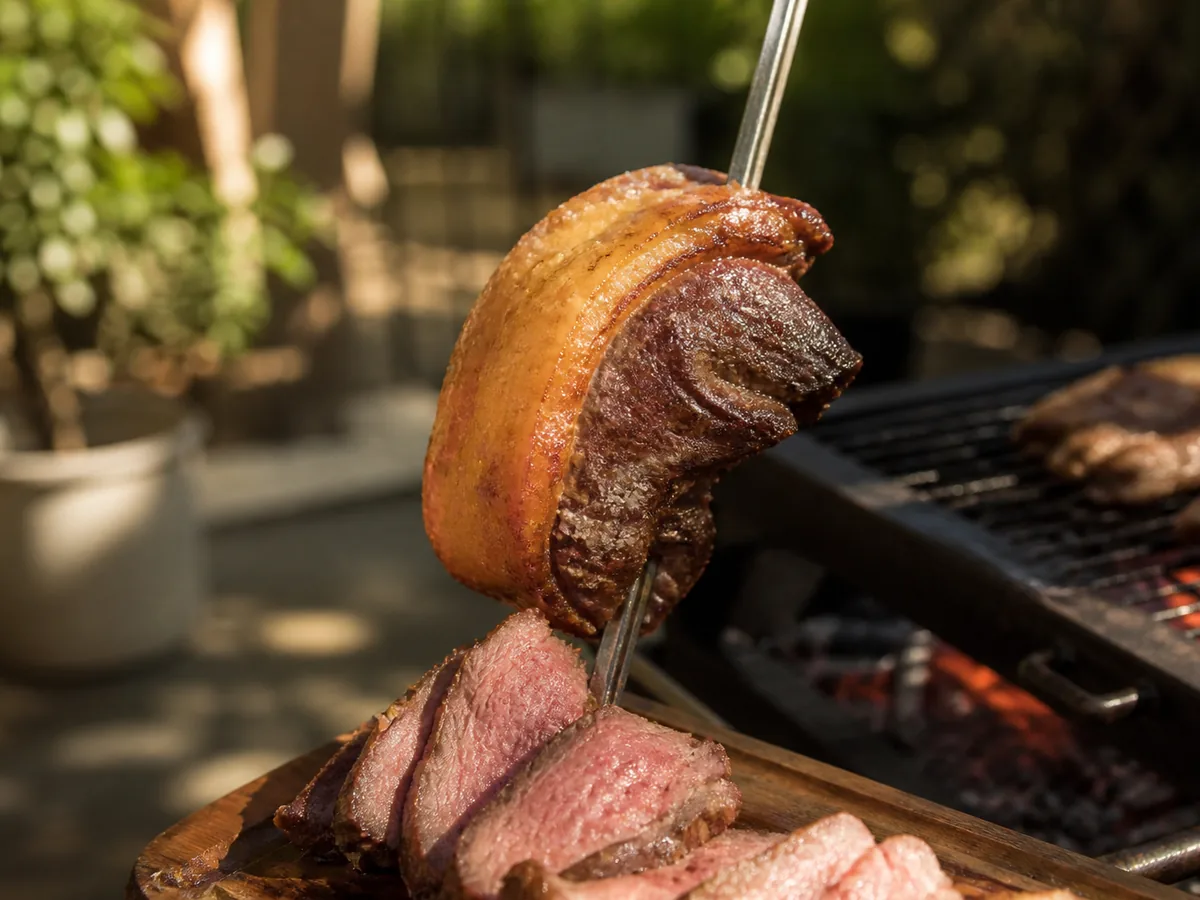
Salt hits the fat cap first, then the fire answers. That is how I open picanha when there is no rodízio spit turning above the coals — only a home grill, a sharp knife, and the triangular sirloin cap Brazilians treat as the star of churrasco.
Both paths here aim at the same place: a warm pink centre and a fat cap that has actually rendered. Skewered C-folds or a whole roast with the fat side managed — the hardware changes, the logic does not.
I close the lid only long enough to finish the centre, then slice against the grain with the fat still shining. Coarse salt, managed fire, medium pink — that is home picanha when the spit is someone else’s job.
The beef
- 1.2–1.6 kg2½–3½ lbWhole picanha, fat cap onsilver skin trimmed from the meat side if it is there. Sold as rump cap or coulotte in some markets — confirm the fat cap is present and thick
- 20–30 g2–3 tbspCoarse salt (sal grosso)more than feels polite. Much of it never dissolves into the meat, and that is the point
- to tasteto tasteFreshly ground black pepperoptional. Purists salt only; I add a light grind after the first sear if the table likes it
- 1 tsp1 tspNeutral oil, for the gratefor the grate only — never on the meat
- a pincha pinchFlaky salt, after slicingoptional, for any undersalted edge
For the table
- 300 g1½ cupsLong-grain white rice, cooked plain
- a small bowla small bowlFarofa (toasted cassava flour)
- 1 bowl1 bowlVinaigrette — diced tomato, onion, bell pepper, parsley, vinegar, oil, salt
Why picanha is its own cut
It is the sirloin cap with its thick fat cap left on. The muscle is relatively lean and tender; the fat bastes it as it renders and carries the coarse salt into a savoury crust. Trim the fat off and you are cooking a different steak. Leave a thin, even layer — roughly 1–1.5 cm / ⅜–⅝ in after neatening — and you have the Brazilian signature.
At the counter
Look for a creamy, even fat cap and bright red meat. Avoid grey edges, or a cap that has been shaved down to nothing. If the butcher only has "sirloin tip" with no fat, ask specifically for picanha or rump cap with the fat on.
The doneness Brazilian tables expect
Medium: a warm pink centre, about 57–60 °C / 135–140 °F after a short rest. Well-done picanha dries out. Rare is fine if your guests want it, but medium is the default at the pass.
The neighbour, in one sentence
Argentine asado usually builds a longer, gentler cook across many cuts with a different salt-and-fire rhythm. Brazilian picanha is coarse-salted, fat-cap managed over hotter direct heat, and sliced for medium.
Equipment
- A charcoal grill, preferred — gas works with a real hot zone and a cool one
- An instant-read thermometer
- A sharp slicing knife
- Long, sturdy metal skewers, if you take the C-fold route
- Tongs, a clean board, and foil for a loose tent
No spit required. That is the whole reason this method exists — skewers or whole-grill fat management stand in for the restaurant rodízio hardware.
Method
Trim and score10–15 min
Pat the meat thoroughly dry. On a board, neaten the fat into an even sheet about 1–1.5 cm / ⅜–⅝ in.
Score the fat in a shallow crosshatch, cutting through fat only — do not dig into the muscle.
Why score: it helps the fat render evenly and stops the cap cupping into a dome that shields the meat from the heat.
Pat meat thoroughly dry and remove any silver skin from the meat side. Trim the fat cap evenly to 1–1.5 cm / ⅜–⅝ in, then score a shallow crosshatch through fat only, without cutting into muscle.
Decide your path before you salt2 min
Whole grill roast: leave the piece intact.
Skewers: cut *with* the grain into 3–4 cm / 1¼–1½ in steaks, fold each into a C so the fat sits on the outside curve, and thread onto skewers. This mimics the spit — fat outside, meat protected — and lets you serve handsome slices straight off the skewer.
Leave the picanha whole for roasting, or cut with the grain into 3–4 cm / 1¼–1½ in steaks. For skewers, fold each steak into a C with fat on the outer curve and thread securely.
Salt10–20 min before the fire
My default at home: salt generously on all sides 10 to 20 minutes before grilling. The coarse crystals sit on the surface and become the crust.
If the piece is thick and fridge-cold: salt lightly 45 to 60 minutes ahead, refrigerate uncovered on a rack, then add a final dusting of coarse salt on the way to the grill. Pat off any surface moisture first.
Why not an overnight brine: the joy of picanha is the contrast between a seasoned crust and a juicy interior. Long salting pushes the texture toward cured.
Never rinse the salt off.
Coarse-salt all sides generously 10–20 minutes before grilling. For thick, fridge-cold meat, salt lightly 45–60 minutes ahead and refrigerate uncovered on a rack; pat surface moisture away, then add a final dusting before grilling. Never rinse off salt.
Build a two-zone fire20–30 min
Light a full chimney of hardwood charcoal. When the coals are ashed over, bank them into two zones: a hot direct side — you should only be able to hold a hand 15 cm / 6 in above it for 2 to 3 seconds — and a cooler indirect side.
Grate clean and lightly oiled, hot enough that fat sizzles on contact within seconds.
Gas: one burner on high, the adjacent burner low or off.
Light a full chimney of hardwood charcoal and bank ashed-over coals into hot direct and cooler indirect zones. Clean and lightly oil the grate, not the meat. For gas, set one burner high and the adjacent burner low or off.
Fat side down first4–6 min
The whole picanha goes fat-side down over direct heat. Render 4 to 6 minutes without fussing at it.
You want the fat to blister, brown and begin to drip: an audible sizzle, the edges turning translucent, the smell of roasted beef fat — not acrid smoke. If flames leap from the drips, move to indirect briefly, then come back.
Why fat first: the early render bastes the meat and builds the crust. Starting meat-side down leaves the cap pale and waxy.
Place whole picanha fat-side down over direct heat for 4–6 minutes, undisturbed, until fat blisters, browns and drips. If dripping fat causes flare-ups, move briefly to indirect heat, then return; avoid acrid smoke.
Set the colour, then move off the heat3–4 min, then 25–40 min
Flip to the meat side over direct heat for 3 to 4 minutes to set colour.
Then move to indirect, fat-side up, lid closed if you have one. Cook until the thickest part of the centre reads 54–55 °C / 129–131 °F — or pull at 52–53 °C / 126–127 °F if your grill carries over hard.
Typical total from first contact is 25 to 40 minutes depending on thickness and coal heat. Flip once more if the fat wants more colour, watching for flare-ups.
Skewered C-folds instead: start fat toward the heat and grill over direct, turning every 3 to 4 minutes, 12 to 18 minutes in total. Check the thickest fold and pull at the same temperature.
Sear meat-side down 3–4 minutes, then cook indirectly, fat up and lid closed, to 54–55 °C / 129–131 °F, or 52–53 °C / 126–127 °F with strong carryover; allow 25–40 minutes total. For skewers, start fat toward direct heat, turn every 3–4 minutes and cook 12–18 minutes to the same centre temperature.
Rest8–12 min
Onto a board, tented loosely with foil — not wrapped tight, or you steam the crust you just built.
The temperature climbs another 3–5 °C / 5–9 °F while the juices redistribute. Cutting straight away floods the board and dries the slices.
Rested: 57–60 °C / 135–140 °F for medium, 54–57 °C / 130–135 °F for medium-rare.
Rest on a board 8–12 minutes under loosely tented foil. Expect a 3–5 °C / 5–9 °F rise: 57–60 °C / 135–140 °F for medium or 54–57 °C / 130–135 °F for medium-rare. Do not wrap tightly or slice immediately.
Slice against the grain3 min
Find the grain — on a whole picanha it usually runs along the long axis of the triangle — and cut perpendicular to it, about 1 cm / ⅜ in thick.
Leave a ribbon of fat on every slice. Serve at once, while the fat is still warm and glossy.
Anyone who wants theirs less pink gets their slices back on the grate for another 30 to 60 seconds. I do not cook the whole piece past medium.
Slice against the grain about 1 cm / ⅜ in thick, leaving a ribbon of fat on each slice. Serve immediately while warm; return individual slices to the grate for 30–60 seconds if guests prefer less pink.
Checkpoints
The coals
Ashed over, banked into two zones, 2 to 3 seconds of hand tolerance over the direct side.
Fat on contact
An immediate sizzle, blistering within 4 to 6 minutes.
Off the grill
54–55 °C / 129–131 °F at the centre, for a medium finish.
After the rest
57–60 °C / 135–140 °F. Pink, juicy, a salted crust, and rendered fat that yields to the tooth without being rubbery.
Storing it
Raw
Cold, fat-side up, loosely wrapped. Cook within 2 to 3 days of buying, or freeze up to 2 months well wrapped and thaw 24 to 36 hours in the fridge. Salted ahead: stay inside the windows above. Do not leave coarse-salted meat at room temperature beyond the short pre-grill window.
Cooked
Slices airtight in the fridge up to 3 days. Reheat gently — 30 to 45 seconds a side in a hot skillet — or serve at room temperature in sandwiches with vinaigrette. The microwave softens the fat unpleasantly. Avoid it if you can. Do not freeze cooked picanha if you care about the fat. Freeze it raw instead.
Troubleshooting
- The fat cap is still thick and chewy.
Not enough time fat-side down, or the cap was left too thick. Render longer over moderate direct heat, and next time trim to 1–1.5 cm and score deeper — still not into the meat.
- Constant flare-ups.
Fat dripping onto coals. Use the two-zone dance: move to indirect when the flames rise, come back when they settle. Do not spray water on charcoal — it ash-bombs the meat.
- A grey band, a dry edge, and a raw centre.
Heat too fierce on a thick whole piece with no indirect finish. Sear, then finish indirect with the lid on.
- No pink left, and disappointed guests.
Overcooked — trust the thermometer earlier and remember carryover. For what is already past medium, slice it thin and serve with vinaigrette and farofa so the dryness matters less.
- Undersalted.
Coarse salt needs real surface presence. Salt more assertively next time. A pinch of flaky salt on the cut face helps, but it will not replace a proper crust.
- The surface is oversalted and packed white.
Fine salt by mistake, or salted and left to sit wet. Use true coarse crystals, and brush off loose excess before it hits the fire.
- The skewers spin and the meat unfolds.
Pack the C tightly, and use two parallel skewers for stability.
- The gas grill tastes flat.
Add a smoker box or wood chips rated for gas. Manage the fat and the temperature exactly the same way. Charcoal still sits closer to the churrasco spirit.
Substitutions
Traditional — the churrasco spirit
Coarse salt, fat cap on, high heat managed rather than avoided, sliced for the table, medium for most eaters, and the classic Brazilian sides beside it. Not drowned in a thick steak sauce.
Departures I accept at home
A gas grill with two zones. A whole roast instead of a spit. A light grind of pepper. A loose foil tent for the rest. Scoring the fat for an even render.
Departures I avoid
Removing the fat cap "for health" and still calling it the same experience. Long sweet marinades that mask the beef. Treating it like a thin Argentine flat-grill cut without acknowledging that the cut logic is different. Pressing the meat with a spatula — that just squeezes the juice out.
The oven, if you must
Sear the fat side in a ripping pan, then roast at 200 °C / 400 °F to the same pull temperatures. It works. But outdoor fat management is the point of this write-up.
Scaling
Thickness sets the timing, not weight. A 1.6 kg piece is not cooked longer than a 1.2 kg one if they are the same depth.
Feeding more
Two whole picanhas side by side beat one oversized piece — the cut comes in a natural size and a bigger triangle just means a thicker centre and a wider grey band. Keep the two-zone fire big enough that both can move off the direct heat at once.
Feeding fewer
The skewered C-fold path suits a smaller crowd: cut only as many steaks as you need, and keep the rest of the piece whole and refrigerated.
What to serve it with
Rice, farofa and vinaigrette, in the churrasco arrangement.
- Plain white rice
- Farofa, for crunch against the fat
- Vinaigrette of tomato, onion, bell pepper and parsley
- Ice-cold lager or pilsner
Chimichurri is not required here — keep the plate Brazilian-leaning. If you want wine, a medium-bodied red that will not fight the salt crust.
Questions
Is picanha the same as fillet or ribeye?
No. It is the sirloin cap with its fat. Different grain, different fat geometry, and different salt-and-fire handling.
Do I have to use charcoal?
Charcoal tastes closer to churrasco. Gas produces excellent medium picanha if you keep a real hot zone and do not steam the meat under a badly vented lid full of flare-up smoke.
Why coarse salt only?
It is the churrasco habit: the crystals season and crust without turning the surface pasty. Fine salt dissolves fast and oversalts shallowly.
My market labels it "coulotte" — is that it?
Often the same muscle. Confirm the fat cap is present and substantial.
How much salt is too much?
If the raw surface looks like a snow crust that never melts into contact, brush some off. You want heavy coverage, not insulation.
Does everyone have to eat it medium?
Most Brazilian tables lean that way. Cook the whole piece to medium and give individual slices a little longer on the grate for anyone who wants less pink.