Sopa de Maní
Not a peanut butter soup. Raw white peanuts are soaked, slipped out of their skins and blended with cold water into a milky suspension, then simmered in beef and chicken broth until their native starch granules swell and emulsify the whole pot into a pale, velvety potage. Crowned with a nest of fried potato needles.
- Prep
- 35 min
- Cook
- 1 hr 15 min
- Serves
- 6 deep bowls
- Difficulty
- Medium
Researched · Kitchen testing pending
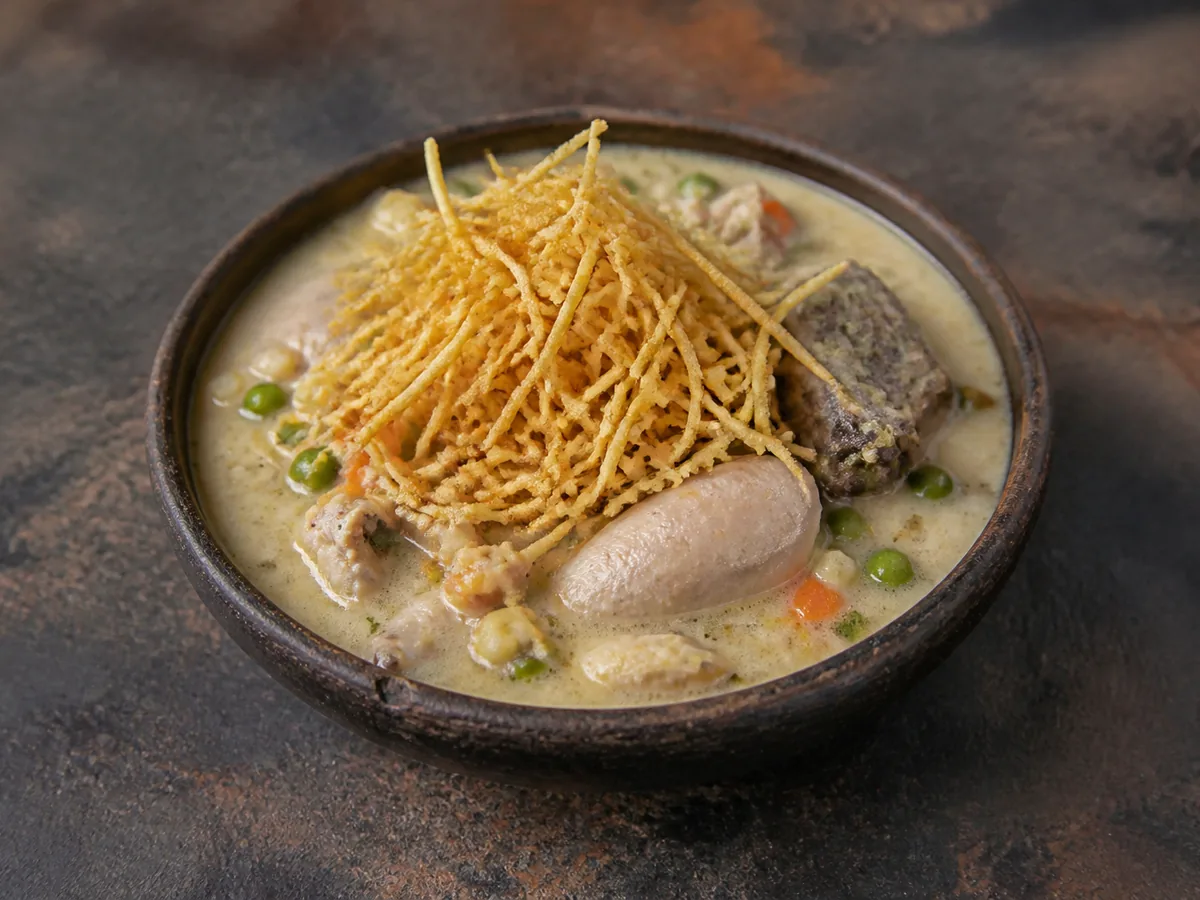
From Oruro to Potosí and Sucre, Sunday lunch in the Bolivian highlands is unthinkable without sopa de maní.
It is built on beef soup bones and chicken thighs, and the magic is in raw, unroasted white peanuts — soaked in warm water, slipped out of their skins, and ground on a stone batán with water into a silken milk. Simmered slowly, the raw peanut starches gelatinise and emulsify with the meat collagen, and the broth turns velvety and pale.
Loaded with sweet peas, carrot, cumin and toasted soup pasta, each bowl is crowned at the last second with a golden nest of hand-cut potato needles.
Broth and meats
- 300 g2 cupsRaw unroasted white peanuts (maní blanco crudo), soaked in warm water 2 hours and skins slipped off
- 800 g1.76 lbBone-in beef ribs (costilla) or beef shank with marrow bones, trimmed of heavy fat
- 600 g4 piecesBone-in chicken thighs or drumsticks, skin removed
- 2.5 L10.5 cupsCold filtered water
Sofrito
- 30 ml2 TbspVegetable oil or beef tallow
- 1 large1 largeYellow onion, peeled and cut into fine brunoise
- 4 cloves4 clovesFresh garlic, minced to a paste
- 1 large1 largeCarrot, peeled and cut into small 5 mm dice
- 1 medium1 mediumRed bell pepper, cored and diced fine
- 8 g2 tspGround cumin seeds, freshly toasted in a dry pan
- 4 g1½ TbspDried wild oregano, hand-crushed
- 15 g1 TbspFine sea saltplus more to adjust at the finish
- 3 g1 tspFreshly ground white or black pepper
Body and crown
- 100 g¾ cupSweet green peas, fresh or frozen
- 100 g1 cupMacaroni or elbow soup pasta, toasted in a dry skillet until golden-brown
- 400 g2 mediumRusset potatoes, peeled and cut into paper-thin 1.5 mm matchsticks (papas al hilo)
- 500 ml2.1 cupsOil, for frying the matchsticks
- 30 g½ cupFresh parsley leaves, minced fine
Raw peanuts, never roasted
Unroasted peanuts still hold un-denatured proteins and native starch granules. Ground with cold water they make a fine colloidal suspension; poured into broth at 85–90 °C the starches swell and thicken while the proteins and fats emulsify with the beef collagen. Roasted peanuts or peanut butter give you a sweet, brown, oily satay soup instead.
Skim the white foam
For the first 15 minutes after the peanut milk goes in, a thick white foam rises. Skimming it takes the raw legume bitterness and saponins with it.
Fifty minutes minimum
Raw peanuts need at least that long at a simmer to cook off their raw bitterness. There is no shortcut.
Stir the floor of the pot
Ground peanut starch sinks fast and scorches. Go across the bottom with a flat wooden spoon every few minutes.
Toast the pasta dry first
A Maillard crust on the dry wheat stops it shedding starch and going gummy in the broth.
Passive time, counted separately
The peanuts soak 2 hours and are then peeled by hand. Neither is active cooking and both sit outside the times quoted above.
The five tastes on this plate
Salt seasons the long-simmered bone broth and the crisp potato needles. Fat is peanut lipids, rendered beef marrow and the fried potatoes. Acid is low by design, brightened at the table with lime and llajwa. Heat is toasted cumin, garlic and white pepper. Umami is beef rib bone, chicken thigh fond, peanut amino acids and toasted pasta.
Equipment
- 8 qt Dutch oven or heavy stockpot
- High-powered blender
- Skillet, for the sofrito
- Ladle, for skimming
- Deep saucepan, for frying
- Wide, deep bowls
Traditionally a deep earthenware olla de barro over charcoal embers. An 8-quart enamelled cast-iron Dutch oven or heavy multi-ply stainless stockpot works in a modern kitchen — the thick encapsulated base is what keeps the ground peanut starch from catching and burning on the bottom.
Method
Peel and grind the peanuts10 min
Soak the raw peanuts in hot water 2 hours, then slip the papery skins off with your fingers.
Blend the peeled white peanuts with 400 ml cold water on high for 90 seconds, until completely smooth, milky and free of grit.
Soak raw, unroasted peanuts in hot water for 2 hours; slip off the skins. Blend with 400 ml cold water on high for 90 seconds until completely smooth and milky.
Start the bone broth35 min
Put the beef ribs, marrow bones and chicken thighs into the Dutch oven with 2.1 litres cold water and bring to a boil.
Skim off all the grey foam for 10 minutes, then turn to low, cover partially, and simmer 25 minutes.
Bring beef ribs, marrow bones and chicken to a boil in 2.1 litres cold water. Skim grey foam for 10 minutes, then lower heat, partially cover and simmer 25 minutes.
Cook the sofrito10 min
Heat 30 ml oil in a skillet over medium heat and sweat the onion, garlic, carrot and bell pepper 8 minutes until soft.
Add the toasted cumin, oregano, pepper and 1 Tbsp salt and cook 2 minutes until fragrant, then pour the whole sofrito into the simmering pot.
Soften onion, garlic, carrot and pepper in 30 ml oil over medium heat for 8 minutes. Add cumin, oregano, pepper and 1 Tbsp salt; cook 2 minutes until fragrant, then transfer everything to the soup.
Add the peanut milk1 hr
Pour the blended peanut milk into the pot, stirring constantly with a wooden spoon, and bring back to a gentle simmer.
Over the next 15 minutes a thick white foam will rise — skim it off to take the raw bitterness with it.
Turn to low, set the lid slightly ajar, and simmer gently 45 minutes, stirring the bottom of the pot every few minutes.
Stir peanut milk into the broth and return to a gentle simmer, about 85–90 °C. Skim white foam for 15 minutes, then simmer on low with the lid ajar for another 45 minutes, stirring across the bottom every few minutes to prevent scorching.
Toasted pasta and peas12 min
Toast the dry macaroni in a dry skillet 3 minutes until golden-brown.
Add it to the soup with the green peas and simmer 10 to 12 minutes until the pasta is tender and the broth has turned opaque and velvety.
Toast dry macaroni in a dry skillet for 3 minutes until golden. Add to the soup with peas; simmer 10–12 minutes until pasta is tender and the broth opaque and velvety.
Fry the potato needles8 min
Rinse the 1.5 mm matchsticks in cold water to shed their surface starch and pat them bone-dry.
Heat 500 ml oil to 185 °C / 365 °F and fry them in batches 2 to 3 minutes until crisp and straw-gold. Drain and salt.
Rinse the 1.5 mm potato matchsticks in cold water and dry completely. Heat 500 ml oil to 185 °C / 365 °F; fry in batches 2–3 minutes until crisp and straw-gold. Drain and salt.
Build the bowls
Ladle the soup into wide, deep bowls, making sure each gets beef rib, chicken, pasta and vegetables.
Crown each one with a tall tangled nest of the potato needles and scatter minced parsley over the top. Serve at once, before the nest softens.
Divide soup between wide, deep bowls, including beef, chicken, pasta and vegetables in each. Top with a tall nest of fried potato and minced parsley; serve immediately before the garnish softens.
Sensory cues of doneness
- Visual: a creamy pale-ivory broth holding beef ribs, tender carrot and bright green peas, crested by a tangle of crisp golden needles.
- Auditory: a quiet, gentle bubbling from the pot, and a light crackle as the spoon breaks through the potato nest.
- Olfactory: simmered beef bone, sweet cooked peanut, toasted cumin, garlic and fresh parsley.
Look for creamy pale broth, tender carrot and bright peas beneath crisp golden potato threads. Keep a gentle simmer; expect a light crunch from the garnish and aromas of beef, cooked peanut, cumin, garlic and parsley.
Troubleshooting
- A sweet, brown, oily soup.
Roasted peanuts or peanut butter were used. It has to be raw unroasted white peanuts for the pale, velvety, savoury broth.
- A scorched pot bottom.
The pot was left alone after the peanut milk went in. Stir the floor with a flat wooden spoon every few minutes.
- A soggy potato garnish.
The needles went into the pot. They belong on top of each individual bowl, right before it is carried out.
Substitutions
One-to-one global substitutions, with the technique adjustment each one requires.
Ingredient substitutions
| Ingredient | Replace with | Culinary impact and technique adjustment |
|---|---|---|
| Raw white peanuts | Raw unroasted blanched peanuts, skins already off | One-to-one, and it saves the peeling |
| Beef ribs (costilla) | Beef shank (osobuco) or short ribs | One-to-one. Both give plenty of marrow and gelatin |
| Fresh parsley | Flat-leaf parsley with cilantro | One-to-one for the fresh finishing herb |
Scaling
Half, for 3 bowls
Halve everything in a 4-quart pot. The 45-minute peanut simmer does not shorten — the starches still need it.
Double, for 12 bowls
Double everything in a 14-quart stockpot and stir vigilantly once the peanut milk is in, or the bottom will scorch.
What to serve it with
- Llajwa fresca spooned into the hot broth, to cut the peanut richness
- Pan marraqueta — crusty, airy Bolivian rolls for dipping
- Cold Paceña or Huari lager
Questions
Where do I find raw white peanuts?
Raw, unroasted, unsalted peanuts turn up in Latin grocers, Asian markets and health-food bulk bins. If they still have red skins, soak them in hot water and slip the skins off.
Why toast the pasta first?
Toasting builds a Maillard crust on the dry wheat starch, which stops the pasta shedding starch and turning gummy in the broth.
Can I use only beef, or only chicken?
Yes. Celebrations use both for depth, but bone-in chicken thighs alone, or beef shank alone, still make an excellent soup.