Fricasé Paceño
La Paz market stalls start serving this at six in the morning. Pork ribs and belly simmered ninety minutes in a golden ají amarillo broth with garlic, cumin and a tied bundle of mint, alongside black chuño — potatoes freeze-dried on Altiplano nights centuries before anyone had a freezer.
- Prep
- 30 min
- Cook
- 1 hr 45 min
- Serves
- 6 deep bowls
- Difficulty
- Hard
Researched · Kitchen testing pending
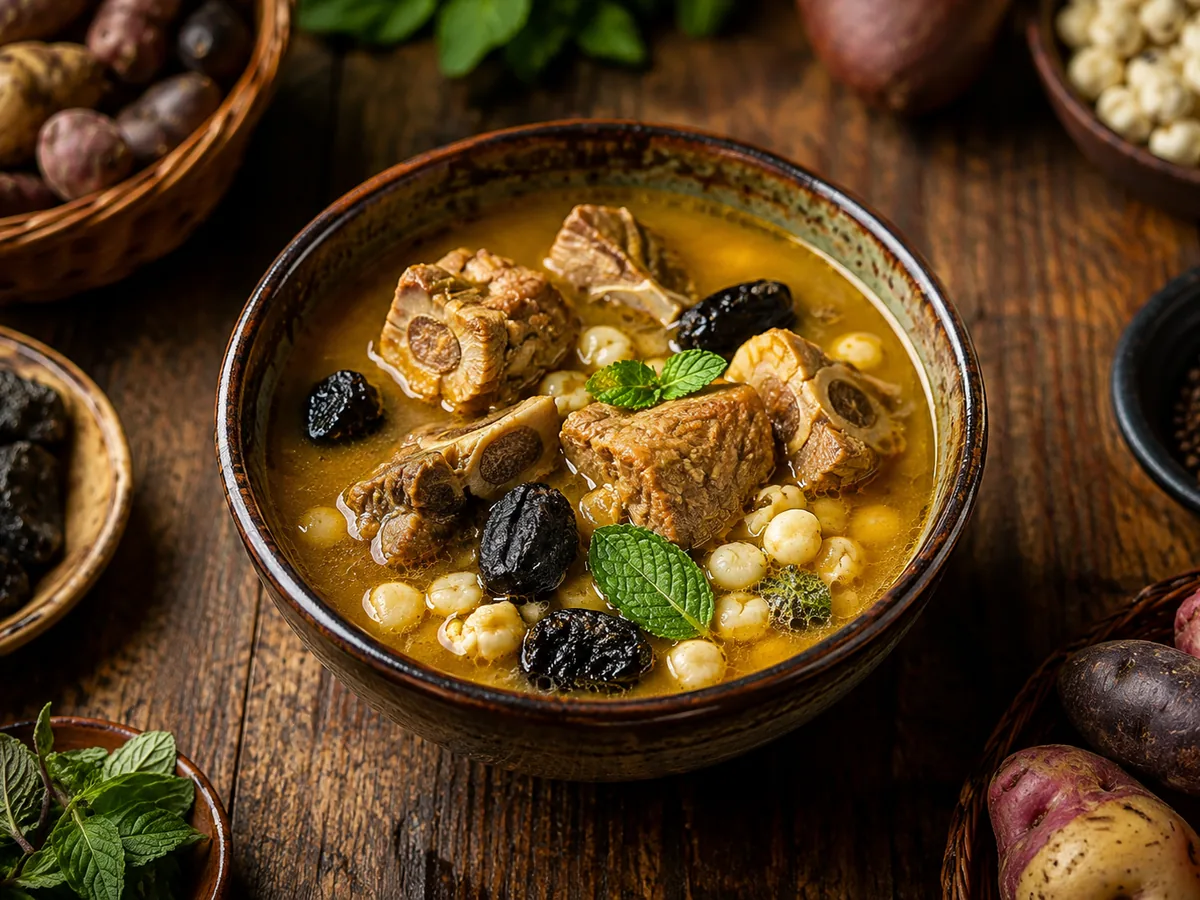
In the thin, freezing air of La Paz, Sunday mornings belong to fricasé paceño. Cavernous market stalls start serving it at six.
Thick chunks of bone-in pork rib and belly are boiled and braised in a fiery golden broth stained with sun-dried ají amarillo, toasted cumin, crushed garlic and fresh mint. The soul of the plate is black chuño: Andean potatoes freeze-dried over sub-zero Altiplano nights, rehydrated and crushed into chewy nuggets that soak up the spicy pork fat.
Served with steamed white mote and crusty marraqueta, it delivers mountain warmth and lip-coating pork collagen.
Pork and broth
- 1.5 kg3.3 lbPork ribs (costilla de cerdo) and pork belly (panceta), cut into 6 large 250 g chunks
- 60 g4 TbspAjí amarillo paste, from whole sun-dried yellow chillies deseeded, boiled and ground
- 8 cloves8 clovesFresh garlic, peeled and crushed to a fine paste
- 12 g1 TbspGround cumin seeds, freshly toasted in a dry pan
- 4 g1½ TbspDried wild oregano, hand-crushed
- 30 g½ cup packedFresh mint (hierbabuena), washed, stems tied with twineplus minced leaves to finish
- 20 g1½ TbspFine sea saltplus more to adjust
- 4 g1 tspFreshly ground black pepper
- 2 L8.5 cupsCold filtered water
- 60 g½ cupFine dry plain breadcrumbsthe thickener
To serve
- 400 g2.5 cupsChuño negro (freeze-dried Andean black potatoes), soaked overnight in cold water, peeled and crushed into bite-sized pieces
- 500 g3 cupsCooked white hominy corn (mote de maíz blanco), warm
- 6 rolls6 rollsPan marraqueta or crusty French rolls
Ninety minutes at a sub-boil
Pork rib and belly carry dense collagen and intramuscular fat. Held at about 90 °C for an hour and a half, that collagen hydrolyses into gelatin and the meat goes fork-tender without shredding apart. Boiled hard it seizes instead.
What chuño actually is
Native potatoes left out through −15 °C Altiplano nights, then trodden and dried under high-altitude sun. The freeze-thaw ruptures the cell walls and polyphenol oxidase darkens the starch. Rehydrated and simmered with the pork it drinks the spicy fat and turns chewy and earthy in a way no fresh potato does.
Breadcrumbs are the gravy
Whisked into the simmering broth at the end, their wheat starch gelatinises and binds the free pork lipids into an unctuous yellow gravy.
Do not skip the mint
Hierbabuena is the herbal counterweight to heavy pork fat and fiery chilli. Without it the bowl is just rich.
Passive time, counted separately
The chuño soaks 12 to 24 hours in cold water. That is not active work and sits outside the times quoted above — but skipping it leaves the centres rock-hard.
The five tastes on this plate
Salt penetrates the pork and the rehydrated chuño. Fat is rendered pork belly and rib collagen making a lip-coating golden broth. Acid is low, brightened with lime squeezed in at the table. Heat is ají amarillo, toasted cumin, garlic paste and fresh mint. Umami is braised pork, bone collagen and ancient freeze-dried chuño starch.
Equipment
- 8 qt Dutch oven
- Wide spoon, for skimming
- Kitchen twine
- Whisk
- Deep ceramic bowls
Traditionally a massive aluminium or clay cauldron over high-pressure market burners. An 8-quart enamelled cast-iron Dutch oven works in a modern kitchen — the steady radiant heat is what stops the breadcrumb thickener catching on the bottom once it goes in.
Method
Soak and crush the chuño — day one8 min
Soak the dried black chuño in cold water 12 to 24 hours.
Drain, peel off any loose skins and wash thoroughly. With your fingers or the base of a cup, break each rehydrated chuño into 2 or 3 chunky pieces.
Soak dried black chuño in cold water for 12–24 hours. Drain, remove loose skins and wash thoroughly, then break each softened potato into 2 or 3 pieces.
Start the pork and aromatics12 min
Put the pork rib and belly chunks into the Dutch oven with 2 litres cold water and bring to a rolling boil.
Skim off all the grey foam for 10 minutes.
Stir in the ají amarillo paste, garlic paste, toasted cumin, oregano, black pepper and 20 g salt, and drop in the tied mint bundle.
Bring pork ribs and belly to a rolling boil in 2 litres cold water. Skim grey foam for 10 minutes, then add ají paste, garlic, cumin, oregano, pepper, 20 g salt and the tied mint bundle.
Braise low1 hr
Turn to medium-low, set the lid slightly ajar, and simmer 1 hour.
The pork takes on the golden ají colour and begins to soften, shedding fat into the broth.
Reduce to medium-low and simmer for 1 hour with the lid slightly ajar, keeping a gentle sub-boil around 90 °C. The pork should begin softening and releasing fat into the golden broth.
Cook the chuño in the broth30 min
Add the crushed soaked chuño straight into the pot with the pork, cover, and simmer 30 minutes.
It will soften and drink in the yellow chilli liquor, turning dark, tender and chewy.
Add the soaked, broken chuño to the pork broth. Cover and simmer 30 minutes, until the chuño absorbs the yellow broth and becomes dark, tender and chewy.
Thicken and check8–10 min
Discard the spent mint bundle.
Stir the 60 g breadcrumbs into a cup with 120 ml of the hot broth until smooth, then whisk that back into the pot. Simmer uncovered on low 8 to 10 minutes, stirring now and then, until the broth thickens into a velvety golden gravy.
The pork should read 90–93 °C / 194–200 °F and slip off the bone.
Discard mint. Mix 60 g breadcrumbs with 120 ml hot broth until smooth; whisk into the pot. Simmer uncovered on low 8–10 minutes, stirring occasionally, until velvety. Pork should release from the bone at 90–93 °C / 194–200 °F.
Build the paceño bowls
Warm six deep bowls. Into each, mound hot mote on one side and chuño on the other, and centre a large piece of pork.
Ladle the spicy yellow broth over everything and scatter minced mint on top. Serve with warm marraqueta for dipping.
Warm six deep bowls. Arrange hot mote and chuño on opposite sides, with a large pork piece in the centre. Ladle over yellow broth, scatter minced mint and serve with warm marraqueta.
Sensory cues of doneness
- Visual: a vivid sunset-yellow broth holding tender pork, dark chuño nuggets and white mote, flecked with green mint.
- Auditory: a steady, gentle bubbling, and the soft yield of pork pulling from the rib bone under a spoon.
- Olfactory: roasted ají amarillo, toasted cumin, fresh mint, simmered pork belly and pungent garlic.
Look for vivid yellow broth, tender pork, dark chuño and white mote with green mint. Maintain gentle bubbling; the pork should yield from its bone, with aromas of ají, cumin, mint and garlic.
Troubleshooting
- Tough, fibrous pork.
It was boiled hard, or the cook time was cut short. Ribs and belly need at least an hour and a half of low simmering to melt their collagen.
- The bowl tastes heavy and one-note.
The mint was left out. Hierbabuena is the herbal counterpoint to the pork fat and the chilli.
- Chuño still hard in the middle.
It went in dry. Chuño must soak in cold water overnight before it ever meets the pot.
Substitutions
One-to-one global substitutions, with the technique adjustment each one requires.
Ingredient substitutions
| Ingredient | Replace with | Culinary impact and technique adjustment |
|---|---|---|
| Chuño negro | Tunta (white chuño), or small boiled waxy red potatoes | Chuño gives the traditional chew; waxy potatoes work at a pinch |
| Ají amarillo paste | Ground yellow chilli paste | One-to-one. Matches the colour and the aromatic heat |
| Mote de maíz blanco | Canned white hominy, rinsed and warmed | One-to-one for the white corn |
Scaling
Half, for 3 bowls
Halve everything in a 5-quart Dutch oven. The braise stays at 1 hour 30 minutes — the collagen needs it either way.
Double, for 12 bowls
Double everything in a 16-quart stockpot and keep the heat low once the breadcrumbs go in.
What to serve it with
- Pan marraqueta caliente — crisp, airy rolls for the yellow broth
- Mote de maíz blanco, warm, to balance the ají heat
- Ice-cold Paceña lager, and fresh lime halves squeezed in at the table
Questions
What is the difference between chuño negro and tunta?
Chuño negro is freeze-dried and then sun-dried, turning black and earthy. Tunta, or chuño blanco, is washed in flowing mountain streams during freeze-drying, giving a milder white starch. Either works here.
Can I make it without pork belly?
Yes — bone-in pork shoulder cut into large chunks works well. The belly is what supplies the traditional unctuous fat.
Why is it eaten so early in the morning?
In La Paz fricasé is the supreme *levanta muertos*: capsaicin, electrolytes and warm calories against a freezing mountain morning.