Majadito Cruceño
Out in the Santa Cruz lowlands the highland potato gives way to cattle and rice. Charque — beef salted and dried under tropical sun — is boiled to draw the salt out, hammered until the fibres shred to cotton, then fried in achiote oil with rice that toasts in the red fat before it drinks the beef broth.
- Prep
- 30 min
- Cook
- 35 min
- Serves
- 6 portions
- Difficulty
- Medium
Researched · Kitchen testing pending
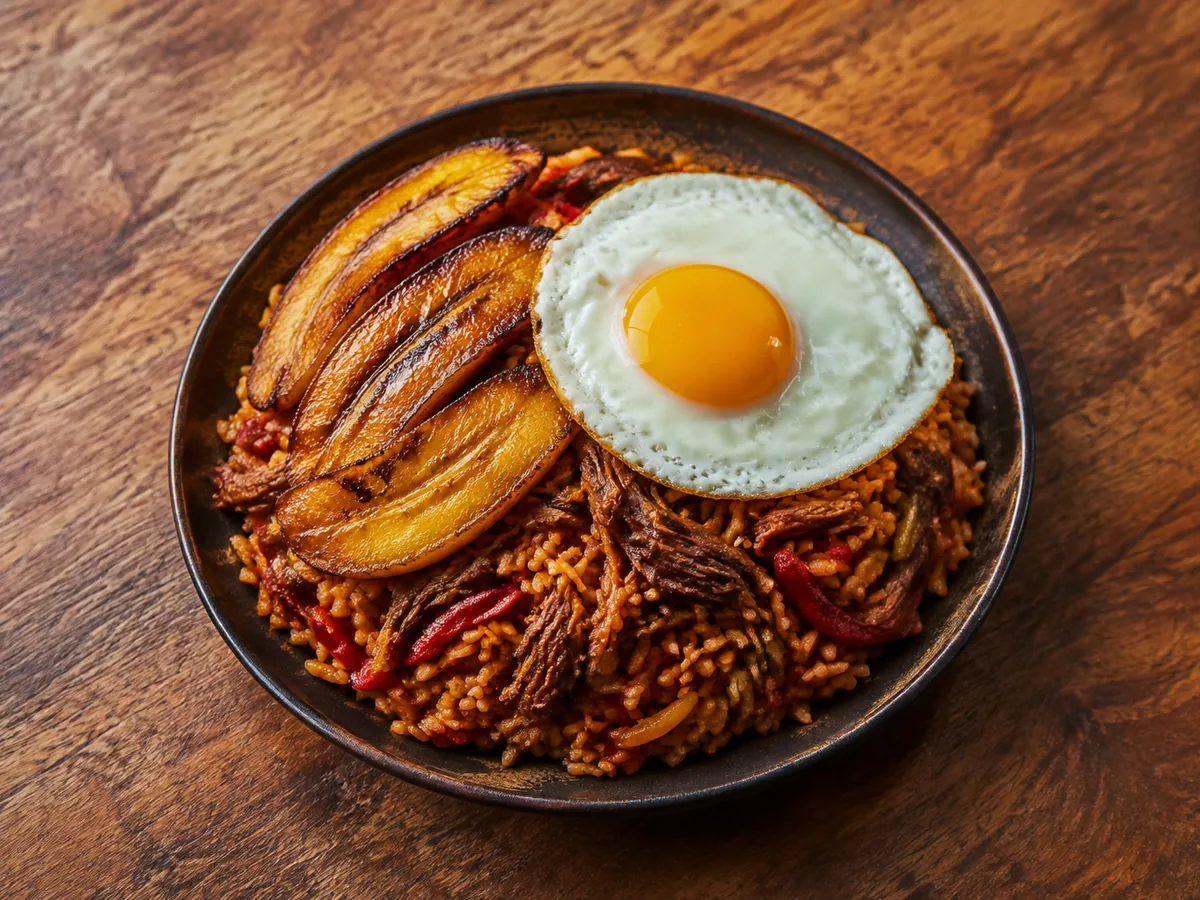
Out in the tropical lowlands of Santa Cruz and the Beni plains, the cooking shifts from highland potatoes to cattle and rice. Majadito takes its name from the Spanish majado, pounded.
The dish turns on charque: beef salted and dried under the burning sun, boiled to draw out the salt, then hammered on a wooden batán until the muscle fibres shred into cotton-like threads. Sautéed in vivid red achiote oil with onion, garlic and sweet pepper, long-grain rice is toasted in that fragrant fat before it simmers in the hot charque broth.
Served either tostado, with dry fluffy grains, or batido, loose and creamy, each plate is crowned with a fried egg and sweet caramelised plantains.
Charque and rice
- 400 g14 ozBolivian charque (sun-dried salted beef), cut into 8 cm pieces, or Mexican cecina seca
- 1.5 L6.3 cupsCold filtered water, for boiling and desalinating the charque
- 400 g2 cupsLong-grain white rice, un-rinsed for majadito batido or rinsed for tostado
- 60 ml4 TbspAchiote oil (neutral oil infused with annatto seeds)
Refrito
- 2 large2 largeRed onions, peeled and cut into fine brunoise
- 6 cloves6 clovesFresh garlic, minced to a paste
- 1 large1 largeRed bell pepper, cored and diced fine
- 2 large2 largeRipe plum tomatoes, peeled, seeded and diced fine
- 8 g2 tspGround cumin seeds, freshly toasted in a dry pan
- 4 g1½ TbspDried wild oregano, hand-crushed
- 10 g2 tspFine sea saltuse conservatively — the charque keeps residual salt
- 3 g1 tspFreshly ground black pepper
To finish
- 3 large3 largeRipe sweet plantains with mottled black skins, sliced diagonally into 1 cm tajadas
- 60 ml4 TbspOil or butter, for frying the plantains
- 6 large6 largeEggs
- 20 g½ cupScallions, green parts only, sliced fine
Boil the charque, then hammer it
Solar drying and salt curing concentrate glutamates in the beef. Thirty minutes of boiling rehydrates the dense fibres and leaches out the excess sodium — skip it and the finished rice is inedibly salty. Pounding the warm meat then shatters the transverse collagen so it pulls into feathery shreds that soak up oil. Forks alone will not do it.
Toast the rice in the red fat
Three minutes in achiote oil at about 160 °C par-cooks the surface starch, so the grains absorb hot beef broth while releasing just enough amylose for the creamy sheen of a real majadito batido.
Batido or tostado
2.5 parts broth to 1 part rice gives batido — loose, creamy, risotto-like, and the traditional version. 2 parts gives tostado, with drier separate grains. Both are correct; the ratio is the only difference.
The egg is part of the sauce
Broken over the top, the yolk's lecithin emulsifies with the achiote fat and coats the rice.
Passive time, counted separately
The charque boiling and pounding, and the 5-minute rest under the lid, sit outside the times quoted above — the source counts them separately too.
The five tastes on this plate
Salt comes mostly from the desalinated cured beef, adjusted at the end. Fat is achiote oil on every grain, the plantain frying fat and the runny yolk. Acid is mellow, brightened with lime and llajwa. Heat is toasted cumin, garlic and black pepper. Umami is concentrated sun-dried beef, reduced charque broth and toasted rice fond.
Equipment
- Pot, for boiling the charque
- Sturdy wooden board
- Flat meat mallet or pestle
- 6 qt enamelled cast-iron Dutch oven
- Skillet, for plantains and eggs
Traditionally a broad cast-aluminium paila cruceña with a heavy wooden pestle, the tacú. A heavy 6-quart enamelled cast-iron Dutch oven works in a modern kitchen — even heat is what keeps the bottom layer of rice starch from scorching while the liquid reduces away.
Method
Desalinate and pound the charque30 min
Put the charque into a pot with 1.5 litres cold water, bring to a boil, and simmer gently 25 to 30 minutes until the meat softens.
Lift the meat out with tongs and keep the hot broth — it is the cooking liquid for the rice.
On a sturdy board, pound the warm meat with a flat mallet or pestle until the fibres flatten and loosen, then shred by hand into thin cottony wisps.
Simmer charque in 1.5 litres cold water for 25–30 minutes until softened. Reserve the hot broth. Pound the warm meat on a sturdy board with a flat mallet or pestle, then hand-shred into fine fibres.
Fry the achiote refrito16 min
Heat 60 ml achiote oil in the Dutch oven over medium heat and fry the shredded charque 4 to 5 minutes until crisp and golden.
Add the red onions, garlic and bell pepper and sauté 6 to 8 minutes until the onion turns soft and sweet.
Stir in the tomatoes, toasted cumin, oregano, black pepper and 1 tsp salt, and cook down 4 minutes into a red, fragrant sofrito.
Heat 60 ml achiote oil over medium heat; fry charque 4–5 minutes until crisp. Sauté onion, garlic and pepper 6–8 minutes until softened. Add tomatoes, cumin, oregano, pepper and 1 tsp salt; cook 4 minutes. Season cautiously: charque retains salt.
Toast the rice3 min
Add the raw rice straight to the pot and stir constantly 3 minutes, toasting it in the red fat until the grains look chalky and translucent at the edges.
Add raw rice, unwashed for batido or rinsed for tostado. Stir constantly in the red fat at about 160 °C for 3 minutes, until the grains look chalky with translucent edges.
Simmer the majadito18 min
Pour in 1 litre of the hot reserved charque broth — 2.5 parts broth to 1 part rice for batido, 2 parts for tostado.
Bring to a rolling boil, drop to low, cover tightly and simmer undisturbed 18 minutes, until the rice has taken up the broth and is tender and moist.
Off the heat, rest 5 minutes with the lid on.
Pour in 1 litre hot reserved broth for batido (2.5 parts broth to 1 part rice; 2 parts for tostado). Boil, cover tightly and simmer on low undisturbed 18 minutes until tender and moist. Rest covered off heat 5 minutes.
Plantains and eggs10 min
While the rice cooks, heat 60 ml oil or butter in a skillet over medium heat and fry the plantain slices 3 to 4 minutes a side until deep golden and caramelised. Drain.
In the same pan, fry the eggs sunny-side up until the whites crisp at the edges and the yolks are still fluid.
While rice cooks, heat 60 ml oil or butter over medium heat. Fry plantains 3–4 minutes per side until deeply golden; drain. Fry eggs in the same pan until whites have crisp edges and yolks remain fluid.
Plate it
Fluff the reddish-orange rice with a fork and mound it across wide plates.
Frame each mound with two slices of fried plantain, crown it with a hot fried egg, and scatter sliced scallion over the top. Serve with llajwa.
Fluff the orange-red rice with a fork and mound on wide plates. Add two plantain slices and a hot fried egg per plate, scatter scallion and serve with llajwa.
Sensory cues of doneness
- Visual: a glistening sunset-orange mound of rice packed with dark beef threads, flanked by mahogany plantains and topped with a glossy egg.
- Auditory: thick, gentle simmering as the rice drinks the red broth, and crackling eggs in hot oil.
- Olfactory: cured sun-dried beef, toasted cumin, frying sweet plantain, garlic and warm achiote.
Look for glossy orange rice threaded with beef, mahogany plantains and a shiny egg. Listen for gentle simmering and sizzling eggs; expect cured beef, cumin, sweet fried plantain, garlic and achiote aromas.
Troubleshooting
- Inedibly salty rice.
The charque was not boiled first. It is heavily salt-cured, and boiling in fresh water is what leaches the sodium out.
- Tough, leathery meat.
The pounding was skipped. Charque has to be hammered warm on a board before the fibres will loosen.
- Dry, chalky rice.
Not enough broth. Authentic majadito cruceño is served batido — moist and creamy — which needs 2.5 parts liquid to 1 part rice.
Substitutions
One-to-one global substitutions, with the technique adjustment each one requires.
Ingredient substitutions
| Ingredient | Replace with | Culinary impact and technique adjustment |
|---|---|---|
| Bolivian charque | Mexican cecina seca, Brazilian carne seca or beef jerky | One-to-one. Boil to desalinate, then pound and shred |
| Achiote oil | 1 Tbsp sweet paprika dissolved in 4 Tbsp warm oil | One-to-one for the red colour |
| Plátanos maduros | Sweet yellow plantains, heavily speckled black | Essential for the caramelisation; green plantains will not work |
Scaling
Half, for 3 portions
Halve everything in a 3.5-quart Dutch oven and simmer the rice 16 to 18 minutes.
Double, for 12 portions
Double everything in an 11-quart Dutch oven, and use two wide skillets in parallel for the eggs and plantains.
What to serve it with
- Llajwa cruceña — crushed tomato, locoto and red onion
- Yuca cocida caliente — steamed buttered cassava
- Somó or chicha camba, the sweet cold corn-and-clove drink of eastern Bolivia
Questions
What if I cannot find Bolivian charque?
Mexican cecina seca, Brazilian carne seca or good unflavoured beef jerky. Soak and boil before shredding. Shredded roast flank steak also works.
What is the difference between majadito de charque and de pato?
De charque uses sun-dried beef. De pato uses braised duck legs cooked in their own rendered fat with the rice.
Why is the rice sunset-orange?
Entirely from achiote — annatto seeds steeped in warm oil — an indigenous tropical colouring that also brings a subtle earthy aroma.