Chicharrón Cochabambino
Not pork rinds. Two kilos of bone-in rib and belly go into a wide pan with water and chicha de jora and simmer uncovered until every drop of liquid has gone — at which point the pot temperature jumps from 100 °C to 175 °C and the pork starts frying in the tallow it just rendered.
- Prep
- 25 min
- Cook
- 2 hr
- Serves
- 6 hearty portions
- Difficulty
- Hard
Researched · Kitchen testing pending
Drive through the valley of Cochabamba on a Saturday and every roadside chicharronería is sending white smoke into the sky.
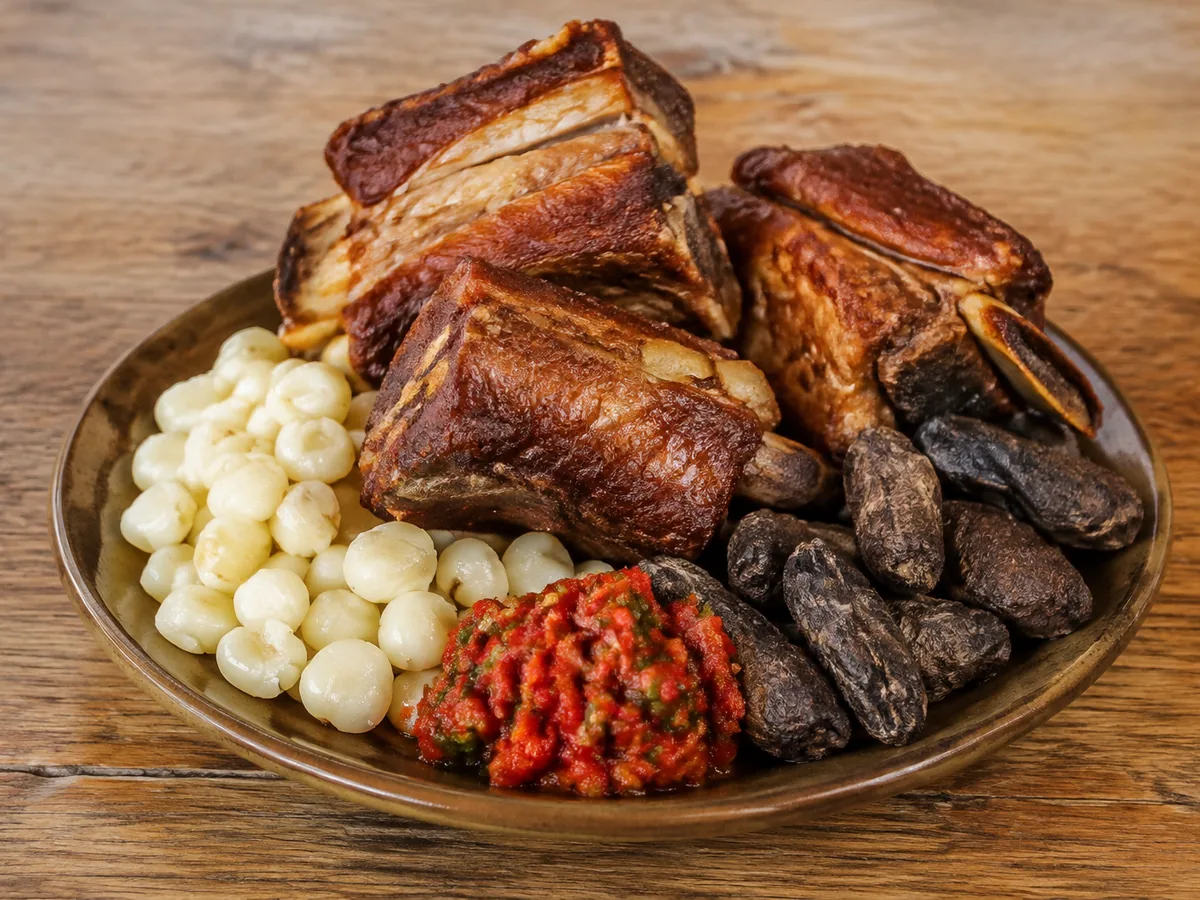
Chicharrón in Bolivia is not a light snack of dried pork rinds. It is a feast plate of bone-in ribs and belly cut into thick chunks and simmered in a broad copper paila with water, chicha de jora, cumin, garlic and salt. As the liquid evaporates over two hours the meat renders its own tallow, and then fries in it until the exterior turns chestnut-brown and crackling-crisp while the inside stays succulent enough to fall off the bone.
Served over steaming white mote and chewy chuño, drenched in tomato-locoto llajwa, it is Cochabamba’s weekend ritual.
The pot
- 2 kg4.4 lbBone-in pork ribs (costilla de cerdo) and pork belly (panceta), cut into large 8 cm chunks
- 1 L4.2 cupsCold filtered water
- 500 ml2.1 cupsChicha de jora (fermented corn chicha), or dark lager beer
- 8 cloves8 clovesFresh garlic, peeled and crushed flat
- 15 g1 Tbsp + 1 tspGround cumin seeds, freshly toasted in a skillet
- 25 g1½ Tbsp + 1 tspCoarse parrillero salt or fine sea salt
- 5 g1½ tspFreshly ground black pepper
- 15 g1 TbspBaking soda (bicarbonato de sodio)the traditional Andean tenderiser and crisping agent
To serve
- 600 g4 cupsCooked white hominy corn (mote de maíz blanco), warm
- 400 g2.5 cupsCooked black chuño, or boiled whole potatoes, warm
- 1 recipe1.5 cupsFresh stone-ground llajwa — locoto, tomato and quirquiña
Two phases in one pot, no oil added
Phase one is a hydrothermal braise: 85–90 °C moist heat hydrolyses the rib collagen into gelatin while the belly renders. Phase two begins the moment the free water has gone — the pot climbs from 100 °C to about 175 °C and the pork confits in its own rendered tallow. Adding vegetable oil breaks the whole mechanism and dulls the flavour.
What the chicha and the baking soda do
Chicha de jora brings lactic and acetic acids that soften the muscle fibres. The spoonful of baking soda lifts the surface pH slightly, which sharply accelerates Maillard browning once the frying phase starts.
The lid stays off
Covered, the water cannot evaporate, and without evaporation there is no transition to frying. You get boiled, soggy pork.
Listen for the change
The sound tells you where you are: wet splashing while water remains, then thick foaming, then a furious crackle as the tallow takes over.
The five tastes on this plate
Salt is coarse salt driven deep into the ribs during the boiling phase. Fat is rendered belly and rib tallow, frying the meat to crackling. Acid is the fermented chicha reduction, cut sharply at the table by tomato-locoto llajwa. Heat is toasted cumin, crushed garlic, black pepper and fresh locoto. Umami is caramelised pork skin, browned fond, marrow and fermented corn malt.
Equipment
- 8 qt enamelled cast-iron Dutch oven, or a deep 14 in cast-iron skillet
- Long wooden paddle
- Tongs and a slotted skimmer
- Wire rack over a tray
- Instant-read thermometer
Traditionally a massive, shallow hand-hammered copper or aluminium paila over a eucalyptus wood fire. A heavy 7-to-8-quart enamelled cast-iron Dutch oven or deep 14-inch cast-iron skillet works in a modern kitchen — thick walls spread the intense frying heat evenly, so nothing sticks the moment the water goes.
Method
Phase one — the aromatic braise1 hr 15 min
Put the pork chunks into the Dutch oven with 1 litre water and 500 ml chicha de jora or beer.
Add the crushed garlic, toasted cumin, black pepper, coarse salt and baking soda, and bring to a boil.
Drop to medium-low and simmer uncovered 1 hour 15 minutes, stirring occasionally with a long wooden paddle, as the liquid evaporates and the pork softens and gives up its fat.
Bring pork, 1 litre water, 500 ml chicha or beer, garlic, cumin, pepper, salt and baking soda to a boil. Simmer uncovered over medium-low heat 1 hour 15 minutes, stirring occasionally; let the pork soften and render without added oil.
Phase two — the fat transition15 min
Watch the pot closely from around the 1 hour 30 minute mark. The bubbling changes character: wet splashing gives way to thick foaming.
Soon all the water has gone and clear golden rendered tallow pools in the bottom of the pot.
Watch closely around 1 hour 30 minutes: wet splashing becomes thick foam, then clear golden fat pools beneath the pork as all the water evaporates. Keep the pot uncovered.
Phase three — confit fry in its own tallow12–15 min
Turn to medium-high. The pork will begin frying furiously in its own fat at around 175 °C / 347 °F.
Turn the chunks every 2 minutes with tongs for 12 to 15 minutes, until the exterior is deep chestnut-brown, crisp and blistered.
The meat should slip off the bone under gentle fork pressure — 93–96 °C / 200–205 °F.
Raise to medium-high and fry in the rendered fat at about 175 °C / 347 °F for 12–15 minutes, turning every 2 minutes. Look for blistered, chestnut-brown crust and meat releasing easily from bone at 93–96 °C / 200–205 °F.
Drain and rest5 min
Lift the chunks out with a skimmer onto a wire rack set over a tray.
Rest 5 minutes so the cracklings crisp up completely.
Lift the pork with a skimmer onto a wire rack over a tray. Rest 5 minutes to let the crackling finish crisping.
Plate the feast
Spread a bed of warm mote and tender chuño across wide platters and heap the hot pork across the centre.
Serve immediately with a bowl of fresh stone-ground llajwa and cold beer.
Arrange warm mote and tender chuño on wide platters, heap hot pork in the centre and serve immediately with fresh stone-ground llajwa and cold beer.
Sensory cues of doneness
- Visual: deep golden-chestnut chunks with blistered, crunchy skin, and meat pulling cleanly from the rib bone.
- Auditory: furious, loud crackling and hissing as the last water boils off and the rendered fat starts frying.
- Olfactory: sizzling pork fat, roasted cracklings, fermented chicha, toasted cumin and fried garlic.
Check for crisp, blistered chestnut skin and meat pulling cleanly from the bone. Listen for strong crackling as water disappears; expect aromas of pork fat, chicha, toasted cumin and fried garlic.
Storing it
Strain the leftover golden fat through cheesecloth and keep it refrigerated in jars. It is pure rendered lard, and it is excellent in tamales, empanadas and tortillas.
Troubleshooting
- Boiled, soggy pork that never crisps.
The lid was on. Cook uncovered so the liquid can cook off and the frying phase can begin.
- Burnt garlic and cumin.
The heat was too high once the fat took over. Hold medium-high through phase three, not maximum.
- It tastes flat and generically fried.
Vegetable oil was added to the pot. Authentic chicharrón renders its own fat from the belly and ribs — nothing else goes in.
Substitutions
One-to-one global substitutions, with the technique adjustment each one requires.
Ingredient substitutions
| Ingredient | Replace with | Culinary impact and technique adjustment |
|---|---|---|
| Chicha de jora | Crisp lager, or hard cider with a splash of vinegar | One-to-one. Supplies the same yeasty acidity |
| Pork ribs and belly | Bone-in pork shoulder with pork belly | One-to-one, provided the fat content stays high |
| Mote blanco | Canned white hominy, drained and steamed | One-to-one |
Scaling
Half, for 3 portions
Halve everything in a 5-quart Dutch oven. Total cooking stays around 1 hour 45 minutes.
Double, for 12 portions
Double everything in a wide 16-quart cauldron, stirring frequently through phase three so every chunk fries evenly.
What to serve it with
- Llajwa fresca de locoto — non-negotiable, spooned over every bite
- Mote de maíz blanco, warm, to absorb the pork tallow
- Chicha cochabambina in clay bowls, or ice-cold Paceña
Questions
Why add baking soda to the pot?
A little raises the pH of the water, which tenderises tough connective tissue and accelerates surface Maillard browning once the frying phase starts.
Can I use boneless pork?
Bone-in ribs give far better flavour, gelatin and marrow. If you must go boneless, combine pork shoulder with skin-on belly.
What do I do with the leftover fat?
Strain it through cheesecloth and refrigerate it in jars. It is pure rendered lard, ideal for tamales, empanadas and tortillas.