Saice Chapaco
Tarija's contribution, from the vineyards and river valleys of the Chapacos. Beef hand-diced rather than minced, simmered with sun-dried red ají cooked until its oil separates, sweet peas and potato — served against two starches at once, white rice and chuño phuti scrambled with egg and fresh cheese.
- Prep
- 30 min
- Cook
- 40 min
- Serves
- 6 portions
- Difficulty
- Medium
Researched · Kitchen testing pending
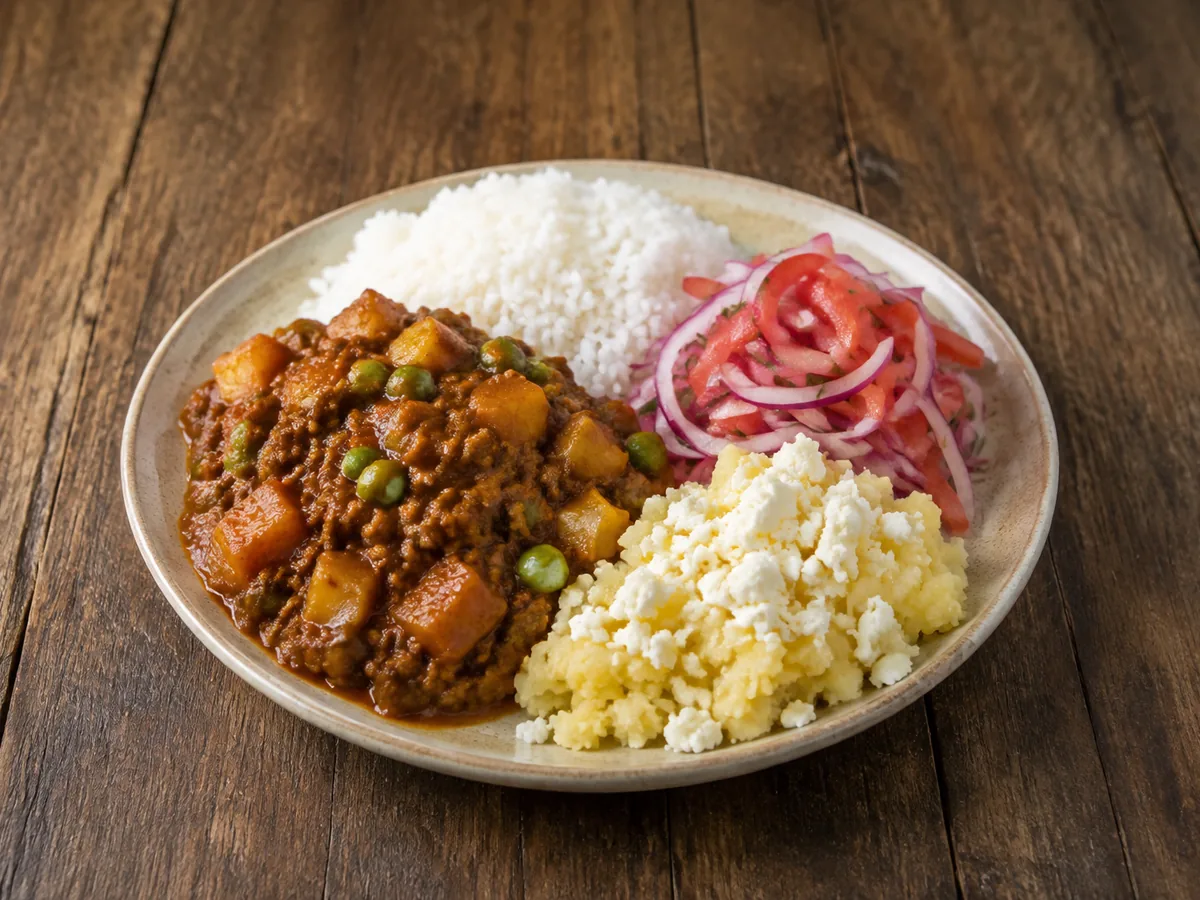
In the sun-drenched vineyards and rolling river valleys of Tarija — the land of the Chapacos — saice is the pride of home kitchens and market stalls alike.
Unlike the thick stews of the Altiplano, saice chapaco is balanced and almost elegant: finely hand-diced beef chuck simmered with sweet green peas and diced potato. Its soul is ground sun-dried red ají colorado, toasted cumin, sweet red onion and beef broth.
It is served with two starches at once — steamed white rice and chuño phuti, crushed chuño sautéed and scrambled with egg and crumbled fresh cheese — and finished with a crisp tomato-onion sarza.
The saice
- 800 g1.76 lbLean beef chuck or top sirloin, hand-cut into small 5 mm dice, or coarse ground beef
- 45 ml3 TbspVegetable oil or beef tallow
- 2 large2 largeRed onions, peeled and cut into fine brunoise
- 4 cloves4 clovesFresh garlic, peeled and minced to a paste
- 60 g4 TbspAjí colorado paste, from sun-dried red ají
- 8 g2 tspGround cumin seeds, freshly toasted in a dry pan
- 4 g1½ TbspDried wild oregano, hand-crushed
- 15 g1 TbspFine sea saltdivided between the saice and the chuño
- 3 g1 tspFreshly ground black pepper
- 500 ml2.1 cupsRich beef bone broth, hot
- 400 g2 mediumRusset or Yukon Gold potatoes, peeled and cut into small 1 cm dice
- 200 g1.5 cupsSweet green peas, fresh or frozen
Chuño phuti
- 300 g2 cupsCooked black chuño, rehydrated, peeled and crushed into small nuggets
- 30 ml2 TbspUnsalted butter or oil
- 3 large3 largeEggs, lightly beaten
- 150 g1.5 cupsQueso fresco, crumbled
To serve
- 1 recipe1 cupSarza — tomato, onion and cilantro dressed with lime and oil
Cook the ají paste properly
Sun-dried red ají holds capsaicin and carotenoids bound up in dried plant skins. Eight minutes in hot oil with onion and garlic blooms the fat-soluble aromatics and strips the raw pepper bitterness through mild pyrolysis. Rush it and the whole stew tastes raw and bitter.
Dice the beef, don't mince it
Hand-cut 5 mm cubes keep a distinct chewy texture that ground meat loses. Ground chuck works and saves time, but the artisanal texture is the point.
The potato is the thickener
Simmering diced potato in the stew releases just enough amylose to bind the broth into a velvety gravy without any flour.
Chuño phuti wants low heat
Fold the beaten egg and crumbled cheese into the sautéed chuño over low heat, until a thermometer confirms 71.1 °C / 160 °F. The egg proteins set around the chewy nuggets while the cheese melts into gooey pockets. High heat turns it to dry rubber.
Passive time, counted separately
The chuño is soaked and cooked ahead, and the rice is steamed alongside. Neither sits inside the times quoted above.
The five tastes on this plate
Salt seasons both the stew and the scrambled chuño. Fat is the sautéing oil, the beef fond, butter and fresh cheese. Acid is the lime-dressed sarza cutting the red chilli and beef. Heat is the deep fruity warmth of ají colorado, toasted cumin, garlic and pepper. Umami is seared beef fond, reduced bone stock and the cheese in the chuño.
Equipment
- 6 qt enamelled cast-iron Dutch oven
- 10 in nonstick or cast-iron skillet
- Wooden spoon
- Spatula
Traditionally a clay olla de barro for the saice with a heavy iron skillet for the phuti. A 6-quart enamelled cast-iron Dutch oven and a 10-inch skillet work in a modern kitchen — the skillet matters most, since the phuti needs gentle, even low heat to stay creamy.
Method
Bloom the red ají sofrito14 min
Heat 45 ml oil in the Dutch oven over medium heat and sweat the red onions and garlic 6 to 8 minutes until translucent.
Stir in the 60 g ají colorado paste, toasted cumin, oregano, black pepper and 10 g salt. Cook over medium-low, stirring constantly, 6 to 8 minutes until the paste darkens, bubbles and the oil separates at the edges.
Heat 45 ml oil over medium heat; soften onion and garlic 6–8 minutes. Add 60 g ají colorado paste, cumin, oregano, pepper and 10 g salt. Stir over medium-low 6–8 minutes until darkened and bubbling, with oil separating at the edges.
Brown the beef and deglaze6 min
Add the hand-diced beef and cook over medium-high 6 minutes, stirring often, until browned and coated in the red paste.
Pour in the 500 ml hot broth, scraping the bottom to dissolve the fond.
Add the hand-diced beef and cook over medium-high heat for 6 minutes, stirring often, until browned and coated in ají. Pour in 500 ml hot broth and scrape up the browned base.
Simmer with potato and peas25 min
Add the diced potatoes, bring to a boil, then turn to low, cover and simmer gently 15 minutes until the potatoes are almost tender.
Stir in the peas and simmer uncovered 8 to 10 minutes, until they are tender-sweet and the sauce has reduced to a glossy brick-red gravy. Taste for salt and keep warm.
Add diced potatoes, boil, then cover and simmer on low 15 minutes until nearly tender. Add peas and simmer uncovered 8–10 minutes until tender and the sauce is glossy brick-red. Check salt and keep warm.
Make the chuño phuti6 min
Melt 30 ml butter in the skillet over medium heat, add the crushed cooked chuño and a pinch of salt, and sauté 3 to 4 minutes until hot and lightly toasted.
Turn the heat to low. Pour in the beaten eggs with the crumbled cheese and fold gently about 2 minutes, until the eggs set into soft creamy curds and the cheese melts into stretchy pockets. Verify the mixture reaches 71.1 °C / 160 °F, then take it off the heat immediately.
Heat 30 ml butter over medium heat; sauté cooked, crushed chuño with a pinch of salt 3–4 minutes. Reduce to low; gently fold in beaten eggs and crumbled cheese for about 2 minutes, until set and melted. Verify the egg mixture reaches 71.1 °C / 160 °F, then remove from heat.
Plate the chapaco feast
On wide plates, mound steamed white rice on one side and a scoop of warm chuño phuti on the other.
Ladle the saice generously over the rice and across the centre, and crown with a spoonful of fresh sarza.
Mound steamed white rice on one side of each wide plate and warm chuño phuti on the other. Ladle saice over the rice and centre, then top with fresh sarza.
Sensory cues of doneness
- Visual: a vibrant brick-red stew of tender beef dice, yellow potato and bright green peas, beside white rice and golden scrambled chuño.
- Auditory: thick, gentle bubbling from the stew pot, and the near-silent folding of egg into warm chuño.
- Olfactory: roasted red ají, toasted cumin, garlic, sweet peas and warm melting cheese.
Check for tender beef and potato in glossy brick-red sauce, bright peas and creamy scrambled chuño. Keep the stew gently bubbling; expect toasted red ají, cumin, garlic, sweet peas and melting cheese aromas.
Troubleshooting
- A raw, bitter chilli taste.
The ají was rushed. The paste needs at least 8 minutes in hot oil with the onions before anything else goes in.
- Dry, rubbery chuño phuti.
The skillet was still on high when the eggs went in. Drop to low and fold gently until just creamy.
- A watery stew.
Too much broth. Start with 500 ml and finish the simmer uncovered — saice should be thick and spoonable, not soupy.
Substitutions
One-to-one global substitutions, with the technique adjustment each one requires.
Ingredient substitutions
| Ingredient | Replace with | Culinary impact and technique adjustment |
|---|---|---|
| Ají colorado paste | Ají panca paste, or sweet smoked paprika with a pinch of cayenne | One-to-one. Matches the brick-red colour and the earthiness |
| Chuño negro | Boiled diced red potatoes, scrambled with the egg and cheese | A straightforward stand-in where chuño is unavailable |
| Tarija red wine | High-altitude Argentine Malbec or Uruguayan Tannat | One-to-one as a pairing |
Scaling
Half, for 3 portions
Halve everything in a 3.5-quart Dutch oven. Simmering times are unchanged.
Double, for 12 portions
Double everything in a 12-quart stockpot, and make the chuño phuti in a wide skillet right before plating so it stays creamy.
What to serve it with
- Sarza de tomate y cebolla — sliced red onion, tomato and cilantro with lime
- Chuño phuti, the scrambled egg, cheese and chuño side
- A Tarija Tannat or Syrah — Bolivia's wine country, and it cuts the red ají
Questions
What is the difference between ají colorado and ají amarillo?
Ají colorado is sun-dried red chilli with a deep, earthy, smoky sweet-heat. Ají amarillo is sun-dried yellow, with a bright, fruity, floral heat.
Can I make saice with ground beef?
Yes, coarse ground chuck works well and saves prep. Hand-diced beef, *a cuchillo*, gives the traditional artisanal texture.
Why is Tarija wine so well regarded in Bolivia?
Its Central Valley sits between 1,800 and 2,200 metres. High UV builds thick grape skins with intense tannins and bold fruit, which stands up to beef stews like this one.