Plato Paceño
A plate with a date on it. When the 1781 siege of La Paz broke, the city had eaten every animal inside the walls and lived on what the mountain farms grew — giant-kernel choclo, potatoes in their skins, broad beans, and slabs of fresh cheese seared in foaming butter. It has stayed vegetarian ever since.
- Prep
- 20 min
- Cook
- 30 min
- Serves
- 4 platters
- Difficulty
- Easy
Researched · Kitchen testing pending
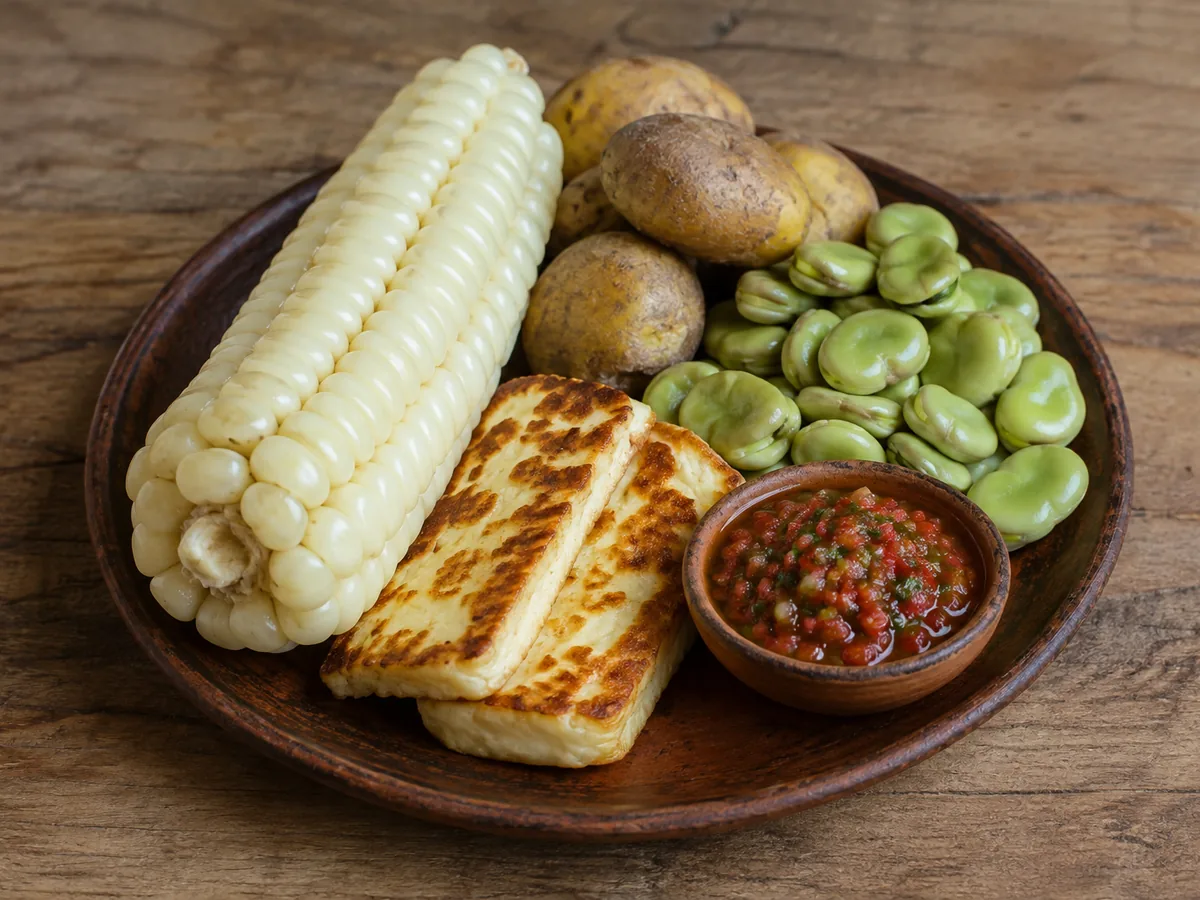
Plato paceño is the harvest celebration of the Altiplano, and it carries a date.
In 1781, during the indigenous siege of La Paz led by Túpac Katari, the city was cut off for months. When the siege broke in high summer, what was left to eat was whatever the surrounding mountain farms grew: sweet giant-kernel choclo, native potatoes, tender broad beans and fresh cow’s milk cheese.
A proper plato paceño is vegetarian by that history, though modern versions sometimes add seared beef. A whole cob is boiled with anise and sugar and served beside whole potatoes in their skins, steamed habas, and thick slabs of salty highland cheese seared in foaming butter until golden and blistered. Drenched in stone-ground llajwa, it is Andean agriculture on a plate.
The harvest
- 4 large ears4 large earsChoclo tierno (giant-kernel Andean sweet corn) or large white field corn, shucked
- 15 ml1 TbspWhole anise seeds, for the corn water
- 30 g2 TbspGranulated cane sugar, for the corn water
- 4 large4 largePapa Imilla, Russet or Yukon Gold potatoes, scrubbed clean, skins left on
- 500 g3 cupsFresh broad beans in the pod (habas tiernas), shelled
- 15 g1 TbspFine sea salt, for the potatoes and habas
The cheese
- 400 g14 ozQueso criollo, queso fresco or halloumi — a salty, firm white cheese that holds its shape — cut into 4 thick 100 g slabs, 1.5 cm thick
- 45 g3 TbspUnsalted European butter, 82% butterfat
To serve
- 1 recipe1 cupFresh stone-ground llajwa — locoto, tomato and quirquiña
No salt in the corn water
Salt toughens the skins of fresh choclo kernels. The pot takes anise and sugar instead — the sugar keeps the corn's own sweetness from leaching out while volatile anethole perfumes the kernels. Salt goes on at the table.
Skins on, for both
Boiling the potatoes and the habas in their skins stops them waterlogging and keeps their minerals in.
The cheese has to be the firm kind
It needs a high melting point and moderate pH — queso criollo, queso blanco or halloumi. In foaming butter at about 180 °C the casein and lactose brown rapidly into a crisp golden crust while the inside just softens. Young mozzarella melts into a puddle instead.
Ten minutes for the habas, no more
Longer and they go grey and mushy. Pull them tender-crisp and bright green.
The five tastes on this plate
Salt is the boiled potatoes and habas, balanced by the briny seared cheese. Fat is foaming butter and the milk fat in the browned crust. Acid is low — the plate is sweet and earthy — and comes from the llajwa at the table. Heat is fresh locoto and quirquiña in that salsa. Umami is the browned cheese crust and sweet cooked Andean corn.
Equipment
- 6 to 8 qt stockpot
- Second pot, for potatoes and habas
- Skimmer
- 12 in seasoned cast-iron skillet
- Fish slice or wide spatula
Traditionally earthenware pots for the corn and potatoes with a heavy iron paila for the cheese. A large stockpot and a 12-inch well-seasoned cast-iron skillet work in a modern kitchen — the skillet's retained heat is what crusts thick cheese slabs golden before they have time to slump.
Method
Boil the choclo25 min
Bring 3 litres of water to a boil in a 6-quart pot with the anise seeds and 30 g sugar. Do not salt it.
Add the choclo cobs and boil over medium-high heat 20 to 25 minutes, until the giant kernels are plump and tender. Keep them warm in the sweet anise water.
Boil 3 litres water with anise seeds and 30 g sugar; do not add salt. Cook choclo over medium-high heat 20–25 minutes until plump and tender. Keep warm in its anise water.
Boil the potatoes and habas25 min
In a second pot, cover the whole scrubbed potatoes and the shelled habas with cold water and 1 Tbsp salt, and bring to a boil.
Lift the habas out after 10 minutes, while they are still tender-firm and bright green, and keep them warm.
Carry on boiling the potatoes 20 to 25 minutes, until a skewer glides through the centre. Drain.
Cover whole scrubbed potatoes and shelled habas with cold water and 1 Tbsp salt; boil with their skins intact. Remove habas after 10 minutes, still bright and tender-firm. Cook potatoes 20–25 minutes until a skewer slides through; drain and keep warm.
Sear the cheese5 min
Pat both faces of the cheese slabs completely dry.
Heat the 45 g butter in the cast-iron skillet over medium-high until foaming, and lay the slabs in.
Sear undisturbed 2 to 3 minutes until a deep golden-brown blistered crust forms underneath, then flip carefully and give the second side 1 to 2 minutes, to a core of about 68 °C / 154 °F.
Dry both sides of the firm cheese slabs. Heat 45 g butter over medium-high until foaming, about 180 °C. Sear cheese untouched 2–3 minutes until golden and blistered; carefully flip for 1–2 minutes, reaching about 68 °C / 154 °F inside.
Build the platter
On each wide plate lay a whole steaming ear of choclo. Set a boiled potato alongside and cut a cross in the top to open the steaming flesh.
Spoon a mound of habas beside it, lay a hot crusty slab of cheese across the vegetables, and spoon fresh llajwa over the cheese and potato.
Place a steaming choclo cob and a boiled potato on each wide plate. Cross-cut the potato top, add habas and hot crusted cheese, then spoon fresh llajwa over the cheese and potato.
Sensory cues of doneness
- Visual: a giant ear of pale choclo beside dark-skinned potatoes, emerald habas and a golden-brown blistered slab of cheese.
- Auditory: a lively sizzle as thick cheese slabs hit foaming butter.
- Olfactory: sweet corn steam carrying liquorice anise, earthy boiled potato, browned butter and fiery locoto.
Look for plump pale corn, skin-on potatoes, bright green habas and blistered golden cheese. Cheese should sizzle in foaming butter; expect sweet anise-scented corn, earthy potato, browned butter and locoto aromas.
Troubleshooting
- Tough corn kernel skins.
Salt went into the corn water. Boil choclo with sugar and anise only, and salt at the table.
- The cheese melts into a puddle.
It was a low-melting-point cheese. Use firm queso criollo, queso blanco or halloumi that holds its shape and crusts.
- Grey, mushy broad beans.
They boiled too long. Ten minutes, then out.
Substitutions
One-to-one global substitutions, with the technique adjustment each one requires.
Ingredient substitutions
| Ingredient | Replace with | Culinary impact and technique adjustment |
|---|---|---|
| Choclo | Frozen giant white corn on the cob, or sweet yellow corn | Frozen Andean choclo turns up in Latin grocers; sweet corn is the fallback |
| Queso criollo | Halloumi, queso blanco para freír, or paneer | One-to-one. Halloumi sears to the same golden, salty crust without melting away |
| Fresh habas | Frozen fava beans or edamame | One-to-one, simmered 6 to 8 minutes |
Scaling
Half, for 2 platters
Halve everything. Every cooking time is unchanged.
Double, for 8 platters
Double everything, boil the corn in a 12-quart stockpot, and sear the cheese in two batches so the skillet stays hot.
What to serve it with
- Llajwa fresca de batán — stone-ground tomato, locoto and quirquiña, and mandatory here
- A thin pan-seared beef steak alongside, the modern optional variation
- Ice-cold Paceña lager
Questions
What kind of corn is authentic choclo?
Andean choclo has kernels roughly three times the size of sweet corn, with a starchy, chewy bite and a subtle sweetness. Look for frozen Peruvian or Bolivian choclo in Latin markets.
Can I eat the potato skins?
Yes. Plato paceño is served *con cáscara*, potatoes in their scrubbed jackets, which keeps the earthy flavour.
Why is it traditionally vegetarian?
The 1781 siege of La Paz exhausted every animal inside the city walls. The surviving population lived on the harvest — corn, potatoes and broad beans — and the plate kept that shape.