Cuñapé
Four o'clock coffee in Santa Cruz. Zero flour, zero gluten — cassava starch and dry salted cheese at 1.25 parts cheese to 1 part starch, bound with egg and butter. A thumbprint pressed into the base gives the steam somewhere to go, so the globes puff instead of splitting.
- Prep
- 20 min
- Cook
- 18 min
- Serves
- 16 rolls, about 50 g each
- Difficulty
- Easy
Researched · Kitchen testing pending
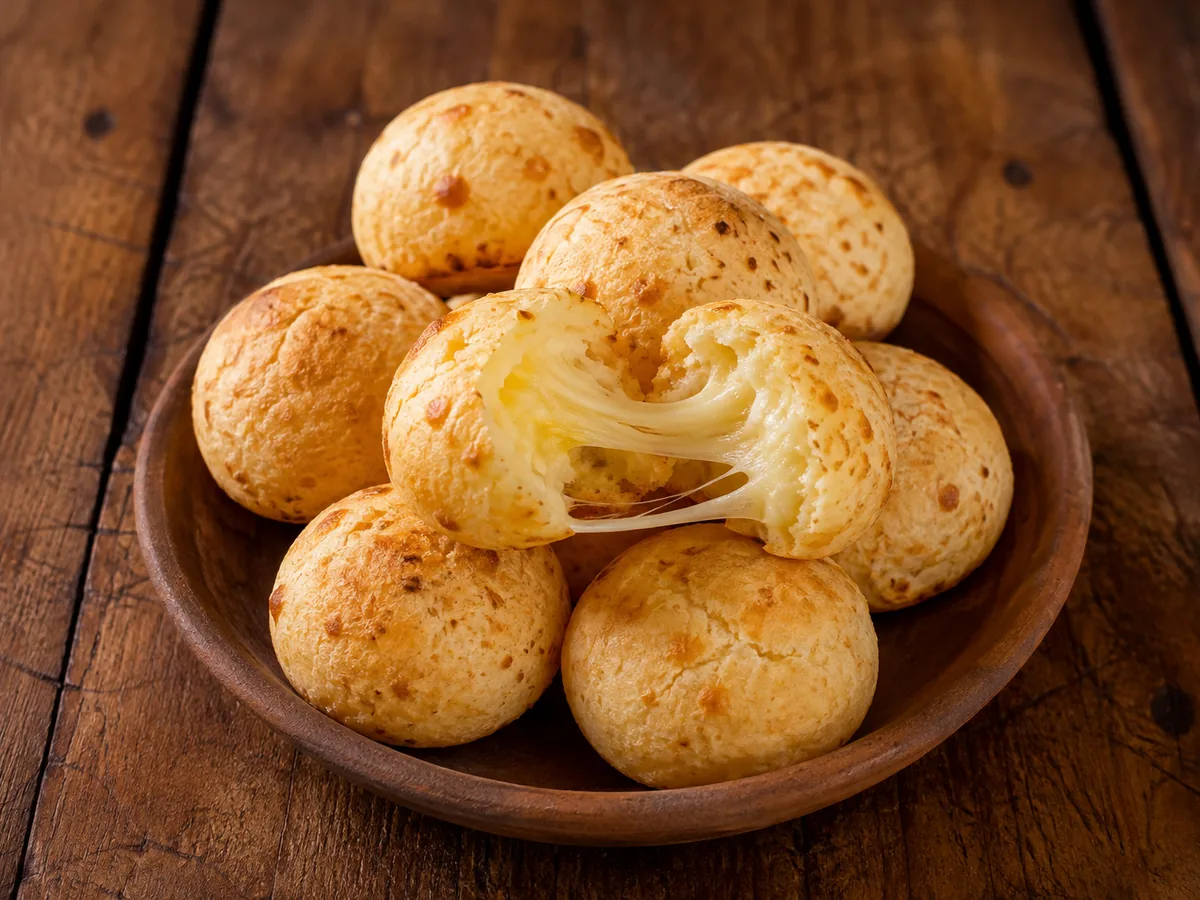
In Santa Cruz de la Sierra and across eastern Bolivia, four o’clock coffee means hot cuñapés. The name comes from Guaraní — cuña, woman, and pé, flat.
Unlike wheat breads, cuñapé contains no flour and no gluten at all. It is built entirely from sour cassava starch and finely grated salty cured cow’s milk cheese, bound with whole eggs, a splash of milk and melted butter. The dough is rolled into smooth balls with a hollow thumbprint pressed into the base.
Baked on hot steel, they puff into golden globes with a crisp, paper-thin shell that shatters over a warm, molten, elastic interior.
Dough
- 400 g3.2 cupsCassava starch / tapioca flour (almidón de yuca, or polvilho azedo), sifted
- 500 g4 cups packedAged queso criollo, queso costeño, Cotija or dry queso blanco, finely grated
- 2 large2 largeEggs, at room temperature, lightly beaten
- 60 g4 TbspUnsalted European butter, 82% butterfat, melted and cooled to warm
- 60–80 ml¼ to ⅓ cupWhole milk, lukewarmadded gradually, a tablespoon at a time
- 5 g1 tspGranulated cane sugarfor surface browning
- 3 g½ tspFine sea salttaste the cheese first; omit if it is heavily salted
- 5 g1 tspBaking powderoptional, for extra lift
Cassava starch behaves nothing like flour
It is over 80% branched amylopectin and gelatinises at only 60–65 °C. With grated dry cheese, butter and egg the granules hydrate without ever forming gluten webs, so there is no kneading to develop and nothing to overwork.
More cheese than starch
The ratio is 1.25 to 1 by weight. That is what guarantees melting cheese proteins intertwine with the expanding starch gel as it bakes.
The thumbprint is an expansion chamber
Pressed 1 cm into the base and baked hollow-side down, it gives the steam from the milk and egg somewhere to go, so the ball balloons evenly instead of blowing open at the top.
Milk one spoonful at a time
Cassava starch drinks liquid fast. Too wet and the dough spreads flat like cookies instead of puffing into tall globes. Stop the moment it comes together.
Dry cheese only
Wet fresh mozzarella collapses them into greasy puddles. Grate the cheese on the finest teeth so it looks like coarse snow.
The five tastes on this plate
Salt is the sharp aged salinity of the grated cheese, and dominates. Fat is melted European butter, whole egg and the milk fat in the cheese. Acid is mellow, with a slight fermented tang if you use traditional sour polvilho azedo. There is no heat by design. Umami is aged cow's-milk protein and baked cassava crust.
Equipment
- Fine box grater or microplane
- Wide mixing bowl
- Half-sheet pan
- Parchment paper or a silicone mat
- Cloth-lined basket
Traditionally a wood-fired clay oven heated with quebracho embers. Heavy half-sheet pans lined with parchment or a silicone mat work in a modern kitchen — bake on the middle rack so the bottoms brown without burning before the tops have puffed.
Method
Grate the cheese6 min
Grate the firm cheese on the finest teeth of a box grater, until it looks like coarse snow.
It must be dry and aged — wet cheese makes the dough gummy.
Finely grate dry, aged cheese until it resembles coarse snow. Avoid wet cheese, which makes the dough gummy and can cause the rolls to spread.
Knead the cassava dough8 min
Combine the sifted cassava starch, grated cheese, sugar, baking powder and salt in a wide bowl and rub together with your fingertips.
Make a well and pour in the beaten eggs and warm melted butter. Knead by hand, drizzling in the lukewarm milk one tablespoon at a time, for 3 to 4 minutes, into a smooth, supple dough with the feel of playdough that does not stick to your hands.
Stop the moment it comes together cohesively.
Rub starch, cheese, sugar, optional baking powder and salt together; omit salt if the cheese is heavily salted. Add beaten eggs and warm melted butter. Knead 3–4 minutes, adding lukewarm milk one tablespoon at a time; stop when smooth, cohesive and nonsticky.
Shape and press the thumbprint8 min
Divide into 16 balls of about 50 g and roll each between your palms until smooth and seamless.
Press a hollow 1 cm deep into the bottom of each ball with your thumb, like an inverted mushroom cap.
Roll 16 smooth, seamless balls of about 50 g each. Press a 1 cm-deep thumb hollow into the bottom of every ball.
Arrange the tray3 min
Preheat the oven to 200 °C / 400 °F.
Set the cuñapés hollow-side down on a parchment-lined sheet, 4 cm apart to leave room for expansion.
Preheat to 200 °C / 400 °F. Place the rolls hollow-side down on a parchment-lined sheet, leaving 4 cm between them for expansion.
Bake to a golden puff18–20 min
Bake on the middle rack undisturbed 18 to 20 minutes. They will swell into light globes with golden-brown cheese freckles across the dome.
Do not open the door in the first 15 minutes — the steam pockets will collapse.
Bake on the middle rack for 18–20 minutes, until puffed with golden-brown cheese freckles. Keep the door closed for the first 15 minutes to prevent collapse.
Serve molten
Tip them straight into a cloth-lined basket and serve within 10 minutes, while the interior is at its stretchy, molten, chewy peak.
Transfer straight to a cloth-lined basket and serve within 10 minutes, while the centres are still molten, stretchy and pleasantly chewy.
Sensory cues of doneness
- Visual: golden-ivory puffed spheres with small toasted cheese freckles on top and flat golden-brown bottoms.
- Auditory: a delicate hollow crunch when tapped with a fingernail, and a silent stretchy yield when torn open hot.
- Olfactory: toasted melting cheese, baked butter, warm milk and sweet toasted cassava.
Look for puffed golden-ivory rolls with toasted cheese spots and golden flat bases. They should sound delicately hollow when tapped and stretch when torn hot, smelling of toasted cheese, butter and cassava.
Storing it
Freeze the shaped raw balls on a tray until solid, then bag them. Bake straight from frozen at 190 °C / 375 °F for 22 to 24 minutes.
Troubleshooting
- They spread flat like cookies.
Too much milk, added too fast. Cassava starch absorbs liquid quickly — go one tablespoon at a time and stop when the dough coheres.
- Greasy puddles instead of globes.
Wet fresh mozzarella was used. It has to be aged, dry, salty cheese.
- They puff, then deflate.
The oven door was opened in the first 15 minutes and the steam escaped. Keep it shut until they are golden.
Substitutions
One-to-one global substitutions, with the technique adjustment each one requires.
Ingredient substitutions
| Ingredient | Replace with | Culinary impact and technique adjustment |
|---|---|---|
| Queso criollo | Aged Cotija, queso blanco duro, or half dry mozzarella and half feta | One-to-one, provided it is dry and salty |
| Cassava starch | Tapioca starch or tapioca flour | One-to-one. Pure cassava starch is essential — cornstarch and wheat flour will not work |
| European butter | Rendered pork lard (manteca) | One-to-one. Lard gives a more rustic snap |
Scaling
Half, for 8 cuñapés
Halve everything. The bake stays 18 minutes at 200 °C.
Double, for 32 cuñapés
Double everything and bake on two sheets, swapping rack positions halfway.
What to serve it with
- Café caliente con leche — the sacred four o'clock pairing across eastern Bolivia
- Ceylon tea, or mate de coca
- Mocochinchi — cold spiced dried-peach drink
Questions
How is this different from Brazilian pão de queijo?
Pão de queijo scalds the starch with hot milk and oil into a batter. Cuñapé kneads cold cassava starch directly with a higher proportion of dry cured cheese, which gives a firmer shell and a denser, chewier interior.
Can I freeze unbaked cuñapés?
Yes. Freeze the shaped raw balls on a tray until solid, then bag them, and bake from frozen at 190 °C / 375 °F for 22 to 24 minutes.
What cheese should I use outside Bolivia?
Aged Cotija, queso duro blanco, or a half-and-half mix of salty feta (drained and crumbled fine) with low-moisture dry mozzarella.