Pique Macho
Cochabamba's communal challenge platter, invented in the 1970s and named for the nerve it takes to finish one. Beef strips and sausage seared in a smoking pan with locoto rings, deglazed with cold lager, then poured over twice-cooked thick-cut fries so the crust drinks the spicy jus without collapsing.
- Prep
- 30 min
- Cook
- 30 min
- Serves
- 6 feast portions, on communal platters
- Difficulty
- Medium
Researched · Kitchen testing pending
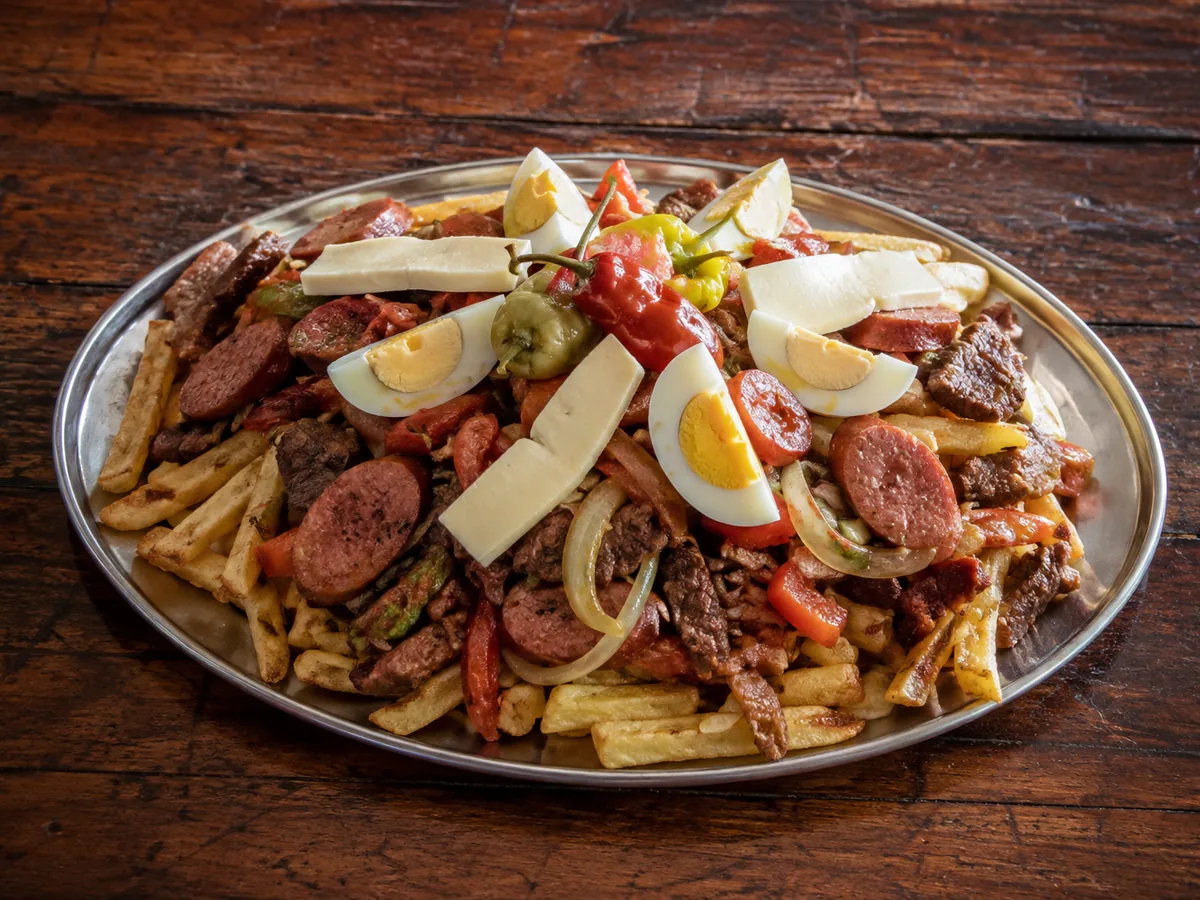
Pique macho is Bolivia’s communal challenge platter, created in Cochabamba in the 1970s. The name is a dare: only a macho with a brave enough palate finishes a whole mountain of fiery locoto, thick-cut fries, seared beef and sausage.
Tenderloin or sirloin is sliced into ribbons and seared hard in a smoking skillet with frankfurters, sweet onions, tomatoes and locoto rings. The pan gets deglazed with beer and Worcestershire into a savoury, spicy jus.
Poured over a base of hot twice-cooked fries and crowned with hard-boiled eggs and white cheese, it arrives on communal platters with cold Paceña.
Meat and pan
- 800 g1.76 lbBeef tenderloin (lomo) or top sirloin, trimmed and cut into strips 5 cm long by 1 cm thick
- 400 g14 ozArtisanal frankfurters (salchichas vienesas) or smoked chorizo links, sliced into 1 cm rounds
- 60 ml4 TbspVegetable oil or beef tallow
- 2 large2 largeRed onions, peeled and sliced into thick half-moons
- 4 large4 largeRipe plum tomatoes, cut into thick wedges
- 4 whole4 wholeFresh locoto chillies, red and green, seeded and cut into thick rings
- 4 cloves4 clovesFresh garlic, minced fine
- 8 g2 tspGround cumin seeds, freshly toasted in a skillet
- 4 g1½ TbspDried wild oregano, crushed
- 120 ml½ cupCrisp lager beer
- 30 ml2 TbspSoy sauce or Worcestershire sauce (salsa inglesa)
- 15 g1 TbspFine sea saltdivided between the beef and the fries
- 3 g1 tspFreshly ground black pepper
Fries and crown
- 1.2 kg2.6 lbRusset or Kennebec potatoes, peeled, cut into 1.5 cm fries and soaked in cold water
- 1 L4.2 cupsHigh-smoke-point oil, for deep-frying
- 4 large4 largeHard-boiled eggs, peeled and quartered
- 150 g1.5 cupsQueso fresco, cut into cubesthe traditional garnish
Twice-cooked, or the whole thing goes soggy
Blanching at 150 °C gelatinises the potato starch; the second pass at 190 °C builds a rigid crust. That crust is what lets the fries absorb the spicy meat liquor like a sponge instead of turning to mush under it.
The pan has to be smoking
Beef strips need a 220 °C surface for instant Maillard browning. In a crowded or cool pan they release their water and stew grey.
Cold beer onto a hot pan
Poured around the perimeter, it boils violently, dissolves the fond and reduces into the savoury, spicy jus that defines the dish. The sausage fat rendered just before it is what carries the fat-soluble capsaicin out of the locoto.
Leave some seeds in
Pique macho is defined by its heat. Keep at least half the chilli seeds in the pan.
The five tastes on this plate
Salt is the seared beef, the sausage and the twice-fried salted potatoes. Fat is rendered beef fat, sausage lipids and the fried batons. Acid is cooked tomato, the beer deglaze and the capsaicin oils. Heat is fresh locoto, toasted cumin, garlic and coarse black pepper. Umami is seared beef, browned sausage, the soy or Worcestershire fond and reduced beer.
Equipment
- Heavy Dutch oven, for deep-frying
- Oil thermometer
- Spider skimmer and wire rack
- 14 in flat-bottomed wok, or two 12 in cast-iron skillets
- Wide communal platter
Traditionally a broad, heavy carbon-steel paila over a screaming gas burner. A 14-inch flat-bottomed wok or two 12-inch cast-iron skillets work in a modern kitchen — the surface area matters more than anything, because crowding the meat into a small pan steams it grey instead of searing it brown.
Method
Blanch the fries10 min
Drain the soaked potato batons and dry them thoroughly.
Heat 1 litre of oil in a heavy Dutch oven to 150 °C / 300 °F and blanch the potatoes 6 to 7 minutes, until cooked through but still pale. Lift out onto a wire rack.
Drain the soaked potato batons and dry thoroughly. Heat 1 litre frying oil to 150 °C / 300 °F; blanch potatoes 6–7 minutes until cooked but pale, then lift onto a wire rack.
Sear the beef and sausage5 min
Heat 45 ml oil in the wok over high heat until smoking, about 220 °C / 428 °F.
Season the beef strips with salt, pepper and cumin, add them in a single layer, and sear without moving for 2 minutes until a deep brown crust forms. Toss for 1 minute.
Add the sausage rounds and toss 2 minutes until they brown and curl at the edges.
Heat 45 ml oil in a wok over high heat to about 220 °C / 428 °F. Season beef with salt, pepper and cumin; sear in one layer untouched 2 minutes, then toss 1 minute. Add sausage; toss 2 minutes until browned and curled.
Stir-fry the aromatics3 min
Add the sliced red onions, garlic and locoto rings and stir-fry aggressively 2 minutes, until the onions soften but keep their bite.
Add the tomato wedges and oregano and toss 1 minute.
Add red onion, garlic and locoto rings; stir-fry vigorously for 2 minutes, keeping some bite in the onion. Add tomato wedges and oregano, then toss for 1 minute.
Deglaze and build the jus2 min
Pour the 120 ml beer and 30 ml soy or Worcestershire around the perimeter of the hot pan. It will boil violently and lift every bit of fond.
Toss everything 1 to 2 minutes until the liquid reduces to a spicy, glossy jus, then pull it off the heat immediately so the beef stays tender.
Pour 120 ml beer and 30 ml soy or Worcestershire around the hot pan edge; expect vigorous boiling. Toss 1–2 minutes to loosen the browned base and reduce to glossy juices, then remove immediately from heat.
Finish the fries4 min
Bring the frying oil up to 190 °C / 375 °F and drop the blanched potatoes back in for 3 to 4 minutes, until deep golden, crisp and hollow-sounding.
Drain, salt, and mound them across a wide platter.
Heat the frying oil to 190 °C / 375 °F. Refry potatoes 3–4 minutes until deeply golden, crisp and hollow-sounding. Drain, salt and mound on a wide platter.
Build the mountain
Pour the sizzling beef, sausage, vegetables and all the jus straight over the bed of hot fries.
Arrange the quartered eggs and cubed queso fresco around the summit and scatter more locoto rings across the top. Serve in the middle of the table.
Pour the hot beef, sausage, vegetables and all their juices over the fries. Top with quartered hard-boiled eggs, queso fresco cubes and more locoto rings; serve at the centre of the table.
Sensory cues of doneness
- Visual: a mountain of golden fries buried under glistening brown beef, pink sausage rounds, red tomato and green locoto rings, crowned with egg.
- Auditory: a roaring sizzle as cold beer hits the smoking pan floor, and a crisp snap from the thick fries.
- Olfactory: seared beef, roasted locoto vapour, toasted cumin, garlic and reduced beer.
Look for browned glossy beef over golden fries, with sausage, tomato, locoto and egg. The beer should sizzle loudly on contact; fries should snap crisply, with aromas of seared beef, locoto, cumin and reduced beer.
Troubleshooting
- Soggy fries under the meat.
They were fried once, or the sauce went onto cold potatoes. Always use twice-fried, still-hot fries.
- Grey, steamed beef.
The pan was overcrowded. Sear in two batches so it browns fast instead of boiling in its own juice.
- It comes out mild.
All the chilli seeds and ribs were discarded. Leave at least half of them in.
Substitutions
One-to-one global substitutions, with the technique adjustment each one requires.
Ingredient substitutions
| Ingredient | Replace with | Culinary impact and technique adjustment |
|---|---|---|
| Locoto chilli | Fresh red habanero, rocoto or red serrano | One-to-one. Rocoto is the direct botanical twin of locoto |
| Beef tenderloin | Top sirloin, ribeye or skirt steak | One-to-one. Slice thin across the grain |
| Cerveza Paceña | Any crisp German or Czech-style pilsner | One-to-one for the deglaze |
Scaling
Half, for 3 portions
Halve everything in a 12-inch skillet and fry the potatoes in one batch.
Double, for 12 portions
Double everything and use two large woks or skillets, so the pan stays searing hot under twice the meat.
What to serve it with
- Extra llajwa, stone-ground, for anyone who wants more heat
- Ice-cold Paceña lager against the locoto burn
- Mustard, mayonnaise and ketchup on the table for the fries
Questions
How hot is authentic pique macho?
Intensely so. Locoto runs between roughly 30,000 and 100,000 Scoville units, with a bold fruity sting that ends up through the whole pan jus.
Which sausages are best?
High-grade pork frankfurters (salchichas vienesas) or smoked pork chorizo links in a natural casing that snaps when bitten.
Can I make it with chicken?
Yes — that version is called pique de pollo, made with chicken breast or thigh strips seared with the same vegetables and beer.