Silpancho Cochabambino
Quechua for "thin, flattened meat", and it is not an exaggeration. A 150 g steak is buried in breadcrumbs and hammered until it spreads from 10 cm to 25 cm across and 2 mm thick, then flash-fried in ninety seconds over rice, sautéed potatoes, two fried eggs and raw locoto salsa.
- Prep
- 30 min
- Cook
- 25 min
- Serves
- 4 large platters
- Difficulty
- Medium
Researched · Kitchen testing pending
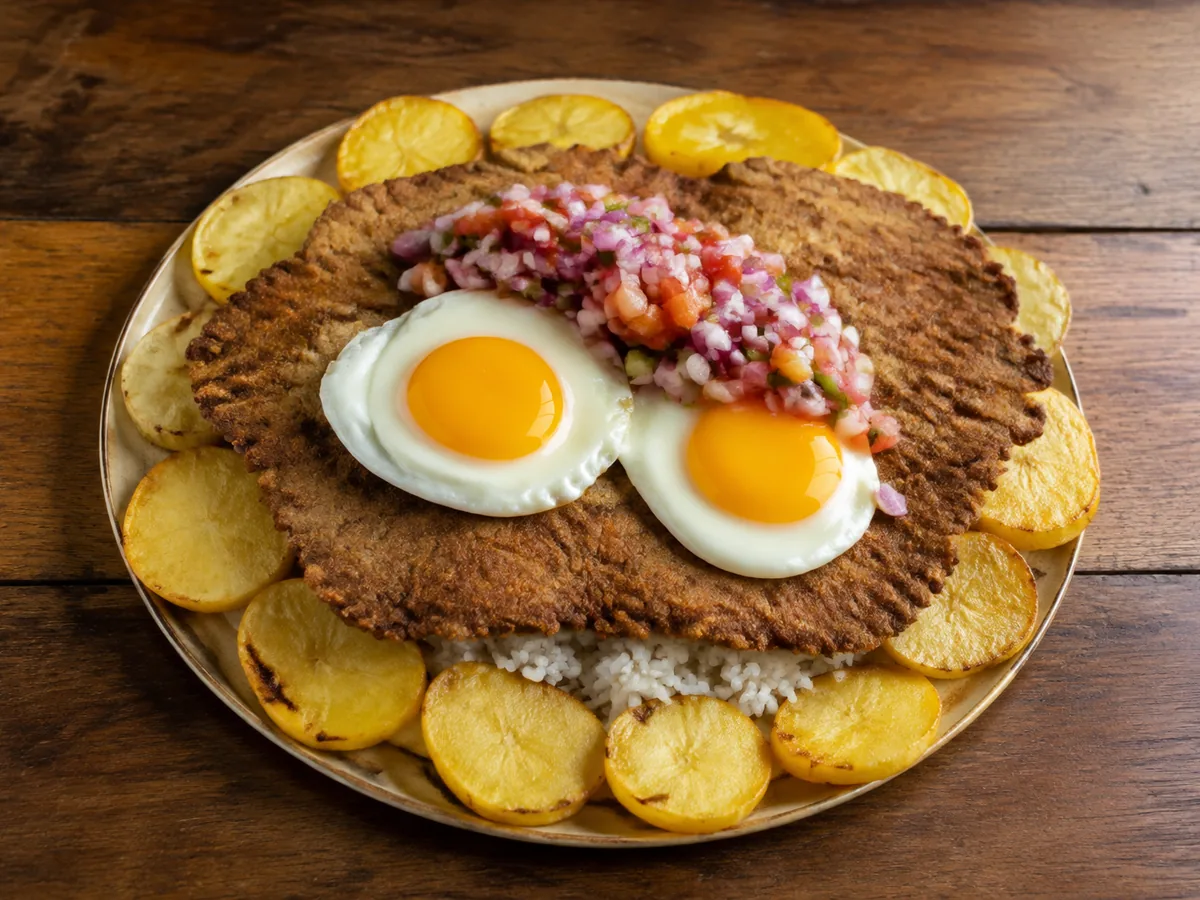
Cochabamba is Bolivia’s acknowledged gastronomic capital, and silpancho is its monument. The name is Quechua for “thin, flattened meat”.
A slice of lean top round goes between heavy plastic sheets, gets buried in fine breadcrumbs, and is hammered with a mallet or a smooth river stone until it spreads into a disc thinner than cardboard and wider than the plate. Flash-fried in barely two minutes, it lands over white rice and boiled, pan-sautéed potatoes.
Crowned with two fried eggs and a brisk raw salad of tomato, red onion and locoto, it is a plate of crisp textures and blunt Andean heat.
The cutlet
- 600 g1.32 lbBeef top round, sirloin or flank, trimmed of silverskin and cut into 4 equal 150 g steaks
- 200 g1.5 cupsFine plain dry breadcrumbs (pan molido), sifted
- 2 cloves2 clovesFresh garlic, crushed to a paste
- 8 g1½ tspGround cumin seeds, freshly toasted in a dry skillet
- 12 g2 tspFine sea saltdivided across the meat, potatoes and salsa
- 3 g1 tspFreshly ground black pepper
- 120 ml½ cupHigh-smoke-point vegetable oil
The platter
- 4 medium4 mediumPapa Imilla, Russet or Yukon Gold potatoes, boiled whole in their skins, peeled and cut into 1 cm rounds
- 400 g2 cupsLong-grain white rice, cooked fluffy and kept hot
- 4 to 8 large4 to 8 largeEggs, one or two per platter
Salsa cruda
- 2 large2 largeRipe plum tomatoes, diced into 5 mm cubes
- 1 medium1 mediumRed onion, peeled and diced into 5 mm cubes
- 2 fresh2 freshLocoto chillies, or red habaneros or serranos, seeded and minced fine
- 15 ml1 TbspFresh lime juice or white vinegar
- 15 ml1 TbspExtra-virgin olive oil
- 10 g¼ cupFresh quirquiña or cilantro leaves, chopped fine
The breadcrumbs are the tenderiser
Pounding the steak between heavy plastic *with* dry breadcrumbs is dry mechanical tenderising. The blows fracture the myofibrillar sheaths while the crumbs drive down between the broken muscle bundles — which is how the disc expands from 10 cm to 25 cm while thinning to 2 mm.
Ninety seconds, no longer
Because the meat is paper-thin, 185 °C for 60 to 90 seconds a side flash-cooks it and dehydrates the crumb mantle into a crisp shell before the interior moisture can escape.
Keep the yolks fluid
The running yolk is the sauce. Cook the eggs until the whites set and the edges crisp, and no further.
What quirquiña is
An Andean herb (*Porophyllum ruderale*) with a cilantro-rue-citrus perfume. It is considered non-negotiable in a real Bolivian llajwa and in this salsa.
The five tastes on this plate
Salt is the seasoned breaded beef, the salted potatoes and the lime-dressed salsa. Fat is the fried crust, the oil-sautéed potatoes and the yolk running across the rice. Acid is lime and ripe tomato cutting the fried meat. Heat is locoto, toasted cumin, garlic and raw red onion. Umami is caramelised beef fond, toasted crumb and egg yolk.
Equipment
- Pot, for boiling potatoes
- Heavy flat-faced meat mallet
- Heavy plastic sheets or plastic wrap
- 12 to 14 in cast-iron skillet
- Tongs and a wire rack
Traditionally a broad iron paila or carbon-steel plancha over a high gas flame. A 12-to-14-inch heavy cast-iron skillet works in a modern kitchen — the thermal mass is the point, holding 185 °C while a very large, very thin steak goes in, so it fries crisp instead of going greasy.
Method
Boil and slice the potatoes25 min
Put the whole potatoes into cold salted water and boil 20 to 25 minutes until tender.
Drain, cool slightly, peel, and cut into 1 cm rounds.
Start whole potatoes in cold salted water and boil 20–25 minutes until tender. Drain, cool slightly, peel and slice into 1 cm rounds.
Dress the salsa6 min
Toss the diced tomato, red onion, minced locoto, lime juice, olive oil, chopped quirquiña and ½ tsp salt in a bowl.
Leave it at room temperature to macerate while you cook.
Toss diced tomato and red onion with minced locoto, lime juice, olive oil, chopped quirquiña and ½ tsp salt. Leave at room temperature to macerate while cooking.
Pound the cutlets20 min
Lay one 150 g steak between two large sheets of heavy plastic. Season with salt, pepper, garlic paste and toasted cumin, and scatter 2 tablespoons of breadcrumbs over the meat.
With a flat-faced mallet, hammer outward from the centre in overlapping blows. Flip, add more crumbs, and keep going until the disc is 2 mm thick and about 25 cm across.
Repeat for all four.
Season each 150 g steak with salt, pepper, garlic and cumin between heavy plastic sheets; add 2 Tbsp breadcrumbs. Pound outward with a flat mallet, flipping and adding crumbs, until 2 mm thick and about 25 cm wide. Repeat for all four.
Sauté the potatoes8 min
Heat 30 ml oil in the cast-iron skillet over medium-high heat and lay the potato rounds in a single layer.
Fry undisturbed 3 to 4 minutes a side until deeply golden and crisp at the edges. Salt them and keep warm.
Heat 30 ml oil over medium-high heat. Fry potato rounds in one layer, undisturbed 3–4 minutes per side, until deeply golden with crisp edges. Salt and keep warm.
Flash-fry the silpanchos8 min
Add 60 ml oil to the skillet and bring it to a shimmer at 185 °C / 365 °F.
Lay in one pounded steak and fry strictly 60 to 90 seconds until the underside is deep golden-brown, then flip and give it 45 to 60 seconds more. Onto a wire rack.
Repeat, adding a splash of oil as needed.
Add 60 ml oil and heat to 185 °C / 365 °F. Fry one cutlet 60–90 seconds until deeply golden underneath, flip for 45–60 seconds, then drain on a rack. Repeat, adding oil as needed.
Fry the eggs3 min
Crack the eggs straight into the pan drippings and fry sunny-side up 60 to 90 seconds, until the whites are set with crisp edges and the yolks are still fluid.
Crack the eggs into the pan drippings. Fry sunny-side up 60–90 seconds until the whites are set with crisp edges and the yolks remain fluid.
Build the platter
Spread hot white rice across a wide platter and ring the edge with the golden potato rounds.
Lay the enormous crisp cutlet over the rice and potatoes, perch the fried eggs on top, and crown it generously with the raw tomato-locoto salsa. Serve at once.
Spread hot rice on wide platters and ring with golden potato rounds. Lay a crisp cutlet over each, top with fried eggs and plenty of tomato-locoto salsa, and serve immediately.
Sensory cues of doneness
- Visual: a massive golden-brown breaded cutlet draping over the plate, crusty golden potatoes, and bright amber yolks still fluid.
- Auditory: loud, furious crackling the instant the thin steak meets the oil.
- Olfactory: toasted breadcrumb, sizzling beef fat, sautéed potato, toasted cumin and pungent locoto.
Look for golden cutlets and crisp potatoes with fluid amber yolks. The thin beef should crackle strongly on contact with oil; expect toasted breadcrumbs, beef fat, potato, cumin and locoto aromas.
Troubleshooting
- Thick, chewy, rubbery meat.
It was not pounded hard enough. Silpancho has to reach 2 mm; anything thicker turns rubbery in hot oil.
- A greasy, soggy crust.
The oil dropped below 175 °C / 347 °F and the crumbs drank it. Keep it hot so the cutlet fries in under 90 seconds.
- Firm yolks.
The eggs were overcooked. The fluid yolk is the sauce for the steak and rice — pull them while it still runs.
Substitutions
One-to-one global substitutions, with the technique adjustment each one requires.
Ingredient substitutions
| Ingredient | Replace with | Culinary impact and technique adjustment |
|---|---|---|
| Beef top round | Sirloin, rump steak or trimmed flank | One-to-one. It must still be pounded to 2 mm with breadcrumbs |
| Locoto chilli | Red habanero or serrano | One-to-one. Seed and mince fine |
| Quirquiña | Fresh cilantro with a pinch of fresh tarragon | One-to-one. Gets close to the herbal, citrusy Andean note |
Scaling
Half, for 2 platters
Halve everything in a 12-inch skillet. Every cooking time is unchanged.
Double, for 8 platters
Double everything and run two large cast-iron skillets side by side so the steaks and potatoes both come off hot.
What to serve it with
- Llajwa cochabambina — stone-ground tomato, locoto and quirquiña
- Chicha cochabambina — cool, slightly sour fermented corn
- An ice-cold Paceña lager against the locoto heat
Questions
What cut of beef works best?
Top round (pulpa redonda) or sirloin. Both are lean, tenderise readily under the mallet, and hold the wide circular disc.
What can I use instead of locoto?
Red Scotch bonnet, habanero or fresh red jalapeño. Locoto has thicker, juicier flesh and black seeds, with a clean floral heat.
What is quirquiña?
An aromatic Andean herb, *Porophyllum ruderale*, with a distinct cilantro-rue-citrus perfume — considered mandatory in authentic Bolivian llajwa and in this salsa.