Salteñas Bolivianas
La Paz eats these before ten in the morning and never with a knife and fork. The filling is a beef stew set solid with gelatin overnight, so it can be spooned into raw dough as a cold jelly; twelve minutes at 260 °C sets the crust before that jelly melts back into soup inside it.
- Prep
- 1 hr
- Cook
- 12 min
- Serves
- 12 large salteñas, about 200 g each
- Difficulty
- Hard
Researched · Kitchen testing pending
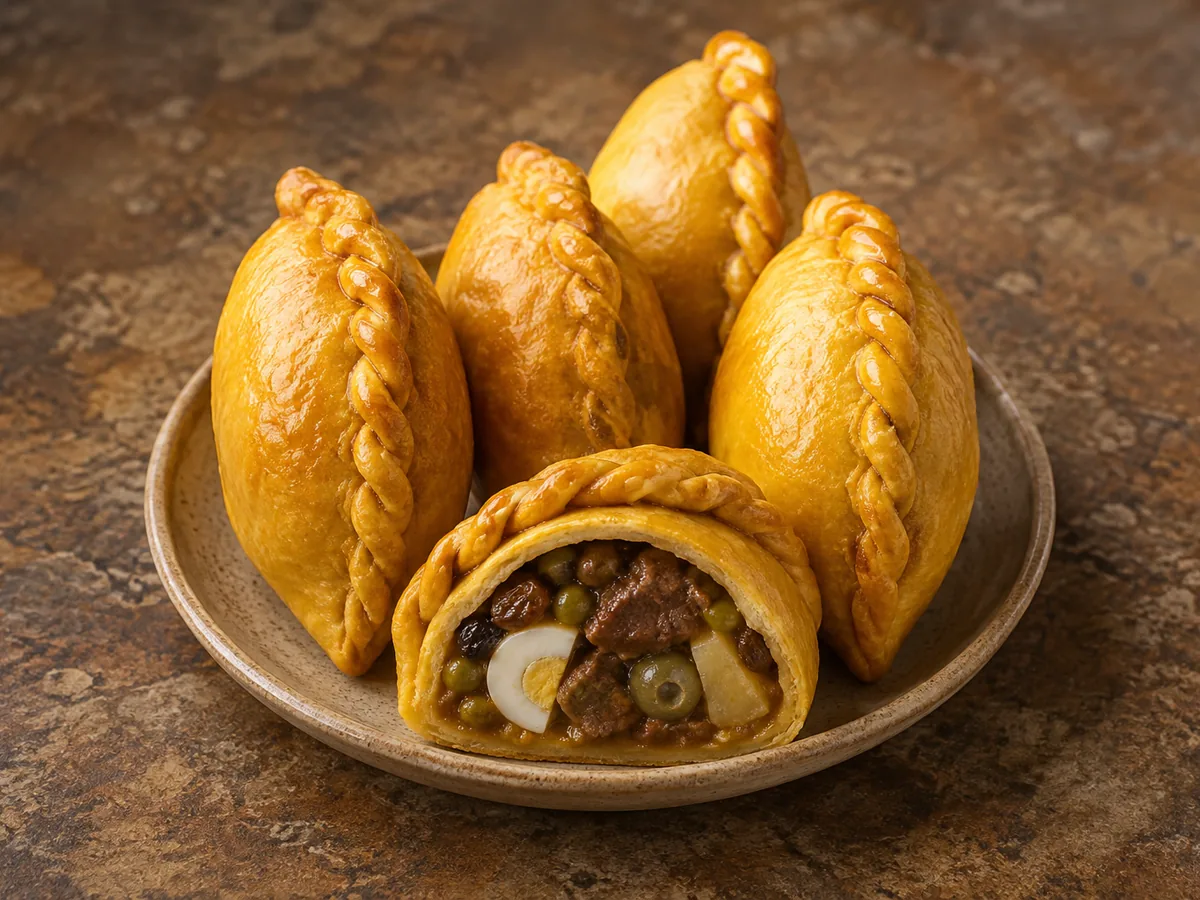
Mornings in La Paz run on salteñas — street carts and steaming glass cases, finished before ten o’clock. The pastry is an engineering problem solved: a sweet, sturdy golden envelope holding a savoury beef stew that turns molten inside the crust as it bakes.
The dish is usually traced to the nineteenth-century Argentine writer Juana Manuela Gorriti, exiled in Tarija and Potosí. The dough is sweetened, tinted with achiote and rolled dense. Inside sits the jigote: braised beef chuck, potato, peas, cumin and ají amarillo, bound in beef gelatin that chills to a solid jelly before folding.
In a screaming-hot oven the gelatin melts back into broth while the pleated top seam, the repulgue, holds fast.
Jigote, the filling
- 600 g1.32 lbBeef chuck roast or top round, hand-cut into 5 mm dice
- 600 g4 cupsYellow onions, peeled and cut into fine 4 mm brunoise
- 45 ml3 TbspRendered beef lard (manteca), or neutral oil
- 45 g3 TbspAjí amarillo paste
- 8 g2 tspGround cumin seeds, freshly toasted in a dry skillet
- 4 g1½ TbspDried wild oregano, hand-crushed
- 20 g1½ TbspGranulated cane sugar
- 15 g2 packetsUnflavoured powdered beef or pork gelatin
- 600 ml2.5 cupsRich beef bone broth, hot
- 300 g2 mediumRusset or Yukon Gold potatoes, peeled, cut into 5 mm dice and boiled tender-firm
- 100 g¾ cupSweet green peas, fresh or frozen
- 10 g2 tspFine sea salt
- 3 g1 tspFreshly ground black pepper
To fill each one
- 12 whole12 wholeBlack olives, pitted
- 50 g⅓ cupDark raisins, plumped in warm water and drained
- 2 large2 largeHard-boiled eggs, peeled and cut into 12 wedges
Sweet annatto pastry
- 600 g4.8 cupsAll-purpose wheat flour, 11% protein, sifted
- 120 g½ cup + 1 TbspRendered beef lard or unsalted European butter, melted hot to 60 °C / 140 °F
- 60 g¼ cup + 1 TbspGranulated cane sugar
- 5 g1 tspFine sea salt
- 15 ml1 TbspAchiote oil (annatto-infused oil)
- 220 mlscant 1 cupLukewarm filtered water, about 45 °C / 113 °F
- 1 large1 largeEgg yolk whisked with 15 ml milk and 2 drops achiote oilthe glaze
The filling is a solid before it is a soup
Gelatin peptides stay coiled in cold water; below 15 °C the collagen helices lock into a rigid network that traps all 600 ml of broth inside the meat and vegetables. That is what lets you spoon a firm, jellied mound into thin raw dough and seal the seam without losing a drop. In the oven it reverses.
Hot fat, then water — in that order
The 60 °C melted lard goes over the flour before any water does, so it coats the flour proteins and holds gluten development back. The dough then rolls thin without fighting you.
The oven has to be brutal
260 °C for strictly 12 minutes. Below about 230 °C the gelatin melts and boils into steam before the crust has set, and the seams blow open.
Press the air out
Trapped air balloons into steam and ruptures the pastry. Press the dough firmly against the cold filling before you start braiding.
Passive time, counted separately
The jigote chills 12 hours and the dough rests 45 minutes to an hour. Neither is active work and both sit outside the times quoted above, which is why this is a two-day recipe.
The five tastes on this plate
Salt is sea salt through the gelatin broth and the pastry dough. Fat is warm melted beef lard in the pastry and marrow fat in the jigote. Acid is mellow, brightened at the table with tomato-locoto llajwa. Heat is fruit-scented ají amarillo, toasted cumin and cracked black pepper. Umami is beef chuck collagen, reduced bone stock and seared beef fond.
Equipment
- Dutch oven, for the jigote
- Shallow tray, for chilling the filling
- Wide mixing bowl
- Rolling pin
- Half-sheet pans rated for 260 °C / 500 °F; use unlined or with a liner rated for that temperature
- Baking stone or steel
- Pastry brush
Traditionally a wood-fired clay oven (horno de barro) running near 280 °C. In a modern kitchen, heavy rimmed half-sheet pans on parchment with a baking stone or steel preheated at 260 °C for 45 minutes — the stone is what gives the base immediate conductive heat, so the bottom crust sets before the filling liquefies.
Method
Cook the jigote — day one25 min
Heat 45 ml lard in a Dutch oven over medium heat and sweat the diced onions 8 minutes until translucent.
Stir in the ají amarillo paste, toasted cumin, oregano, black pepper, sugar and 10 g salt, and cook 3 minutes until the oil turns golden.
Add the diced beef and cook 5 minutes until no longer pink. Pour in the 600 ml hot broth and simmer 5 minutes.
Bloom the 15 g gelatin in 60 ml cold water for 5 minutes, then stir it into the hot stew until completely dissolved. Off the heat, fold in the cooked potatoes and peas.
Transfer to a shallow tray, cover and refrigerate promptly, within 2 hours (1 hour above 32 °C / 90 °F). Chill 12 hours, until set firm like jelly.
Soften onion in 45 ml lard over medium heat 8 minutes. Add ají, cumin, oregano, pepper, sugar and 10 g salt; cook 3 minutes. Add beef; cook 5 minutes until no longer pink. Add 600 ml hot broth; simmer 5 minutes. Bloom 15 g gelatin in 60 ml cold water 5 minutes; dissolve in hot stew. Off heat, fold in cooked potatoes and peas. Transfer to a shallow tray, cover and refrigerate promptly, within 2 hours (1 hour above 32 °C / 90 °F); chill 12 hours until firmly jellied.
Make the pastry — day two12 min
Whisk the flour, sugar and salt in a wide bowl.
Heat the melted lard with the achiote oil to 60 °C / 140 °F and pour the hot fat over the flour. Rub it in with your fingertips until the flour looks like yellow sand.
Add the lukewarm water gradually, working it into a cohesive mass, then knead on an unfloured counter 5 minutes into a smooth, firm, elastic dough. Wrap and rest at room temperature 45 minutes.
Mix flour, sugar and salt. Heat lard with achiote oil to 60 °C / 140 °F; rub into flour before adding water. Gradually add water at about 45 °C / 113 °F. Knead on an unfloured counter 5 minutes until smooth and firm. Wrap; rest 45 minutes at room temperature.
Roll the discs12 min
Cut the dough into 12 balls of about 80 g.
Roll each from the centre outward into an oval roughly 15 cm long, 12 cm wide and 3 mm thick. Keep them under a damp cloth as you go.
Divide dough into 12 balls of about 80 g. Roll from the centre into ovals 15 cm long, 12 cm wide and 3 mm thick; keep covered with a damp cloth.
Fill and braid the seam25 min
Lay an oval flat and spoon 100 g of the cold jellied jigote down the centre. Add one olive, a few raisins and one egg wedge.
Brush the edge with water, bring both sides up over the filling to meet at the top, and pinch firmly along the crest to expel all the air.
Starting at one corner, fold and twist small triangles of dough forward into a tight rope along the top ridge — the repulgue. Each salteña must stand upright on its flat base.
Place 100 g cold jellied filling, one olive, a few raisins and one egg wedge on each oval. Wet edges; bring sides together on top and pinch out all air. Fold and twist a tight braided ridge; stand upright on the flat base.
Glaze and blast12–14 min
Preheat the oven to 260 °C / 500 °F with the stone inside for 45 minutes.
Use a baking sheet rated for 260 °C / 500 °F, unlined or with a liner rated for that temperature; do not use parchment unless its manufacturer permits it. Stand the salteñas upright, 4 cm apart, and brush with the yolk and achiote glaze.
Slide the pan straight onto the hot stone and bake undisturbed strictly 12 to 14 minutes, until the pastry bubbles, turns deep amber-gold and the braided crest crisps. Pull them out immediately.
Preheat oven and stone at 260 °C / 500 °F for 45 minutes. Use a tray rated for 260 °C / 500 °F, unlined or with a liner rated for that temperature; no unrated parchment. Stand salteñas 4 cm apart and brush with yolk, milk and achiote glaze. Bake on the stone 12–14 minutes undisturbed, until amber, blistered and crisp along the braid. Remove immediately.
Rest, then eat them properly
Rest 5 minutes.
Eat upright, from a napkin, tilting a little with each bite to sip the hot broth inside. Never with a knife and fork.
Rest 5 minutes before eating. Hold each salteña upright in a napkin, tilting slightly between bites to sip the hot broth inside.
Sensory cues of doneness
- Visual: glowing amber-gold pastry with blistered brown highlights along the braid, and no broth leaking onto the sheet.
- Auditory: a distinct sloshing when a baked salteña is tilted upright in the hand.
- Olfactory: sweet baked lard pastry, toasted cumin, ají amarillo and hot beef marrow broth.
Look for amber-gold pastry with browned blisters along the braid and no leaking broth. The filling should slosh when tilted; expect sweet baked pastry, cumin, ají amarillo and hot beef-broth aromas.
Storing it
Flash-freeze the assembled raw salteñas on a sheet until solid, then bag them. Bake straight from frozen at 250 °C / 485 °F for 16 to 18 minutes.
Troubleshooting
- Filling leaks through the seams before baking.
The jigote was warm, so the gelatin was still liquid. It must go in refrigerator-cold and solid.
- The seams blow open in the oven.
The oven was below 230 °C, so the gelatin boiled to steam before the crust set. Blast it at 260 °C.
- The pastry balloons and ruptures.
Air was trapped inside. Press the dough firmly against the cold filling before braiding.
Substitutions
One-to-one global substitutions, with the technique adjustment each one requires.
Ingredient substitutions
| Ingredient | Replace with | Culinary impact and technique adjustment |
|---|---|---|
| Ají amarillo paste | Ground yellow chilli paste, or mild orange habanero with sweet paprika | One-to-one. Carries the fruity aroma and the colour |
| Beef lard (manteca) | Unsalted European butter or leaf pork lard | One-to-one. Butter gives dairy richness; lard the traditional snap |
| Achiote oil | ½ tsp ground turmeric dissolved in the melted fat | Gives the same warm yellow-gold pastry hue |
Scaling
Half, for 6 salteñas
Halve everything. The bake stays 12 to 14 minutes at 260 °C.
Double, for 24 salteñas
Double everything, but bake one sheet at a time on the stone so the oven temperature never drops.
What to serve it with
- Llajwa tradicional — red locoto and tomato ground on a stone batán with fresh quirquiña
- Mocochinchi — chilled sun-dried peach drink with cinnamon, clove and caramelised sugar
- Strong dark-roast drip coffee, against the sweet pastry
Questions
Can I make chicken salteñas instead?
Yes. Swap the beef chuck for hand-diced chicken thigh, cooked in the same ají amarillo broth with the same gelatin.
Why is there sugar in the dough?
Because the signature of a salteña is a sweet, crisp shell playing against the spicy, savoury, gelatinous broth inside it.
Can unbaked salteñas be frozen?
Yes. Flash-freeze them on a sheet until solid, then bag, and bake from frozen at 250 °C / 485 °F for 16 to 18 minutes.