Texas Smoked Brisket
Central Texas, stripped of sauce. A whole packer brisket trimmed cold to an aerodynamic 6 mm fat cap, rubbed with nothing but kosher salt and coarse 16-mesh pepper, smoked over post oak for twelve to fourteen hours, wrapped in butcher paper through the stall, and rested four hours in a cooler before it is sliced.
- Prep
- 45 min
- Cook
- 14 hr
- Serves
- 16 to 20, from one 6.5 kg packer
- Difficulty
- Hard
Researched · Kitchen testing pending
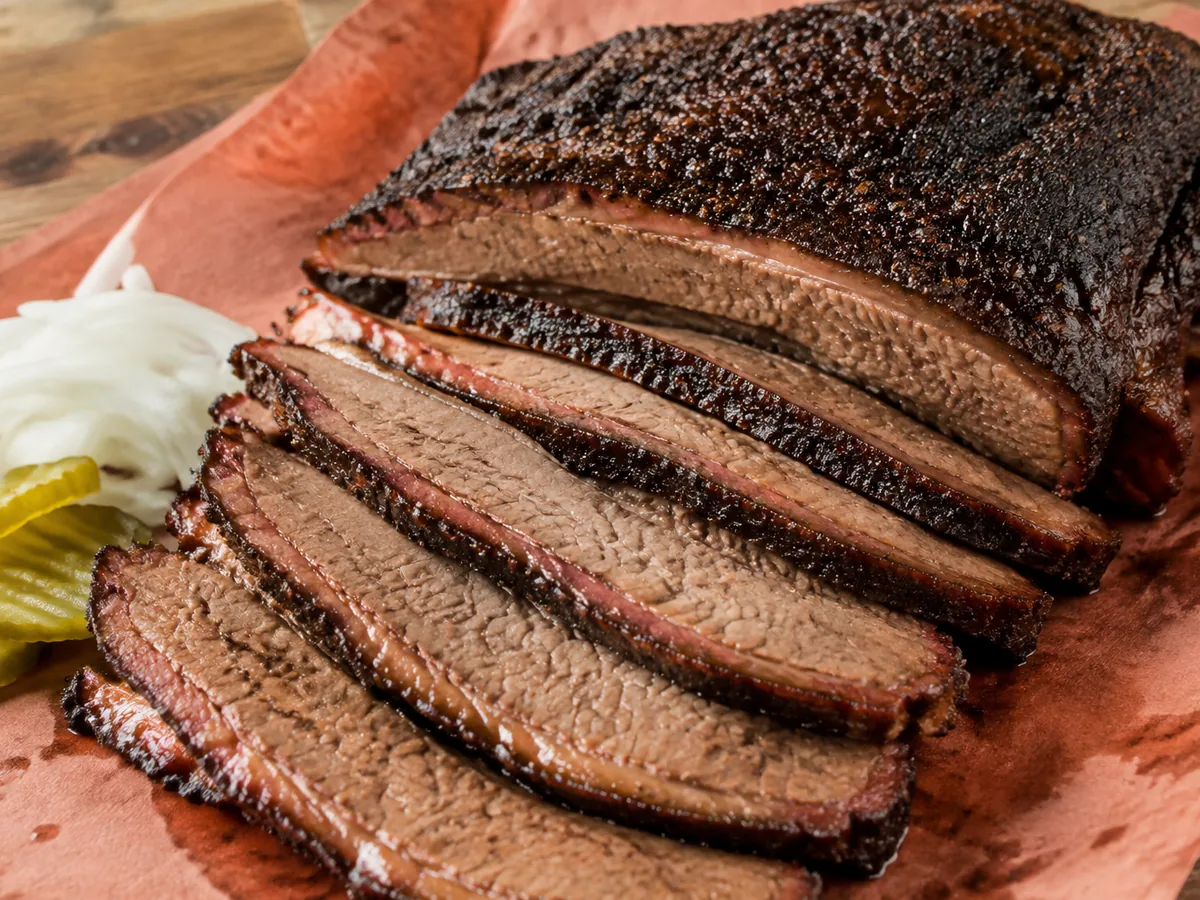
In the Texas Hill Country, from Lockhart and Luling to Austin, barbecue is a craft stripped of sweet glazes and sauces. It centres on the whole packer brisket, point and flat intact, and a seasoning of nothing but coarse salt and coarse black pepper. The pit burns seasoned post oak.
Over twelve to sixteen hours at 110 to 120 °C the brisket transforms. Nitric oxide from clean smoke paints a crimson ring under a jet-black pepper crust. Once the stall is broken inside breathable butcher paper, the core climbs to 95 °C and the collagen turns to gelatin, leaving the meat trembling and fork-tender.
- 6.5 kg14 to 15 lbWhole USDA Prime packer brisket, untrimmed, chilled firm at 3 °C
- 60 g½ cupCoarse kosher salt
- 60 g½ cupCoarse 16-mesh black pepper, butcher grindessential for the bark
- 15 g1 TbspGranulated garlicoptional, Austin style
- 6 to 8 logs6 to 8 logsSeasoned post oak splits, aged 9 to 12 months
- 2 sheets2 sheetsUnwaxed pink butcher paper, about 1.2 m each
- 250 ml1 cupApple cider vinegar and water, equal parts, in a spray bottle
Coarse pepper is not optional
Fine pepper coats the meat in a muddy paste. Sixteen-mesh flakes form an open matrix that lets the smoke gases reach the myoglobin for the pink ring, while rendering fat fries the flakes into a brittle black bark.
The stall, and why paper
Between 65 and 77 °C the surface evaporates as fast as heat goes in and the temperature freezes for hours. Wrapping in porous butcher paper stops the evaporative cooling without steaming the bark soft the way foil does.
Probe tender, then four hours in a cooler
At 95 °C the type-I collagen has hydrolysed and a probe slides through like warm butter. Sliced then, the juices and melted gelatin gush out. Wrapped in towels in an insulated cooler for three to four hours they redistribute and thicken.
The five tastes on this plate
Salt is kosher salt driven in over fourteen hours. Fat is marbling and the rendering cap. Acid is the cider spritz and pickled jalapeños at the table. Heat is the biting coarse pepper bark. Umami is beef, oak smoke phenols and gelatin.
Equipment
- Offset wood smoker, or a pellet or kamado grill set to 110 °C with post oak chunks
- Flexible 6-inch boning knife
- Spray bottle
- Instant-read probe thermometer
- Insulated cooler and two bath towels
- Long slicing knife
The Hill Country pit is quarter-inch steel burning post oak splits. A pellet or kamado grill can hold 110 °C with oak chunks. The cooler is not optional; it is where the brisket finishes.
Method
Trim cold30 min
Work with the brisket chilled hard. Fat side down, carve out the hard white deckle fat between the flat and the point until soft meat shows. Flip and shave the top cap to an even 6 mm across the flat. Round off the square corners so the smoke flows without drying the edges.
Keep brisket cold and firm. With fat down, remove hard deckle fat between flat and point until soft meat shows. Flip; trim the cap evenly to 6 mm over the flat and round the corners.
Apply the Dalmatian rub45 min
Combine equal volumes of kosher salt and 16-mesh pepper, with garlic if using. Coat every side evenly, pressing the rub on rather than rubbing it in. Rest at room temperature 45 minutes while the fire comes up.
Combine equal volumes of kosher salt and 16-mesh pepper, with garlic if using. Coat every side evenly, pressing the rub on rather than rubbing it in. Rest at room temperature 45 minutes while the fire comes up.
Build a clean fire45 min
Light a lump charcoal base and feed seasoned post oak splits. Hold the chamber at 110 to 120 °C with thin, translucent blue smoke. An oxygen-starved firebox makes acrid white smoke; keep the vents open.
Light a lump charcoal base and feed seasoned post oak splits. Hold the chamber at 110 to 120 °C with thin, translucent blue smoke. An oxygen-starved firebox makes acrid white smoke; keep the vents open.
Smoke to the bark6 to 8 hr
Set the brisket fat side up with the thick point toward the firebox. Smoke undisturbed 3 hours, then spritz dry patches every 45 minutes. Continue 6 to 8 hours total until the rub has set into a jet-black bark that does not smudge under a finger and the core reads 74 to 77 °C.
Place brisket fat-up, point toward firebox. Smoke undisturbed 3 hours; spritz dry patches every 45 minutes thereafter. Cook 6–8 hours total until bark is jet-black and does not smudge, and centre reaches 74–77 °C.
Wrap in butcher paper4 to 6 hr
Lay two sheets of pink paper overlapping, set the brisket in the centre, and fold it into a snug double-layer parcel. Return it fat side up and cook at 120 °C for 4 to 6 hours until a probe slides into the thickest part of the flat with no resistance, 95 to 98 °C.
Overlap two unwaxed pink butcher-paper sheets; wrap brisket snugly in two layers. Return fat-up at 120 °C for 4–6 hours until a probe slides without resistance into the thickest flat, at 95–98 °C.
The long rest3 to 4 hr
Wrap the parcel in two bath towels and shut it inside an insulated cooler for 3 to 4 hours. Do not open it.
Wrap the parcel in two bath towels and shut it inside an insulated cooler for 3 to 4 hours. Do not open it.
Carve to order10 min
Unwrap on a board and separate the flat from the point along the fat seam. Slice the flat across the grain into pencil-thick 6 mm slices. Cut the point thicker, about 1 cm, or cube it for burnt ends. Serve at once with pickles and white bread.
Unwrap; separate flat and point along the fat seam. Slice flat across the grain at 6 mm; slice point about 1 cm thick or cube for burnt ends. Serve immediately with pickles and white bread.
Sensory cues of doneness
- Visual: a coal-black glistening bark flecked with amber fat, and a 5 mm neon-pink smoke ring around a moist interior when sliced.
- Auditory: the crackle of oak coals, and a soft sigh as the whole brisket bends under its own weight when lifted.
- Olfactory: sweet post oak smoke, roasted black pepper, caramelised tallow and charred bark.
Check for glossy black bark flecked with amber fat, a moist interior and a 5 mm pink smoke ring. Expect a tender bend when lifted and oak, roasted pepper, caramelised tallow and bark aromas.
Storing it
Leftover brisket keeps 4 days wrapped tight. Reheat slices gently in a covered pan with a splash of stock, or vacuum-seal whole and warm in water at 65 °C.
Troubleshooting
- Muddy, soft bark.
Fine table pepper. Sixteen-mesh butcher grind is what builds a crunchy, open bark.
- Dry slices in a puddle of juice.
Cut straight off the smoker. The long cooler rest is essential.
- Bitter, tongue-burning smoke taste.
The fire was smothered and made creosote. Burn dry oak with open vents and clear blue smoke.
Substitutions
One-to-one swaps, with the technique change each one needs.
Ingredient substitutions
| Ingredient | Replace with | Culinary impact and technique adjustment |
|---|---|---|
| Post oak | White oak, red oak or pecan | One-to-one. Oak keeps the neutral Texas smoke |
| Pink butcher paper | Unwaxed brown kraft paper or parchment | One-to-one. Never plastic-coated freezer paper |
| 16-mesh pepper | The coarsest setting on a hand mill | Must be flakes, never powder |
Scaling
Half
A 3 kg trimmed flat. About 8 hours, wrapped at 74 °C, rested 2 hours.
Double
Two packers side by side on a wide offset grate. Fuel doubles; timing stays at 12 to 14 hours.
What to serve it with
- Soft white sandwich bread, to catch the tallow
- Thick raw sweet onion and pickled jalapeños
- A Shiner Bock, or a bold Texas Tempranillo
Questions
Why butcher paper instead of foil?
Foil seals airtight and steams the bark to mush. Butcher paper breathes, letting steam escape while holding heat and fat.
What is the stall?
The hours-long plateau around 65 to 75 °C when evaporation from the surface matches the heat going in. Wrapping breaks it.
How do I know it is done without a thermometer?
A skewer or probe slides through the flat like warm butter with no resistance.