Smash Cheeseburger
The lunch-counter burger as thermodynamics. Two loose 85 g balls of an 80/20 chuck, brisket and short rib grind hit a dry 230 °C cast-iron plate and get crushed paper-thin within ten seconds, building a lacy mahogany crust, then stacked with American cheese on a toasted potato bun with pickles, shaved onion and special sauce.
- Prep
- 20 min
- Cook
- 8 min
- Serves
- 4 double burgers
- Difficulty
- Medium
Researched · Kitchen testing pending
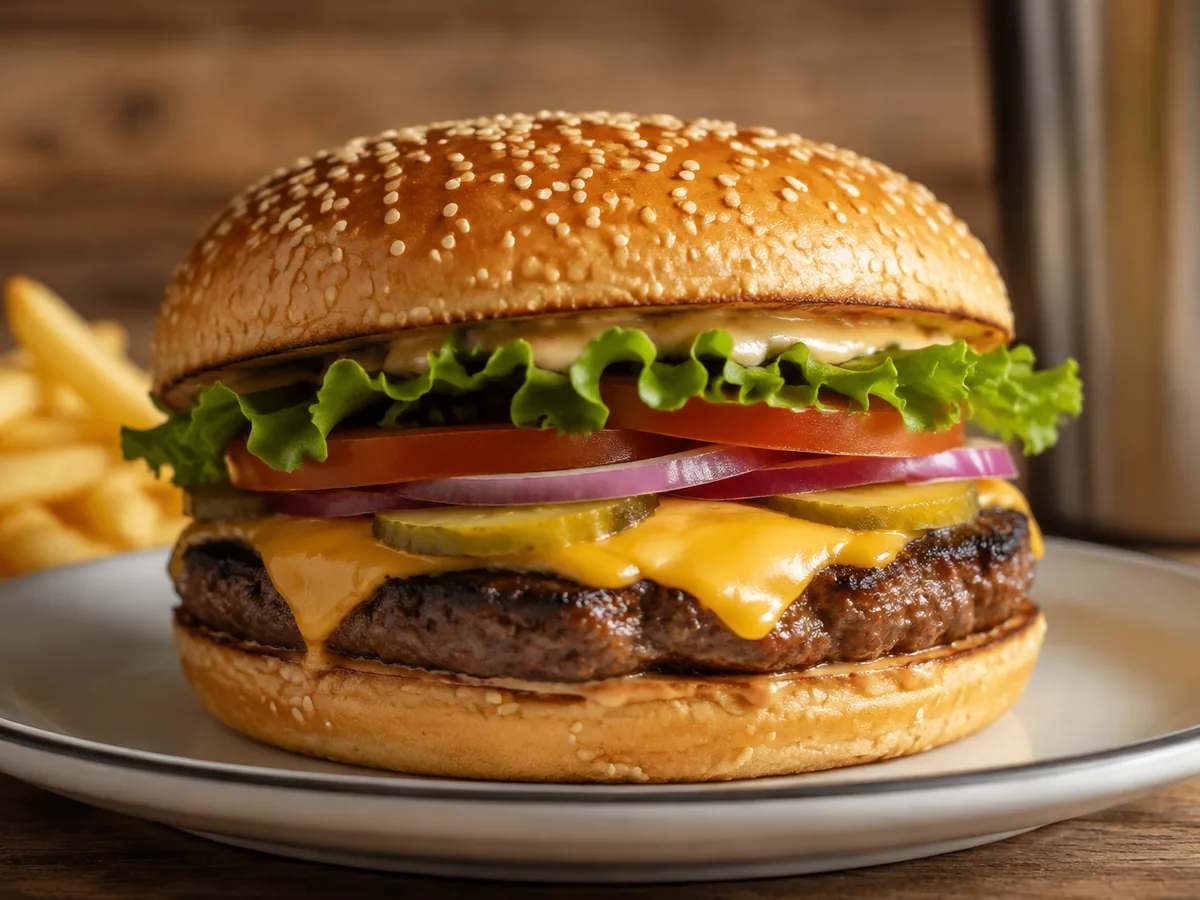
From roadside drive-ins to city lunch counters, the cheeseburger became the country’s vernacular street food, and the smash burger is its purest form. Where a steakhouse patty is broiled gently, the smash burger is a piece of thermodynamics: two loose balls of freshly ground beef crushed paper-thin against a screaming cast-iron plate within seconds of landing.
The pressure forces the meat into total contact with the iron and produces a deep, lacy mahogany crust while the inside stays juicy. American cheese melts over the top into a glossy sheet, and the whole thing goes into a toasted potato bun with pickles, shaved sweet onion and a tangy special sauce.
Patties
- 680 g1½ lbFreshly ground beef, 50 percent chuck, 25 percent brisket, 25 percent short rib, coarse grind, 80/20divided into 8 loose 85 g balls and chilled
- 8 slices8 slicesDeli-grade yellow American cheese
- 12 g2 tspCoarse kosher salt
- 4 g1½ tspCoarsely ground black pepper
Buns and toppings
- 44Potato rolls or soft brioche buns, split
- 45 g3 TbspUnsalted butter, softened, for toasting
- 1 medium1 mediumSweet onion, shaved paper-thin on a mandoline
- 16 slices16 slicesCrinkle-cut dill pickle chips
Special sauce
- 60 ml¼ cupWhole-egg mayonnaise
- 30 ml2 TbspTomato ketchup
- 15 ml1 TbspPickle relish
- 5 ml1 tspYellow mustard
- 2 ml½ tspWorcestershire sauce
Smash early or not at all
Beef fat melts between 35 and 45 °C. If the ball is pressed before the proteins have set, in the first ten to twenty seconds, the meat is forced into total contact with the iron, the surface water flashes off, and the Maillard crust forms above 150 °C. Smash after a minute and you only squeeze out rendered fat and juice.
Why American cheese
Sodium citrate in deli American cheese holds the calcium so the casein cannot clump or oil off. It melts to a smooth liquid coat at 65 °C. Aged cheddar separates into an oily slick at the same heat.
Dry pan
Oil stops the beef adhering to the iron, and adhesion is what builds the lacy crust you scrape up with the spatula. The fat in the meat is all the lubrication you want.
The five tastes on this plate
Salt is kosher salt at the sear, pickle brine and the cheese. Fat is brisket and short rib, butter on the bun and mayonnaise. Acid is pickle, ketchup and mustard against the tallow. Heat is black pepper, raw sweet onion and mustard seed. Umami is the Maillard crust, beef and melted cheese.
Equipment
- 12-inch bare cast-iron skillet or flat griddle, preheated 10 minutes
- Stiff, sharp-edged steel spatula, unslotted
- A heavy press, a second spatula or a pestle, for downward force
- Parchment squares
- Mandoline
- Infrared thermometer, useful but not essential
The diner uses a steel flat-top and a bacon press. At home the pan must be bare cast iron, screaming hot, and the spatula rigid enough to scrape every scrap of crust off the metal.
Method
Mix the sauce and prep the toppings8 min
Whisk the mayonnaise, ketchup, relish, mustard, Worcestershire and a pinch of pepper. Shave the onion paper-thin. Split the buns and butter the cut faces.
Whisk the mayonnaise, ketchup, relish, mustard, Worcestershire and a pinch of pepper. Shave the onion paper-thin. Split the buns and butter the cut faces.
Toast the buns2 min
Heat the skillet over medium, about 180 °C, and toast the buns cut side down 90 seconds until deep golden with a crisp ring. Move to plates, spread both halves with sauce, and lay four pickle chips on each base.
Heat the skillet over medium, about 180 °C, and toast the buns cut side down 90 seconds until deep golden with a crisp ring. Move to plates, spread both halves with sauce, and lay four pickle chips on each base.
Heat the pan to smoking5 min
Turn the heat to high until the surface reads 230 to 245 °C. Add no oil.
Turn the heat to high until the surface reads 230 to 245 °C. Add no oil.
The smash1 min
Set two cold, loose balls on the dry iron 10 cm apart. Wait 10 seconds. Lay a parchment square over one, and with the stiff spatula press down with your body weight for 10 seconds, crushing it into a 12 cm patty with thin ragged edges. Repeat at once with the second. Discard the parchment.
Place two cold 85 g beef balls 10 cm apart on dry iron. Wait 10 seconds; cover one with parchment and press hard with a stiff spatula 10 seconds into a ragged 12 cm patty. Repeat immediately; discard parchment.
Season and sear2 min
Season the flattened patties well with salt and pepper and scatter a small handful of shaved onion over the raw top of each. Leave them undisturbed for 2 minutes while deep browning creeps up the edges and juices bubble through the centre.
Season the flattened patties well with salt and pepper and scatter a small handful of shaved onion over the raw top of each. Leave them undisturbed for 2 minutes while deep browning creeps up the edges and juices bubble through the centre.
Scrape, flip and cheese1 min
Hold the spatula at 45 degrees and scrape firmly under each patty, lifting all the dark crust off the iron. Flip, so the onions sizzle underneath. Lay a slice of cheese on each patty and stack one on the other. Cook 45 seconds until the cheese is molten and the core reads 71 °C.
Scrape under each patty with the spatula at 45 degrees, keeping all the crust. Flip onto onions; add one cheese slice each and stack. Cook 45 seconds until cheese melts and centre reaches 71 °C.
Assemble and serve
Slide the double stack onto the pickles on the bottom bun, close, press gently so the juices run into the crumb, and serve at once. Repeat for the rest.
Slide the double stack onto the pickles on the bottom bun, close, press gently so the juices run into the crumb, and serve at once. Repeat for the rest.
Sensory cues of doneness
- Visual: two ragged, lacy-edged patties with deep mahogany crusts and molten yellow cheese draping over a toasted golden bun.
- Auditory: a deafening sizzle as the cold beef is crushed onto the smoking iron.
- Olfactory: seared beef fat, browned butter, toasted potato bread, pickle vinegar and caramelising onion.
Look for two lacy-edged mahogany patties and melted yellow cheese on a golden bun. Expect a strong searing sizzle and aromas of beef fat, butter, toasted bread, pickle vinegar and caramelising onion.
Troubleshooting
- No crust, grey patties.
The pan was oiled, so the beef never adhered. The pan must be dry.
- Dry, chalky burgers.
Smashed too late, after the fat had rendered. Press within the first 20 seconds.
- The crust stays stuck to the pan.
A flimsy or slotted spatula bent under pressure. Use a rigid, sharp-edged steel spatula and scrape at 45 degrees.
Substitutions
One-to-one swaps, with the technique change each one needs.
Ingredient substitutions
| Ingredient | Replace with | Culinary impact and technique adjustment |
|---|---|---|
| Custom grind | 80/20 ground chuck | One-to-one. Freshly ground, never a dense vacuum-packed tube |
| Potato bun | Brioche or soft sesame bun | One-to-one. Toast well to make a moisture barrier |
| American cheese | Mild cheddar, Monterey Jack or Havarti | One-to-one. Young, high-moisture cheeses melt smoothly |
Scaling
Half, for 2
Four patties. Griddle time stays at about 2½ minutes a batch.
Double, for 8
Sixteen patties in batches of four on a wide two-burner griddle, wiping the iron between rounds.
What to serve it with
- Twice-fried shoestring fries with fine salt
- A fountain cola, or a thick vanilla milkshake
- A citrus-forward West Coast IPA, or a neat bourbon
Questions
Why chuck, brisket and short rib?
Chuck for beefy shoulder flavour, brisket for collagen richness, short rib for buttery fat that melts into the crust. Keep it 80/20.
Can I use cheddar?
Aged cheddar oils off under high heat. Blend it with a slice of American, or use a young cheddar.
Why potato buns?
A soft, pillowy, moist crumb that compresses around the crisp patties without falling apart or sliding.