New England Clam Chowder
The Boston chowder, ivory-white and velvety. Live quahogs steamed just until they open so their liquor can be strained and kept, salt pork rendered and onion and celery sweated in the fat, russets simmered in the clam broth with a light roux, then cream and the chopped clams folded in at a sub-boil that never curdles either.
- Prep
- 30 min
- Cook
- 35 min
- Serves
- 6
- Difficulty
- Medium
Researched · Kitchen testing pending
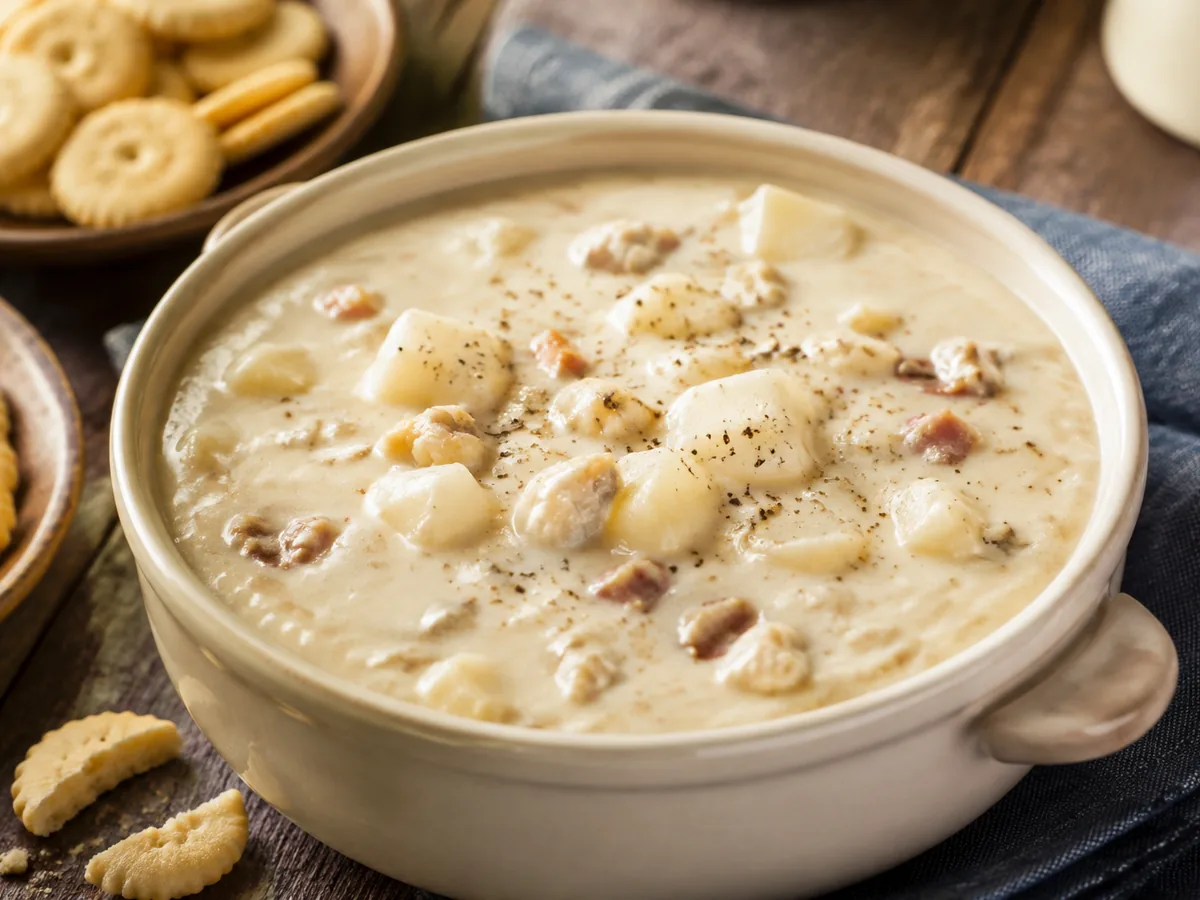
Along the foggy wharves of Boston, Cape Cod and coastal Maine, clam chowder has anchored maritime life since the eighteenth century. It descends from Breton fishermen who pooled salt pork, ship’s biscuit and shellfish into a communal cauldron, the faire chaudière that gave the dish its name.
Boston chowder rejects Manhattan’s tomato and Rhode Island’s clear broth for a velvety ivory cream. Hard-shell quahogs are steamed open in water to harvest their liquor. Salt pork is rendered in iron, sweet onion and celery sweat in the fat, and starchy russets simmer in the clam broth with a light roux before cream and the chopped clams go in and the pot never boils again.
- 1.8 kg4 lbLive hard-shell clams, quahogs, cherrystones or littlenecks, scrubbed
- 500 ml2.1 cupsCold water, for steaming the clams
- 150 g5 ozSalt pork belly, rind trimmed, in 5 mm lardonsor thick slab bacon
- 45 g3 TbspUnsalted butter
- 45 g⅓ cupPlain flour, for a blonde roux
- 2 large2 largeYellow onions, diced fine
- 2 stalks2 stalksCelery with leaves, minced fine
- 2 cloves2 clovesGarlic, minced to a paste
- 600 g3 mediumRusset potatoes, peeled and cut into 1 cm cubes
- 500 ml2.1 cupsReserved clam steaming broth, strained through cheesecloth
- 250 ml1 cupFish stock or light chicken stock
- 500 ml2.1 cupsHeavy cream, at room temperature
- 250 ml1 cupWhole milk
- 2 whole2 wholeBay leaves
- 4 sprigs4 sprigsFresh thyme, tied
- 6 g1 tspFine sea saltseason cautiously; the broth and pork are salty
- 3 g1 tspFreshly ground white pepper
- 30 g2 TbspChives, sliced fine, to garnish
- 1 bag1 bagOyster crackers
Open, not cooked
Quahogs are steamed only until their shells pop, around 75 °C. Any longer and the meat wrings itself into rubber. The liquor they release is the soup's backbone, strained through cheesecloth to drop the grit.
Potato does the thickening
Russets are high in amylose. Simmered in the clam broth, free starch sloughs off and thickens the liquid; the blonde roux is a light hand on top of that, never spackle.
Never boil the dairy
Cream and milk go in at the end and the pot stays around 82 °C. At 100 °C the casein micelles break and the chowder curdles, and the clams turn to rubber bands.
The five tastes on this plate
Salt is the clam brine, rendered salt pork and a little sea salt. Fat is pork fat, the butter roux and cream. Acid is mellow, with hot sauce or lemon at the table. Heat is white pepper, alliums, thyme and chives. Umami is clam nucleotides, pork fond and potato starch.
Equipment
- 8-quart enamelled cast-iron Dutch oven with lid
- Fine sieve and cheesecloth
- Tongs and a slotted spoon
- Whisk and wooden spoon
Enamelled cast iron keeps dairy from scorching along the floor. The historical pot was an iron cauldron on a ship's hearth.
Method
Steam the clams and harvest the broth15 min
Put the scrubbed clams and 500 ml water in the Dutch oven over high heat, cover tightly, and steam 6 to 8 minutes, shaking the pot once. As the clams open, lift them out to a tray; discard any that stay shut. Strain the liquid through cheesecloth and keep 500 ml. Shuck the meat, chop coarsely into 1 cm pieces, cover and chill.
Steam scrubbed clams with 500 ml water, tightly covered over high heat, 6–8 minutes; shake once. Remove as they open; discard unopened clams. Strain liquid through cheesecloth, reserving 500 ml. Shuck, chop meat into 1 cm pieces, cover and chill.
Render the pork and sweat the aromatics14 min
Wipe the pot dry. Cook the lardons over medium-low 8 minutes until golden and rendered. Lift out half to garnish. Add the butter, then the onion, celery and garlic, and sweat 6 minutes until soft with no colour.
Wipe the pot dry. Cook the lardons over medium-low 8 minutes until golden and rendered. Lift out half to garnish. Add the butter, then the onion, celery and garlic, and sweat 6 minutes until soft with no colour.
Cook a blonde roux3 min
Sprinkle the flour over the vegetables and stir constantly 2 to 3 minutes to cook out the raw taste while keeping it pale.
Sprinkle the flour over the vegetables and stir constantly 2 to 3 minutes to cook out the raw taste while keeping it pale.
Simmer the potatoes in the clam broth18 min
Stream in the warm clam broth and the fish stock, whisking to keep it smooth. Add the potatoes, bay, thyme and white pepper. Bring to a gentle boil, reduce to low, cover partially, and simmer 15 to 18 minutes until the potatoes are tender and the broth has thickened.
Whisk warm clam broth and fish stock into the roux. Add potatoes, bay, thyme and white pepper. Bring to a gentle boil; lower heat, partially cover and simmer 15–18 minutes until potatoes are tender and broth thickens.
Add the cream and fold in the clams7 min
Drop the heat to its lowest, about 82 °C. Stir in the cream and milk and simmer gently, uncovered, 5 minutes. Stir in the chopped clams and heat 2 minutes only, never boiling. Taste and season.
Drop the heat to its lowest, about 82 °C. Stir in the cream and milk and simmer gently, uncovered, 5 minutes. Stir in the chopped clams and heat 2 minutes only, never boiling. Taste and season.
Serve
Discard the bay and thyme. Ladle into wide bowls, top with the crisp lardons and chives, and pass the oyster crackers.
Discard the bay and thyme. Ladle into wide bowls, top with the crisp lardons and chives, and pass the oyster crackers.
Sensory cues of doneness
- Visual: a thick, velvety ivory chowder holding tender potato cubes, golden lardons and chopped clam, coating the ladle smoothly.
- Auditory: lazy sub-boil plops on low heat, and the crunch of oyster crackers.
- Olfactory: sweet clams, rendered salt pork, thyme, sweet onion and warm cream.
Check for velvety ivory chowder smoothly coating the ladle, with tender potatoes, golden pork and clams. Expect slow gentle bubbling and aromas of sweet clams, pork, thyme, onion and cream.
Storing it
Better the next day as the starch and cream settle. Refrigerate up to 3 days and reheat gently on low without boiling.
Troubleshooting
- A curdled, grainy chowder with rubbery clams.
It boiled after the cream and clams went in. Hold it at 82 °C on the lowest heat.
- Flat, tinny flavour.
Canned clams packed in water. Use live clams, or good whole baby clams packed in real clam juice.
- Thick paste rather than soup.
Too much roux. The body should come from the potatoes, with only a light roux.
Substitutions
One-to-one swaps, with the technique change each one needs.
Ingredient substitutions
| Ingredient | Replace with | Culinary impact and technique adjustment |
|---|---|---|
| Live quahogs | Two 8 oz jars of minced sea clams in clam juice | One-to-one. Add the juice with the potatoes and fold the meat in at the end |
| Salt pork | Unsmoked pancetta, or slab bacon blanched 2 minutes | One-to-one. Blanching strips the smoke that masks the clams |
| Heavy cream | Half-and-half plus 2 Tbsp melted butter | One-to-one. A slightly lighter body |
Scaling
Half, for 3
Halve everything in a 4-quart pot. Times are the same.
Double, for 12
Double in a 14 to 16-quart stockpot and stir the floor often.
What to serve it with
- Oyster crackers floated on the surface
- Warm sourdough with salted butter
- A Narragansett lager, or an unoaked Chablis
Questions
Boston versus Manhattan?
Boston is cream and milk with potatoes and salt pork. Manhattan is a clear tomato broth with peppers and carrots and no dairy at all.
Why salt pork and not bacon?
Salt pork is cured in salt alone, without smoke, so the clean sweetness of the clams comes through. Smoked bacon buries it.
Can I make it ahead?
Yes. It is better the next day. Reheat gently on low without boiling.