Southern Fried Chicken
Cast-iron skillet fried chicken on three pillars. A twelve-hour buttermilk brine with hot sauce and garlic, a flour dredge cut with cornflour and baking powder and flicked with brine to build shaggy crags, and a shallow fry in peanut oil held at 165 to 175 °C until the crust shatters and the dark meat reads 80 °C.
- Prep
- 30 min
- Cook
- 25 min
- Serves
- 4 to 6, from 8 pieces
- Difficulty
- Medium
Researched · Kitchen testing pending
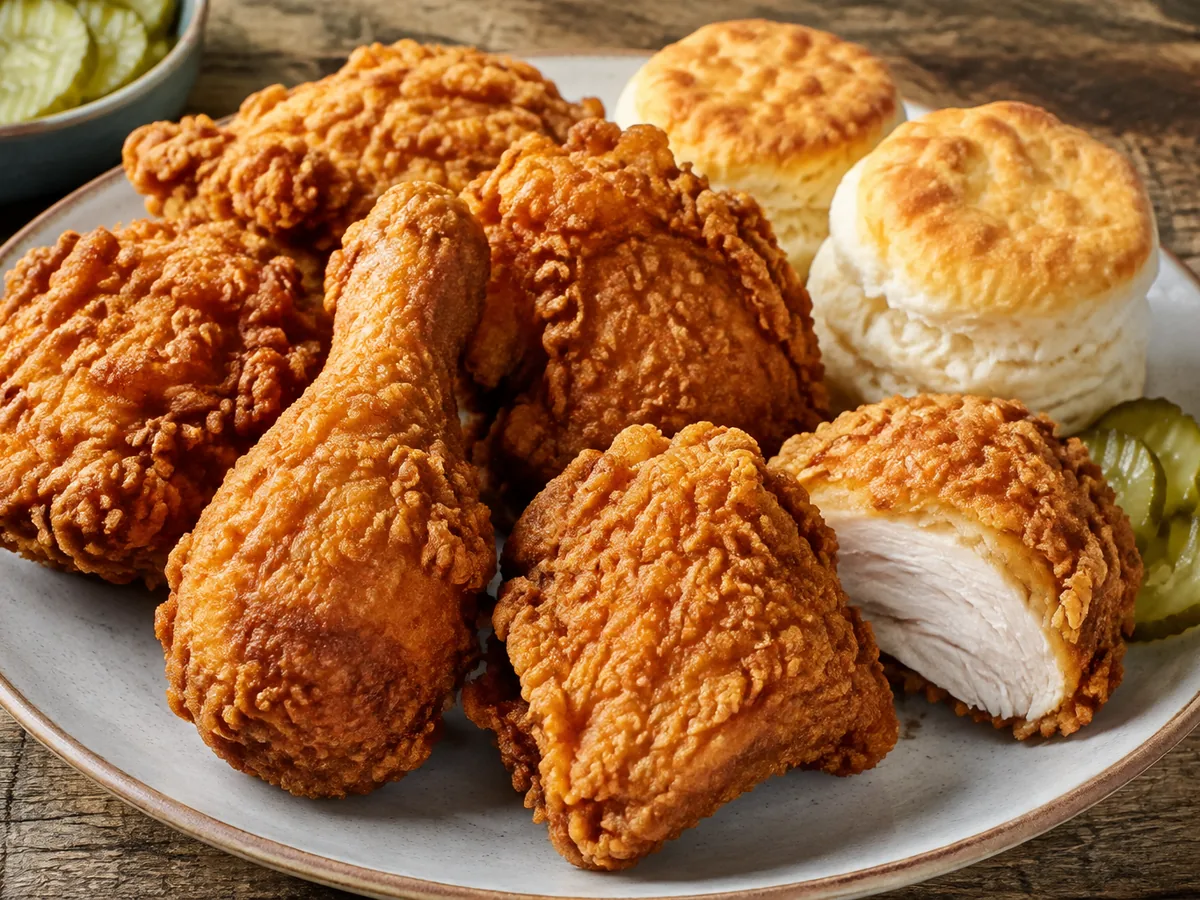
From Nashville boarding houses to Sunday suppers across the Deep South, skillet-fried chicken is the crown of Southern hospitality, and its mastery traces to enslaved West African cooks who brought deep-frying to the region’s kitchens. It stands on three pillars: an acid-salt buttermilk brine, a seasoned flour hydrated into craggy flakes, and a shallow fry in cast iron.
The brine’s lactic acid and enzymes tenderise the meat while salt travels into the fibres. Flour cut with cornflour and flicked with brine builds a crust of enormous surface area, and peanut oil at 165 to 175 °C sets it shatteringly crisp while the meat inside stays juicy.
Brine
- 1 whole, about 1.8 kg3½ to 4 lbChicken, cut into 8 pieces, breasts halved crosswise
- 1 L4.2 cupsCultured whole buttermilk
- 30 ml2 TbspLouisiana-style hot sauce
- 20 g1 Tbsp + 1 tspFine sea salt
- 10 g2 tspGarlic powder
- 10 g2 tspOnion powder
- 8 g2 tspSweet smoked paprika
- 4 g1½ tspCayenne pepperdivided, 1 tsp for the brine and ½ tsp for the flour
Dredge
- 400 g3¼ cupsPlain flour, sifted
- 60 g½ cupCornflour
- 10 g2 tspBaking powder
- 10 g2 tspCoarsely ground black pepper
- 8 g1½ tspFine sea salt
Frying
- 1 L4.2 cupsRefined peanut oil or lard
What the buttermilk does
At a pH around 4.5, the lactic acid and calcium in cultured buttermilk wake the meat's own calpain enzymes and loosen the actin-myosin bonds, while the salt travels in and raises the water the meat can hold. Twelve hours is the number.
The crags
Cornflour lowers the gluten. Baking powder releases carbon dioxide in the hot oil and puffs thousands of tiny bubbles through the crust. Flicking three tablespoons of brine into the dry flour makes pea-sized clumps that fry into brittle ridges.
Rack, never paper
Fried chicken on paper towels steams its own underside soft. An elevated wire rack keeps the whole crust crisp, and a 95 °C oven holds the first batch for half an hour.
The five tastes on this plate
Salt is the seasoned brine deep in the meat and the salted flour. Fat is crisp skin, peanut oil and lard. Acid is lactic buttermilk and fermented hot sauce. Heat is cayenne, black pepper, garlic and onion. Umami is fried skin, marrow and toasted flour.
Equipment
- 12-inch deep cast-iron skillet
- Oil thermometer
- Wide shallow dish, for the dredge
- Wire rack set in a rimmed baking sheet
- Tongs and an instant-read thermometer
The classic is a deep-walled 12-inch iron skillet. A 6-quart enamelled Dutch oven works too. Whichever, the oil is 2.5 cm deep and the chicken drains on a rack.
Method
Brine twelve hours12 to 24 hr
Whisk the buttermilk, hot sauce, salt, garlic powder, onion powder, paprika and 1 teaspoon cayenne. Submerge the chicken, turning to coat, cover, and refrigerate 12 to 24 hours.
Whisk the buttermilk, hot sauce, salt, garlic powder, onion powder, paprika and 1 teaspoon cayenne. Submerge the chicken, turning to coat, cover, and refrigerate 12 to 24 hours.
Make the shaggy dredge5 min
In a wide dish whisk the flour, cornflour, baking powder, black pepper, salt and the remaining half teaspoon cayenne. Drizzle in 3 tablespoons of brine from the chicken bowl and rub it through with your palms into small, shaggy clumps.
In a wide dish whisk the flour, cornflour, baking powder, black pepper, salt and the remaining half teaspoon cayenne. Drizzle in 3 tablespoons of brine from the chicken bowl and rub it through with your palms into small, shaggy clumps.
Dredge and rest20 min
One piece at a time, lift the chicken from the brine, let it drip 3 seconds, and press it firmly into the flour, packing it into every fold. Turn, pack again, and shake off the loose excess. Rest the pieces on the rack 15 minutes at room temperature so the starch hydrates and the crust stays put.
Lift each piece from brine; drip 3 seconds. Press flour firmly into every fold, turn and repeat, then shake off loose excess. Rest on a rack 15 minutes at room temperature to hydrate the coating.
Heat the oil8 min
Pour 2.5 cm of oil into the skillet and heat over medium-high to 175 °C.
Pour 2.5 cm of oil into the skillet and heat over medium-high to 175 °C.
Fry in two batches26 min
Lay the dark meat in skin side down without crowding. The oil will drop to about 160 °C; adjust to hold 165. Fry 12 to 14 minutes, turning once at 7, until deep golden-mahogany and 79 to 82 °C at the bone. Move to the rack.
Bring the oil back to 175 °C and fry the breasts and wings 10 to 12 minutes to 74 °C.
Fry dark meat skin-down without crowding; oil drops to about 160 °C, then maintain 165 °C. Cook 12–14 minutes, turning at 7, until mahogany and 79–82 °C near bone. Rack, never paper; optionally hold at 95 °C up to 30 minutes. Return oil to 175 °C; fry breasts and wings 10–12 minutes to 74 °C.
Rest and serve8 min
Hit the hot chicken with a pinch of flaky salt and rest it on the rack 5 to 8 minutes so the steam settles and the crust sets to full crunch.
Hit the hot chicken with a pinch of flaky salt and rest it on the rack 5 to 8 minutes so the steam settles and the crust sets to full crunch.
Sensory cues of doneness
- Visual: a deep golden-mahogany crust covered in jagged flakes, juices running clear with no pink at the bone.
- Auditory: vigorous bubbling as the cold chicken goes in, and a loud shatter when teeth break the skin.
- Olfactory: toasted flour, sizzling chicken fat, cayenne, garlic and hot peanut oil.
Look for jagged golden-mahogany crust, clear juices and no pink by the bone. Expect vigorous frying bubbles and a crisp crust, with toasted flour, chicken fat, cayenne, garlic and peanut-oil aromas.
Troubleshooting
- A soggy underside.
Drained on paper towels, which trapped steam. Always drain on an elevated rack.
- Greasy crust.
Ice-cold chicken dropped the oil 30 degrees. Rest the dredged pieces 15 minutes at room temperature first.
- Pale chicken boiling in its own juice.
Eight pieces in one pan. Fry in two batches.
Substitutions
One-to-one swaps, with the technique change each one needs.
Ingredient substitutions
| Ingredient | Replace with | Culinary impact and technique adjustment |
|---|---|---|
| Cultured buttermilk | Whole milk plus 2 Tbsp lemon juice or vinegar, curdled 10 minutes | One-to-one. Supplies the lactic acid |
| Peanut oil | Lard, tallow or high-oleic canola | One-to-one. Peanut oil is clean with a high smoke point |
| A whole cut-up chicken | Bone-in, skin-on thighs only | Thighs stay juicy and forgive a minute either way |
Scaling
Half
Four pieces in a 10-inch skillet, oil 2.5 cm deep. Times are the same.
Double
Sixteen pieces across two 12-inch skillets on two burners.
What to serve it with
- Flaky buttermilk biscuits with salted butter and honey
- Creamy coleslaw with cider vinegar mayonnaise
- Sweet iced tea with lemon, or a bourbon and ginger ale highball
Questions
Why cornflour and baking powder in the flour?
Cornflour lowers the protein so the crust stays crisp rather than tough, and baking powder puffs the coating light and airy in the oil.
Can I air-fry it?
Hot air cooks the chicken, but it cannot make the deep, larded Maillard crust of a cast-iron shallow fry.
How do I keep the first batch hot?
On its rack in a 95 °C oven. It stays crunchy for up to 30 minutes.