Nasi Goreng
The Javanese-Surinamese fried rice, darker and richer than the Chinese kind. Day-old chilled rice broken apart by hand and tossed on maximum heat into a bumbu of shallot, garlic, minced lemongrass, grated galangal and toasted trassi with foaming ketjap and dark soy, until every grain is mahogany, served with glazed roast chicken, a lacy fried egg, kroepoek and pickled cucumber.
- Prep
- 25 min
- Cook
- 30 min
- Serves
- 6
- Difficulty
- Medium
Researched · Kitchen testing pending
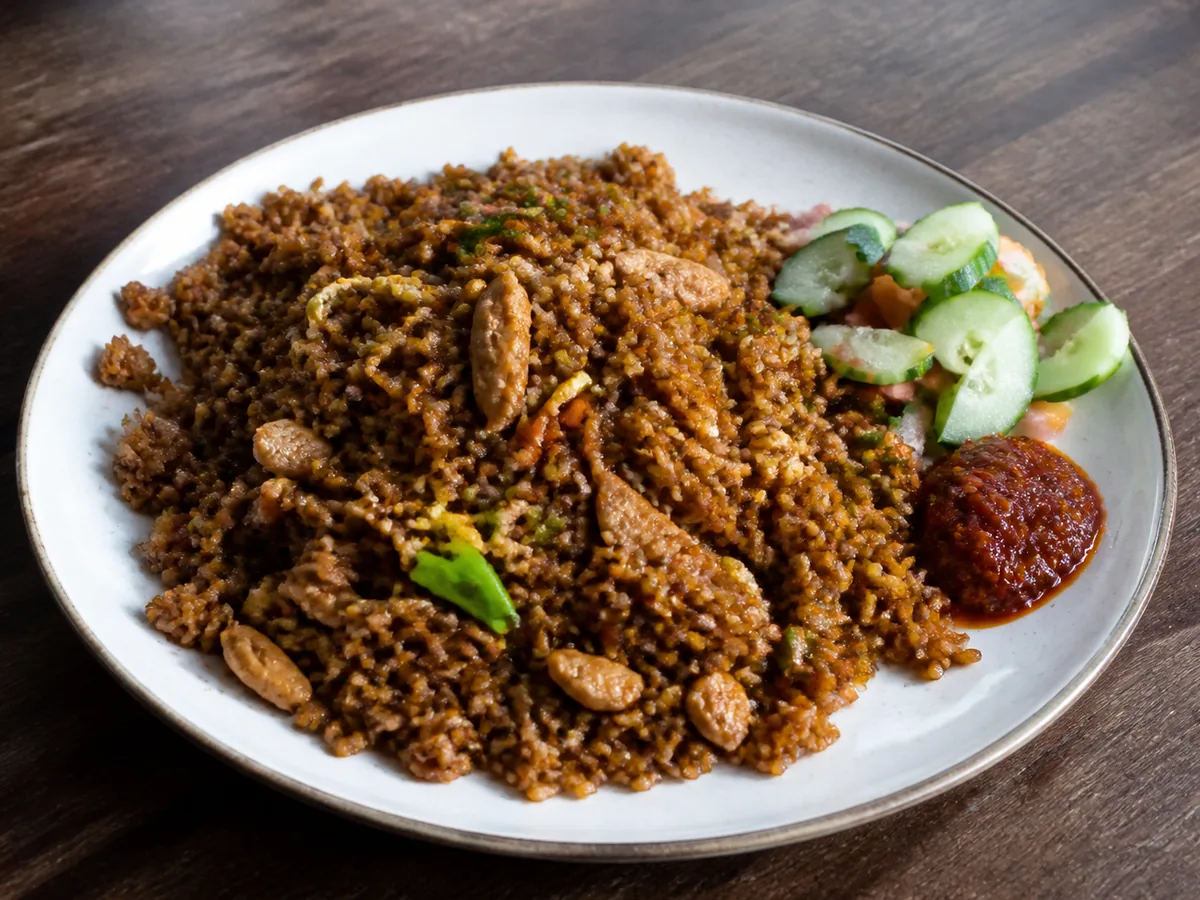
Nasi goreng is the rice half of the Javanese-Surinamese pair with bami. Adapted from Indonesia, the Surinamese version took on fresh galangal, bruised lemongrass, toasted trassi and a heavy hand with ketjap manis, and it comes out deep golden-brown rather than pale.
The texture depends on day-old rice, chilled until its moisture has gone, so the grains fry cleanly in the aromatic oil instead of steaming. It is served with spiced roast chicken, a fried egg, sweet-sour pickled cucumber and crunchy kroepoek, at weekend family tables and late-night warungs alike.
Rice and bumbu
- 900 g6 cups cookedCooked long-grain white rice, chilled overnight, clumps broken apart with oiled fingers
- 90 ml6 TbspKetjap manisdivided
- 30 ml2 TbspDark soy sauce
- 6 g1 tspTrassi, toasted dry until fragrant
- 2 stalks2 stalksLemongrass, white bulb only, finely minced
- 25 g1-inch knobFresh galangal, peeled and finely grated
- 44Shallots, finely minced
- 8 cloves8 clovesGarlic, minced to a pastedivided
- 25 g½ cupSurinamese celery leaves, finely chopped
- 3 g½ tspGround allspice
- 60 ml4 TbspNeutral oil
- 10 g1½ tspFine sea salt
- 3 g1 tspFreshly ground black pepper
Chicken and garnish
- 900 g2 lbBone-in skinless chicken thighs, trimmed
- 2 g½ tspFive-spice, fennel-free and anise-free
- 44Eggs, fried sunny-side up with crisp lacy edges
- 1212Kroepoek, fried shrimp or cassava crackers
- 150 g1 cupZuurgoed, pickled cucumber ribbons, chilled
Day-old rice
Twelve to twenty-four hours in the fridge lets the cooked starch retrograde: it recrystallises, pushes out free water and firms the grain walls. Those hard grains fry clean in the wok; fresh rice steams and breaks.
Bloom the sauce first
Ketjap and soy go into the hot wok and foam before the rice, so every grain lands in bubbling sauce and colours evenly. Sauce poured over cold rice leaves white grains.
Only the pale part of the lemongrass
The lower three inches, minced as fine as garlic. The green upper leaves are fibrous and woody.
The five tastes on this plate
Salt is sea salt and dark soy on the rice. Fat is the wok oil and chicken fat on each grain. Acid is the pickled cucumber. Heat is lemongrass, galangal, garlic and black pepper. Umami is toasted trassi, ketjap and roasting juices.
Equipment
- 14-inch carbon-steel wok, or a wide 12-inch heavy skillet
- Wok spatula
- Roasting pan
- Small skillet, for the eggs
The warung wok sits over a high-output burner. At home, use the largest flame on full and do not crowd the pan.
Method
Roast the chicken30 min
Heat the oven to 200 °C. Season the thighs with 30 ml ketjap manis, a tablespoon of oil, two minced garlic cloves, the five-spice, salt and pepper. Roast 30 minutes to 74 °C. Slice into strips and keep the drippings.
Heat the oven to 200 °C. Season the thighs with 30 ml ketjap manis, a tablespoon of oil, two minced garlic cloves, the five-spice, salt and pepper. Roast 30 minutes to 74 °C. Slice into strips and keep the drippings.
Prepare the cold rice5 min
Take the chilled rice from the fridge and break every clump apart with lightly oiled fingers into single grains. Set it by the wok.
Use cooked rice refrigerated 12–24 hours. Break all clumps into separate grains with lightly oiled fingers; set the cold rice beside the wok.
Toast the trassi2 min
Toast the trassi in the dry wok over medium-low 1 to 2 minutes until fragrant and powdery. Set aside.
Toast the trassi in the dry wok over medium-low 1 to 2 minutes until fragrant and powdery. Set aside.
Fry the bumbu3 min
Heat 45 ml oil over medium-high. Add the shallots, remaining garlic, minced lemongrass, grated galangal and toasted trassi and stir-fry 2 to 3 minutes until aromatic and the shallots are golden.
Heat 45 ml oil over medium-high. Stir-fry shallots, remaining garlic, finely minced pale lemongrass bulb, grated galangal and toasted trassi 2–3 minutes until aromatic and the shallots are golden.
Foam the sauces1 min
Pour in 60 ml ketjap manis, the dark soy, allspice, a teaspoon of salt, black pepper and two tablespoons of the chicken drippings. Stir rapidly as it bubbles and foams, about 20 seconds.
Pour in 60 ml ketjap manis, the dark soy, allspice, a teaspoon of salt, black pepper and two tablespoons of the chicken drippings. Stir rapidly as it bubbles and foams, about 20 seconds.
Wok-fry the rice6 min
Tip all the cold rice into the bubbling sauce and turn the heat to maximum. Scoop and press with the spatula continuously 5 to 6 minutes, breaking any clumps, until every grain is evenly mahogany and piping hot.
Tip all the cold rice into the bubbling sauce and turn the heat to maximum. Scoop and press with the spatula continuously 5 to 6 minutes, breaking any clumps, until every grain is evenly mahogany and piping hot.
Finish with celery leaves1 min
Scatter the celery leaves over and toss hard 45 seconds.
Scatter the celery leaves over and toss hard 45 seconds.
Fry the eggs and serve4 min
In the small skillet with hot oil, fry the eggs sunny-side up until the edges are crisp and lacy and the yolks still liquid. Mound the rice on plates and top each with an egg, sliced chicken, kroepoek and pickled cucumber.
In the small skillet with hot oil, fry the eggs sunny-side up until the edges are crisp and lacy and the yolks still liquid. Mound the rice on plates and top each with an egg, sliced chicken, kroepoek and pickled cucumber.
Sensory cues of doneness
- Visual: uniform deep golden-brown glistening grains flecked with green celery and shallot, with bronze chicken, white kroepoek and a sunny egg.
- Auditory: a loud, dry crackle and pop as the grains bounce on the scorching wok.
- Olfactory: sweet toasted palm sugar, lemony sereh, piney galangal, pungent trassi and sizzling garlic.
Look for evenly golden-brown, glossy grains with celery and shallots, bronze chicken, kroepoek and a fried egg. Expect a dry crackle in the wok and aromas of toasted palm sugar, lemongrass, galangal, trassi and garlic.
Troubleshooting
- Mushy, clumpy rice.
Fresh, warm rice with too much surface water. Cook it the day before and chill it thoroughly.
- Patchy colour and white grains.
Sauce poured over cold rice. Foam the ketjap and soy in the hot wok first, then add the rice.
- Woody bits.
The green upper lemongrass leaves went in. Use only the tender pale lower stalk, minced fine.
Substitutions
One-to-one swaps, with the technique change each one needs.
Ingredient substitutions
| Ingredient | Replace with | Culinary impact and technique adjustment |
|---|---|---|
| Lemongrass | 1 tsp dried sereh powder, or 1 tsp grated lemon zest | A fallback; fresh is better |
| Galangal | Fresh ginger with a pinch of black pepper | One-to-one |
| Kroepoek | Emping cassava crackers, or potato chips | One-to-one |
Scaling
Half
Halve everything; it is fast in an 11-inch skillet.
Double
Never 1.8 kg of rice in one home wok. Two batches, so the pan stays hot and the grains toast.
What to serve it with
- Kroepoek, to scoop the rice
- Zuurgoed of cucumber and red onion
- Bakabana, crisp fried sweet plantain
Questions
How is it different from Indonesian nasi goreng?
More ketjap manis for a darker, sweeter glaze, five-spice roast chicken alongside, allspice in the pan, and Dutch-Creole pickled cucumber.
Best rice?
Surinamese long-grain or any long-grain white rice. Jasmine works if chilled overnight. Not short-grain or basmati.
Vegetables in the rice?
Traditionally the rice stays clean, seasoned with aromatics and celery leaf, and the vegetables come alongside as kouseband and pickles.