Bami
The Javanese-Surinamese noodle plate. Spaghetti or thick egg noodles boiled al dente and rinsed cold, then wok-tossed in a bumbu of shallot, garlic, ginger and toasted trassi with ketjap manis and dark soy until every strand is glossy mahogany, finished with celery leaf and served under sliced five-spice roasted chicken, omelette ribbons and pickled cucumber.
- Prep
- 30 min
- Cook
- 35 min
- Serves
- 6
- Difficulty
- Medium
Researched · Kitchen testing pending
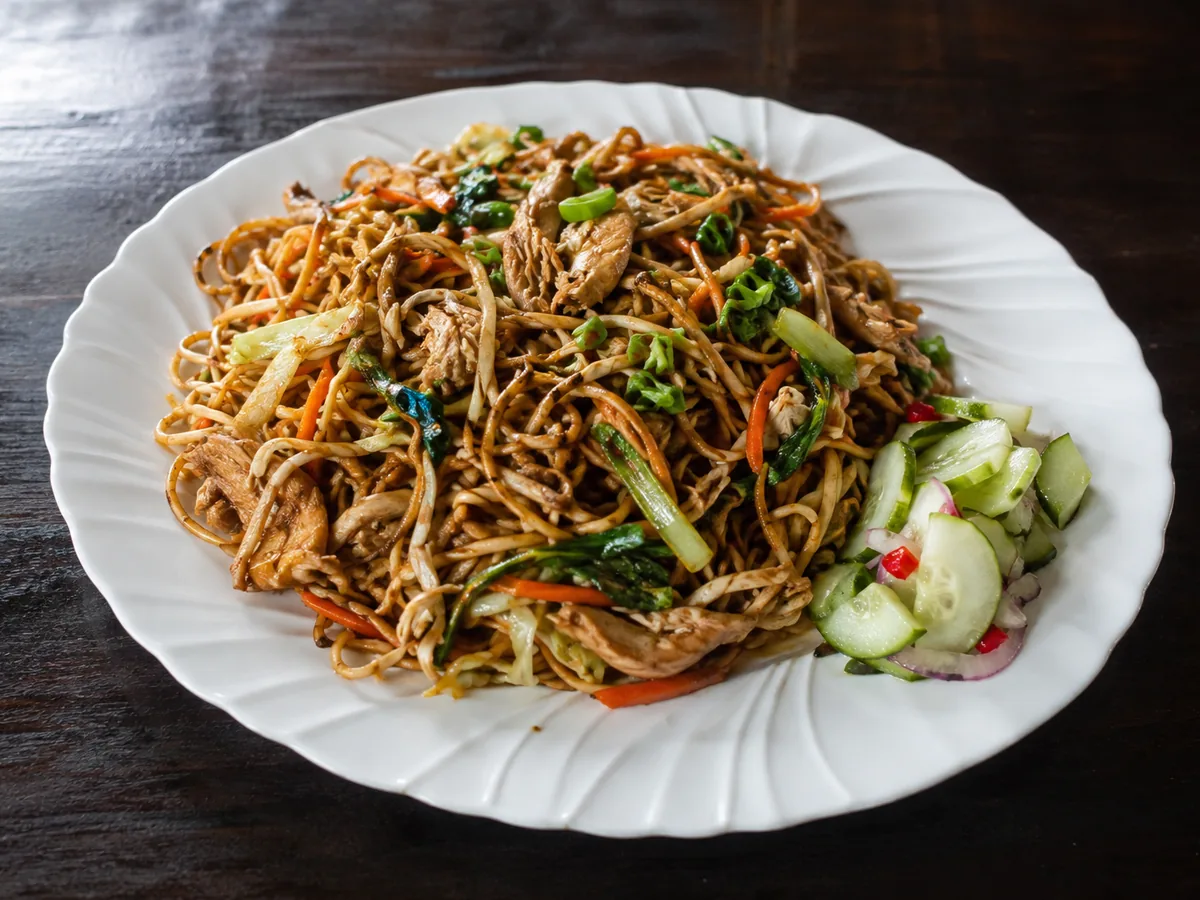
Bami is the noodle counterpart to nasi goreng, brought by Javanese immigrants who adapted the Chinese-Indonesian bakmi to the Guianas. Over a century it developed a signature dark gloss and savoury-sweet depth that sets it apart from any Asian stir-fry.
Thick noodles or spaghetti, boiled al dente and rinsed cold, are wok-fried in a bumbu of garlic, ginger, shallot and toasted trassi, bathed in ketjap manis and seasoned with celery leaves. It is never served plain: it comes crowned with sliced five-spice roast chicken, fried egg ribbons and crisp sweet-sour pickled cucumber.
Noodles and sauce
- 500 g1.1 lbSpaghetti or thick Chinese egg noodles, boiled firm al dente, rinsed cold, tossed with 1 Tbsp oil
- 120 ml½ cupKetjap manisdivided
- 30 ml2 TbspDark mushroom soy sauce
- 6 g1 tspTrassi, fermented shrimp paste, toasted dry until crumbly
- 44Shallots, finely minced
- 8 cloves8 clovesGarlic, minced to a pastedivided
- 20 g1½-inch pieceFresh ginger, finely grated
- 30 g½ cup packedSurinamese celery leaves, finely chopped
- 3 g½ tspGround allspice
- 60 ml4 TbspNeutral oildivided
- 12 g2 tspFine sea saltdivided
- 3 g1 tspFreshly ground black pepper
Chicken and garnish
- 900 g2 lbBone-in skinless chicken thighs, trimmed
- 4 g1 tspFive-spice, fennel-free and anise-free, of cinnamon, clove, ginger, black pepper and coriander
- 22Eggs, beaten, fried into a thin omelette, rolled and sliced into ribbons
- 1 medium1 mediumCucumber, thinly sliced and pickled in cane vinegar, water and sugar
Cold, oiled noodles
Rinsing boiled noodles under cold water strips the loose surface starch that would glue them into a clod. A tablespoon of oil then coats each strand so it fries alone in the wok.
Ketjap caramelises
Ketjap manis is up to half palm sugar. Over 180 °C in the wok those sugars caramelise and react with the soy and trassi proteins into the deep mahogany colour and smoky depth. Left unmoved it burns; toss the noodles the moment it bubbles.
Why spaghetti
Twentieth-century Suriname adopted Italian spaghetti because it survives a long toss in heavy sweet soy better than fragile egg noodles.
The five tastes on this plate
Salt is sea salt and dark soy on noodles and chicken. Fat is the oil on the noodles and rendered thigh fat. Acid is the pickled cucumber. Heat is garlic paste, ginger, black pepper and allspice. Umami is toasted trassi, ketjap and roasting juices.
Equipment
- 14-inch carbon-steel wok or a 12-inch sauté pan with high sides
- Roasting pan
- Two wooden spatulas
- Large pot and colander
A round-bottomed wok over a big flame is the warung tool. A flat-bottomed carbon-steel wok on the largest burner comes close; toss with two spatulas.
Method
Roast the chicken35 min
Heat the oven to 200 °C. Toss the thighs with 30 ml ketjap manis, a tablespoon of oil, two minced garlic cloves, the five-spice, half a teaspoon of salt and black pepper. Roast 30 to 35 minutes until browned and caramelised, 74 °C inside. Slice into strips and keep the pan juices.
Heat oven to 200 °C. Coat thighs with 30 ml ketjap, 1 tablespoon oil, 2 minced garlic cloves, five-spice, ½ teaspoon salt and black pepper. Roast 30–35 minutes until caramelised and 74 °C inside. Slice into strips; reserve juices.
Parboil the noodles10 min
Cook the noodles in boiling salted water one minute short of the packet time. Drain and rinse under cold running water until fully chilled. Toss with a tablespoon of oil.
Cook the noodles in boiling salted water one minute short of the packet time. Drain and rinse under cold running water until fully chilled. Toss with a tablespoon of oil.
Toast the trassi2 min
In the dry wok over medium-low, toast the trassi 1 to 2 minutes until dry, crumbly and aromatic. Remove and crush.
In the dry wok over medium-low, toast the trassi 1 to 2 minutes until dry, crumbly and aromatic. Remove and crush.
Fry the omelette3 min
Heat a teaspoon of oil in the wok, pour in the beaten eggs to a thin sheet, cook a minute a side, roll and slice into ribbons.
Heat a teaspoon of oil in the wok, pour in the beaten eggs to a thin sheet, cook a minute a side, roll and slice into ribbons.
Stir-fry the bumbu2 min
Heat 30 ml oil over medium-high. Add the shallots, the remaining garlic, the ginger and the toasted trassi and sauté hard 2 minutes until fragrant.
Heat 30 ml oil over medium-high. Add the shallots, the remaining garlic, the ginger and the toasted trassi and sauté hard 2 minutes until fragrant.
Bubble the sauce1 min
Stir in 90 ml ketjap manis, the dark soy, allspice, a teaspoon of salt, black pepper and three tablespoons of the roasting juices. Bring to a rapid, glossy boil for 30 seconds.
Stir in 90 ml ketjap manis, the dark soy, allspice, a teaspoon of salt, black pepper and three tablespoons of the roasting juices. Bring to a rapid, glossy boil for 30 seconds.
Toss the noodles5 min
Add the cold noodles, turn the heat to high, and toss continuously with two spatulas 4 to 5 minutes, lifting and turning, until every strand is coated dark and heated through.
Add the cold noodles, turn the heat to high, and toss continuously with two spatulas 4 to 5 minutes, lifting and turning, until every strand is coated dark and heated through.
Finish and serve
Scatter the celery leaves over and toss 30 seconds until they wilt. Pile onto platters, top with the sliced chicken and egg ribbons, and serve with the pickled cucumber and sambal.
Scatter the celery leaves over and toss 30 seconds until they wilt. Pile onto platters, top with the sliced chicken and egg ribbons, and serve with the pickled cucumber and sambal.
Sensory cues of doneness
- Visual: glossy, uniformly dark mahogany noodles flecked with green celery leaf, beside golden roast chicken with charred edges and crisp egg ribbons.
- Auditory: a violent, rhythmic sizzle and pop as the noodles hit the wok walls.
- Olfactory: caramelised palm sugar, pungent toasted trassi, ginger, garlic and roasting spice.
Look for uniformly glossy mahogany noodles with green celery leaves, caramelised roast chicken and egg ribbons. Expect rhythmic sizzling as noodles hit the wok, with palm-sugar, toasted trassi, ginger, garlic and roast-spice aromas.
Troubleshooting
- Sticky, clumped noodles.
Overcooked, or not rinsed cold at once. Boil al dente, rinse until cold to the touch, and oil before the wok.
- Pale, watery bami.
Light soy stood in for ketjap manis and dark soy. Only real ketjap has the viscosity and palm sugar.
- Burnt, bitter sugar.
The ketjap sat in the hot wok unattended. Add the noodles the moment it bubbles and keep tossing.
Substitutions
One-to-one swaps, with the technique change each one needs.
Ingredient substitutions
| Ingredient | Replace with | Culinary impact and technique adjustment |
|---|---|---|
| Ketjap manis | Kecap Manis Bango, or dark soy simmered with brown palm sugar | One-to-one |
| Surinamese celery leaves | Tender inner celery leaves or flat-leaf parsley | One-to-one |
| Trassi | Thai shrimp paste, or 1 Tbsp fish sauce; 1 Tbsp red miso for a shellfish allergy | One-to-one |
Scaling
Half
Halve everything; it tosses easily in a 12-inch skillet.
Double
Never a kilo of noodles in one home wok. Stir-fry in two sequential batches.
What to serve it with
- Zuurgoed of cucumber and red onion in spiced cane vinegar
- The sliced five-spice roast chicken on top
- Kroepoek, cassava or shrimp crackers
Questions
Why spaghetti?
It holds up to a long toss in heavy sweet soy; delicate Asian egg noodles break.
Can I leave out the trassi?
It is the foundational umami of Javanese-Surinamese cooking. For a shellfish allergy, use a tablespoon of red miso or mushroom soy.
How do I make the pickled cucumber?
Slice a cucumber thin. Dissolve 2 Tbsp sugar and 1 tsp salt in ½ cup white vinegar and ¼ cup water with four allspice berries and submerge the slices at least 30 minutes.