Pollo a la Brasa
Peru's rotisserie chicken, done in a home oven — a soy, garlic, cumin and ají panca marinade worked under the skin, hours in the fridge, then a hot start and a steady roast until the skin lacquers and crackles. Fries, salad and ají mayo alongside.
- Prep
- 30 min
- Cook
- 1 hr 5 min
- Serves
- 4 servings
- Difficulty
- Medium
Researched · Kitchen testing pending
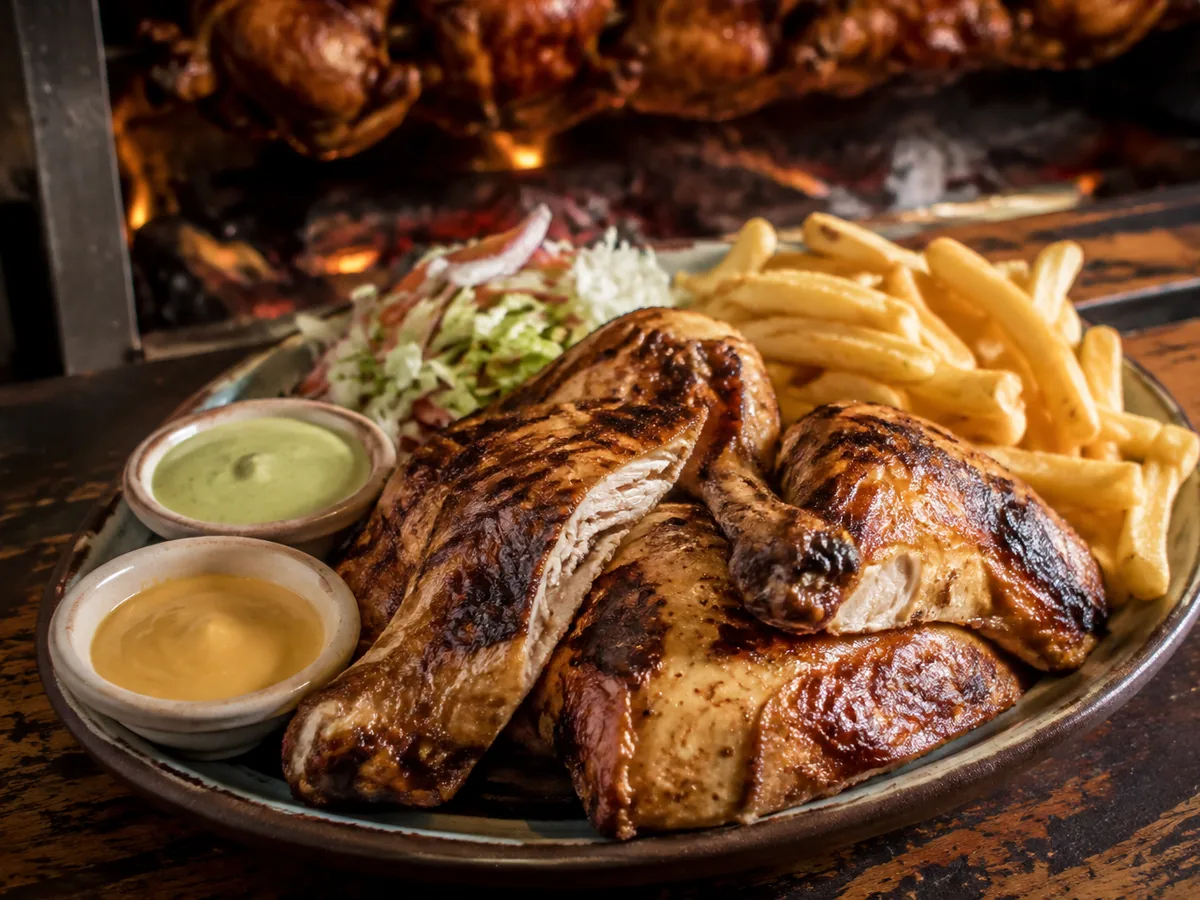
Soy sauce, garlic, cumin and ají do the heavy lifting long before the oven does. The dark marinade goes under and over the skin, and then the bird gets hours in the fridge so salt and spice reach the meat, not just the surface.
Pollo a la brasa is Peru’s rotisserie chicken: lacquered, cumin-forward, a little sweet-salty from soy, with skin that crackles when you carve. What follows is a home-oven method rather than a street-cart rotisserie, aiming for the same flavours — high heat to start, then steady roasting, with a final blast if the skin needs more snap.
Chicken
- 1.6–1.8 kg3½–4 lbWhole chicken, giblets removed and patted very dry
- 6–9 g1–1½ tspKosher saltfor the cavity and any under-seasoned spots after marinating
- 5 ml1 tspNeutral oil, or oil spray, for the pan rackonly if needed
Marinade (soy, garlic, cumin, ají)
- 60 ml¼ cupSoy sauceregular, not sweet soy
- 45 ml3 TbspRed wine vinegar or white vinegar
- 30 ml2 TbspVegetable oil
- 12 g1½ TbspGround cuminyes, that much — brasa should smell of cumin when it hits the table
- 15 ml1 TbspAjí panca pastedeep, fruity, mild heat — preferred
- 5–10 ml1–2 tspAjí amarillo pasteoptional but welcome, for brightness and extra heat
- 25–30 g6–8 clovesGarlic, minced or mashed to a paste
- 15 ml1 TbspAjí amarillo-style hot sauce, or a pinch of dried oreganoif your pastes are mild
- 4 g1 tspFreshly ground black pepper
- 4 g1 tspPaprika, sweet or lightly smokedsmoked is a home departure
- 15 ml1 TbspLime juice, from ½ lime
- 4 g1 tspSugar or honeyoptional; helps browning
- 15 ml1 TbspPisco, or a splash of dark beer in place of part of the vinegaroptional classic note
For roasting
- 1 small1 smallOnion, quartered, for the cavityoptional
- ½½Lemon or lime, for the cavityoptional
- 120 ml½ cupWater or beer, for the bottom of the pankeeps the drippings from burning
To serve (classic accompaniments)
- Mayonnaise-ají sauce, or a creamy salsa golf-style dip — mayo plus ají amarillo
- Thick-cut fries, or roasted potato wedges
- A simple salad of lettuce, tomato and cucumber, lightly salted
- Huancaína on the side, for a full Peruvian chicken-house spread
The marinade is assertive on purpose
It should look dark brown-red and smell strongly of garlic and cumin. If it smells only of soy, add another teaspoon of cumin and more garlic. This is not a light herb rub — roasting mutes it, so it starts loud.
Why soy sauce in a Peruvian dish
Twentieth-century Peruvian cooking absorbed Chinese-Peruvian chifa influences. Soy in a brasa marinade is standard in countless home and commercial recipes, not a fusion gimmick.
Passive time, counted separately
The bird needs at least 4 hours in the fridge and ideally overnight, 8–12 hours, then 20–30 minutes out of the fridge before roasting and 10–15 minutes resting after. All of that is hands-off and sits outside the times quoted above. Cold time is not optional theatre: soy and salt need hours to season past the surface, and garlic and cumin need time to stop tasting raw.
The marinade is not a table sauce
Anything that touched the raw chicken gets discarded. Make fresh ají mayo for dipping.
Equipment
- Roasting pan with a rack, or a sheet pan with a wire rack
- Mixing bowl
- Instant-read thermometer
- Kitchen twine, for loose trussing
- Foil, for tenting if the skin browns too fast
- Rimmed board for carving
Method
Make the marinade5 min
Whisk the soy sauce, vinegar, oil, cumin, ají panca, optional ají amarillo, garlic, pepper, paprika, lime, and the optional sugar or pisco until combined.
Taste a drop: salty, tangy, warm chile, heavy spice.
Whisk soy, vinegar, oil, cumin, panca, garlic, pepper, paprika and lime with optional amarillo, sugar or pisco. Taste before adding chicken: salty, tangy and strongly spiced. If soy dominates the aroma, add another teaspoon of cumin and more garlic.
Prep the chicken and get marinade under the skin10 min
Remove the giblets. Pat the chicken dry inside and out with paper towels — wet skin never crisps.
On a board, gently loosen the skin over the breasts and thighs with your fingers, working carefully so you do not tear it open. Spoon and smear roughly one-third of the marinade directly onto the meat under the skin.
Rub the remaining marinade all over the outside, into the cavity, and around the legs and wings. Sprinkle a little kosher salt into the cavity if the marinade did not reach well.
Set the chicken in a bowl or zip bag, pour any leftover marinade over it, and seal or cover. Refrigerate at least 4 hours, preferably overnight, flipping once halfway if you remember.
Remove giblets and dry chicken inside and out. Loosen breast and thigh skin without tearing; spread one-third of marinade underneath. Rub the remainder outside and into the cavity, adding cavity salt if needed. Cover and refrigerate at least 4 hours, ideally 8–12, turning halfway.
Bring toward room temperature and set the oven20–30 min
Pull the chicken from the fridge 20–30 minutes before it goes in. Wipe off thick clumps of marinade that would burn, leaving a thin coat. Tuck the wing tips under and tie the legs loosely if they splay. Onion and lemon in the cavity are optional.
Preheat the oven to 220 °C / 425 °F with a rack in the lower-middle position. Set a rack in the roasting pan, and pour the water or beer into the pan below it so the drippings do not scorch.
Why a rack: air under the bird dries the skin. A bird sitting in its juices steams the underside and gives you soggy back skin.
Remove chicken 20–30 minutes before roasting. Wipe off thick marinade clumps; tuck wings and loosely tie legs. Add optional cavity onion and citrus. Preheat to 220 °C / 425 °F, lower-middle shelf. Place a rack in the roasting pan with 120 ml (½ cup) water or beer underneath. Discard raw-contact marinade.
High-heat start, then steady roast60–75 min
Place the chicken breast-side up on the rack. Roast at 220 °C / 425 °F for 20 minutes to jump-start the browning and render fat under the skin.
Reduce the heat to 190 °C / 375 °F and continue until an instant-read thermometer in the thickest part of the thigh, not touching bone, reads 74 °C / 165 °F — often 40–55 minutes more for a 1.6–1.8 kg bird. Total time commonly lands around 65–75 minutes.
If the breast skin darkens too fast, tent loosely with foil for the middle stretch, then remove it for the last 10–15 minutes.
Optional crisp finish: for the last 5–8 minutes, raise the heat again to 220 °C / 425 °F, or switch to the broiler. Stay at the oven — sugar and soy go from lacquered to bitter in under a minute.
Roast breast-up at 220 °C / 425 °F for 20 minutes, then 190 °C / 375 °F for 40–55 minutes until thickest thigh reaches 74 °C / 165 °F without touching bone. Tent darkening breast loosely; uncover the last 10–15 minutes. Optionally finish 5–8 minutes at 220 °C / 425 °F or under the broiler, watching constantly for burning.
Rest and carve10–15 min
Transfer the chicken to a board and rest it uncovered, or lightly tented, for 10–15 minutes. Resting lets the juices settle so the breast meat stays moist when you cut.
Carve into quarters, or traditional brasa pieces: legs, thighs, wings, breast halves. Spoon a little pan juice over the meat if it tastes dry — but do not drown the crisp skin.
Serve immediately with fries, salad and ají mayo. The first smell when you cut should be cumin and roasted garlic, then soy-savoury skin.
Rest on a board uncovered or loosely tented 10–15 minutes. Carve into quarters or separate legs, thighs, wings and breast halves. Add a little pan juice to dry meat without soaking the skin; serve immediately with fries, salad and fresh ají mayonnaise.
On the plate
Think chicken-house tray, not a fine-dining breast fan. Pile the pieces over or beside the fries. Put the creamy ají sauce in a ramekin for dipping — people will dunk skin and potato alike. The salad cuts the richness.
The skin should look mahogany, not pale blond and not charcoal. Meat near the bone stays juicy. If only the breast is done and the thighs lag, your oven has hot spots — rotate the pan next time, and always trust the thigh temperature.
Pile chicken pieces beside or over fries, with creamy ají sauce in a dipping bowl and salad alongside. Look for mahogany skin and juicy meat near the bone; verify thigh doneness rather than judging by the breast alone.
Sensory checkpoints and why they matter
- Marinade before it hits the bird: cumin and garlic jump out, soy underneath. If it smells only salty, boost the cumin and ají.
- Skin before roasting: tacky with a thin marinade film, not dripping wet. Excess liquid steams.
- Sound in the oven after 20 minutes: a soft sizzle. Silence means too cool; smoke-alarm drama means too much sugar or marinade pooled in the pan.
- Colour at mid-roast: deep golden going toward lacquered brown. Patchy white skin means the oven was too cool, or the bird too wet at the start.
- Thermometer: 74 °C / 165 °F in the thigh. Guesses carve into dry or unsafe meat.
- Skin when tapped after resting: a thin crackle, not rubber. Rubber means under-rendered fat or steaming.
- Taste: salt-savoury soy, warm cumin, garlic, mild chile fruit from ají panca — not barbecue sweet, and not plain roast chicken with lemon.
Check a thin, tacky marinade coating before roasting and a soft sizzle after 20 minutes. Skin should turn deep golden, then lacquered brown. Confirm 74 °C / 165 °F in the thigh; rested skin should crackle, with cumin and roasted garlic aromas.
Why the method is ordered this way
The marinade comes first so the clock can start on fridge time, the longest step. Under-skin application happens before the outside rub, so you do not wash away the exterior coat while fishing under the breast. The cold rest seasons deeply, and wiping thick clumps prevents bitter black spots without removing flavour.
The hot start renders and colours; the lower finish cooks through without incinerating garlic-soy sugars. A thermometer beats time charts because bird size and fridge temperature vary. Resting before carving keeps the board from filling with lost juice. Sauce and fries are last-minute so the potato stays crisp against the chicken.
The first bite should crackle, then run cumin, garlic and soy into the meat, with ají warmth lagging half a second behind. Next to a fry dragged through mayo-ají, that is the oven method doing its job — no spinning spit required, and no confusion with plain roast chicken.
Apply marinade under the skin before coating the outside, then complete the refrigerated rest. Remove thick clumps before the hot start; lower heat to finish and use a thermometer. Rest before carving; prepare fries and fresh dipping sauce for immediate service.
Home oven against a rotisserie
True brasa spins past a flame so the fat bastes continuously and the skin dries evenly. A home oven approximates with dry heat, a rack and a hot start. Rotisserie gives continuous basting and even drying; a home oven gives control and accessibility.
What compensates
Dry skin. Marinade under the skin. Rack elevation. A hot start. Thermometer discipline. And optionally spatchcocking.
Spatchcock, an acceptable home departure
Backbone removed and the bird flattened shortens the time and crisps more evenly. Roast skin-up at 220 °C / 425 °F for about 40–50 minutes to the same internal temperature. The marinade method stays identical.
The two contracts
The flavour contract is the marinade; the texture contract is crisp skin and juicy thigh meat. Hit both and nobody at the table asks where the spinning spit went.
Storing it
Leftover chicken keeps refrigerated up to 3–4 days in a sealed container. Reheat pieces on a rack at 190 °C / 375 °F for 10–15 minutes so the skin re-crisps — better than a microwave, which works for meat destined for sandwiches but softens skin. Shred leftover meat into fried rice, soups, or sandwiches with ají mayo. Freeze carved meat up to 2 months and thaw in the fridge. Marinade that touched raw chicken is not a table sauce — discard it, and make fresh ají mayo for dipping.
Troubleshooting
- The skin is not crispy.
The bird went in wet, the oven was crowded, there was no rack, or the temperature was too low. Pat it drier, use the rack, keep the hot start, and finish with a brief high-heat blast. Do not sauce the skin after roasting if you want shatter.
- Burned marinade, or bitter skin.
Sugar or thick paste clumps scorched. Wipe thick deposits before roasting, tent earlier, and keep liquid in the pan bottom so smoke stays down.
- Pale chicken.
The oven was not fully preheated, or the door was opened too often. Give it the full 220 °C / 425 °F start.
- Dry breast, underdone thighs.
Common with whole birds. Tent the breast with a foil shield after it browns, or switch to spatchcock so everything finishes together. Always measure at the thigh.
- Too salty.
Soy brands vary. Next time use low-sodium soy, or cut the soy to 3 tablespoons and add a tablespoon of water. Serve with unsalted fries and plenty of salad.
- It is not "brasa enough".
Increase the cumin and garlic, use ají panca, marinate overnight, and do not skip the soy — that savoury backbone is part of the modern Peruvian profile.
- A smoky apartment.
The pan drippings burned. Always add water or beer under the rack, and clean the oven floor between high-heat cooks if old fat is waiting to ignite.
- Rubbery under-skin.
The fat did not render — it needs more time at heat, or a drier surface. Slice and flash the skin pieces under the broiler on a rack for 2–3 minutes as a salvage.
Substitutions
Traditional spine: a whole chicken in a soy-garlic-cumin-ají marinade, especially panca, cooked on a rotisserie until the skin is dark and crisp, and served with fries, salad and creamy ají sauces. Ubiquitous across Peru as both takeaway and restaurant staple.
Acceptable home departures
Oven roasting on a rack. Spatchcock for even crisping. Ají amarillo paste added to the panca for brighter heat. An overnight fridge marinade. A brief broil at the end. Store-bought ají mayo if you are not blending sauce from scratch.
Departures that change the identity
Skipping soy and cumin for a lemon-herb American roast. A sweet barbecue glaze as the main flavour. Boneless skinless breasts with no crisp skin. Calling any roast chicken "a la brasa" without the marinade profile. Keep the name for the soy-cumin-ají bird.
Scaling
Chicken pieces instead of a whole bird
Thighs and drumsticks are ideal. Marinate the same way, then roast on a rack at 220 °C / 425 °F for about 35–45 minutes, to 74 °C / 165 °F. Skin crisps even more reliably on pieces.
Convection ovens
Reduce the set temperatures by about 10–15 °C (roughly 25 °F), or check 10 minutes early. Convection helps the skin; watch the thermometer.
What to serve it with
- Thick-cut fries, or roasted potato wedges — half the ritual of a brasa meal
- Creamy ají mayo in a ramekin, for dipping skin and potato alike
- A simple lettuce, tomato and cucumber salad, lightly salted
- Huancaína on the side, for a full Peruvian chicken-house spread
Questions
Ají panca or ají amarillo?
Panca is the deeper, smokier-fruity backbone of many brasa marinades; amarillo adds brighter heat. Using both is excellent. If you only find one, use panca first — though amarillo alone still beats skipping chile paste entirely.
Can I use chicken pieces instead of a whole bird?
Yes. Thighs and drumsticks are ideal. Marinate the same way and roast on a rack at 220 °C / 425 °F for about 35–45 minutes, to 74 °C / 165 °F. Skin crisps even more reliably on pieces.
How long can it marinate?
Up to 24 hours is fine. Beyond that, soy and acid can make the surface texture slightly cured and mushy. Four hours is the practical minimum for flavour.
What if no ají pastes are available?
A blend of mild chilli powder, a little paprika and a touch of hot sauce approximates the colour and heat poorly, but keeps cumin, soy and garlic in charge. Call it a stand-in, not classic.
Should I truss it tightly?
Loose is better for even cooking. Tight trussing makes a neat shape but can thicken the thigh joint and slow the cooking.
What internal temperature gives juicier meat?
The food-safe thigh target is 74 °C / 165 °F. Some cooks pull at 71 °C / 160 °F in the breast and rest to finish — still verify the thighs. Do not serve pink thigh meat near the bone.
Fries from scratch, or frozen?
Both are traditional at home, depending on energy. Crisp and salt them well; they are half the ritual of a brasa meal.