Red Peas Soup with Spinners
Saturday soup. Red kidney beans simmered with salted pig tail and beef until they burst and turn the water creamy, then yellow yam, sweet potato, plantain and coconut milk, and finally the spinners, hand-rolled flour dumplings dropped in for the last quarter hour.
- Prep
- 35 min
- Cook
- 2 hr 15 min
- Serves
- 8
- Difficulty
- Medium
Researched · Kitchen testing pending
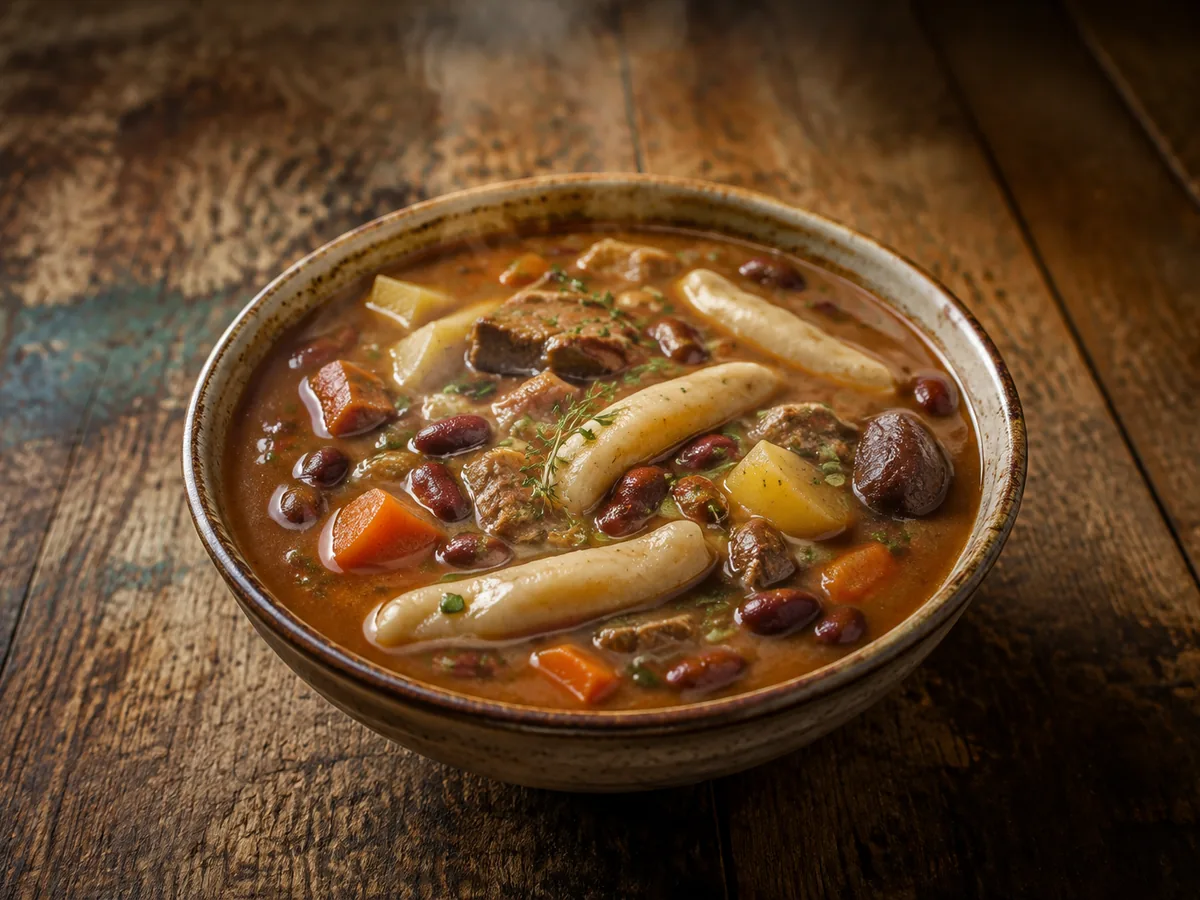
Saturday across Jamaica is soup day, and red peas soup is king of the pot. Red peas are dried kidney beans. They simmer with salted pig tail or beef until they burst and release their starch, turning the water into a dark, creamy red broth.
Then come the ground provisions: yellow yam, sweet potato, green plantain, and coconut milk. Last are the spinners, small flour dumplings rolled between the palms into thin tapered spindles. A whole green Scotch bonnet floats on top with thyme and crushed allspice, and the finished soup is thick and hearty enough to be a complete meal.
Soup
- 450 g1 lb (2 cups)Dried red kidney beans, picked over and soaked overnight
- 450 g1 lbSalted pig tail, cut into 5 cm piecesor salted beef brisket, or smoked turkey wings
- 450 g1 lbBeef stewing meat, chuck or shank, in 3 cm chunks
- 2.5 L10.5 cupsCold water
- 240 ml1 cupUnsweetened coconut milk
- 450 g1 lbYellow yam, peeled and cut into 4 cm chunks
- 300 g1 mediumCaribbean sweet potato, peeled and cut into 3 cm chunks
- 1 whole1 wholeGreen plantain, peeled and sliced into 2 cm coins
- 6 stalks6 stalksScallions, crushed flat with the side of a knife
- 6 cloves6 clovesGarlic, crushed
- 6 sprigs6 sprigsFresh thyme, tied together
- 10 whole10 wholePimento (allspice) berries, crushed
- 1 whole1 wholeGreen Scotch bonnet pepper, left whole with the stem on
- 10 g2 tspFine sea salttaste first; the salted meat seasons the pot
- 3 g1 tspFreshly ground black pepper
Spinners
- 250 g2 cupsPlain flour
- 5 g1 tspFine sea salt
- 120 ml½ cupCold water
Where the body comes from
Past 90 °C the starch inside the kidney beans gelatinises and swells. Crushing about a quarter of the cooked beans against the pot wall releases that starch into the water, where it emulsifies with the coconut fat and the collagen from the pig tail. That is what turns bean water into a creamy red soup.
Why spinners hold together
Flour, cold water and as little kneading as possible keeps the gluten short. Dropped into simmering soup, the starch on the surface gelatinises at once and seals each dumpling into a firm, chewy spindle that will not dissolve.
The whole pepper
Floated intact, the Scotch bonnet scents the steam without releasing capsaicin. Lift it out carefully at the end.
The five tastes on this plate
Salt is the cured pig tail and a little sea salt reaching the dense roots. Fat is pork collagen and coconut milk. Acid is low and earthy, balanced by the sweetness of yam and coconut. Heat is the whole pepper's aroma, allspice and black pepper. Umami is pork collagen, beef shank and the burst beans.
Equipment
- 8 to 10-quart enamelled cast-iron Dutch oven or heavy stockpot
- 4-quart saucepan, for blanching the salted meat
- Wooden spoon
A heavy base spreads low heat evenly so the bean starch does not settle and catch. The Jamaican version is a 10 to 12-quart cast-aluminium Dutchie over an outdoor coal stove.
Method
Desalinate the cured meat20 min
Put the pig tail pieces in a 4-quart pot, cover with cold water, and boil 20 minutes over medium-high heat. Drain and discard the water. This strips excess curing salt while keeping the flavour.
Cover salted pig-tail pieces with cold water in a 4-quart pot. Boil over medium-high for 20 minutes, then drain and discard the salty water.
Simmer the beans and meat1 hr 15 min
In the Dutch oven, combine the soaked, drained beans, the blanched pig tail, the beef, garlic and crushed pimento. Pour in 2.5 litres cold water. Bring to a rolling boil, then reduce to medium-low. Cover partially and simmer 1 hour 15 minutes until the beans yield when pressed between your fingers.
Combine overnight-soaked, drained beans, blanched pig tail, beef, garlic and crushed pimento with 2.5 L cold water. Bring to a rolling boil, reduce to medium-low and partially cover; simmer 1¼ hours until beans yield when pressed.
Add coconut milk and provisions15 min
Crush some of the soft beans against the pot wall with the back of a spoon to thicken the broth. Pour in the coconut milk. Add the yam, sweet potato, plantain, crushed scallions and the thyme bundle. Float the whole Scotch bonnet on top without puncturing it. Simmer uncovered 15 minutes.
Mash about a quarter of the soft beans against the pot wall. Add coconut milk, yam, sweet potato, plantain, crushed scallions and tied thyme. Float the intact Scotch bonnet on top; simmer uncovered 15 minutes.
Roll the spinners10 min
While the provisions simmer, mix the flour and salt, and add cold water gradually to form a firm dough that is not sticky. Pinch off marble-sized pieces and roll each between your palms into a thin, tapered spindle about 8 cm long. You should get 16 to 20.
Meanwhile, mix flour and salt, gradually adding cold water to make firm, nonsticky dough with minimal kneading. Pinch off marble-sized pieces; roll between palms into 16–20 tapered spinners about 8 cm long.
Drop the spinners and thicken15 min
Drop the spinners in one by one, stirring gently so they do not stick together. Simmer over medium-low 15 minutes. They will float and firm up, the yam will turn tender, and the soup will thicken into a deep red cream.
Add spinners one at a time, stirring gently to prevent sticking. Simmer over medium-low 15 minutes until dumplings float and firm up, yam is tender and the soup is thick and deep red.
Retrieve the pepper and serve
Lift out the whole Scotch bonnet and the thyme stems. Taste and season with black pepper and salt only if needed. Ladle into wide bowls, making sure each gets beans, meat, yam and several spinners.
Carefully remove intact Scotch bonnet and thyme stems. Add black pepper and salt only after tasting. Serve each bowl with beans, meat, yam and several spinners.
Sensory cues of doneness
- Visual: a thick, velvety burgundy broth holding tender beans, golden yam, plantain rounds and pale spinners.
- Auditory: a heavy, steady bubble from under the lid.
- Olfactory: coconut milk, crushed allspice, garden thyme, cured pork and sweet yam.
Look for velvety burgundy broth holding tender beans, golden yam, plantain rounds and firm pale spinners. Expect heavy, steady bubbling and aromas of coconut, allspice, thyme and cured pork.
Troubleshooting
- The soup is blisteringly hot.
The Scotch bonnet burst. Float it whole and lift it out with care.
- Beans that take hours and cook unevenly.
They were not soaked. Soak dried kidney beans overnight in cold water.
- Soggy, broken dumplings.
The spinners went in at the start. Add them for the last 15 minutes so they stay chewy.
Substitutions
One-to-one swaps, with the technique change each one needs.
Ingredient substitutions
| Ingredient | Replace with | Culinary impact and technique adjustment |
|---|---|---|
| Salted pig tail | Smoked turkey wings, smoked ham hocks or salted beef brisket | One-to-one. Boil 15 minutes first to drop the surface salt |
| Yellow yam | Taro (dasheen), yuca or Yukon Gold potatoes | One-to-one. Same comforting starchy bite |
| Red kidney beans | Gungo (pigeon) peas | One-to-one. Makes the equally traditional gungo peas soup |
Scaling
Half, for 4
Halve everything in a 5-quart pot. Simmer times stay the same to soften the beans.
Double, for 16
Double the ingredients in a 14 to 16-quart stockpot, and stir often once the provisions and spinners are in so the starch does not catch.
What to serve it with
- Thick slices of hard dough bread, for dipping
- Ginger beer, or chilled spiced sorrel
Questions
Can I make it vegetarian?
Yes. Skip the pig tail and beef, double the coconut milk, add sweet potato, carrot and pumpkin, and simmer the beans until creamy. That is the Rastafarian Ital version.
What if I cannot find yellow yam?
White yam, taro or a waxy potato. Yellow yam has a dry, earthy texture that holds up in a long simmer, but the others work.
Why are they called spinners?
They are spun quickly between the palms into tapered spindles rather than rolled into balls, so they cook evenly and stay chewy.