Escovitch Fish
Whole red snapper scored to the bone, fried in hot oil until the skin blisters, then buried under a hot cane-vinegar pickle of carrot, onion, sweet pepper, chayote and Scotch bonnet ribbons that has simmered for two minutes only, so it stays crisp.
- Prep
- 25 min
- Cook
- 20 min
- Serves
- 4 whole fish, one each
- Difficulty
- Medium
Researched · Kitchen testing pending
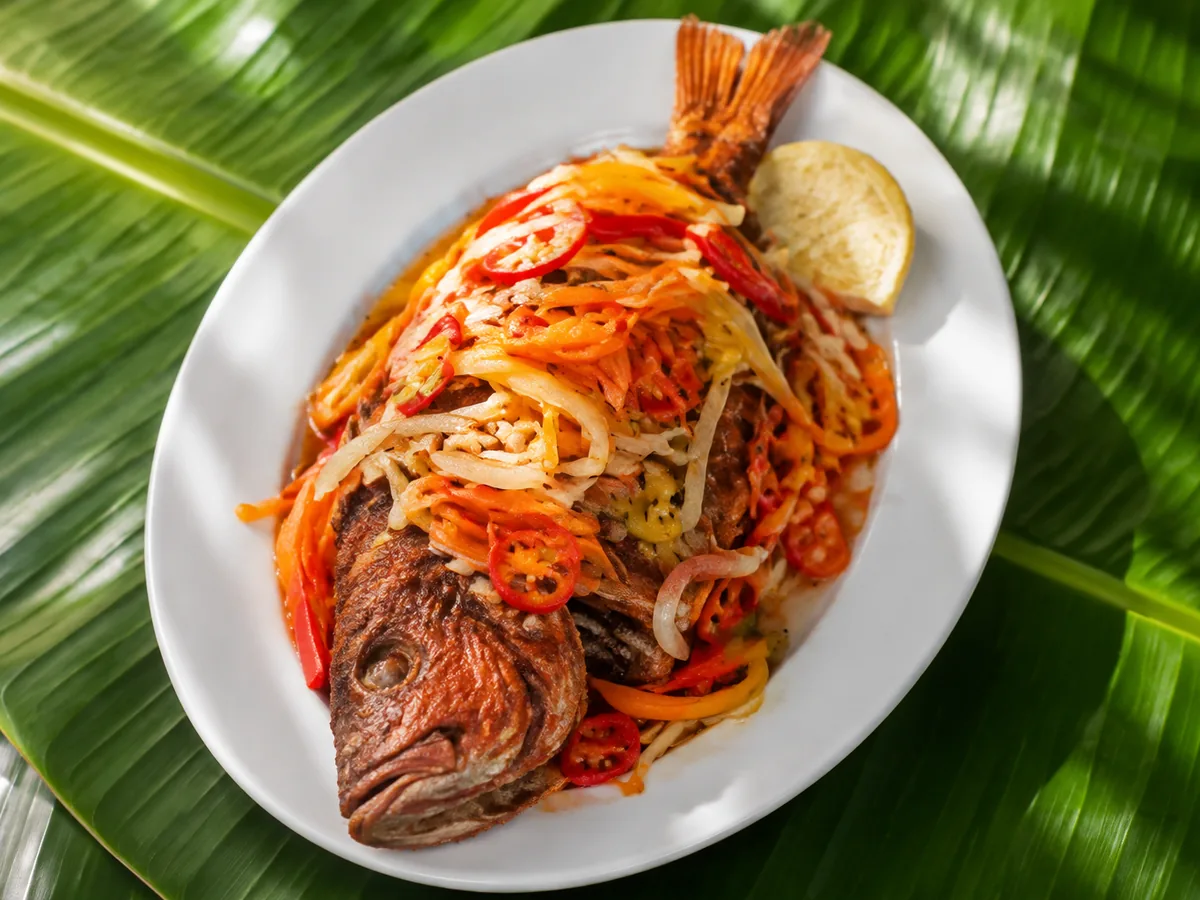
Head out to Hellshire Beach on a Saturday and the air smells of coconut oil and sharp vinegar. Escovitch is Jamaica’s coastal pride, and the name gives away its origin: escabeche, the Mediterranean method of preserving fried fish in an acidic marinade, brought by Spanish Jewish settlers early in the colonial era.
A whole snapper is scored to the bone, seasoned with lime, salt and pepper, and fried until the skin blisters while the flesh stays moist. Straight out of the oil it is blanketed with a hot pickle of carrot, sweet pepper, onion and Scotch bonnet simmered briefly in cane vinegar with pimento. The vinegar sizzles against the skin and soaks in without robbing it of its crunch.
Fish
- 4 whole4 whole, about 1 lb eachRed snapper, scaled, gutted, gills removed, washed in lime water and driedor yellowtail snapper
- 60 ml4 TbspFresh lime juice, for washing
- 10 g2 tspFine sea salt
- 5 g1 tspFreshly ground black pepper
- 5 g1 tspGarlic powder
- 500 ml2.1 cupsNeutral vegetable or coconut oil, for shallow frying
Escovitch pickle
- 240 ml1 cupJamaican white cane vinegar
- 15 g1 TbspGranulated sugar
- 5 g1 tspFine sea salt
- 10 whole10 wholePimento (allspice) berries, lightly crushed
- 1 large1 largeYellow onion, cut into thin rings
- 1 large1 largeCarrot, cut into fine 5 cm matchsticks
- ½ medium½ mediumChayote (cho-cho), peeled and cut into fine matchsticks
- 1 large1 largeRed bell pepper, cut into thin strips
- 1 to 2 whole1 to 2 wholeScotch bonnet peppers, seeded and cut into thin lengthwise ribbons
Dry skin, hot oil
Fish skin holds water and collagen. Fried wet, that water turns to steam, drops the oil temperature and leaves the skin soft. Dried thoroughly and fried at 185 °C, the collagen sets into a crisp shell before the flesh dries past 63 °C. Scoring three times to the bone lets the heat into the thick back muscle quickly.
Hot pickle on hot fish
Poured over straight from the pan, the hot vinegar sinks into the scores and seasons the flesh, while the barely cooked vegetables keep their crunch. Two minutes in the vinegar is all they get.
The five tastes on this plate
Salt is rubbed into the deep scores and seasons the pickle. Fat is the frying oil in the crisp skin over lean flesh. Acid is sharp cane vinegar cutting through the fry. Heat is Scotch bonnet ribbons, pimento and black pepper. Umami is fresh snapper and the softened onion.
Equipment
- 12 to 14-inch heavy cast-iron skillet or straight-sided sauté pan
- Small stainless saucepan, for the pickle
- Two fish spatulas
- Wire rack over a tray
- Instant-read thermometer
Cast iron holds its oil temperature when a cold fish goes in, which is the difference between crisp and greasy. The Jamaican pot is a cast-aluminium Dutchie holding hot oil over a flame.
Method
Clean and season the snapper20 min
Wash the fish inside and out with cold water and lime juice. Dry every fish thoroughly with paper towels. Make three diagonal slashes on each side, right through to the bone. Season the skin, cavity and cuts with salt, pepper and garlic powder and leave at room temperature 15 minutes.
Wash fish with cold water and lime; dry thoroughly. Make three diagonal cuts to the bone on each side. Season skin, cavities and cuts with salt, pepper and garlic powder; leave at room temperature 15 minutes.
Simmer the escovitch pickle5 min
In a small stainless saucepan, bring the vinegar, sugar, salt and crushed pimento to a boil, stirring to dissolve the sugar. Add the onion rings, carrot, chayote, bell pepper and Scotch bonnet ribbons. Simmer for two minutes only, so the vegetables soften a little but stay crisp. Take off the heat and keep warm.
Boil vinegar, sugar, salt and crushed pimento, stirring to dissolve sugar. Add onion, carrot, chayote, bell pepper and Scotch bonnet; simmer only 2 minutes to retain crunch. Remove from heat and keep warm.
Heat the oil5 min
Pour the oil into the skillet to about 2.5 cm deep and heat over medium-high to 185 °C. A piece of onion dropped in should sizzle at once.
Pour oil 2.5 cm deep into the skillet and heat over medium-high to 185 °C. A small piece of onion should sizzle immediately.
Shallow-fry the fish12 min
Lay two fish into the oil away from you. Fry undisturbed 6 to 7 minutes until the bottom edge is crisp and golden. Turn with two spatulas and fry the second side 5 to 6 minutes until the skin is blistered and brittle. A thermometer near the backbone should read 63 °C.
Lower two fish into oil away from you. Fry untouched 6–7 minutes until golden underneath; turn with two spatulas and fry 5–6 minutes until blistered and crisp. Check the thickest flesh near the backbone reaches 63 °C.
Drain and repeat12 min
Move the fried fish to a wire rack over a tray. Fry the remaining two.
Transfer fried fish to a wire rack set over a tray, then fry the remaining two fish the same way.
Dress and serve
Arrange the hot fish on a platter. With a slotted spoon, heap the warm pickled vegetables over each one and spoon several tablespoons of the warm vinegar over the top. Serve at once while the skin is crisp.
Arrange hot fish on a platter. Heap warm pickled vegetables over each with a slotted spoon, then add several tablespoons warm vinegar. Serve immediately while the skin is crisp.
Sensory cues of doneness
- Visual: blistered golden-bronze skin, the eye turned opaque white, flesh pulling from the backbone in juicy flakes.
- Auditory: a loud, steady frying roar as the fish goes in, calming to a light crackle as the surface water boils off.
- Olfactory: crisp fish skin, sweet vinegar steam, raw Scotch bonnet and crushed allspice.
Look for blistered golden-bronze skin, opaque eyes and juicy flakes releasing from the backbone. Frying should settle from a steady roar to a light crackle; expect fish, vinegar and allspice aromas.
Storing it
Escovitch is traditionally made ahead for beach trips. As it cools the fish soaks up the vinegar and tastes better hours later, though the skin softens. Refrigerate up to 2 days.
Troubleshooting
- Soft, soggy skin.
The fish was wet, or the oil dropped below 175 °C. Dry the fish with paper towels before seasoning and fry in properly hot oil.
- Limp, dull pickle vegetables.
They were boiled for ten minutes. Two minutes in the vinegar keeps the bite and the colour.
- The fish sticks and tears.
It was turned before the skin had set. Leave it 6 minutes; it releases on its own once browned.
Substitutions
One-to-one swaps, with the technique change each one needs.
Ingredient substitutions
| Ingredient | Replace with | Culinary impact and technique adjustment |
|---|---|---|
| Red snapper | Yellowtail snapper, black sea bass or whole porgy | One-to-one. Choose fresh, clear-eyed whole fish |
| Chayote | Crisp jicama, or extra carrot | One-to-one. Same watery crunch in the pickle |
| White cane vinegar | Distilled white or apple cider vinegar | One-to-one. Cider vinegar adds a mild fruity sweetness |
Scaling
Half, for 2
Halve everything and fry in a 10-inch skillet. Times stay at 6 to 7 minutes a side.
Double, for 8
Double the ingredients, make the pickle in a 3-quart pan, and fry in batches of two so the oil stays hot.
What to serve it with
- Bammy, the cassava flatbread soaked in coconut milk and fried
- Festival, sweet fried cornmeal dough to cut the vinegar
- A frosty Red Stripe, or a Ting
Questions
Can I use fillets?
Yes. Thick skin-on snapper, grouper or cod fillets work. Fry skin side down first for 4 minutes, flip, and top with the hot pickle.
Can it be eaten cold?
Yes. In Jamaica it is made ahead and packed for the beach. The fish soaks in the vinegar as it cools.
No cane vinegar?
Distilled white vinegar or cider vinegar swap one-to-one.