Jerk Chicken
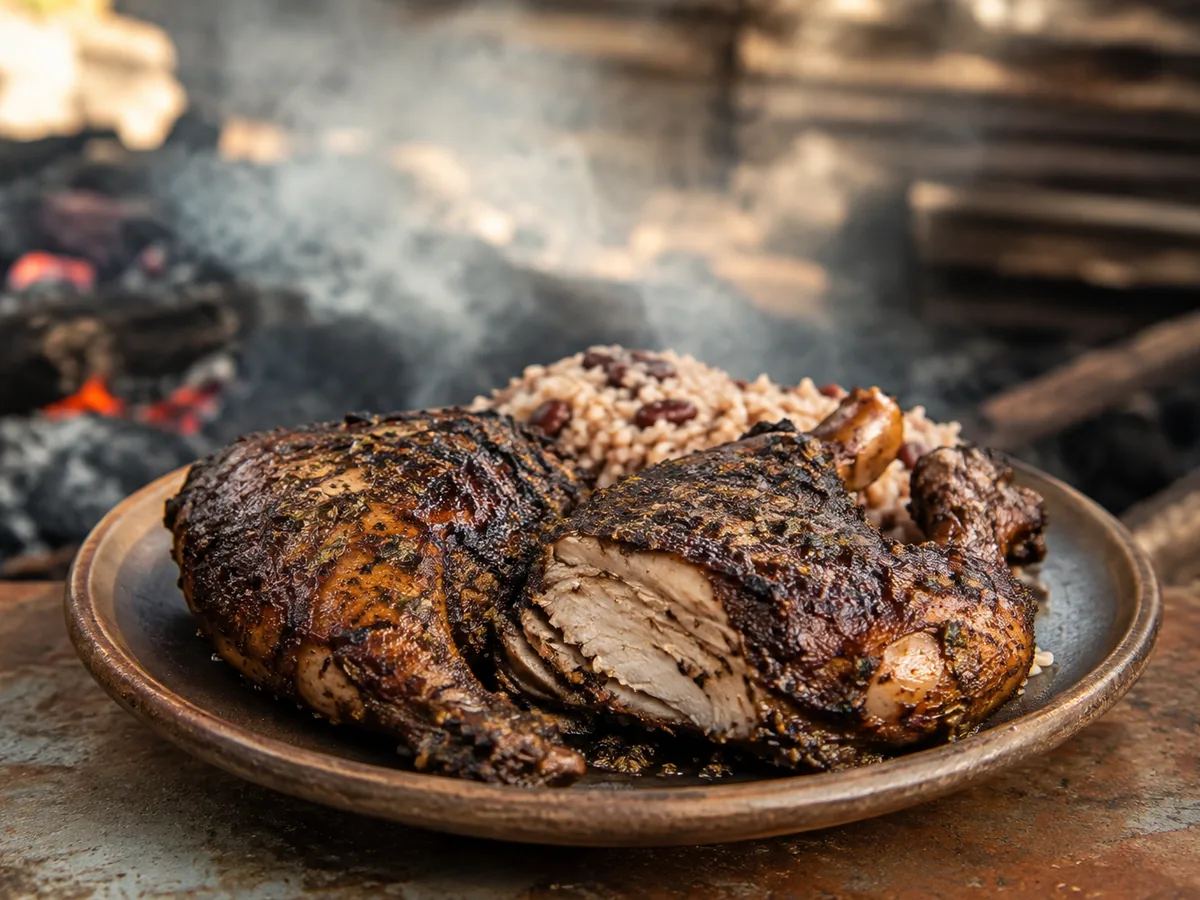
Bone-in leg quarters slashed to the bone and soaked overnight in a wet rub of Scotch bonnet, fresh-ground pimento, scallion, thyme and ginger, then smoked low over pimento wood and finished over the coals until the skin is dark and blistered.
- Prep
- 30 min
- Cook
- 1 hr 15 min
- Serves
- 6
- Difficulty
- Hard
Researched · Kitchen testing pending
Real jerk belongs to the roadside smoke shacks of Boston Bay in Portland, where meat sizzles over green pimento logs. The Maroons, escaped Africans who allied with Taíno hunters in the Blue Mountains, invented it as a way to preserve wild boar with wild allspice, bird peppers and salt.
The chicken must be bone-in, slashed deep, and soaked in a wet marinade of crushed pimento berries, Scotch bonnet, scallion, thyme, ginger and garlic. The cooking is a slow smoke-roast over smouldering coals, traditionally under sheets of zinc, until the fat has rendered and the skin is charred and crisp over spice-stained meat.
Chicken
- 1.8 kg4 lbBone-in, skin-on chicken leg quarterstrimmed of loose fat
- 60 ml4 TbspFresh lime juice or cane vinegarfor washing the chicken
Jerk paste
- 6 stalks6 stalksScallions, roots trimmed, roughly chopped
- 3 whole3 wholeScotch bonnet peppers, stems removedseeds in for roadside heat, seeds out for medium
- 6 cloves6 clovesGarlic, peeled
- 40 g2-inch pieceFresh ginger, peeled and sliced
- 25 g2 TbspWhole dried pimento (allspice) berries, freshly ground
- 15 g3 TbspFresh thyme leaves
- 30 ml2 TbspDark soy sauce
- 30 ml2 TbspJamaican dark rum or cider vinegar
- 30 g2 TbspDark brown sugar
- 20 g1 Tbsp + 1 tspCoarse sea salt
- 5 g1 tspFreshly grated nutmeg
- 3 g1 tspGround cinnamon
- 3 g1 tspBlack peppercorns
- 45 ml3 TbspVegetable oilcarries the fat-soluble aromatics
Eugenol is the flavour of jerk
The oil that defines pimento is eugenol, the same compound that scents cloves. Grinding whole berries fresh and exposing them to low heat over wood smoke drives the eugenol into the meat along with the phenols from the smoke. Pre-ground allspice from a jar has already lost most of it.
Why the slashes matter
Cutting to the bone opens the thick thigh muscle to the salty, acidic paste. Salt dissolves myosin, which lets moisture and aromatics travel deep into the tissue instead of sitting on the skin.
Indirect first, then direct
Smoking at 120 to 135 °C renders the fat under the skin slowly and crisps it without scorching the sugar in the paste. The move over the coals is the last few minutes only.
The five tastes on this plate
Salt is sea salt and dark soy driven deep by the slashes. Fat is rendered skin basting the meat through the long smoke. Acid is lime and vinegar loosening the outer proteins. Heat is Scotch bonnet backed by pimento's eugenol. Umami is soy and the browned, smoky drippings.
Equipment
- Kettle grill with lid, set up for two-zone indirect cooking
- Chimney starter and lump charcoal
- Pimento wood chips, or whole allspice berries and bay leaves, soaked
- Blender or food processor
- Rubber gloves, for handling the paste
- Instant-read thermometer
- Heavy cleaver, for chopping
The roadside version is a steel-drum smoker burning hardwood charcoal, green pimento branches and sweetwood logs. A kettle grill with soaked pimento chips on the coals gets most of the way there. No grill at all: roast on a rack over a foil-lined tray at 190 °C for 50 minutes, then 5 minutes under a hot grill to crisp the skin.
Method
Clean and slash the chicken10 min
Wash the leg quarters in a large bowl with 1 litre cold water and the lime juice. Drain and pat completely dry.
With a sharp knife, make three deep diagonal slashes across the thickest part of each thigh and drumstick, right down to the bone, so the marinade can reach the interior meat.
Wash leg quarters in a bowl with 1 L cold water and lime juice, then drain and dry completely. Make three diagonal slashes to the bone across the thickest part of each thigh and drumstick.
Blend the wet jerk paste5 min
Put the scallions, Scotch bonnets, garlic, ginger, ground pimento, thyme, soy, rum, brown sugar, salt, nutmeg, cinnamon, peppercorns and oil in a blender. Purée for 60 to 90 seconds to a thick, gritty, dark green paste.
Blend scallions, Scotch bonnets, garlic, ginger, freshly ground pimento, thyme, soy, rum, brown sugar, salt, nutmeg, cinnamon, peppercorns and oil for 60–90 seconds into a thick, gritty dark-green paste.
Marinate overnight12 to 24 hr
Wearing gloves, rub the paste hard into the chicken, working it into every slash and under the skin. Put the chicken and every scrap of paste into a large zip bag or glass dish, seal, and refrigerate at least 12 hours, ideally 24.
Wear gloves to rub paste into every cut and beneath the skin. Place chicken and all paste in a sealed bag or glass dish; refrigerate at least 12 hours, ideally 24.
Set up the fire20 min
Light lump charcoal in a chimney and tip it onto one side of the grill. Scatter the soaked pimento chips over the coals, or a foil packet of allspice berries with holes punched in it. Aim for an ambient temperature of 135 to 150 °C. Put a drip pan with a cup of water on the empty side.
Bank lit charcoal on one side of the grill. Add soaked pimento chips or a perforated foil packet of allspice berries. Set ambient heat to 135–150 °C; place a drip pan containing 1 cup water on the empty side.
Smoke low and slow50 to 60 min
Lay the chicken skin side up on the cool side, away from the coals. Close the lid with the vent directly over the chicken so the smoke is drawn across it. Smoke undisturbed for 50 to 60 minutes, basting once with the pan juices.
Place chicken skin-up on the cool side, away from coals. Close the lid with its vent over the chicken. Smoke undisturbed 50–60 minutes, basting once with pan juices.
Char over the coals and check the core8 min
When the thigh reads 70 °C, move the pieces over the hot coals, skin side down. Grill uncovered 3 to 4 minutes a side, watching for flare-ups, until the skin is dark, blistered and crisp.
Probe the thickest part of the thigh: it must read 77 to 80 °C.
At 70 °C in the thigh, move chicken skin-down over hot coals. Grill uncovered 3–4 minutes per side, watching for flare-ups, until dark, blistered and crisp. Check the thickest thigh reaches 77–80 °C.
Rest and chop10 min
Rest on a board for 10 minutes. With a heavy cleaver, chop each leg quarter into three or four street-style chunks and serve hot.
Rest the chicken on a board for 10 minutes. Use a heavy cleaver to divide each leg quarter into three or four chunks; serve hot.
Sensory cues of doneness
- Visual: dark mahogany, blistered skin with scattered charcoal marks, and a rosy smoke ring at the bone running with clear juices.
- Auditory: rhythmic quiet hissing as fat hits the coals, sending up puffs of white smoke.
- Olfactory: smouldering allspice wood, caramelised brown sugar, charred skin and sharp thyme.
Look for blistered mahogany skin and charcoal marks with clear juices; use the temperature check for doneness. Expect quiet hissing over coals and aromas of allspice smoke, caramelised sugar and thyme.
Troubleshooting
- Black, bitter crust and raw meat at the bone.
The chicken went straight over the flames. The brown sugar and aromatics scorch within 5 minutes. Always smoke indirect first, then sear at the end.
- Flat, dusty flavour.
Old pre-ground allspice has lost its eugenol. Grind whole dried pimento berries fresh in a spice grinder.
- Spicy skin, bland meat.
The chicken was not slashed. Unbroken skin keeps the thick paste from reaching the dense thigh meat. Cut to the bone before marinating.
Substitutions
One-to-one swaps, with the technique change each one needs.
Ingredient substitutions
| Ingredient | Replace with | Culinary impact and technique adjustment |
|---|---|---|
| Scotch bonnet | Habanero | One-to-one. Same heat range and the same fruity profile |
| Pimento berries | Whole allspice berries | Pimento is the Jamaican name for allspice; they are the same berry |
| Dark soy sauce | Tamari, or Worcestershire with 1 tsp molasses | One-to-one. Same dark colour and savoury depth |
Scaling
Half, for 3
Halve everything. Smoking time stays at 1 hour to 1 hour 15 minutes, because heat penetration depends on the thickness of the piece, not the size of the batch.
Double, for 12
Double the ingredients and keep two clear fire zones. Do not crowd the indirect side or the pieces steam instead of smoking.
What to serve it with
- Festival, the sweet fried cornmeal fritters that balance the heat
- Rice and peas
- Breadfruit roasted over the coals until charred outside and soft inside
- Ice-cold Red Stripe, or a Ting to put out the fire
Questions
How do I get the flavour without pimento wood?
Soak 2 tablespoons of whole allspice berries and a few bay leaves in water for 30 minutes, then throw them straight onto the hot coals. They release the same eugenol smoke.
How hot is this recipe?
Three whole Scotch bonnets with seeds is roadside heat, distinctly fiery. For mild to medium, remove the seeds and membranes, or drop to one or two peppers.
Can I use boneless chicken breast?
You can, but breast dries out fast over smoke. Pull it the moment it reads 74 °C. Leg quarters are far juicier and take smoke much better.