Ackee and Saltfish
The national dish. Salt cod boiled twice until it is seasoned rather than salty, then folded into sweated onion, pepper, thyme and Scotch bonnet with the ackee going in last and barely touched, so the lobes stay whole like soft curds.
- Prep
- 25 min
- Cook
- 20 min
- Serves
- 4 to 6 breakfast plates
- Difficulty
- Medium
Researched · Kitchen testing pending
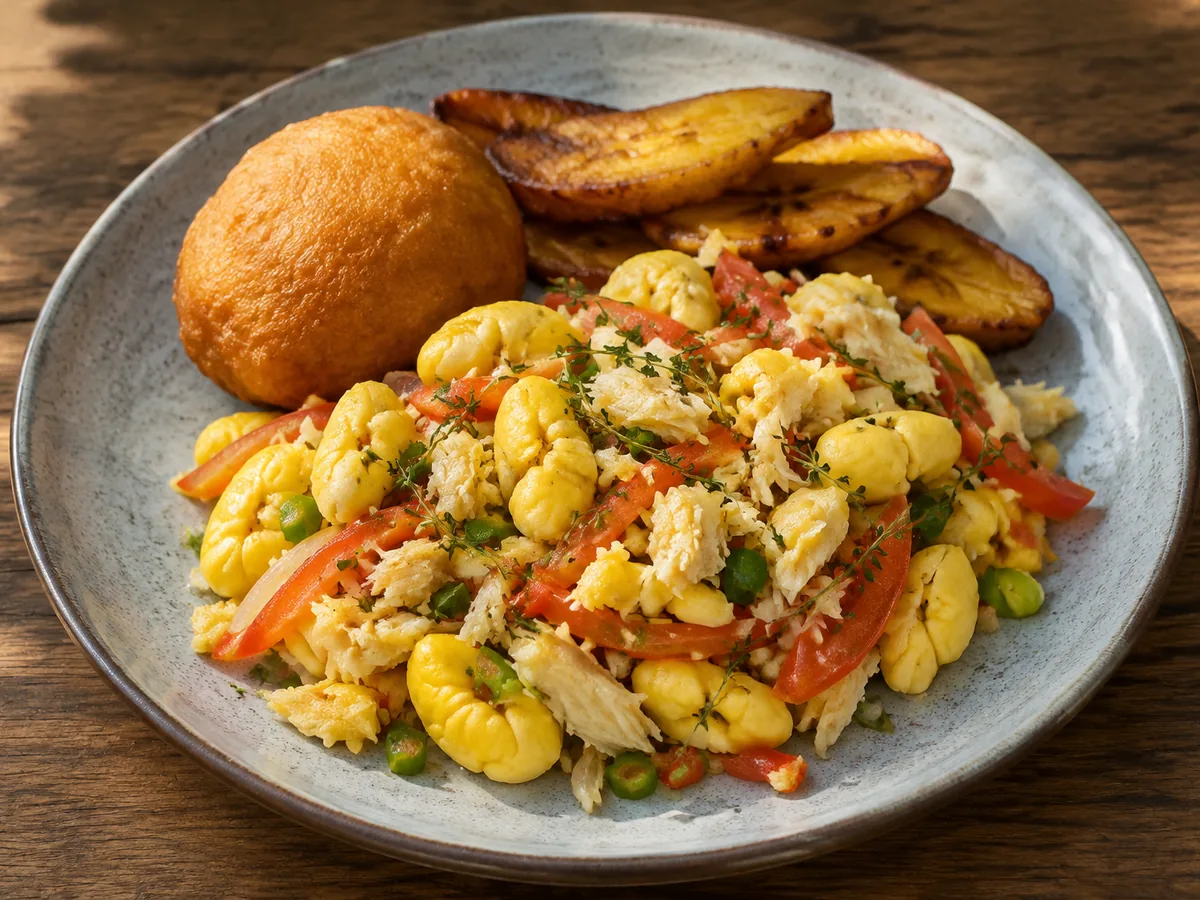
Breakfast across Jamaica starts with the crackle of salt cod and ripe ackee in a skillet. The ackee tree came from West Africa in the eighteenth century and took root on the island; when the red pods split open on the branch they show three cream-coloured lobes around glossy black seeds. Only naturally opened fruit is safe to pick.
The cod is boiled in fresh water, twice, to draw out the curing salt while the flesh stays moist and flaky. Onion, sweet pepper, Scotch bonnet, garlic and thyme sweat in coconut oil or butter, the fish and tomato go in, and the ackee goes in last. From there it is a light hand: fold with a wide spatula so the lobes stay whole like soft curds rather than turning into yellow mush.
Saltfish
- 450 g1 lbBone-in, skin-on salted cod (saltfish)rinsed of surface salt crystals
- 540 g1 can (19 oz)Canned Jamaican ackee in brine, drained gently in a colanderor 450 g fresh ripe ackee arils from naturally opened pods, parboiled 5 minutes
Aromatics
- 45 ml3 TbspUnrefined coconut oil or unsalted butter
- 1 medium1 mediumYellow onion, cut into thin half-moons
- 4 stalks4 stalksScallions, sliced into 5 mm rounds
- 4 cloves4 clovesGarlic, finely minced
- ½½Scotch bonnet pepper, seeds and white membrane removed, minced fineabout 1 tsp
- 1 medium1 mediumRed bell pepper, sliced into thin 4 cm strips
- 2 medium2 mediumFirm plum tomatoes, cored, seeded and cut into 1 cm dice
- 4 sprigs4 sprigsFresh thyme, leaves stripped
Finish
- 3 g1 tspCoarsely ground black pepper
- 15 ml1 TbspFresh lime juice
Why ackee breaks so easily
Ackee arils are more than 16 percent fat, mostly oleic and linoleic acids, which is why they eat like scrambled egg. Unlike egg there is no albumin holding them together, only thin plant cell walls and pectin. Toss the pan hard and the walls break, the water comes out, and the lobes collapse into a yellow soup. Fold from underneath, three or four lifts, and stop.
Two boils, not one
Cold soaking and gentle boiling pull sodium out of the cod by osmosis while the dried muscle rehydrates. Keeping the water under 90 °C stops the fish proteins seizing into dry strings. One short boil leaves the fish inedibly salty; two full changes of water bring it to seasoned.
No salt in the pan
Even after two boils the cod keeps enough sodium to season the whole skillet. Taste before you reach for the salt. Almost always you will not need any.
The five tastes on this plate
Salt is the desalinated cod itself. Fat is coconut oil or butter and the ackee's own oils. Acid is diced tomato and the finishing squeeze of lime. Heat is Scotch bonnet and black pepper. Umami is the cured fish, deepened by sweated scallion and garlic.
Equipment
- 3-quart saucepan, for boiling the cod
- 12-inch heavy stainless or enamelled cast-iron skillet
- Wide flat spatula, silicone or fish
- Colander
In Jamaica this is cooked in a heavy cast-aluminium Dutch pot over low embers. A wide, flat 12-inch skillet does the same job at home, and the width is the point: room to fold the ackee without crushing it.
Method
Desalinate the saltfish30 min
Rinse the cod under cold water to wash off surface salt. Put it in a 3-quart saucepan with 1.5 litres cold water and bring to a boil over medium-high heat. Boil gently for 15 minutes.
Drain, refill with fresh cold water, and boil a second time for 10 minutes. Drain again and cool until you can handle it.
Rinse cod to remove surface salt. Cover with 1.5 L cold water in a 3-quart saucepan; bring to a gentle boil for 15 minutes. Drain, refill with fresh cold water and gently boil 10 minutes. Drain and cool enough to handle.
Flake the fish5 min
Pull off the skin and scrape away any dark membrane. Pick through the flesh with your fingers, discarding bones, and break the meat into clean bite-sized flakes of 2 to 3 cm. Do not shred it to fibres.
Remove skin and dark membranes. Check carefully with your fingers for bones and discard them; separate the cod into 2–3 cm flakes without shredding it.
Sweat the aromatics8 min
Heat the coconut oil in the skillet over medium heat until it shimmers. Add the onion, bell pepper and garlic and sweat for 5 to 6 minutes, stirring often, until the onion is soft and translucent.
Add the scallions, Scotch bonnet and thyme and cook 2 minutes more until fragrant.
Heat coconut oil over medium until shimmering. Sweat onion, bell pepper and garlic 5–6 minutes, stirring often, until translucent. Add scallions, Scotch bonnet and thyme; cook 2 minutes more.
Add the cod and tomatoes3 min
Add the flaked cod and diced tomato. Toss gently with a wooden spatula for 3 minutes so the fish takes on the seasoned oil. Season with black pepper. Taste before adding any salt; the cod usually needs none.
Add cod flakes and diced tomato; turn gently in the seasoned oil for 3 minutes. Add black pepper and taste before adding salt; the cod usually supplies enough.
Fold in the ackee4 min
Turn the heat to low. Tip the drained ackee over the fish. With a wide flat spatula, fold from the bottom up, lifting and turning three or four times only. Do not stir in circles.
Leave the pan undisturbed over low heat for 3 to 4 minutes so the ackee heats through to about 75 °C without breaking.
Use gently drained canned ackee, or ripe fresh arils from naturally opened pods, parboiled 5 minutes. Add over the fish on low heat. Fold upward with a wide spatula only three or four times, never in circles. Leave undisturbed 3–4 minutes until about 75 °C, keeping lobes intact.
Finish and plate
Squeeze the lime over the pan, give one last gentle lift, and slide onto a warm platter straight away.
Squeeze lime over the pan, lift the mixture gently once more, and slide onto a warm serving platter immediately.
Sensory cues of doneness
- Visual: pale yellow unbroken ackee curds beside white fish flakes, glossy red pepper strips and green scallion.
- Auditory: a quiet, gentle sizzle, never a spitting fry.
- Olfactory: warm coconut oil, cured cod, bruised thyme, sweet alliums and the fruit of Scotch bonnet.
Keep the pale-yellow ackee lobes whole beside white cod flakes, red pepper and green scallions. Listen for a gentle sizzle, not spitting, and expect coconut, thyme and Scotch bonnet aromas.
Troubleshooting
- Mushy, puréed ackee.
The pan was stirred after the ackee went in. The lobes are fragile. Fold from the bottom with a flat spatula two or three times and then leave it.
- Fish is far too salty.
It was boiled once, briefly. Saltfish needs two separate boils in fresh water to come down to a pleasant level.
- Acrid smoke and a scorched chilli.
The Scotch bonnet went into smoking-hot oil at the start. That vaporises the capsaicin and burns the pepper. Add it with the aromatics over medium heat.
Substitutions
One-to-one swaps, with the technique change each one needs.
Ingredient substitutions
| Ingredient | Replace with | Culinary impact and technique adjustment |
|---|---|---|
| Salted cod | Salted pollock or haddock, or fresh cod packed in coarse salt for 24 hours | One-to-one. Desalinate with the same two-boil method |
| Scotch bonnet | Habanero | One-to-one. Same heat range and the same fruity aroma |
| Coconut oil | Unsalted butter or ghee | One-to-one. Same rich pan coating |
Scaling
Half, for 2 to 3
Halve everything and use a 10-inch skillet. Boiling and cooking times stay the same.
Double, for 8 to 12
Double the ingredients and use a wide 14-inch rondeau or two 12-inch skillets. Never pile double the ackee into a narrow pot; its own weight crushes it.
What to serve it with
- Fried dumplings (johnny cakes), for scooping
- Boiled green bananas and yellow yam
- Fried ripe plantains, for sweetness against the brine
- Blue Mountain coffee, or cold coconut water straight from the nut
Questions
Can I use fresh ackee outside the Caribbean?
Rarely. Fresh ackee is restricted for export because unripe fruit carries hypoglycin A. Canned Jamaican ackee is harvested at full maturity, certified safe, and gives the same texture if you drain it gently.
Why shouldn't I salt the pan?
The cod keeps interior sodium even after two boils. Salt added before tasting tips the dish over the edge.
How do I stop canned ackee breaking?
Never dump it from the tin with its brine. Tip it into a colander, let it drain by gravity for 5 minutes, and do not rinse it under pressure.